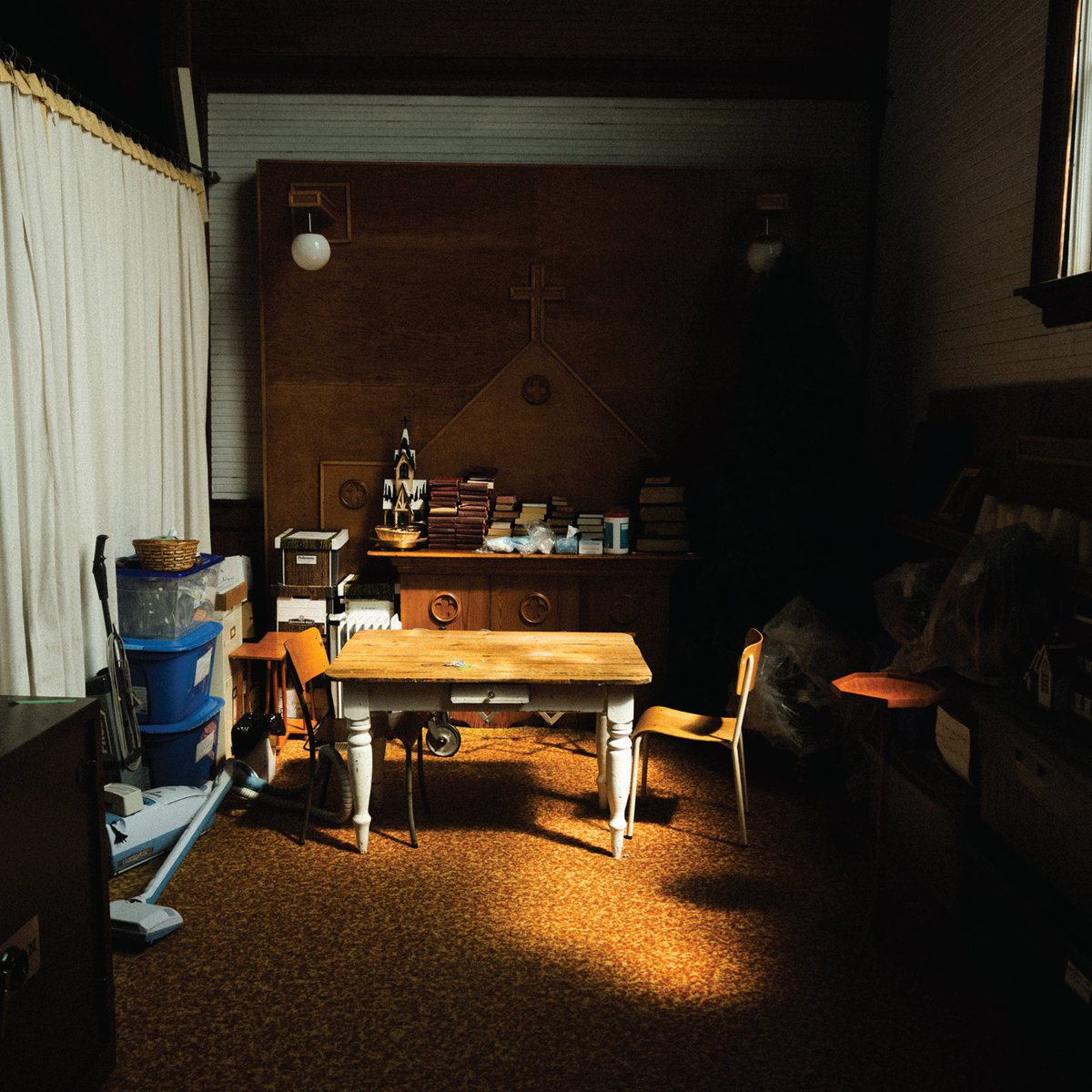
Michael Cloud Duguay’s ‘Kingdom Come, Kingdom Go’ is an album about listening to places until they begin to disclose the people who inhabit them. Its subject may be Newfoundland, its most visible instrument may be the organ, and religion provides much of its vocabulary, but none of those descriptions fully contain what Duguay has created. This is music concerned with memory, geography, faith, disappearance, and community, assembled from organs, field recordings, voices, strings, winds, and the resonant spaces of churches scattered throughout coastal Newfoundland. Rather than presenting those elements as archival artifacts, Duguay allows them to remain alive and imperfect. The album becomes a meeting point between composition and documentation, between the deliberate shaping of sound and the unpredictable evidence of human presence.
“Pond 1” establishes the record’s unusual scale with remarkable patience. Duguay’s organ seems to emerge from the architecture around it, creating a sense that the instrument is not merely being played but is conversing with the building that houses it. Field recordings deepen that impression. The sounds of a place are not ornamental background; they are part of the composition’s vocabulary. From its opening moments, ‘Kingdom Come, Kingdom Go’ encourages the listener to consider how sound carries the history of a community. “River of Ponds” broadens that perspective. Organ chords move with a stately deliberation while environmental details suggest an expansive landscape beyond the immediate room. Duguay has an extraordinary instinct for scale: a single sustained note can seem intimate one moment and geographical the next. The music never requires a grand crescendo to communicate magnitude. Its power comes from allowing duration to become meaningful.
“Greenspond Tickle” introduces a more animated character, and its title hints at the playful relationship between Duguay’s compositions and the specific communities that inspired them. The album never treats Newfoundland as an abstract wilderness. Its landscapes are inhabited, remembered, worked, prayed in, and passed through. That distinction gives the record warmth. Even when the organ takes on a monumental presence, the music remains connected to ordinary human life. “Winterhouse,” featuring Scions, brings additional voices into that environment. Jake Nicoll contributes flute and voice, while Noah Bender adds voice, and the ensemble gives the piece an almost spectral spaciousness without turning it into mere atmosphere. The voices are crucial because they remind us that the album is ultimately concerned with people. Churches may provide the acoustic environments, but communities provide the meaning.
“Little Seldom,” composed by Duguay with Andrew MacKelvie, is among the album’s richest examples of musical collaboration. MacKelvie contributes organ, saxophones, flute, piano, and even rocks to the broader sonic palette, and his involvement helps expand Duguay’s already unusual conception of what an organ-centered record can contain. Maria Peddle’s violin and the contributions of Mary Tucker on organ further complicate the textures. These instruments never feel inserted simply for variety. They become additional ways of responding to place. The brief “Pond 2” acts almost as a pause in the album’s larger architecture. At only fifty seconds, it demonstrates Duguay’s sensitivity to proportion. Not every musical idea needs to become a fully developed statement. Sometimes a fragment can reset the listener’s attention more effectively than another extended composition. The pond motif itself becomes increasingly suggestive as the album progresses, functioning almost like a recurring landmark in an unfamiliar landscape.
“Tilting,” featuring MacKelvie, brings a more unstable quality to the record. His instrumental contributions introduce movement and contrast into Duguay’s spacious organ language. The title itself suggests an altered sense of balance, and the music captures that sensation without resorting to theatricality. It is one of several places where ‘Kingdom Come, Kingdom Go’ reminds us that sacred music need not be solemn in a conventional sense. Spiritual experience can include uncertainty, humor, disorientation, wonder, and even play. “Change Islands” extends the collaboration with MacKelvie and develops the album’s relationship with Newfoundland’s geography. Yet the music resists the temptation to become scenic accompaniment. Instead, the landscape seems to exist inside the sound, mediated through organs, winds, field recordings, and the reverberant qualities of the churches in which much of the material was recorded. Duguay’s approach recognizes that a place is never merely visual. It has acoustics, rhythms, silences, voices, and memories.
“Damnable Island” is one of the album’s most imposing pieces. Its extended duration gives the organ room to accumulate weight, while the surrounding sounds create a sense of distance and isolation. Yet even here, the music avoids becoming purely austere. There is a strange vitality in its persistence. Duguay understands that sustained sound can carry both solemnity and exhilaration, and that the difference between the two often depends upon how closely one listens. “Settlement,” composed by Georges E. Sioui, introduces his voice into the album’s carefully constructed world. His presence reinforces the record’s broader concern with history and belonging, particularly the complicated meanings embedded in the word settlement itself. The piece does not provide a neat historical narrative. Instead, it adds another human perspective to an album already crowded with voices, places, and inherited memories. The effect is expansive without becoming explanatory.
The closing “Pond 3,” a traditional hymn performed by Mary Tucker, brings the recurring pond motif to its quiet conclusion. After compositions that have moved through organs, saxophones, flute, piano, violin, voices, rocks, and environmental recordings, the final gesture is strikingly simple. Tucker’s performance connects the album to an older tradition of communal music-making, reminding us that these sounds existed before Duguay arrived with recording equipment and will continue to carry meaning beyond the album. The production team is integral to the album’s character. Duguay and Dave Grenon produced the record, with Jake Nicoll and Grenon handling engineering, while Jeff McMurrich mixed the album at Sonology in Toronto and East End Mastering handled the final mastering. Yet the polish never sterilizes the recordings. The presence of churches, congregations, coastal environments, and individual voices remains audible. The album feels assembled with great care while preserving the unpredictable qualities that make field documentation compelling.
The musicians and recorded voices form a remarkable community around Duguay’s compositions: Reverend Renee Easton, Frank Blackmore, Tom Blackmore, Reverend W.H. Neal Buffet, Mary and Watson Tucker, Reverend Amanda Barnes, Cormac Culkeen, and others contribute to a sonic portrait in which individual testimony matters as much as formal composition. Duguay’s organ, field recordings, and compositional framework provide the connective tissue, but the album derives its emotional force from the many people and places allowed to inhabit it.
‘Kingdom Come, Kingdom Go’ is therefore neither conventional ambient music nor straightforward documentary work. It occupies a more elusive territory where composition becomes a means of paying attention. Duguay listens to buildings, landscapes, instruments, voices, and silences, then brings those elements into conversation without forcing them into uniformity. The album asks what it means for music to remember a place, and whether documentation can itself become an act of affection. By its closing moments, the title takes on a broader resonance. Kingdoms, communities, buildings, beliefs, and ways of life can all arrive and disappear. What remains may be less tangible: a voice recorded in a church, an organ note suspended in a room, a remembered melody, the sound of wind beyond a wall. ‘Kingdom Come, Kingdom Go’ understands that impermanence is not the enemy of meaning. It may be the condition that gives meaning its urgency. Duguay has made a deeply attentive album in which Newfoundland is not merely represented but listened to, and in which the act of listening becomes a form of remembrance.
Learn more links:
Michael Cloud Duguay
Watch That Ends The Night