
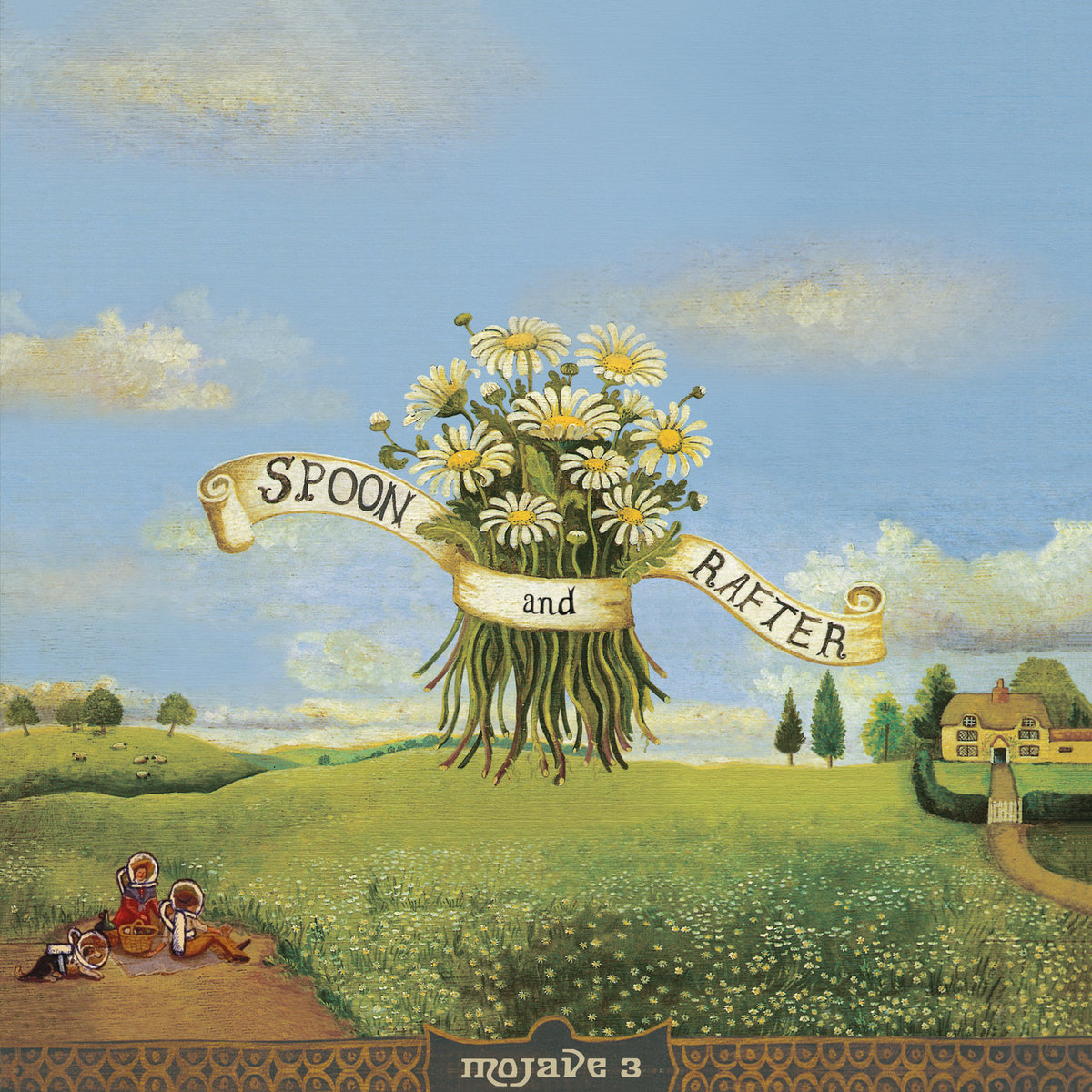
Few bands possess the confidence to broaden their musical vocabulary without weakening the qualities that first earned them devoted listeners. By the time Mojave 3 released ‘Spoon And Rafter’, Neil Halstead, Rachel Goswell and Ian McCutcheon had already established themselves as architects of understated beauty, crafting songs that favored emotional nuance over overt display. Rather than repeating the familiar aesthetic of their previous records, they embraced a richer and more adventurous sonic landscape. Electronics, glockenspiel, melodica and subtle studio experimentation entered the picture alongside the folk and country influences that had long informed Halstead’s writing. The result was not a rejection of the band’s identity but a vivid expansion of it. The 2026 remaster brings this colorful production into sharper focus, revealing an album whose imaginative arrangements now sparkle with renewed vitality.
The opening statement, “Bluebird of Happiness,” immediately announces broader ambitions. Lasting more than nine minutes, it is among the most expansive compositions Mojave 3 ever recorded, yet its length never feels excessive. Halstead allows themes to develop with remarkable patience, layering acoustic guitars with shimmering electric textures, understated electronic elements and carefully placed instrumental flourishes that gradually enrich the composition. McCutcheon’s drumming remains wonderfully restrained despite the increased complexity surrounding him, providing steady momentum while leaving generous room for the arrangement to flourish. Goswell’s harmonies drift gracefully through the song; softening Halstead’s introspective vocals and adding emotional radiance without drawing attention away from its reflective center.
“Starlite #1” condenses that richness into a more concise form, balancing melodic immediacy with sophisticated production. The Beatlesque influence often associated with this album becomes especially apparent, not through imitation but through an appreciation of inventive studio craftsmanship serving memorable songwriting. Glockenspiel accents and subtle keyboard textures brighten the arrangement, while Halstead’s gently weathered vocal retains the sincerity that has always anchored Mojave 3’s music. The remaster reveals remarkable separation between these instrumental details, allowing every element to occupy its own distinct space.
“Bill Oddity” presents one of the album’s most charming character studies. Halstead writes with warmth and understated wit, avoiding caricature while sketching an individual whose humanity emerges through small observations rather than dramatic storytelling. The arrangement benefits from imaginative instrumentation that enhances rather than distracts from the song’s narrative. Goswell’s harmonies once again provide understated emotional shading, reinforcing the band’s remarkable instinct for collective balance.
The contemplative “Writing to St Peter” ranks among Halstead’s finest lyrical achievements. Mortality, memory and spiritual uncertainty are approached with humility rather than grand philosophical pronouncements. The song leaves meaningful questions suspended in the air instead of insisting upon definitive answers. Musically, Mojave 3 demonstrates how much their palette had expanded. Melodica, keyboards and carefully layered guitars coexist naturally, creating an atmosphere of quiet wonder that the remaster renders with extraordinary clarity. “Battle of the Broken Hearts” showcases the band’s growing confidence as arrangers. What might once have been presented as a sparse acoustic meditation evolves into a richly textured ensemble performance. McCutcheon’s rhythmic discipline remains central throughout, his drumming quietly guiding the composition while allowing the surrounding instrumentation to bloom organically. Halstead’s vocal communicates emotional fatigue without surrendering to despair, while Goswell’s harmonies introduce moments of gentle consolation that deepen the song’s emotional complexity.
Following these expansive pieces, “Hard to Miss You” demonstrates the enduring effectiveness of brevity. Lasting less than three minutes, it captures longing with remarkable economy, proving that Halstead’s songwriting had lost none of its gift for concise emotional expression even as the band’s arrangements became increasingly sophisticated. Every melodic phrase feels carefully considered, leaving a lasting impression disproportionate to the song’s modest duration.
“Tinkers Blues” reconnects Mojave 3 with the folk traditions that first inspired their earliest recordings, yet it does so through the wider sonic vocabulary developed across this album. Acoustic guitars intertwine with subtle electronic textures, creating an engaging dialogue between pastoral intimacy and contemporary production. Halstead’s guitar work remains elegantly understated, never prioritizing technical display over emotional communication.
“She’s All Up Above” introduces a welcome sense of buoyancy. Its melodic brightness never slips into carefree optimism, instead accepting joy as something fragile and deeply precious. Goswell’s harmonies become especially significant here, lifting the chorus with effortless grace while preserving the song’s reflective character. The remaster enhances the shimmering instrumental tints that define the arrangement, revealing new dimensions within familiar passages. The understated “Too Many Mornings” explores repetition, memory and emotional endurance with characteristic subtlety. Halstead avoids melodrama by focusing on ordinary moments, knowing that profound emotional truths often emerge through everyday experience rather than extraordinary events. McCutcheon’s measured drumming provides quiet continuity, allowing the composition to maintain forward movement without unnecessary emphasis.
Closing with “Between the Bars,” Mojave 3 offers an interpretation that reflects both reverence and individuality. Rather than attempting to transform the familiar composition through dramatic reinterpretation, they approach it with deep sensitivity, allowing their own musical identity to shape every phrase. Halstead delivers one of his most intimate vocal performances, while Goswell’s harmonies enrich the emotional atmosphere with remarkable delicacy. The band’s restrained arrangement highlights the enduring beauty of the song while integrating it naturally into the emotional landscape established throughout the album.
The defining achievement of ‘Spoon And Rafter’ lies in its willingness to embrace expansion without sacrificing coherence. Many artists struggle when broadening their sonic ambitions, often mistaking additional instrumentation for greater depth. Mojave 3 avoids that pitfall because every creative decision remains firmly rooted in Halstead’s songwriting and the extraordinary empathy shared between the musicians. Instrumentation and layered studio production never function as decorative novelties; they become natural extensions of melodies and emotions that already possessed remarkable substance.
The 2026 remaster reinforces this balance beautifully. The richer arrangements benefit enormously from improved separation and enhanced dynamic range. Acoustic guitars retain their warmth, electronic textures acquire greater dimensionality, percussion emerges with impressive definition and the vocal interplay between Halstead and Goswell sounds more immediate than ever. Rather than modernizing the album, the restoration clarifies the intricate craftsmanship that has always resided within these recordings.
‘Spoon And Rafter’ captures Mojave 3 at a fascinating stage in their artistic evolution. It honors the introspective qualities that defined their earlier work while embracing broader musical possibilities with imagination and assurance. Halstead’s increasingly ambitious compositions find ideal partners in Goswell’s luminous harmonies and McCutcheon’s exquisitely judged percussion, resulting in an album whose sophistication never obscures its emotional directness. The 2026 remaster confirms that this was not merely an intriguing stylistic detour but one of the band’s richest creative statements, revealing fresh colors within music that continues to communicate with quiet eloquence and enduring emotional wisdom.
Releases July 24, 2026
For more information or to pre-order, please visit 4AD | Bandcamp