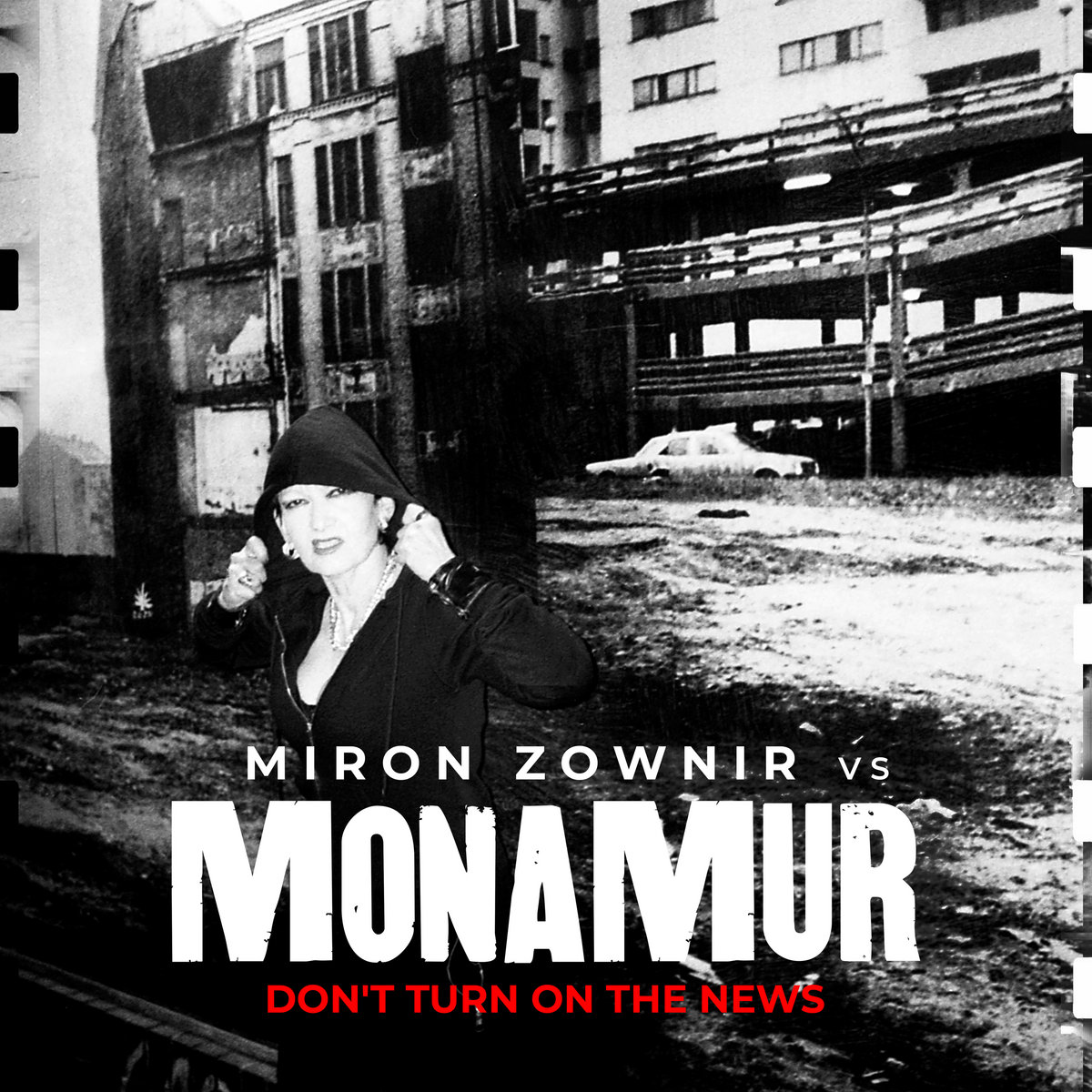
Mona Mur has never treated music as a decorative art. Her work has always carried the sense of an encounter: voice against machinery, melody against abrasion, intimacy against the cold architecture of modern life. On ‘Don’t Turn On The News,’ that instinct becomes particularly concentrated. Across nine songs, Mur and the photographer, poet and author Miron Zownir construct a bleakly elegant body of urban electronic poetry in which guitars, electronics, programmed rhythms and spoken-word sensibilities are fused into something neither conventionally industrial nor simply rock. It is music with the temperature of a city after midnight, when illuminated windows reveal fragments of lives but explain nothing about them.
The album’s severity is inseparable from its humanity. Zownir’s poems, written specifically for Mur, do not attempt to soften the world they describe. They confront alienation, appetite, resentment, mortality and the peculiar absurdities of contemporary existence with a writer’s economy. Mur takes those words and subjects them to her own musical language, one she has refined over decades: ominous electronic architecture, muscular guitars, severe rhythmic patterns and a voice capable of sounding simultaneously commanding and wounded. The result is not merely an album with literary lyrics. It is a genuine collaboration between two artists who have spent their careers examining the margins of respectable reality.
“Find out what you love and hate it” establishes that atmosphere immediately. Its title alone contains one of the album’s central paradoxes: desire and rejection are presented as inseparable impulses. Mur’s delivery gives the line an almost aphoristic force, while the production surrounds it with a stark electronic environment that refuses the comforts of conventional pop arrangement. The track has the quality of a nocturnal monologue transmitted through damaged circuitry, yet its emotional argument is remarkably direct. Mur understands that alienation becomes most persuasive when it is allowed to remain personal rather than inflated into grand political rhetoric. “Keep Me Up-to-Date” turns its attention toward the relentless demand to remain informed, connected and responsive. In lesser hands, such material could become an obvious indictment of digital culture. Mur and Zownir instead approach the subject through irritation, fatigue and dark humor. The song captures the strange coercion of perpetual awareness: the expectation that one should know everything happening everywhere while possessing almost no meaningful power to alter any of it. Mur’s production gives that predicament a restless electronic pulse, as though the machinery of communication itself has become incapable of switching off.
The title track is the album’s most immediate statement and perhaps its most revealing piece. It does not advocate ignorance so much as acknowledge the psychological violence of unfiltered information. Mur has spoken of experiencing a profound blockage with words in the face of the massacres and stupidity saturating contemporary life. Zownir’s poems supplied the missing language. That origin matters because the song never sounds like a detached commentary on catastrophe. It sounds exhausted by catastrophe, angry at it, and still stubbornly alive. The distinction gives the track considerable emotional weight. “I passed a few bars” moves into more intimate territory, evoking the social geography of streets, drinking places and fleeting encounters. Zownir’s writing has long been concerned with people who exist outside polished representations of urban life, and here Mur translates that perspective into a piece that feels cinematic without becoming sentimental. Her music suggests passing scenes rather than resolving them. A bar appears, a person disappears, an observation lingers. The song’s economy is one of its strengths: it understands that a city can reveal itself through details that would seem insignificant from a distance.
“Regret what you want” is more psychologically pointed. Its title sounds almost like a rebuke, but beneath the provocation lies a meditation on the strange permanence of remorse. Mur does not sing regret as melodrama. She gives it an abrasive, controlled presence, allowing the production to carry much of the emotional burden. The electronic textures and guitar-driven force create an atmosphere in which personal history seems less like something remembered than something physically encountered. It is one of the album’s clearest examples of Mur’s ability to make severity sound seductive. With “Don’t count me in”, the record becomes openly defiant. Yet the refusal here is more complicated than a simple gesture of rebellion. To decline participation can mean independence, exhaustion, disgust or self-preservation. Mur’s voice accommodates all four possibilities. Her performance has the authority of someone who has no interest in asking permission to occupy her own artistic territory. That quality has been central to her work since the 1980s, when her fusion of punk, poetry, rock and electronics placed her outside comfortable genre categories. Decades later, the refusal still sounds convincing because it has never been merely an aesthetic pose.
“Someday” introduces a different shade of melancholy. The title carries the promise of a future while remaining deliberately vague about what that future might contain. Against Mur’s dark sonic framework, the word acquires an almost painful ambiguity. Is “someday” hope, postponement, denial or simply another word for mortality? The track wisely refuses to answer. Instead, it allows uncertainty to become part of its emotional architecture, giving the album a rare moment in which its darkness seems to look beyond itself. “Stick to the small time” brings the album’s preoccupation with scale into sharper focus. Zownir’s artistic practice has consistently directed attention toward lives and spaces ignored by conventional narratives of success, while Mur’s music has similarly resisted the requirement to become easily categorized or domesticated. The song’s title therefore reads as something more substantial than a celebration of obscurity. It suggests an alternative value system in which proximity, survival and authenticity matter more than visibility. In a culture obsessed with expansion, “small time” can sound almost radical.
The closing “If I’m still around” is perhaps the most quietly devastating song on the record. After so much confrontation, its conditional phrasing carries enormous significance. Existence itself becomes provisional. The track gathers the album’s concerns of mortality, social disillusionment, desire, memory and resistance and leaves them suspended rather than neatly resolved. Mur’s voice is particularly effective here because she does not overplay the sentiment. The restraint makes the possibility contained in the title feel more serious. One can hear the shadow of disappearance without being instructed how to feel about it. The musical language throughout the record is unmistakably Mona Mur’s, but its force also comes from the larger constellation of musicians and collaborators that has surrounded her career. Her history includes work with FM Einheit of Einstürzende Neubauten, J.J. Burnel and Dave Greenfield of The Stranglers, En Esch of KMFDM, Anja Huwe, and Polish rock figure Grzegorz Ciechowski. Those associations help explain the unusual breadth of her musical vocabulary, although this album does not depend upon nostalgia for any of those earlier chapters. Mur produces from Studio KATANA with the confidence of a musician who has absorbed decades of experimentation and no longer needs to demonstrate allegiance to a particular scene.
That independence is crucial. ‘Don’t Turn On The News feat. Miron Zownir’ could easily have become a retrospective exercise, a reunion of established underground figures surrounded by familiar industrial signifiers. Instead, it sounds contemporary precisely because it does not chase contemporary fashion. Mur’s electronics are not there to make the album sound futuristic; they function as compositional instruments. The guitars are not deployed simply for aggression; they provide mass, contrast and emotional pressure. Her voice does not merely deliver lyrics; it serves as another layer of sound, sometimes declarative, sometimes intimate, sometimes almost spectral. Zownir’s contribution is equally fundamental. His photographs and writings have long confronted the dispossessed, the unruly and the socially inconvenient without converting them into fashionable symbols. That sensibility translates unusually well into song because his poetry carries an observational discipline. His language can be cruel, but it is not careless. Mur recognizes that quality and gives it an environment in which words can strike with the suddenness of images.
What makes the record particularly arresting is the absence of easy catharsis. Mur does not turn despair into spectacle, and Zownir does not offer nihilism as an adolescent solution. Their worldview is considerably more mature and therefore more unsettling. The world may be absurd, brutal and saturated with information, but the answer is not necessarily surrender. Sometimes it is the act of making something precise from the wreckage: a song, an image, a sentence, a refusal. The album’s title might therefore be read as both instruction and provocation. “Don’t turn on the news” sounds like withdrawal, yet the record itself is deeply engaged with the realities from which it supposedly asks us to look away. Mur is not asking listeners to become indifferent. She is asking what happens to consciousness when exposure to catastrophe becomes continuous and mediated, when horror arrives between advertisements, notifications and entertainment. Her answer is not silence. It is art sharpened into a form of resistance.
‘Don’t Turn On The News’ feels appropriately resistant to the logic of mass consumption. It is compact, severe and unusually personal, an album that treats collaboration not as a promotional concept but as a genuine exchange of artistic instincts. Mur supplies the machinery, the voice and the sonic architecture; Zownir supplies language born from decades of staring directly at what polite culture prefers to crop out. The deepest achievement of the record lies in that shared gaze. Neither artist offers consolation on demand, yet neither abandons beauty. Between electronic darkness and guitar force, between poetry and performance, between disgust and tenderness, they create a work that understands ugliness as part of the human record without allowing ugliness to have the final word. ‘Don’t Turn On The News’ is severe music, but it is not empty music. Beneath its black-and-white surface is a stubborn, almost fragile insistence on remaining awake, observant and creatively alive.
Learn more links:
play loud! productions
Bandcamp