
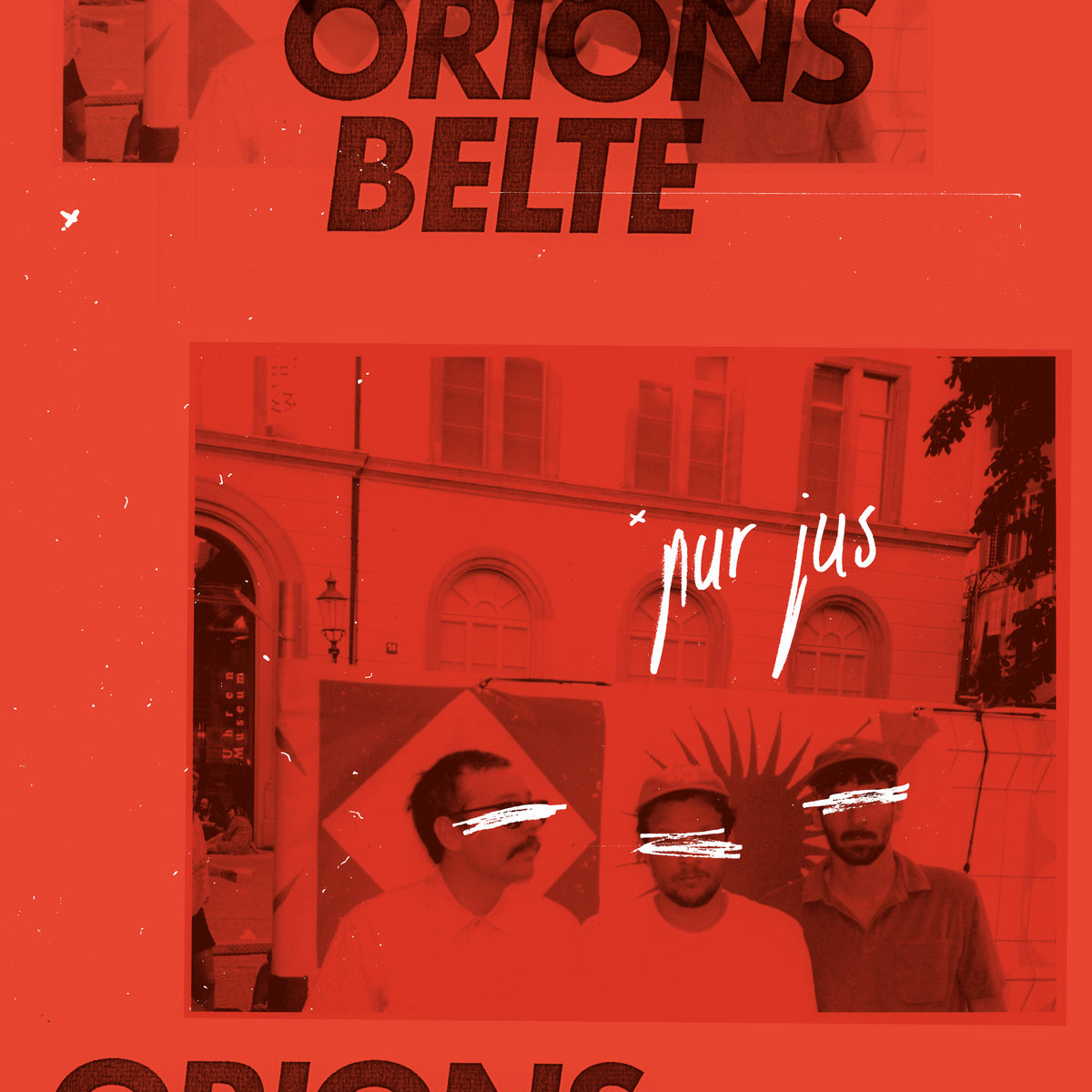
Orions Belte’s ‘Pur Jus’ arrives with the confidence of a band no longer interested in disguising instinct behind ornamentation. The Norwegian trio have spent years refining a style that drifts between cosmic country, psychedelic rock, surf music, and ambient folk without pledging loyalty to any one tradition, yet this record sounds markedly different from its predecessors because of how little it tries to prove. The decision to record live in a single room with only bass, drums, guitars, and occasional keys does not function here as a retro affectation or purist manifesto. Instead, it reveals a group trusting chemistry over architecture, interplay over polish. What emerges is not austerity but clarity: a record stripped of decorative insulation, exposing the grain of performance itself.
The opening track, “The Carneddau,” establishes the album’s emotional weather immediately. Øyvind Blomstrøm’s guitar lines stretch outward like distant lights appearing through fog, while Chris Holm’s bass anchors the piece with patient melodic gravity rather than rhythmic insistence. Kim Åge Furuhaug’s drumming is especially remarkable throughout the album for its restraint; he never crowds the music with unnecessary emphasis, preferring subtle propulsion that gives each composition room to expand naturally. On “The Carneddau,” that philosophy becomes the album’s thesis statement. Every note appears placed according to intuition rather than calculation, and the result carries an unusual sense of trust among the musicians.
“Lakeside” deepens this atmosphere but introduces a warmer, almost pastoral dimension. Earlier Orions Belte releases occasionally pursued expansiveness through accumulation, layering textures until tracks resembled drifting dream sequences. Here, however, the trio discovers expansiveness through omission. “Lakeside” leaves deliberate empty spaces between phrases, allowing silence to function as part of the arrangement. Holm’s bass becomes conversational, answering Blomstrøm’s guitar with understated melodic detours, while the room itself seems to participate in the recording. One hears air moving around cymbals, amplifiers humming faintly beneath chords, fingers shifting against strings. Such details create intimacy without sentimentality.
The album’s title proves surprisingly apt. ‘Pur Jus’ does not merely advertise authenticity as an abstract virtue; it describes the sensation of hearing musicians reduce their practice to essentials and discovering that those essentials are enough. That approach reaches one of its most compelling expressions on “Echo Chamber,” where cyclical guitar figures flirt with repetition but never collapse into hypnosis. Instead, the track carries a peculiar emotional ambiguity, balancing melancholy with gentle momentum. The trio resist dramatic crescendos at every turn, preferring subtle modulation over explosive release. That refusal gives the music unusual durability. It lingers not because it overwhelms but because it remains emotionally unresolved.
“Milk Champagne” introduces a lighter energy, though not frivolity. The track possesses a loose-limbed swagger that recalls improvised late-night sessions, yet the musicians’ precision prevents it from drifting into casualness. Furuhaug deserves particular praise here; his percussion choices create tiny pockets of swing that destabilize the rhythm just enough to keep the performance alive and unpredictable. Blomstrøm’s guitar tone, meanwhile, avoids the saturated excess commonly associated with contemporary psych-rock. He favors warmth over distortion, lyricism over spectacle.
That preference for understatement becomes central to the album’s identity. Many instrumental rock records attempt transcendence through sheer scale, but Orions Belte pursue something quieter and perhaps more difficult: emotional immediacy without theatricality. “Rev Super” exemplifies this achievement beautifully. The composition moves with understated confidence, allowing melodic fragments to circulate gradually until they acquire emotional weight through repetition alone. Holm’s keyboard textures remain subtle enough to avoid altering the trio’s core dynamic, functioning more as atmospheric shading than structural support.
The brief “Lifeblood” serves as the album’s emotional hinge. At just over two minutes, it might appear transitional on paper, yet it contains some of the record’s most affecting playing. The performance feels almost private, as though the listener has entered the rehearsal room accidentally and remained unnoticed. The absence of embellishment becomes deeply expressive here. One senses musicians listening intensely to one another in real time, responding instinctively rather than executing predetermined arrangements.
“Spark” arrives with renewed momentum, its rhythmic pulse more assertive than anything preceding it. Yet even here the trio avoids obvious catharsis. Instead, the track circles around possibility, teasing release without fully surrendering to it. Blomstrøm’s guitar work throughout the piece is extraordinary in its economy; he extracts emotional resonance from modest melodic gestures rather than technical display. That discipline characterizes the album as a whole. Nothing on ‘Pur Jus’ sounds designed to impress, which paradoxically makes the musicianship more impressive.
“The Unshaken Frame” may be the album’s defining statement. The composition captures Orions Belte at their most refined, balancing meditative stillness with subtle rhythmic movement. The live recording process becomes especially important here because the track depends entirely upon collective responsiveness. Tiny tempo fluctuations, nearly imperceptible shifts in emphasis, and the natural elasticity of human performance give the music vitality impossible to replicate through heavily edited production techniques. The trio sound completely synchronized without ever sounding mechanical. By the time “Fallin’ Forever” closes the album, ‘Pur Jus’ has quietly transformed its apparent modesty into something profound. The final track drifts with bittersweet elegance, carrying traces of every emotional register explored earlier on the record: serenity, longing, warmth, uncertainty, and muted joy. The performance never seeks grand finale status. Instead, it recedes gradually, leaving behind the sensation of having shared physical space with the musicians rather than simply consuming a finished product.
What distinguishes ‘Pur Jus’ most sharply from many contemporary psych-rock releases is its resistance to excess. Modern production often mistakes density for depth, but Orions Belte recognizes that atmosphere can emerge through restraint just as powerfully as through accumulation. Mixed by the band themselves and mastered by Matias Tellez with admirable sensitivity, the album preserves imperfections that lesser productions would erase. Those imperfections become inseparable from the music’s emotional truth. The record also reflects a band increasingly confident in ambiguity. These compositions rarely announce clear emotional intentions, nor do they rely on dramatic structural pivots to sustain attention. Instead, Orions Belte cultivate subtle emotional states that shift gradually over time, rewarding concentration without demanding interpretive certainty. Such an approach requires enormous confidence from musicians, particularly in a musical climate often obsessed with immediacy and overstimulation.
What remains most striking after repeated immersion in ‘Pur Jus’ is how communal the album sounds. Not communal in the abstract sense of audience participation or collective sentiment, but in the literal sense of three musicians occupying the same physical space and shaping music through attentive listening. One hears not only performances but relationships: the intuitive timing between Holm and Furuhaug, the conversational elasticity between bass and guitar, the unspoken trust allowing each player to leave space unfilled. That quality gives the album unusual emotional resonance. ‘Pur Jus’ is not interested in reinvention, nor does it aspire toward conceptual grandeur. Its achievement lies elsewhere. Orions Belte have distilled their musical identity to its most essential form and discovered something quietly revelatory within that simplicity: virtuosity not as domination, but as attentiveness; authenticity not as branding, but as presence. Few records sound so unconcerned with spectacle, and fewer still derive such richness from that refusal.
Find out more by visiting Jansen Records | Bandcamp | YouTube | Instagram | Facebook