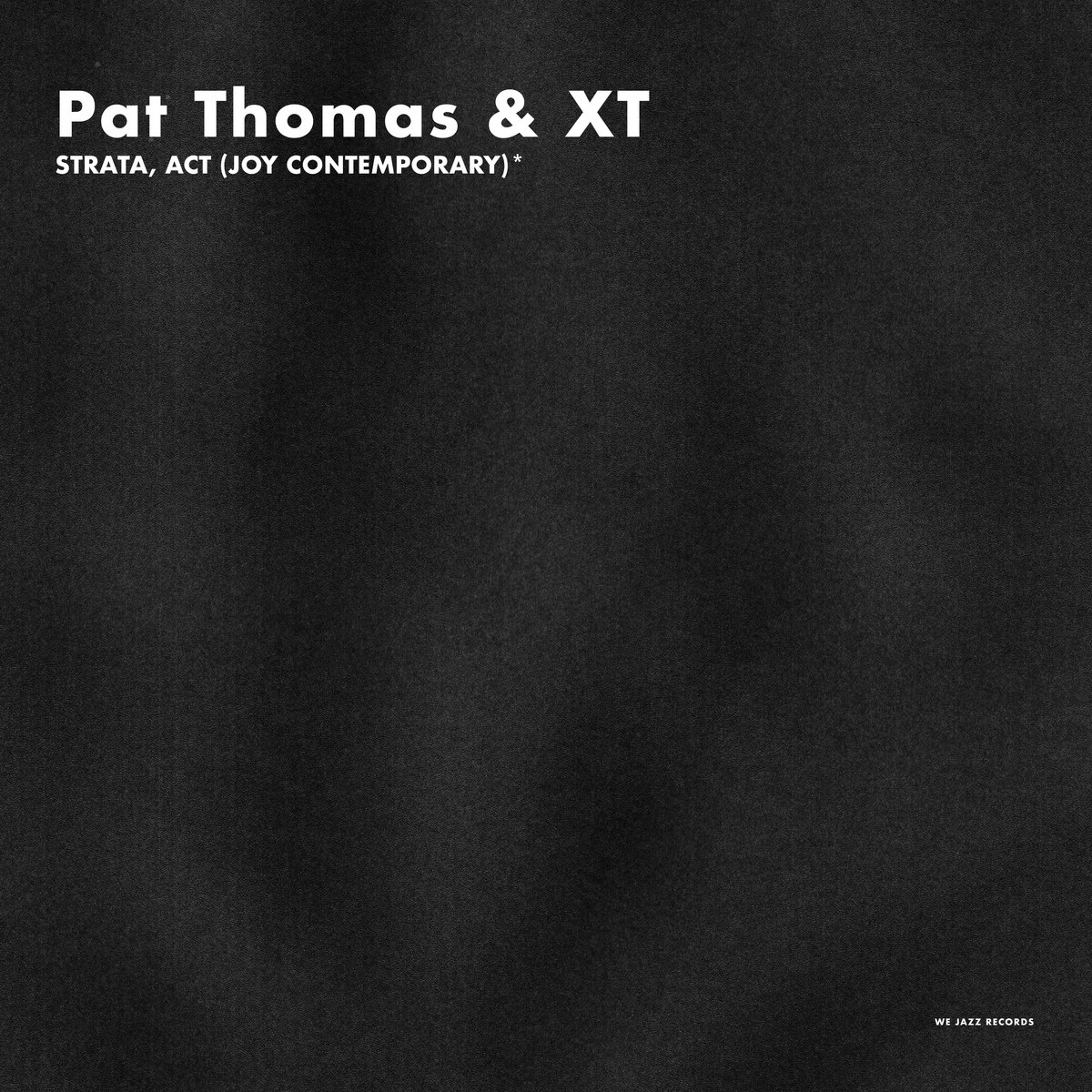
There are recordings that document performance, and there are recordings that seem to alter the conditions under which listening itself takes place. ‘Strata, Act (Joy Contemporary)’ by Pat Thomas and XT (comprising Seymour Wright and Paul Abbott), belongs firmly to the latter category. Spread across multiple performances captured in London and Zurich, it resists any stable notion of form, instead presenting improvisation as a continuously reconstituting field of relations: between acoustic gesture and electronic mutation, between individual agency and collective emergence, between memory and the yet-to-be-articulated.
The suite’s opening statement, “Strata, Act (Joy Contemporary)* London SECOND SET,” establishes the trio’s language not through exposition but through accretion. Thomas’s piano, often refracted through electronics, does not function as a harmonic anchor so much as a catalytic surface, where tones are struck, extended, and dissolved into currents of signal. Wright’s saxophone, described as both actual and potential, lives up to that framing; its lines slip between breath-driven articulation and something more ambiguous, as if the instrument were thinking aloud in multiple registers simultaneously. Abbott’s drums, equally at ease in their “real and imaginary” designation, provide neither pulse nor commentary in any conventional sense, but instead generate a shifting terrain of impact and resonance that continually redefines the ensemble’s center of gravity.
If the London material introduces the trio’s expanded vocabulary, “Strata, Act (Joy Contemporary)* Zurich TWO” deepens it into something more elusive. Here, duration becomes a compositional element in its own right. Ideas are not developed so much as revisited under altered conditions, their identities reshaped by context rather than progression. The influence of electro-acoustic traditions is palpable, yet never explicit; instead, it is absorbed into the trio’s internal logic, where electronics are not an overlay but an extension of touch, breath, and motion.
“Strata, Act (Joy Contemporary)* Zurich THREE” intensifies this sensibility, pushing the music toward states that feel simultaneously dense and permeable. Thomas’s interventions often arrive as clusters or shards that seem to hover at the threshold between pitch and noise, while Wright’s saxophone navigates a space that feels less like melody and more like a continuous act of negotiation with the surrounding sound field. Abbott, for his part, operates with a remarkable sensitivity to absence as much as presence, allowing silence—or near-silence—to function as an active participant in the unfolding structure.
The sequencing choice to return to London with “Strata, Act (Joy Contemporary)* London FIRST SET” is more than archival; it reframes the earlier material as part of a broader, recursive process. Heard in this context, the London performance takes on a different character, its gestures no longer initial but already implicated in a network of future possibilities. The trio’s interplay here is particularly striking in its refusal to settle into any fixed configuration. Roles dissolve and reappear, instruments exchange functions, and the boundary between acoustic and electronic becomes increasingly porous.
The closing piece, “Strata, Act (Joy Contemporary)* Zurich ONE,” functions less as a conclusion than as a reorientation. By presenting what is chronologically earlier material at the end, the album underscores its own resistance to linear narrative. What matters is not sequence but relation: how each moment refracts the others, how each sound carries traces of what has been and anticipations of what might follow.
Throughout ‘Strata, Act (Joy Contemporary)’, the trio engages with a lineage that includes figures such as Cecil Taylor and the British improvising tradition, yet their approach is neither referential nor revisionist. Instead, they treat history as a set of conditions to be reactivated and transformed. The electronics, handled collectively and fluidly, play a crucial role in this process, not as a means of expansion for its own sake, but as a way of destabilizing assumptions about instrumental identity and musical space.
What emerges is a work of remarkable conceptual and sonic scope, one that asks the listener to relinquish familiar frameworks and instead inhabit a mode of attention attuned to flux, contingency, and emergence. Thomas, Wright, and Abbott do not so much perform as they construct and deconstruct environments in real time, inviting us to consider improvisation not as a genre or technique, but as a way of thinking through sound.
In its scale, ambition, and execution, ‘Strata, Act (Joy Contemporary)’ stands as a significant statement within contemporary improvised music. It does not seek to resolve the questions it raises, nor to offer a definitive account of its influences. Rather, it opens a space in which those questions can continue to resonate, unfolding across time in ways that remain, by design, unresolved.
Learn more by visiting Bandcamp and We Jazz Records.