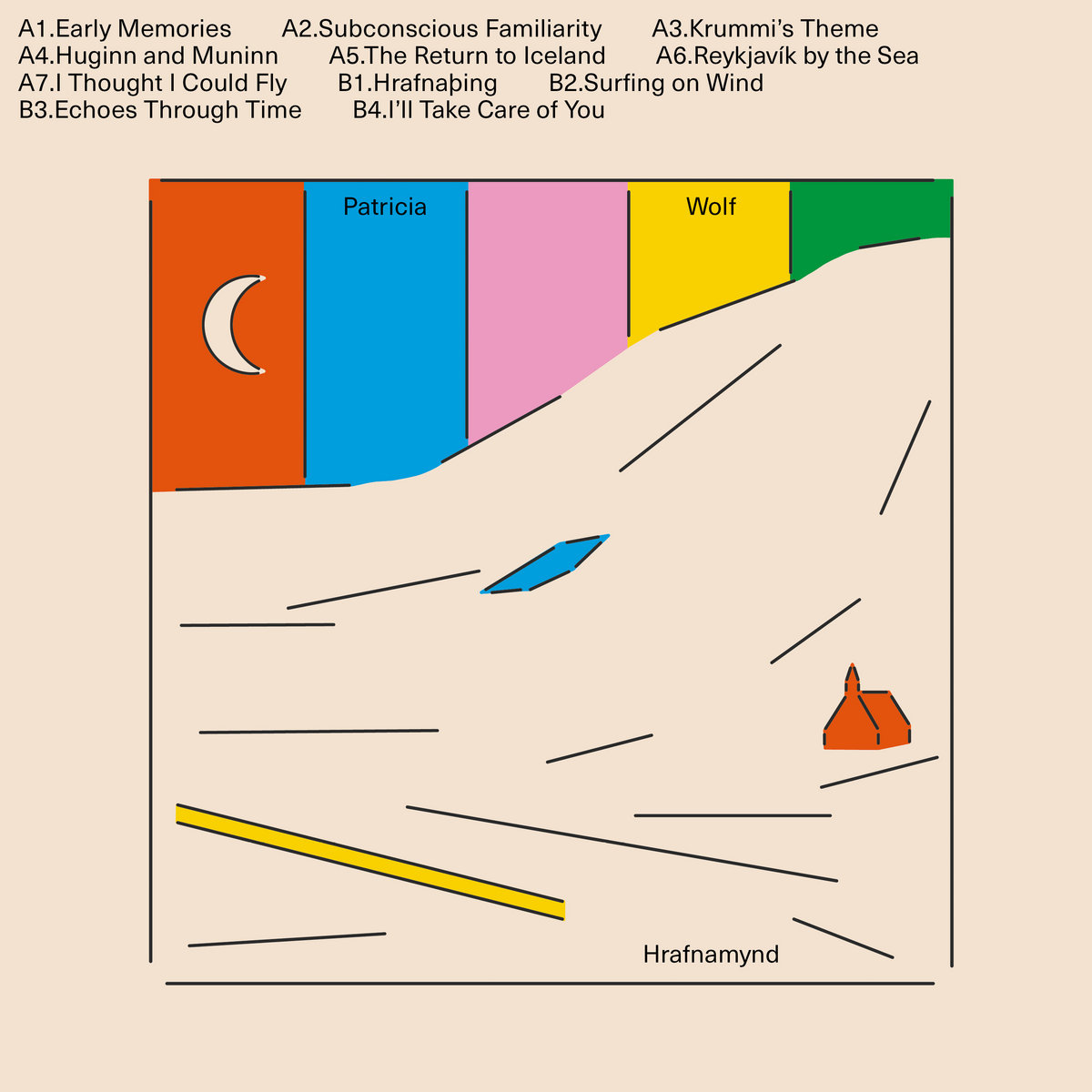
With ‘Hrafnamynd,’ Patricia Wolf accomplishes something quietly audacious: she composes a film score that feels inseparable from its images while remaining wholly persuasive as a stand-alone record. Commissioned for Hrafnamyndby experimental filmmaker Edward Pack Davee and released as Balmat 17, the album is both a continuation of Wolf’s meditative language and a widening of its expressive field. It deepens the inward gaze of her earlier work without retreating into familiarity.
The film’s title translates to “raven film,” and its subject (childhood in Iceland, folklore, and the watchful intelligence of ravens, including a talking bird named Krummi), demands a score attuned to memory and myth. Wolf answers with restraint rather than spectacle. Largely shaped on the UDO Super 6 synthesizer, her palette favors warm, string-like pads and glistening mallet tones that seem to hover in cold air. Occasional nylon string guitar figures appear like shafts of angled light. Field recordings gathered in Iceland, including subtle traces of birdsong and wind, are woven so seamlessly into the harmonic fabric that one ceases to distinguish environment from melody.
“Early Memories” opens the album with a kind of suspended exhale. Its chords bloom gradually, neither nostalgic nor sentimental, but searching. The piece does not reconstruct the past; it regards it from a contemplative distance. “Subconscious Familiarity” follows with gently pulsing undercurrents that suggest recognition before recollection, as if sound itself were remembering. Wolf’s gift lies in her ability to make the simplest motif feel alive, to allow a small melodic figure to gather emotional weight through patient repetition.
“Krummi’s Theme” introduces a more defined contour, its luminous mallet tones hinting at the personality of the raven without caricature. There is curiosity here, and a quiet humor, but also dignity. The subsequent “Huginn and Muninn” nods toward the mythic ravens of Norse lore, though Wolf avoids grandiosity. Instead, she layers airy harmonics that rise and dissipate like thoughts carried on a coastal wind, suggesting the birds’ roles as bearers of memory and insight.
Midway through the record, “The Return to Iceland” provides one of the album’s emotional fulcrums. A slowly unfurling chord progression seems to widen the horizon, evoking the act of arrival not as spectacle but as recognition. The music feels less like a travelogue and more like a homecoming to an inner landscape. “Reykjavík by the Sea” complements it with subtle rhythmic motion beneath luminous pads, capturing urban quietude rather than bustle. Wolf’s Reykjavík is spacious, reflective, and edged with salt air.
“I Thought I Could Fly” introduces a fragile upward-reaching motif that almost dissolves under its own aspiration. It is among the album’s most affecting passages, balancing hope and humility in equal measure. “Hrafnaþing,” named for a gathering of ravens, deepens the tonal palette with darker, resonant textures. The piece hums with communal presence, as if multiple unseen voices are conferring in low registers.
Later, “Surfing on Wind” brings a gentle lift. The synth lines tilt and sway, animated by subtle modulations that mirror shifting currents of air. It is one of the score’s most kinetic moments, though even here Wolf resists overt propulsion. Movement is suggested rather than declared. “Echoes Through Time” returns to the album’s central preoccupation with memory, its reverberant tones folding in on themselves in slow arcs. The past is not presented as fixed; it shimmers, refracted through the present.
The closing “I’ll Take Care of You” offers a benediction of sorts. Its harmonies are simple yet deeply felt, a quiet affirmation that lingers long after the final note recedes. In the context of Pack Davee’s autobiographical film, the piece resonates as an expression of familial devotion. As a stand-alone track, it feels like Wolf addressing the listener directly.
Throughout the album, Wolf demonstrates a rare discipline. She limits her tools and in doing so discovers unexpected colors within them. Composed, performed, and mixed by the artist herself and sensitively mastered by Max Wolf, the record bears the imprint of careful listening at every stage. The production allows space for air and silence, acknowledging that absence can be as eloquent as sound.
What ultimately distinguishes ‘Hrafnamynd’ is its empathy. Wolf does not impose emotion onto the images she accompanies; she listens to them. That responsiveness grants the score a fluid, almost sentient quality. It feels guided by the movements of ravens, by shifting clouds over lava fields, by recollections half-buried in Ektachrome hues. In honoring another artist’s life story, Wolf has also crafted one of her most personal statements to date; a love letter to Iceland, to memory, and to the mysterious intelligence that links landscape, animal, and human heart.
For more details, please visit: Bandcamp | Link Tree | Balmat