
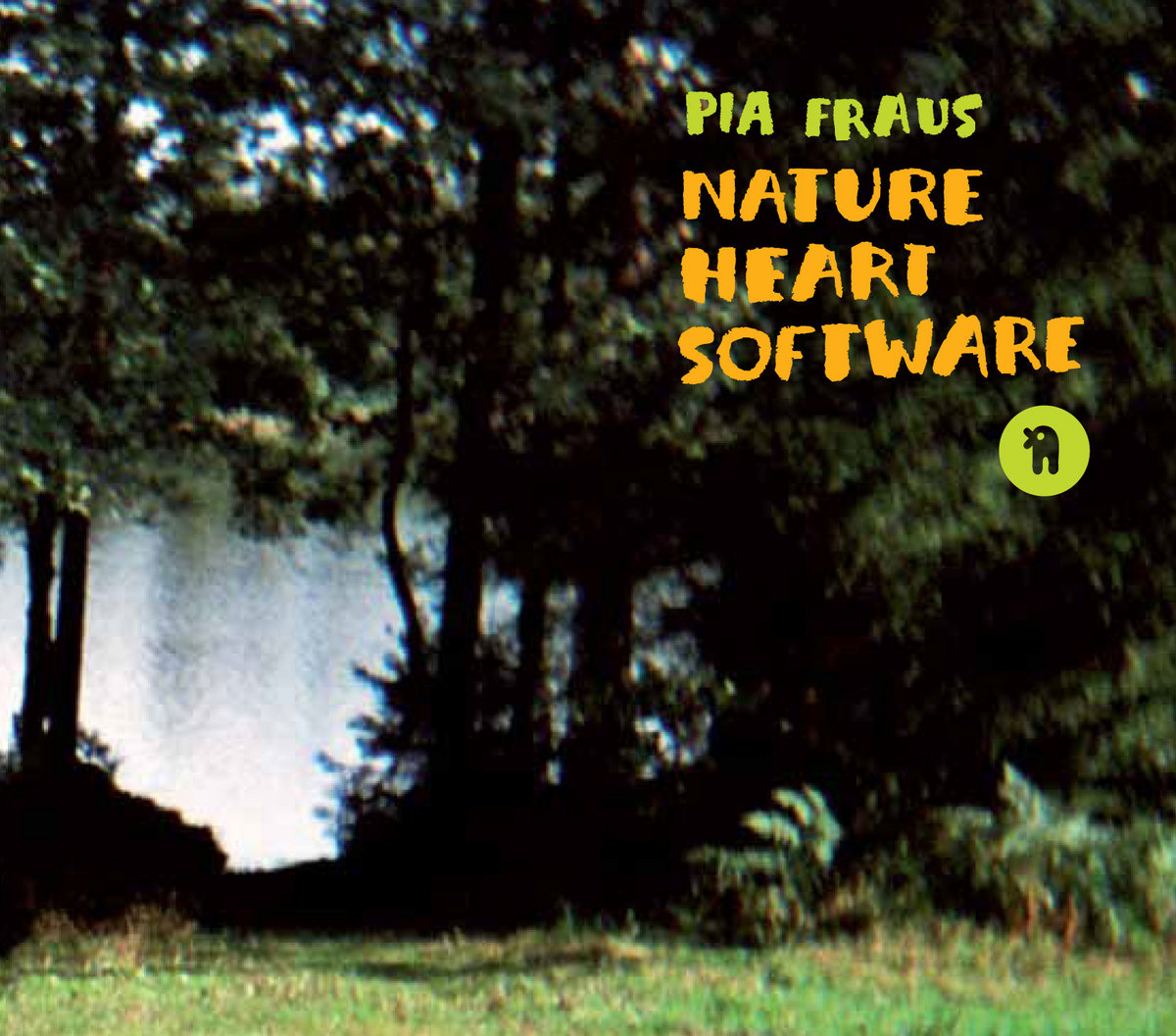
Pia Fraus return to their 2006 statement with the 20th Anniversary Edition of ‘Nature Heart Software’ inviting a renewed hearing of an album that already seemed suspended in its own carefully constructed atmosphere. The reissue does not revise the original intent so much as restore its edges, allowing its internal logic of shimmer, restraint, and melodic obscurity to register with fresh clarity. Across its twelve compositions, the record operates as a shared language between Eve Komp’s lyrical sensibility and Rein Fuks’ compositional architecture, with the broader Pia Fraus ensemble shaping a sound that resists haste in favor of gradual accumulation and finely graded texture.
The opening “Birds Still Swing” establishes this equilibrium with unusual immediacy. Drums performed by Fuks sit within a soft-focus rhythmic frame, while Komp’s lyrics drift through the arrangement like half-remembered phrases caught in air currents. Rather than presenting a declarative introduction, the track suggests a threshold state, as though the album is already in motion when the listener arrives “Pretend To Be Here” extends that sensibility into more defined melodic territory. With lyrics by Komp and music by Fuks, it articulates a quiet contradiction between presence and evasion. The song’s surface calm conceals a careful design of overlapping guitar lines, each one slightly offset from the next, producing a sense of suspended articulation rather than direct statement. It is one of the clearest demonstrations of how Pia Fraus balance accessibility with opacity.
“Chromatic Nights” continues this exploration of tonal layering. Eve Komp’s lyrical contributions sit within Rein Fuks’ composition as if embedded rather than placed upon it. The track’s harmonic shifts are subtle but persistent, generating an impression of colour changing under low light. The band’s attention to incremental transformation becomes especially pronounced here, where even small melodic turns carry structural weight. In “Day Week Or Season,” the ambiguity of time becomes a central motif. The collaboration between Komp and Fuks produces a piece that refuses to anchor itself to a fixed temporal register. Instead, it moves through cycles of repetition that feel neither mechanical nor linear. The song’s restraint allows its internal phrasing to carry emotional resonance without overt emphasis.
“You Know There Are People Living In The Country” introduces a shift in authorship, with Pia Fraus themselves credited alongside Eve Komp. This broader compositional imprint brings a slightly more panoramic quality to the track. The lyrical premise gestures toward distance and observation, yet the arrangement remains intimate, built from soft contours rather than expansive gestures. It is a study in how understatement can still produce narrative suggestion. “Teenage Girl” marks one of the album’s more direct entries, with Rein Fuks responsible for music, lyrics, and drums. The consolidation of roles results in a focused, almost singular voice within the record. Its rhythmic clarity contrasts with the surrounding haze of earlier tracks, yet it does not break the album’s continuity; instead, it reframes it, revealing how structure and spontaneity can coexist within the same compositional space.
With “Super Timeknowing Gentleman”, credited to Pia Fraus with words by Eve Komp, the album returns to its more elusive mode. The title alone suggests a playful conceptual framing, and the music mirrors this with shifting melodic fragments that resist settling into predictable repetition. The track feels shaped by curiosity rather than resolution, allowing ambiguity to guide its progression. “Thank You Peter Parker” introduces one of the album’s most distinctive arrangements. Fuks leads both music and lyrics, while Madis Aesma contributes trombone and trumpet. These brass elements do not dominate but rather weave through the composition like faint signals emerging from within the sonic field. The result is a subtle expansion of timbral range, offering a rare moment of instrumental brightness without disrupting the album’s cohesive atmosphere.
“Come To Me” returns to Rein Fuks’ dual role as composer and lyricist, stripping the arrangement back toward direct melodic expression. Its simplicity is deceptive, built on carefully layered repetition that avoids predictability through slight rhythmic displacement and tonal shading. The track suggests invitation without insistence, maintaining the record’s characteristic restraint.
Komp’s lyrics alongside the Fuks composition of “Feeling Is New,” stands among the album’s most emotionally articulate moments. Its structure is fluid yet controlled, allowing melodic lines to emerge and recede with understated elegance. The phrase suggested by its title is not treated as declaration but as observation, an awareness shaped through sonic detail rather than lyrical emphasis alone. “No Borders” shifts the textural palette again, with metallophone contributions from Kärt Ojavee and composition by Tõnis Kenkmaa alongside lyrics by Kenkmaa himself. The metallic resonance introduces a more percussive clarity, yet it is integrated into the surrounding fabric rather than isolated as contrast. The idea of boundary becomes sonically complex here, not erased but gently destabilized through arrangement.
The closing piece, “Japanese Heart Software,” brings together multiple strands of the album’s identity. Fuks’ compositional role is joined again by metallophone textures from Ojavee and brass work from Aesma, creating a layered conclusion that feels both reflective and outward-facing. The title suggests technological intimacy filtered through emotional abstraction, and the music mirrors this by combining precise instrumental placement with an atmosphere that remains deliberately unhurried.
Across the full span of ‘Nature Heart Software’, the interplay between Eve Komp’s lyrical voice and Rein Fuks’ compositional framework remains central, supported by the broader contributions of Pia Fraus and collaborators such as Kenkmaa, Ojavee, and Aesma. The 20th Anniversary Edition, issued through Seksound Record Label, re-contextualizes these works not by altering them, but by allowing their internal balances to register with renewed attention. The album’s architecture reveals itself less as a fixed structure than as a carefully maintained system of tonal relationships, where each element depends on subtle adjacency rather than prominence. In this restored form, the record affirms its place as a quietly ambitious work of constructed atmosphere and deliberate musical patience.
For more information, please visit SekSound Record Label | Pia Fraus | Instagram | Soundcloud