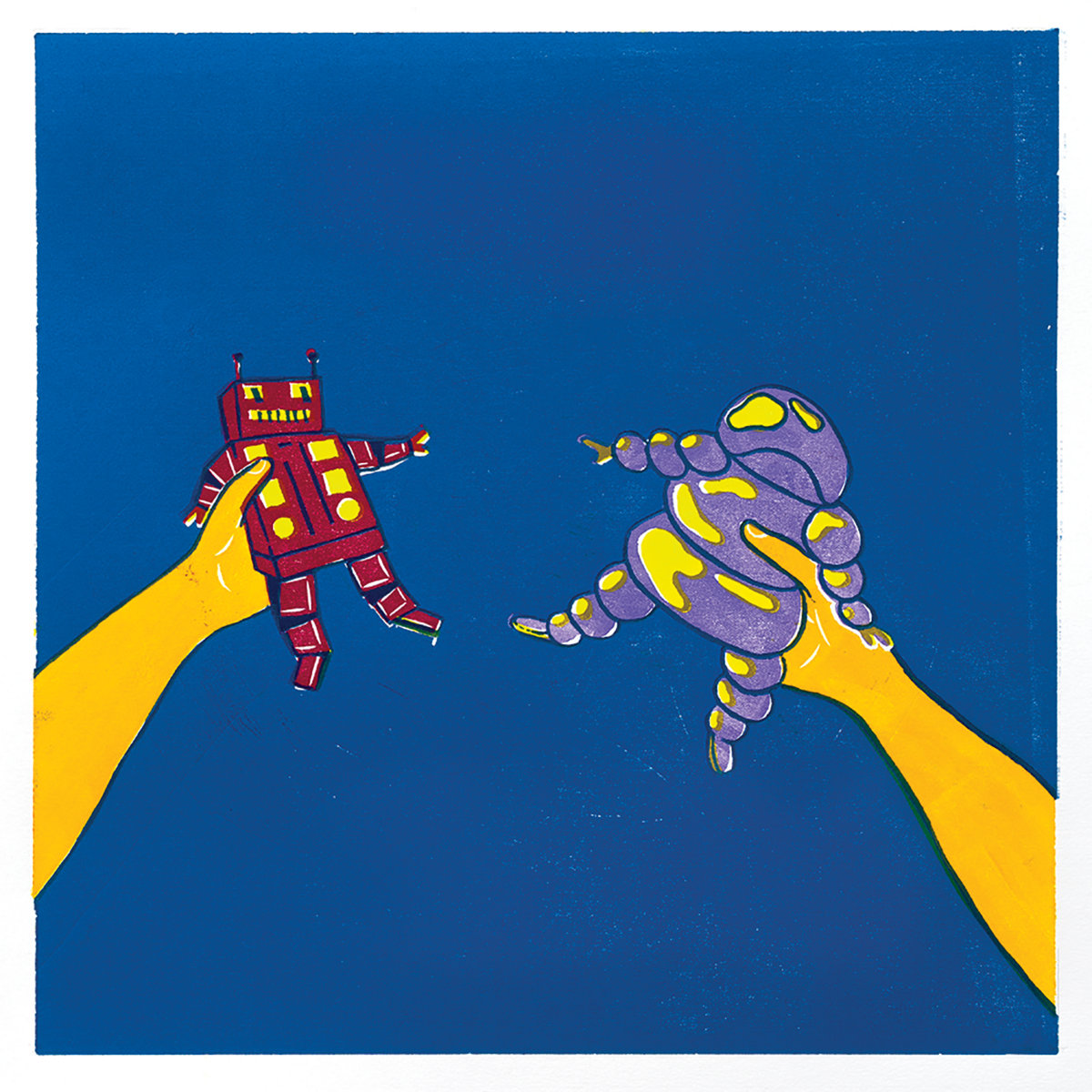
Pickle Darling’s ‘Bots’ is an album fascinated by imperfection—not as an aesthetic pose, but as a way of thinking. Lukas Mayo has taken the familiar materials of indie pop like guitar, voice, melody, rhythm, intimacy and subjected them to a process of deliberate disassembly, allowing fragments to become the basic units of composition. The effect is peculiar and exhilarating: music that sounds handmade and digitally scrambled at once, emotionally open while remaining suspicious of anything too polished. If ‘Laundromat’ represented a careful refinement of Pickle Darling’s sound, ‘Bots’ feels like Mayo kicking open the studio door and letting the machinery remain visible.
That machinery is immediately apparent on “Obsolete,” which begins with a spoken recording by songwriter Ava Mirzadegan and spends nearly two minutes withholding Mayo’s singing voice. It is an unusually patient opening, particularly for a record whose ideas can seem to flicker into existence before being abruptly reshaped. When Mayo finally arrives, the entrance carries the tentative quality of someone stepping into a conversation already in progress. The song’s construction reinforces that uncertainty. Guitar parts have been recorded note by note and assembled rather than performed as a continuous gesture, creating a strange musical perspective in which the listener can hear both the instrument and the act of constructing it.
“Violence Voyager” sharpens that method into something more restless. Mayo’s editing becomes a compositional language in its own right, with repetition and interruption producing a sense of movement that never quite settles into conventional momentum. Yet the album is never merely an exercise in studio experimentation. Beneath the distortion, reversals, clipped phrases and curious sonic juxtapositions is a songwriter with an acute instinct for emotional economy. A small melodic turn can carry an enormous amount of feeling precisely because Mayo refuses to decorate it unnecessarily. “Earthshaped” offers another version of that balance. Its title suggests something elemental and physical, while its construction repeatedly nudges the listener toward the artificial and abstract. This contradiction is central to ‘Bots’: organic feeling is continually processed through technological means, but technology never becomes the subject for its own sake. Mayo uses manipulation to get closer to the instability of memory, thought and affection; the way an experience can be altered every time we revisit it.
The miniature “Congratulations Champion” might be the album’s most revealing piece. At just over a minute, it has little room for conventional development, yet its central image of love compared to black mold on a windowsill turns sweetness into something unsettlingly durable. It is funny, grotesque, romantic and faintly devastating in the same breath. Mayo understands that affection does not become less sincere when it is expressed through an ugly metaphor; sometimes the opposite is true. The image lingers because it refuses the clean language normally assigned to love. “Human Bean Instruction Manual” gives Mayo considerably more space to explore that sensibility. The title itself sounds like a joke aimed at the absurdity of trying to understand human behavior through instructions, systems or procedures. The music answers accordingly, moving through assembled fragments as if attempting to document a consciousness that cannot be reduced to a set of rules. Mayo’s refusal to present a seamless performance becomes increasingly meaningful here. Every splice suggests a choice, every disruption a reconsideration.
“Steps” acts as a brief connective tissue before “Massive Everything,” arguably the album’s most direct encounter with pop. Mayo has described the latter as the closest they have come to writing a pop song, and that description makes sense without implying conventionality. The melody has a generosity that the album’s more fragmented passages sometimes deliberately conceal, while the production continues to complicate the surface. It is an unusually affecting combination: a song that wants to communicate immediately while retaining the peculiarities of the mind that made it. The closing “Infinite Trolley” expands the record’s concerns into something almost philosophical. The title evokes an absurd thought experiment, an endlessly moving object that becomes a metaphor for choice, consequence and circular reasoning. Mayo’s music has spent the album questioning what constitutes a finished song, a coherent self and a stable feeling; by the finale, those questions have begun to feel inseparable. The track does not offer a neat resolution because the album’s entire premise resists one. Instead, it leaves the listener inside the same unsettled creative space that generated the record.
Mayo wrote, performed and produced the album themselves, with Matt Gunn providing mixing and additional production and Alan Douches handling mastering at West West Side Music. Those contributions matter because ‘Bots’ is not simply the sound of a solitary artist retreating into eccentricity. Its unconventional production has been shaped into something remarkably communicative. Even at its strangest, the record maintains an instinct for melody and emotional clarity. What makes ‘Bots’ memorable is the seriousness with which Mayo treats messiness. The album does not romanticize accidents, nor does it mistake incompleteness for profundity. Instead, it argues that editing, distortion, hesitation and contradiction can reveal something a pristine recording might conceal. These songs sound like objects that have survived their own making: altered, patched together, occasionally unstable, but alive.
Pickle Darling has built a world over several releases, and ‘Bots’ is perhaps the boldest expression yet of its willingness to question the rules governing that world. It is playful without being frivolous, experimental without becoming academic, and vulnerable without demanding solemnity. Most importantly, it understands that intimacy can exist inside fragmentation. Mayo does not smooth away the seams; they make those seams part of the emotional vocabulary. In doing so, ‘Bots’ becomes more than an album about creative process. It becomes a persuasive argument for embracing the unfinished, the contradictory and the slightly broken as legitimate forms of beauty.
Learn more links:
Father/Daughter Records
Bandcamp
YouTube
Button Down
Tumblr
Instagram
Facebook