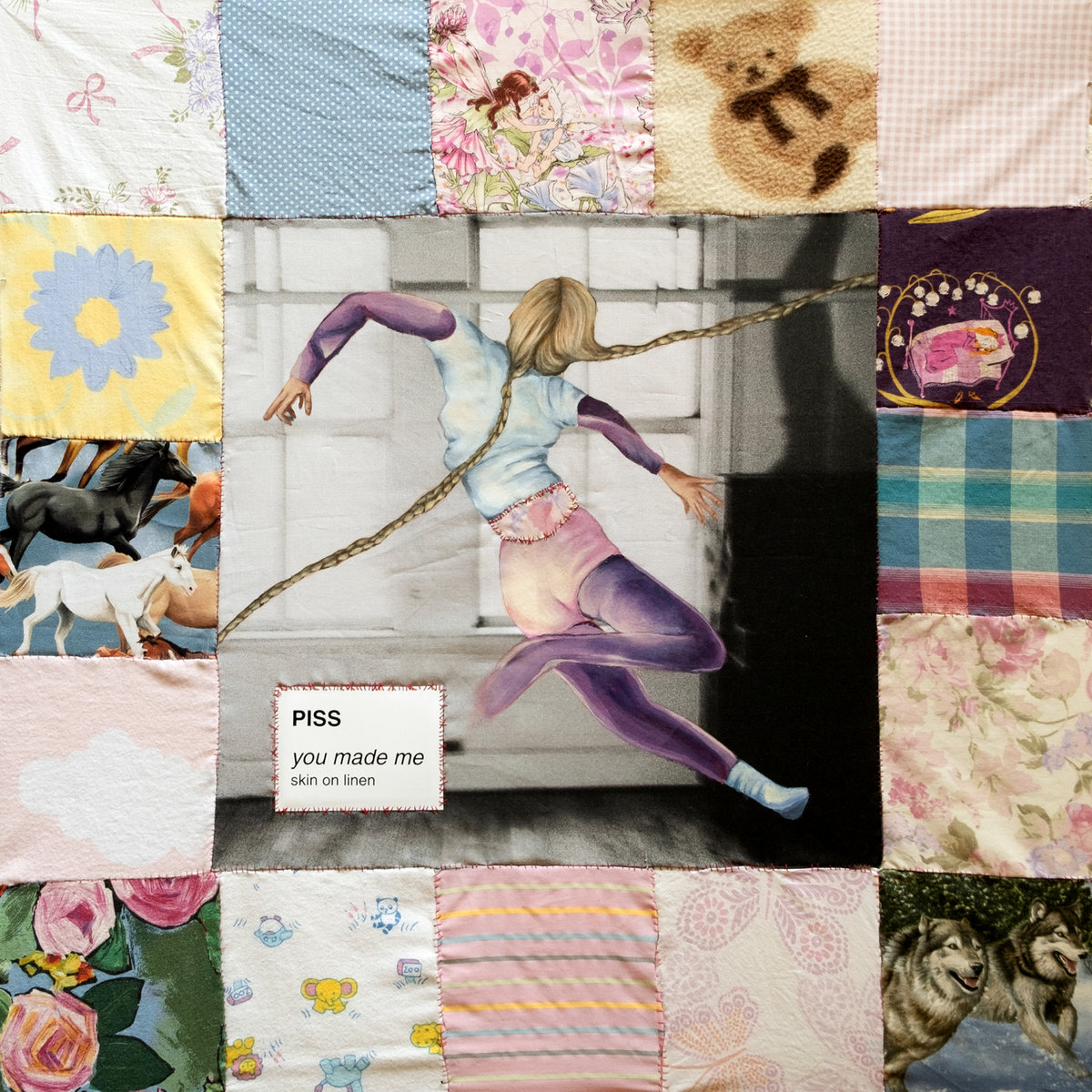
In ‘you made me / skin on linen,’ Vancouver’s PISS, use 15 songs to create a captivating and, sometimes unsettling, experience. Unlike most punk records which can be difficult to classify, this one is easily identifiable as a collection of short entries in a personal museum. It’s written with raw honesty, in some parts even brutal veracity, about the band members’ personal experiences and theories, backed by noise rock instrumentation. Recorded by Colin Stewart at Hive Creative Labs, this album displays the members’ commitment to fully expressing their beliefs, both mentally and physically.
The album opens with children talking about the future in ‘kai and friends.’ That short moment of youth and innocence is then replaced with the harsh reality of “i wanted to be a singer”. Here, Tyler Paterson uses his guitar to slash through the noise to create a dissonant wall of sound, accompanied by the heavy rhythm section of Garreth Roberts (drums) and Gavin Moya (bass). Taylor Zantingh takes vocal performance to the extreme, literally screaming to the point of vocal destruction to represent her desperation to be heard. The band uses extreme elements of sound to represent aspects of the story they’re telling. This is evident as early as the first song on the album.
The band creates a musical dialogue to discuss various iterations of feminism over time. Interspersed archival recordings are used to give the listener further exposure to some of the issues being addressed. Two of these recordings are of Andrea Dworkin, who also appears as a moral influence in ‘toni.’ Still other recordings include that of Manon Garcia, in “manon on the trial of gisèle pelicot”, and of Pelicot in “a little girl’s horse craze betrays her”. PISS uses these as well as other legal and illegal atrocities against children to illustrate how girls and women are raised to accept, and even embrace, violence and abuse.
The Moya’s bass provides the foundation to each song, keeping the more “out there” elements of the arrangement grounded. On “time loop at hot slit” Moya and Roberts, play a rigid, repetitive rhythm to represent trauma and PTSD. Guitarist Tyler Paterson uses unusual effects to create sudden drops to silence and swelling feedback to build a sense of menace. ‘Slowing down’ to create an eerie, cold atmosphere is achieved with the use of very little instrumentation, as demonstrated on “there was a door”. In this piece each cymbal crash is reminiscent of an alarm being set off in an empty room.
The second half of the album shifts focus more to the process of recovery. On “how can you act opposite to this emotion?” phrases from dialectical behavior therapy are used to contrast the strategies used to cope with the rage, the frustration, the insanity, of having to engage in ‘the process’ of recovery. On “blocking a scene you can’t remember”, the member of the band Zantingh is trying to heal, and express her frustration at having to slowly reconstruct her lost memories, and suddenly explodes with anger and distress to do so.
Some references to visual art appear on “self-blame with thorn necklace and hummingbird”, with the band using Frida Kahlo’s self portrait to express the idea that pain eventually becomes part of one’s identity. The band next includes a spoken word contribution by Vikki Reynolds to preface the song ‘Rote Zora’ on which the band once again references militant action. The band samples a 1984 interview with the West German anarcho feminist group Rote Zora to express views on legitimate self defense against violence against women.
After nearly twenty-eight minutes of relentless confrontation, acoustic dissonance, and archival reckoning, “i keep trying to change the ending” strips away the amplification entirely. Returning to the gentle, nostalgic swell heard at the very beginning of the album, Zantingh offers a quiet, halting lullaby that reclaims language from the wreckage. After such extreme noise the listener is left with Zantingh’s quiet, fragile voice assuring them that ‘the bleeding’ of life will eventually stop.
‘you made me / skin on linen’ is easily one of the most remarkable debut albums of recent years. The band uses their own personal experiences to illustrate various historical and political situations, and as a result create a piece of art that transcends both personal trauma and politics to become a universal testament of the will to survive. Zantingh, Paterson, Moya and Roberts have created a masterpiece that requires, and deserves, the audience’s full attention and empathy. It is evident that noise and poetry are very effective means to aid in the renewal of the self.
Learn more links:
PISS
Sub Pop
Bandcamp
Instagram