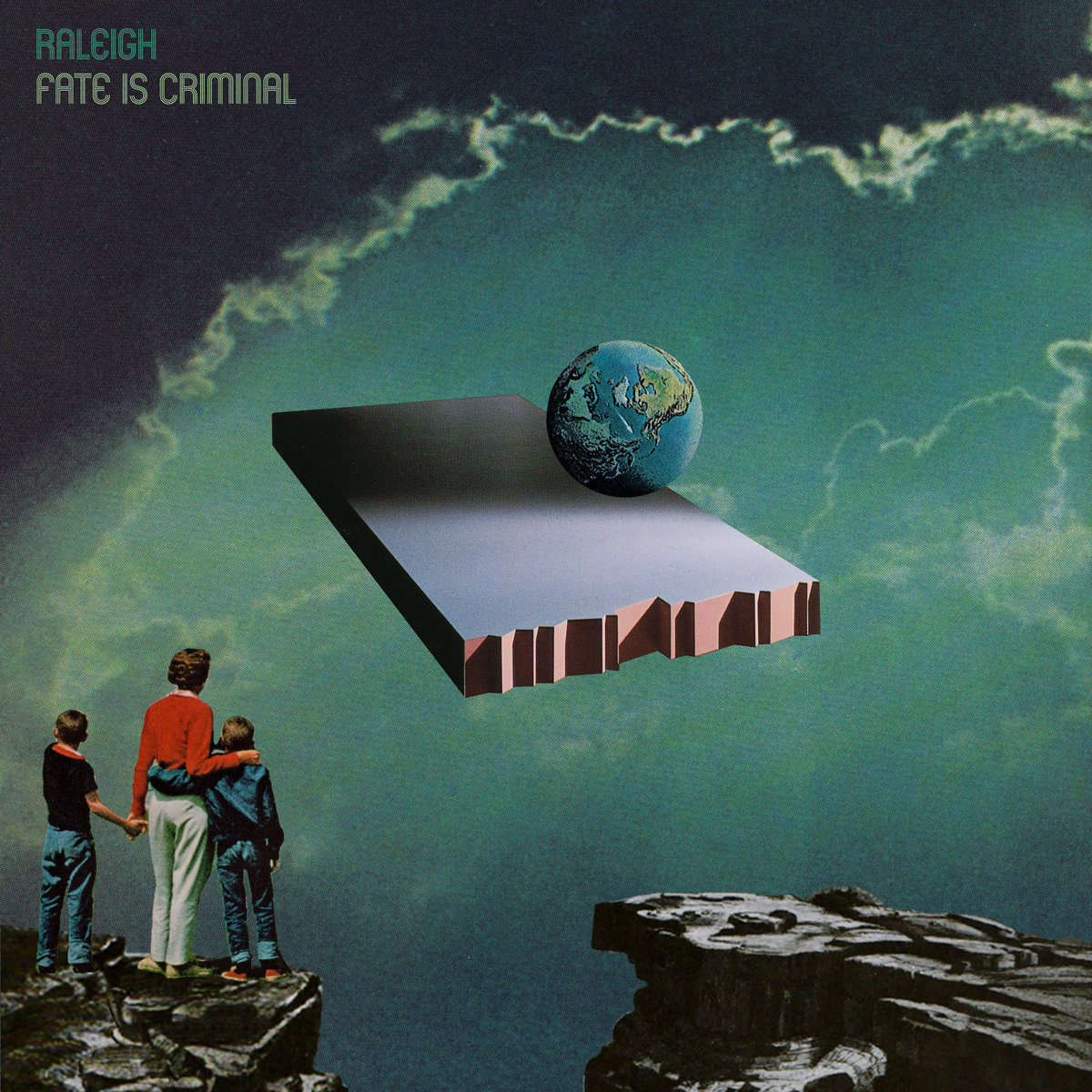
RALEIGH’s ‘Fate Is Criminal’ occupies a fascinating emotional territory where nostalgia and foresight coexist, where affection is inseparable from anxiety, and where every expression of hope carries an awareness of impermanence. Described as a collection of love letters warning of loss, premonitions of journeys yet to come, and hopeful laments searching for joy between regret, the album succeeds because it embraces these contradictions rather than attempting to resolve them. Across ten thoughtfully constructed songs, Clea Anaïs, Brock Geiger, and Will Maclellan create a work that examines the fragile architecture of human relationships with uncommon sensitivity and intelligence.
The title itself is provocative. ‘Fate Is Criminal’ suggests a challenge to inevitability, a refusal to accept that loss, distance, and change should be regarded as natural or just. Throughout the record, RALEIGH explores this idea from multiple angles, questioning whether the forces that shape our lives deserve the authority we grant them. The result is an album deeply concerned with time: how it alters people, erodes certainty, and transforms memories into something both precious and unreliable.
Opening track “Lost Desire” immediately establishes this preoccupation. The song contemplates longing not as an active force but as something partially vanished, existing in fragments rather than in full form. Its emotional complexity prevents it from becoming a simple meditation on absence. Desire remains present even as it fades, creating a poignant ambiguity that resonates throughout the album. The arrangement reflects this duality, balancing intimacy with expansiveness in a way that feels both personal and cinematic. The sprawling “By Ourselves” expands these concerns into a broader reflection on companionship and isolation. At more than six minutes, it allows RALEIGH to explore emotional nuances that shorter compositions might overlook. The song examines the paradox that people often feel most vulnerable when they are closest to one another. Rather than presenting solitude as either liberation or loneliness, it acknowledges the shifting relationship between independence and connection. Clea Anaïs’ vocal presence is particularly compelling here, conveying emotional complexity without relying on dramatic gestures.
“Bridges” functions as one of the album’s central metaphors. Bridges connect distant points, but they also emphasize separation by making it visible. The song captures this contradiction beautifully, exploring relationships sustained across emotional or physical distances. The composition carries a sense of movement without destination, reflecting the uncertainty inherent in maintaining connections through changing circumstances. On “Pendulum,” RALEIGH examines cycles of thought and feeling. The title evokes constant motion without progress, a recurring oscillation between opposing emotional states. The song captures the psychological experience of revisiting old questions and unresolved memories, discovering that time has altered perspective without providing definitive answers. Musically, it demonstrates the trio’s ability to create momentum while remaining reflective, a balance that becomes one of the album’s defining characteristics.
“USA” introduces a broader social dimension. While many of the album’s songs focus on personal relationships, this track widens the frame to consider place, identity, and belonging. Yet even here, RALEIGH avoids simplistic commentary. The song approaches its subject through individual experience, recognizing that national narratives gain meaning only through the people who inhabit them. Its relatively concise runtime contributes to its effectiveness, delivering its observations with clarity and restraint. One of the album’s most intriguing pieces is “Intergalactic Spasms.” The title suggests absurdity and cosmic scale simultaneously, and the song embraces both possibilities. Beneath its playful surface lies a meditation on disorientation and perspective. By framing personal concerns against a vast imaginative backdrop, RALEIGH highlights both the significance and insignificance of individual experience. The result is a composition that feels adventurous without losing its emotional grounding.
“Syd” serves as one of the record’s most intimate moments. Its brevity enhances its impact, presenting what feels like a carefully preserved memory rather than a fully narrated story. The song’s strength lies in its specificity. Rather than attempting to represent universal experience directly, it achieves universality through particularity, allowing listeners to project their own histories onto its emotional framework. The album’s darker currents emerge more clearly in “End of Days.” Despite its apocalyptic title, the song focuses less on catastrophe than on anticipation. It explores the human tendency to imagine endings, whether personal, relational, or societal, and the ways those imagined futures influence present decisions. The composition balances urgency with reflection, creating an atmosphere of uncertainty that never collapses into despair.
“Stranger Strangers” examines one of the album’s most compelling themes: the gradual transformation of familiar people into mysteries. Relationships evolve, memories distort, and individuals change in ways that challenge previous understandings. The song captures the melancholy of that process while recognizing its inevitability. Its concise structure mirrors the fleeting nature of the realizations it describes, arriving with quiet force before disappearing almost as quickly.
Closing track “Never Happened” provides a remarkable conclusion. Extending beyond six minutes, it serves as both summary and reconsideration of the album’s central ideas. The title evokes denial, revision, and the fragility of memory itself. Throughout the song, RALEIGH explores the possibility that the stories people tell themselves about their lives may be as significant as the events those stories attempt to describe. Rather than offering closure, the composition leaves listeners suspended between remembrance and reinvention, a fitting ending for a record so deeply invested in ambiguity.
The musicianship throughout ‘Fate Is Criminal’ deserves considerable praise. The trio perform with a collective sensitivity that prioritizes emotional communication over technical display. Every musical choice serves the album’s thematic concerns, creating a sense of cohesion that extends beyond individual tracks. The additional contributions from Carson Gant, Jennifer Crighton, Jamey Lougheed, and Carsten Rubeling enrich the arrangements without overwhelming the trio’s core identity, adding subtle layers that expand the album’s emotional and sonic range. Equally important is the production work shared by RALEIGH and Nyles Spencer. The recording possesses a remarkable sense of space, allowing each element room to resonate while maintaining intimacy. Spencer’s mixing enhances the album’s reflective character, emphasizing detail without sacrificing warmth. Dave Horrocks’ mastering completes the process with a clarity that allows the emotional nuances of the performances to remain fully intact.
What distinguishes ‘Fate Is Criminal’ is its willingness to inhabit uncertainty. Many albums about love and loss seek conclusions, lessons, or resolutions. RALEIGH recognizes that life rarely provides such neat outcomes. Instead, the record focuses on questions: How do people carry joy alongside regret? How do relationships survive change? What remains when memory begins to blur? By refusing easy answers, the album achieves a deeper honesty. ‘Fate Is Criminal’ is a profoundly thoughtful work that examines the spaces between attachment and departure, hope and resignation, remembrance and reinvention. RALEIGH transforms these complex emotional states into songs of remarkable depth and grace, creating an album that understands the beauty of human connection precisely because it understands its fragility. It is a record that lingers not through grand declarations but through its careful attention to the fleeting moments that shape a life.
For more information, please visit Bandcamp | Instagram | Facebook