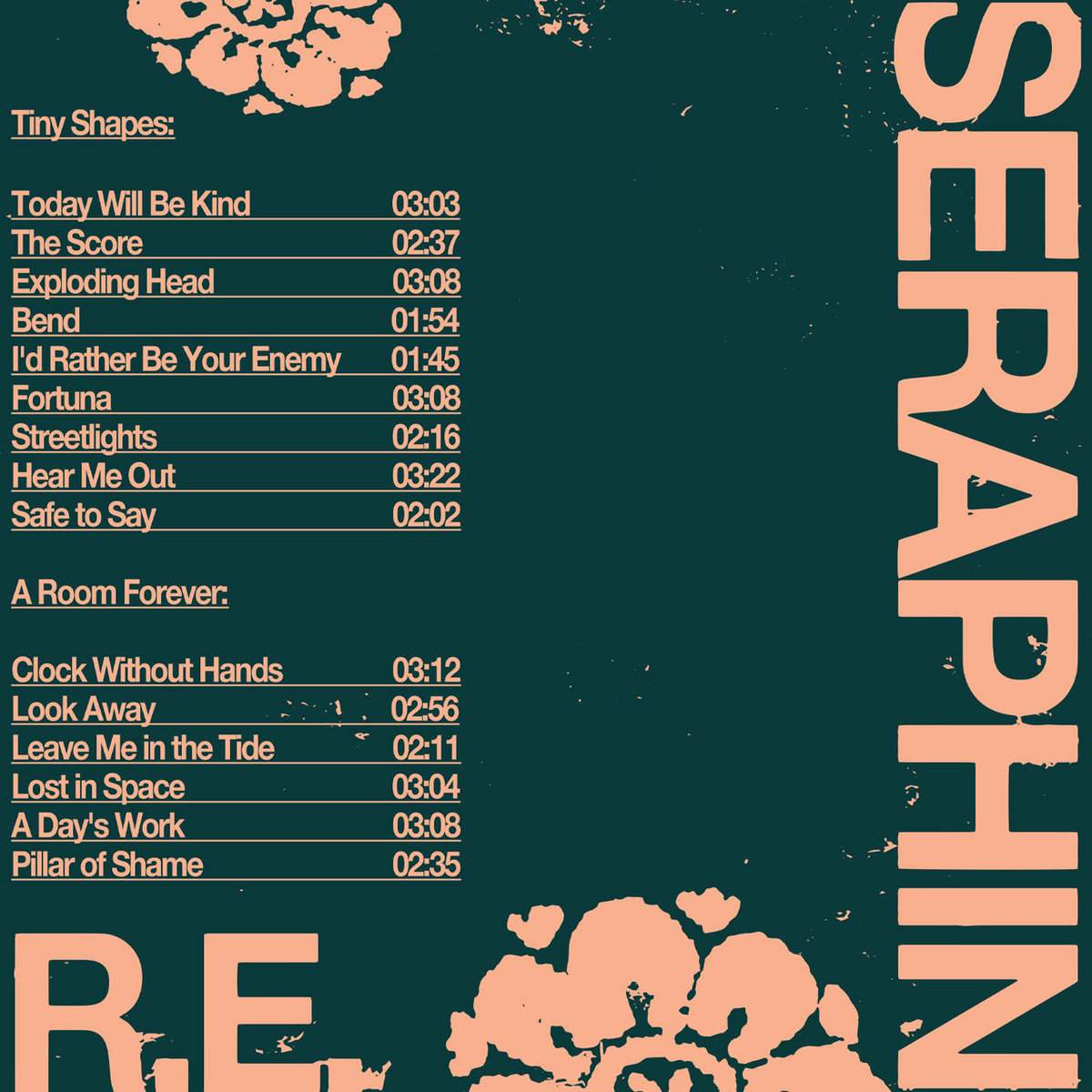
R.E. Seraphin’s ‘Tiny Shapes / A Room Forever’ is a deeply affectionate yet remarkably inventive exploration of pop music’s overlooked corners, a collection that honors the past without becoming trapped by nostalgia. Across these twenty-one songs, Seraphin demonstrates a rare understanding of the delicate balance between immediacy and atmosphere, crafting melodies that feel familiar while revealing unexpected details with each passing moment. This is music built from memory, influence, and curiosity, but it never settles for imitation. Instead, it transforms decades of guitar-pop language into something personal, strange, and vividly alive.
The release captures Seraphin’s ongoing refinement of what has been described as “paisley pop,” drawing from the melodic intelligence of late-’70s and ’80s underground rock while allowing room for hazier textures, unusual arrangements, and a handmade sense of character. The influence of groups such as The Feelies can be sensed in the chiming guitars, restrained rhythms, and carefully shaped melodies, yet Seraphin’s work reaches beyond revivalism. His songs possess the intimacy of old recordings discovered in a forgotten collection, where imperfections, tape hiss, and subtle sonic distortions become part of the emotional landscape rather than distractions.
The opening “Today Will Be Kind,” establishes the album’s particular atmosphere immediately: wistful but not fragile, melodic but never predictable. The song carries a gentle optimism that feels earned rather than simplistic, setting the stage for a record fascinated by the complicated relationship between hope, uncertainty, and recollection. “The Score” follows with a sharper pop sensibility, its concise structure revealing Seraphin’s ability to make economy feel expansive. Nothing is wasted, yet every arrangement choice creates additional depth. Throughout ‘Tiny Shapes,’ Seraphin’s songwriting thrives on contrast. “Exploding Head” channels the reckless charm of classic power pop, combining urgency with an almost playful looseness. “Bend” and “I’d Rather Be Your Enemy” reveal a different side of his approach, embracing brevity and atmosphere while allowing each song to leave a distinct impression. The inclusion of “I’d Rather Be Your Enemy,” originally written by Lee Hazlewood, fits naturally into the collection, reflecting Seraphin’s talent for finding overlooked material that aligns with his own artistic vocabulary.
The album’s centerpiece moments arrive through songs such as “Fortuna,” where layered guitar passages, rhythmic movement, and a memorable chorus merge into one of the release’s most irresistible statements. The track showcases Seraphin’s gift for creating sophisticated arrangements that remain approachable, using echoes and cascading instrumentation as compositional tools rather than decoration. “Streetlight” continues that approach with a reflective glow, while “Hear Me Out” balances melodic sweetness with a more unsettled emotional undercurrent. Seraphin’s vocal style is one of the record’s defining characteristics. His performances avoid conventional rock theatrics, instead occupying a space between vulnerability, detachment, and understated confidence. There is a fragile elegance to the way he delivers these songs, as though each phrase has been carefully considered but never over-rehearsed. That quality enhances tracks like “Safe To Say” and “Clock Without Hands,” where the tension between polished songwriting and raw presentation creates much of the album’s appeal.
The musicians surrounding Seraphin contribute significantly to the richness of the recording. Seraphin handles vocals, guitar, bass, and programming, while Owen Adair Kelley adds lead guitar, bass, keyboards, vocals, and programming that broaden the sonic palette. Jasper Leach brings guitar, percussion, vocals, and keyboards, providing essential color and movement, while Yea-Ming Chen’s vocals add another dimension to the arrangements. Phil Lantz’s drumming gives the material a grounded rhythmic foundation. Additional contributions from Matt Bullimore on guitar, vocals, and keyboards, along with Nick Allen’s vocals, further enhance the layered character of the release.
‘A Room Forever’ extends the ideas introduced on ‘Tiny Shapes’ while shifting toward a more dreamlike and spacious presentation. The songs maintain Seraphin’s affection for compact pop structures but allow more room for atmosphere and subtle experimentation. “Leave Me In The Tide” is an immediate highlight, propelled by a bass-led groove before blooming into shimmering guitar textures and a chorus that feels both timeless and newly discovered. Its coastal imagery and cinematic qualities create a world where classic pop instincts meet a more surreal sense of place. The original version of “Clock Without Hands” included on ‘A Room Forever’ provides a fascinating alternate perspective on one of Seraphin’s strongest compositions. Rather than feeling incomplete compared with later interpretations, this version highlights another facet of the songwriter’s personality. Its softer edges and gentle melodic flow reveal a fascination with the kind of understated guitar pop that defined bands like The La’s, while Owen Adair Kelley’s synthesizer contributions introduce an unusual atmosphere that subtly shifts the song’s emotional temperature.
Seraphin’s interpretation of Luna’s “Lost In Space” is another standout, demonstrating his abilities as an arranger and interpreter. He understands the essential qualities of the original while reshaping the song with a renewed sense of motion and personality. The performance does not simply recreate a beloved composition; it examines the song’s architecture and finds new possibilities within it. That same instinct reflects one of Seraphin’s greatest strengths: his ability to approach musical history as a living conversation rather than a museum exhibit. Across both albums, songs including “A Day’s Work,” “Pillar Of Shame,” “Look Away,” and “Leave Me In The Tide” reveal a songwriter with a remarkable command of melody, texture, and emotional nuance. Seraphin’s music succeeds because it understands why classic pop songwriting remains powerful: a great melody can contain contradiction, a simple arrangement can hold complexity, and a familiar sound can still carry a unique perspective.
‘Tiny Shapes / A Room Forever’ stands as a compelling document of an artist deeply connected to the lineage of guitar-driven pop while continuing to push that tradition forward. It celebrates the overlooked brilliance of previous generations, yet its greatest achievement is proving that these sounds still have room to evolve. R.E. Seraphin does not merely recreate a beloved era; he enters into dialogue with it, reshaping its vocabulary through his own experiences, instincts, and imagination. The end result is a richly detailed collection that rewards attention, invites discovery, and confirms Seraphin as a songwriter with both historical awareness and a distinctly personal voice.
Learn more links: