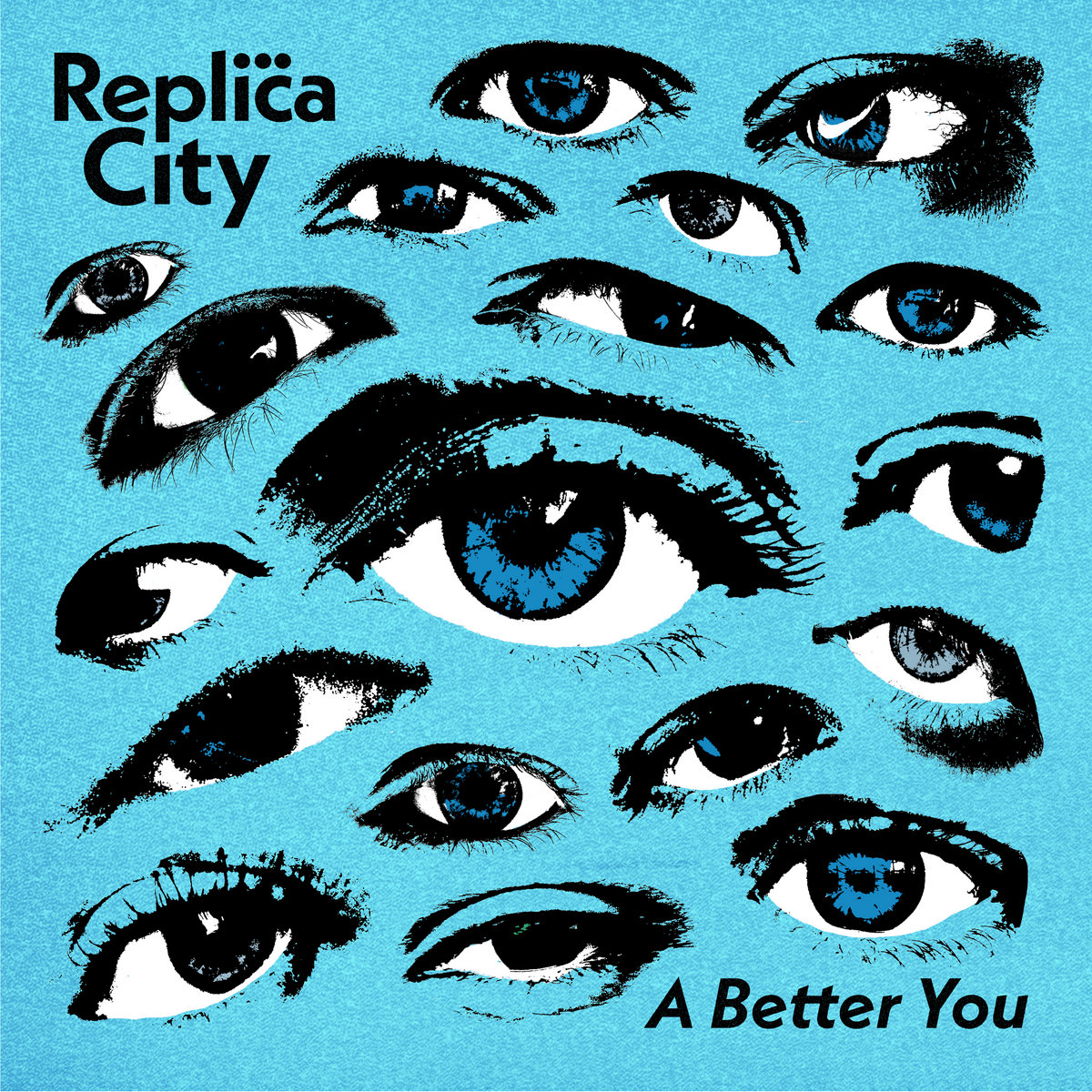
Few debut albums arrive with such a clear sense of identity as Replica City’s ‘A Better You’. Across ten tightly wound tracks, the Denver trio channels the nervous energy of post-punk, the bruised directness of post-hardcore, and the melodic instincts of alternative rock into a record that sounds both confrontational and strangely inviting. Rather than chasing nostalgia for the underground sounds that clearly inform its DNA, ‘A Better You’ treats those influences as raw material, reshaping them into something urgent, contemporary, and deeply human.
At the center of the record is the chemistry between guitarist and vocalist Corey Fruin, bassist Matt Dunne, and drummer Nathan Rodriguez. Much has been made of the album’s rhythmic foundation, and rightly so. Dunne and Rodriguez operate with an intuitive understanding of movement and restraint, creating grooves that are constantly threatening to spin apart yet remain remarkably focused. Their interplay supplies the album with its pulse, while Fruin’s guitar work alternates between sharp-edged propulsion and unexpectedly nuanced textures. The opening track, “Welcome,” serves as an ironic handshake. Rather than easing listeners into the album’s world, it thrusts them directly into it. The song establishes the record’s emotional climate immediately: anxious, restless, and suspicious of easy answers. Fruin’s vocal performance is particularly effective here, avoiding the detached cool often associated with post-punk in favor of something more exposed and immediate.
That sense of emotional vulnerability becomes even more pronounced on “Sweethearts.” Beneath its deceptively approachable title lies a song that interrogates connection and performance, examining the ways people present themselves to others while concealing less flattering realities. Replica City demonstrate an impressive ability to make discomfort memorable, embedding unsettling observations inside hooks that linger long after the song concludes.
“TV Static” captures one of the album’s central themes: information overload and modern alienation. The track crackles with nervous momentum, its rhythmic drive evoking the endless stream of noise that characterizes contemporary life. Yet what makes the song compelling is not merely its critique of overstimulation but its recognition that people are often complicit in their own distractions. The arrangement mirrors that contradiction, balancing chaos with precision.
On “Bunkerville,” the band expands its scope without sacrificing intensity. The song carries an undercurrent of social commentary, though Replica City wisely avoid didacticism. Instead, they focus on atmosphere and implication, allowing listeners to draw their own conclusions from the unease that permeates the track. Fruin’s guitar lines cut through the mix with remarkable clarity, creating a sense of forward motion even when the emotional terrain remains uncertain.
One of the album’s most immediate highlights arrives with “Don’t Get Cute.” Compact, energetic, and sharply constructed, it encapsulates many of Replica City’s strengths within a concise runtime. The song’s appeal lies in its refusal to overcomplicate itself. Every element feels purposeful, from Rodriguez’s agile drumming to Dunne’s commanding bass presence. What could have been a straightforward punk-inspired outburst becomes something richer through the band’s attention to dynamics and pacing.
The title track, “A Better You,” occupies the album’s conceptual center. Its name evokes the language of self-improvement culture, but Replica City approach the subject with skepticism rather than optimism. The song questions whether personal transformation is genuinely attainable or merely another product being sold. Rather than offering answers, it exposes the contradictions inherent in the endless pursuit of self-reinvention. Musically, the track balances aggression and introspection with impressive confidence, revealing a band capable of engaging with complex ideas without sacrificing momentum. “The Grift” continues this examination of authenticity and deception. One of the record’s most incisive compositions, it scrutinizes systems of influence, manipulation, and self-interest through a lens that feels both personal and societal. The song benefits enormously from the album’s production. Collin Ingram, working alongside additional engineering support from Raymond Suny and production contributions from Lauren Beecher, captures the band’s raw energy while preserving clarity and definition. Every instrument retains its character without becoming overly polished.
“Menace” lives up to its title through atmosphere rather than brute force. The song radiates unease, drawing power from implication instead of volume alone. Fruin’s vocal delivery reaches some of its most compelling moments here, conveying frustration, uncertainty, and determination in equal measure. The performance underscores one of the album’s greatest strengths: its emotional honesty. Replica City never hide behind irony or abstraction when direct expression will suffice. By the time “Deadliner” arrives, the album has developed a portrait of contemporary existence defined by pressure, acceleration, and diminishing certainty. The track channels those anxieties into one of the record’s most relentless performances. Rodriguez’s drumming deserves particular recognition, maintaining a kinetic intensity that drives the song forward while allowing space for subtle shifts in mood and emphasis.
The closing track, “Out of Pocket,” functions as both conclusion and reflection. Rather than resolving the album’s concerns, it gathers them together and presents them in their most distilled form. The song captures the sense of dislocation that runs throughout the record while hinting at resilience beneath the frustration. It leaves listeners with questions rather than certainty, a choice that suits the album’s broader perspective. A significant factor in the album’s success is the work of mixer and mastering engineer Justin Pizzoferrato. His approach preserves the immediacy of Replica City’s performances while ensuring that the complexities of the arrangements remain audible. The record sounds alive, retaining the imperfections and unpredictability that give great rock music its emotional force.
What distinguishes ‘A Better You’ from many contemporary post-punk releases is its refusal to rely solely on style. Replica City possesses the aesthetic hallmarks of the genre, but they understand that atmosphere alone cannot sustain an album. Every song is built around genuine emotional and thematic concerns, whether examining identity, authenticity, social pressure, or the search for meaning amid confusion. The result is a debut that communicates urgency without resorting to empty provocation. Replica City emerge from ‘A Better You’ as a band with a fully realized artistic voice. The album captures the exhilaration and uncertainty of modern life with intelligence, conviction, and considerable musical skill. It is a record that recognizes how difficult it can be to become a better version of oneself while acknowledging that the struggle between skepticism and hope remains worth documenting.
Find out more by visiting Bandcamp | Power Goth Recordings | Instagram