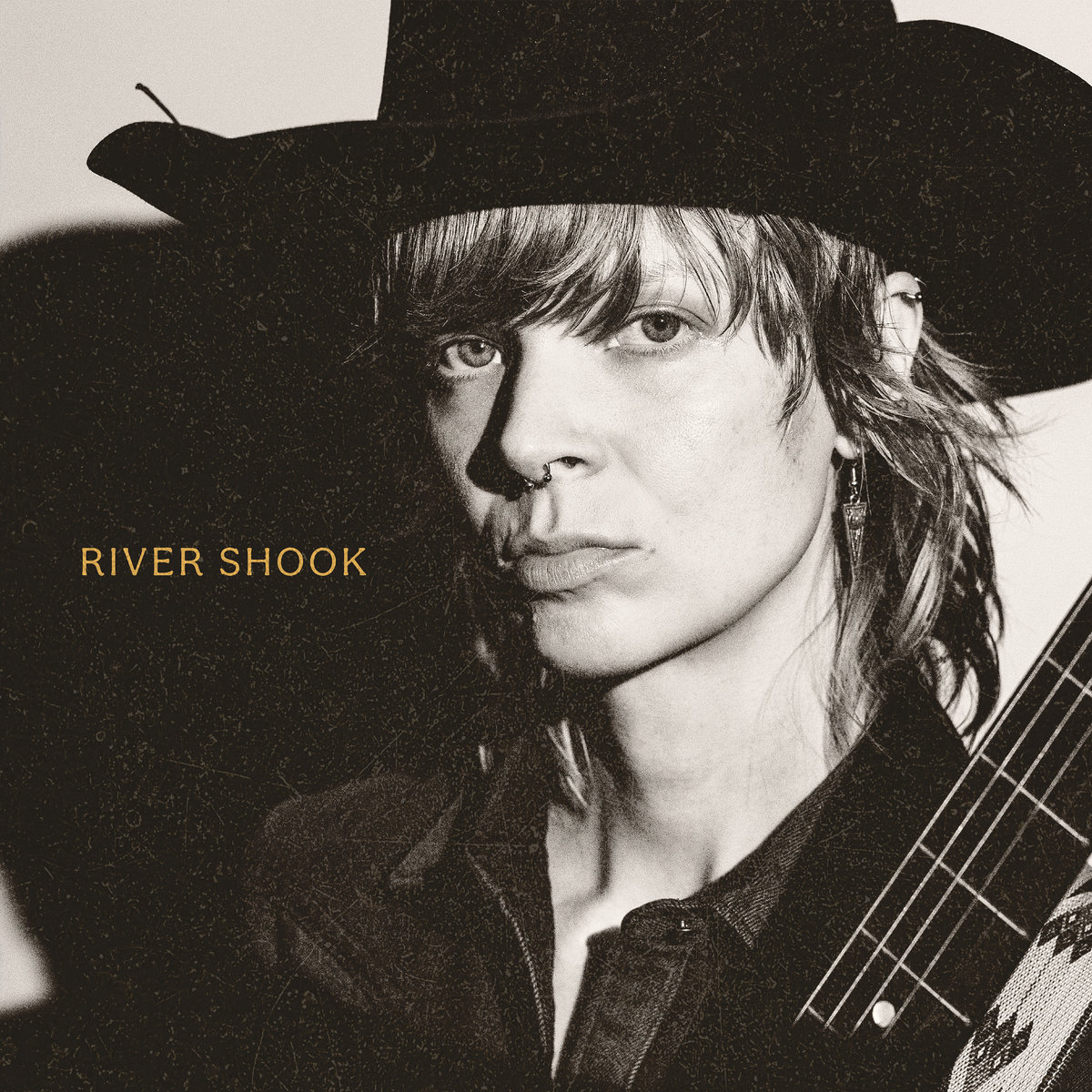
River Shook does not treat reinvention as a marketing concept on ‘River Shook.’ They treat it as demolition. The album arrives after the end of Sarah Shook & the Disarmers, a band whose decade-long existence had given River Shook a recognizable artistic identity, and the new record carries the strange exhilaration that can follow the collapse of something once thought permanent. It is country rock, certainly, but it is also a document of somebody testing the limits of their own voice and discovering that the limits were never quite where they had been imagined.
That sense of liberation is present from the opening seconds of “Free At Last.” The title could suggest pure joy, yet Shook wisely complicates the idea. Freedom can be thrilling, but it’s terrifying to realize that without structure, there are less things to blame. Once nobody else steers, every wrong turn belongs to you. Shook sings from precisely that precarious position, with an honesty that never sounds rehearsed. “Country Angel” introduces a more tender side of the record. The song inhabits familiar country imagery and Shook’s voice gives the material an earthy authority. Their vocal presence has always had the ability to make a line sound personally lived rather than merely performed, but here there is a greater spaciousness around it. Shook and Blake Tallent’s co-production gives the guitars room to stretch, while the layered instrumentation creates the impression of a much larger band than the two-person operation behind the album.
Tallent plays electric, acoustic, slide and 12-string guitar, as well as drums, bass, Wurlitzer, organ, piano, percussion and harmonica. Shook contributes acoustic and electric guitar alongside vocals, while Taylor Swan supplies pedal steel and banjo. What could have been a limitation becomes an opportunity for precision. Every instrument has a reason to exist. “Lost Without Your Love” draws the album toward more vulnerable territory, allowing longing to become something more complicated than romantic yearning. Shook is interested in the peculiar helplessness that comes with needing someone who may not be capable of meeting you where you are. While it carries the ache of classic country, the song remains unsentimental, rejecting the myth that love is somehow noble just because it’s painful.
“Venom & Gold” sharpens that perspective. Its title captures one of Shook’s central strengths as a songwriter: the ability to recognize that people and relationships rarely arrive in clean categories. A person can enrich your life while still causing damage. The song gives these contradictions a muscular musical setting, with Tallent’s guitars adding breadth and bite without overpowering Shook’s storytelling. “Fading” slows the emotional pulse. It is a song about disappearance, but the album’s larger context gives that disappearance another dimension. Shook has just walked away from one artistic identity, and throughout the record there is a recurring awareness that leaving something behind does not mean it stops being part of you. The past remains in the room, even after it has been painted.
“Blue Vervain” is among the album’s more atmospheric moments, with the natural imagery providing an elegant counterpoint to the psychological concerns elsewhere. Shook has a gift for grounding abstract feelings in tangible places, objects and landscapes. The song does not need to announce its symbolism. It allows the image itself to carry emotional weight. “If We Got A Chance” brings a more open-hearted quality to the record. The drums (mixed by Tallent for this track), give it a particularly sturdy rhythmic foundation, while the guitars widen the frame around Shook’s vocal. The song considers possibility without pretending that possibility guarantees happiness. Hope here is not naïveté. It is a wager.
“Beater Car” brings the listener back onto the road, and with it comes one of the album’s most appealing qualities: movement. Shook’s songs often feel populated by people in motion, whether they are physically traveling or trying to escape an emotional situation. More than just part a prop, the battered car anchors the track. It speaks to a rough-edged independence and a freedom that refuses to buy into the shiny romanticism of the highway. That idea reaches a particularly vivid expression in “Running To Georgia.” The geography is specific, but the emotional destination is harder to pinpoint. Shook sings with the urgency of somebody who knows that movement can be both escape and avoidance. You can cross state lines, yet you cannot outrun your fears. The song understands that notion without turning it into a sermon.
“Loving Me Is Like Rolling A Big Old Rock” provides the album with its most wryly self-aware title and perhaps its most revealing emotional premise. Loving another person requires work, but Shook is brave enough to ask whether they themselves have become the difficult object in the equation. Behind the initial levity sits an uncomfortable question about self-worth: how much effort should another person invest in simply trying to stay close to you? That question brings the album back to its central theme. ‘River Shook’ is about becoming more honest, but honesty here does not mean presenting a polished portrait of personal growth. Shook admits to struggle, vulnerability, bad judgment and uncertainty. They also recognize that a path isn’t a life sentence, you can always choose a different route if you have the fortitude. The album does not demand admiration for every decision made by its protagonist. It asks for the harder thing: attention.
Learn more by visiting Bandcamp.