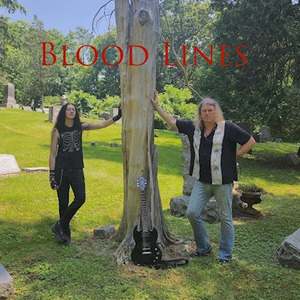
Robin Ross and Carmine Gontz’s “Blood Lines” comes from a place where rock music is still allowed to believe in big feelings. Released via RPM Entertainment, the single is not shy about its scale. It moves with heavy guitars, dramatic vocals, thick harmonies, and the kind of direct emotional force that only works when the people making it are willing to stand fully inside the song. Ross and Gontz do not treat family as a soft subject. They treat it as something physical, something that moves through blood, memory, grief, habit, and survival before anyone has the language to explain it.
That is the part of “Blood Lines” that gives it weight. The song is not only about loving the people you come from. It is about the strange burden of continuation. A baby is born, a grandparent dies, and the world does the cruelest thing it can do: it keeps going. Ross writes from inside that movement, where loss and life do not cancel each other out. They exist in the same room. The bloodline keeps moving, not as a clean symbol, but as a fact people carry whether they asked for it or not.
The arrangement understands that kind of inheritance as something loud. Bill Snyder’s power guitar and Scott Cowan’s melodic guitar give the song its height, while Frank Cinquegrana’s drums and Joe Torres’ bass keep it grounded in a steady, almost ritual pulse. The guitars do not just decorate the track. They widen it. They make the private feeling feel communal, as if one person’s family story has opened into something older, heavier, and less easy to put down.
Gontz gives “Blood Lines” its darker charge. His vocal does not smooth out the sentiment in Ross’ writing. It sharpens it. There is a theatrical force in his delivery, but it works because the song is already reaching for something close to ceremony. He sings family history like it is tender and punishing at the same time, like love can be sacred without being gentle. That is where the performance finds its strongest register. It does not ask the listener to admire restraint. It asks them to feel the size of what is being carried.
The video by Tina Ross keeps the song tied to people rather than letting it disappear into abstraction. “Blood Lines” could easily become all symbol: sand, time, ancestry, heaven, memory. The visual side keeps pulling it back toward faces, connection, and the human evidence of continuation. That gives the song a needed closeness. Its subject may be generational, but its impact is personal. You feel a family line most clearly through individual bodies, individual absences, individual rooms that are changed by who is no longer in them.
Written and performed by Ross with Jack’s Maze, “Blood Lines” also carries the sound of musicians returning to a shared instinct. The song’s classic rock language feels lived in because it is being played by people who understand the form from the inside. Ross has spent decades as a musician, songwriter, producer, and studio builder across the Pennsylvania, New Jersey, and New York music scenes, and that history matters here because “Blood Lines” is partly a song about endurance. It sounds made by someone still trying to turn experience into something that can outlast him.
Recorded at Baa Baa Leaf Music Studio in Milford, Pennsylvania, produced and mixed by Ross, and shaped with supervising engineer Jonathan Duckett, the track has the polish of a careful studio piece while still feeling hand built. That matters. A song like this cannot sound detached from the people making it. The production lets the guitars rise, the harmonies gather, and the vocal sit forward enough for the feeling to stay exposed. It is full, heavy, and earnest, which is exactly the world the song chooses to live in.
The best thing about “Blood Lines” is its refusal to make family neat. A bloodline carries love, but it also carries grief, obligation, repetition, pride, and all the unfinished material people pass down without meaning to. Ross and Gontz let that complexity stay intact. The song does not treat legacy as a trophy. It treats it as a force that survives through people, shaping them before they know how to name it.
“Blood Lines” works because it understands volume as a form of devotion. The song makes memory heavy enough to touch, lets grief move through the body, and gives family history the kind of sound that feels built to survive more than one lifetime. Ross and Gontz are not chasing cool distance here. They are making a song about what remains, what leaves, and what keeps moving through the line.
“Blood Lines” is out now via RPM Entertainment.
Blood Lines video
Bandcamp
Spotify
Apple Music
Mind Space album
Back To The Forest EP
Robin Ross online:
Website
Bandcamp
Facebook
Instagram
YouTube
Reverbnation
Carmine Gontz online:
Website
Facebook
Instagram
YouTube
TikTok