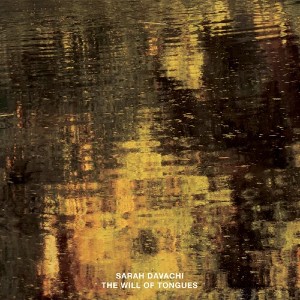
Not everyone’s idea of Sunday morning come down music consists of two violas and a cello (The Sung Blood Players) performing a “unison canon,” (a type of drone), but it suits me just fine. After all, Sunday mornings are contemplative, meditative times, and drones, more than any type of music are the perfect soundtracks to deep introspection.
It is fitting that this three LP work currently sits amongst my records sandwiched between Spacemen 3 and Popol Vuh, two bands whose styles, though somewhat in opposition, share the same blunt force tool: the drone. On The Will of Tongues, Davachi’s works are subtle and expansive. Still, the opening drone of “Interlude I: Polyphonic, for Strings,” for all of its subtleties, hits one like a bag of bricks.
A palate cleanser of sorts, “Interlude I” wipes clean that ear worm you can’t get rid of, your agenda list for the day, the morning’s infirmities, even the taste of your coffee. It prompts you to stop, sit, and listen, much in the way that “How Does it Feel?” from Playing with Fire does.
Eight minutes later, and suitably prepared, you fall prey to Davachi’s penchant for beauty as she herself overwhelms you with a medieval pipe organ (tuned to meantone temperament…take notes, kids) whose subtle blending of tones lifts you one step closer to the ecstatic.
In listening to The Will of Tongues while writing this, it is hard not to get contemplative…philosophical. There are many reasons why songs follow a repetitive structure. One of which is that structure, when tightly adhered to, is, in essence, a type of drone. A repetitive action that, when eschewing three minute formulas, drills deep into the lizard brain and takes hold of something cosmic.
Take Neil Young’s “One the Beach.” The strengths of that song are many, but the thrust of the song is a repeated guitar phrase, accentuated at times, but never truly broken. Like Davachi’s work here, Young’s song leads you to an openness, a state of responsiveness.
The lyrics, in Young’s case, guide that responsiveness. Here, Davachi’s instrumentals allow you to make a contextual break, freeing you of earthly confines, allowing you to explore inner worlds, time on standby, or your connection to the enigmatic that swirls around us like so much dark matter. There are no sign posts, no guard rails. You are you, laid bare, sans pretense.
As such, this is dangerous music.
Why? Because introspection is not always a pleasurable endeavor, and neither is transcendence if you aren’t used to finding it in art. Thus, even here (“The Second Tuning”), during one of the album’s more peaceful turns, you can imagine a “what the heck are you listening to” kind of response from a random passerby.
Still, there is something primal in us that responds to drones, and eagerly so. Hence the popularity of La Monte Young’s Dreamhouse in New York City, the problems with getting a ticket to a Terry Riley show, or why a Mary Jane Leach performance in the 90s wherein the chorus of female vocalists surrounded the audience remains one of my all time favorite concert going experiences (right up there with Slant 6 and Polvo).
I can only imagine what hearing “The Rose Dialogues, Part II”, my favorite track off the album, would be like in a church or cathedral. Yes, the organ would sound massive, as would the strings, but the sound of the air from the bellows as it passes through the pipes, so audible and oddly pitchy here, would nearly overwhelm me, I think.
By turns eerie, disquieting, and melancholy, “The Rose Dialogues” is–on side five–followed and offset by the elevated heights of the quizzically titled “Songs of the Smile’s Fig: II. Salts,” a dazzling chamber choral piece that does its best to pierce the veil.
There isn’t a wasted moment on any of the varied compositions that make up this album’s six sides. As a whole, the record is cohesive, despite shifting focus between pieces for organ, strings, choir, and brass. The works flow beautifully each into the next, maintaining an overall mood of transcendence despite radical shifts between sounds that both frighten and exalt.
In an alternate universe, in which composers and experimental artists hold equal footing with pop stars, Davachi would be a Bowie, a Lennon, a MItchell. But in this world…I fantasize that Davachi (soon to be Dr. Davachi), a Los Angelean, decked out in Hippie Shake couture and a stylish wolf cut, rolls into the hippest low-key bar, siddles up to a group of kids and lets slip that she’s just finished her latest drone piece. The kids all respond, ”Woah, so rad!” A night of heavy partying ensues, leading to Sunday morning and the need to recover to the sounds of The Will of Tongues.