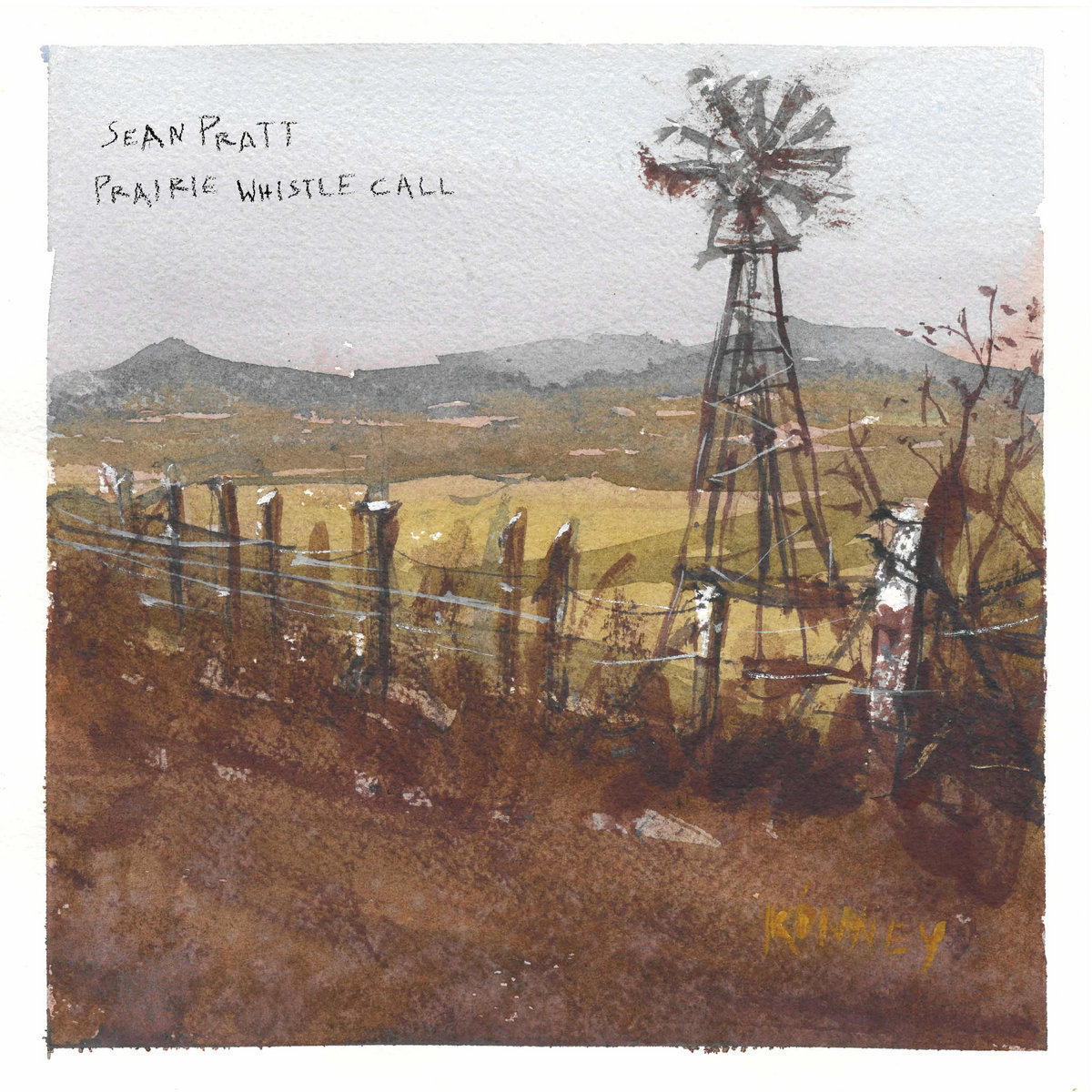
Nebraska’s Sean Pratt emerges with a quietly commanding statement of place and memory on “Prairie Whistle Call,’ a collection of songs that feels simultaneously expansive and intimately tethered to the Nebraskan plains. From the first notes of “Eyes Wide Open,” Pratt establishes a musical language that balances spacious Midwestern landscapes with the delicacy of human observation. His voice, measured and tender, slides seamlessly over the interplay of instruments, creating a sense of ease as if the listener is settling into a conversation with an old friend while the horizon stretches endlessly.
“Hall County Line” captures the subtle tension of rural passage, the roads, the wind, and the imperceptible rhythms of daily life, underpinned by Colin Duckworth’s resonant Dobro lines and shimmering mandolin. Pratt’s narratives inhabit the spaces between the notes, leaving room for Megan Siebe’s violin and cello to lend an emotional undercurrent that is both grounding and ethereal. “Need a Crowd” shifts the perspective inward, a quiet rumination made buoyant by the buoyant, springing textures of Duckworth’s Moog Model D and James Maakestad’s supporting piano motifs, providing a gentle counterpoint to the song’s reflective lyricism.
“Driving Into the Night” is a standout for its cinematic sweep, where the harmonium hums beneath Siebe’s subtle vocal harmonies, evoking the flickering intimacy of headlights moving through open fields. In “Smile,” Pratt embraces a more delicate minimalism, allowing the sparse instrumentation and cello lines to frame moments of human vulnerability without sentimentality. Each element feels purposeful: nothing is added for decoration alone, and yet the songs are richly layered in emotional resonance.
The latter part of the album, anchored by “In the Coulee” and “Wedding Shoes,” demonstrates Pratt’s mastery of blending narrative clarity with musical subtlety. Duckworth’s banjo interweaves with Siebe’s strings, producing a gentle propulsion that carries Pratt’s vocals with quiet insistence. “Porch Light” exemplifies the intimacy of the record; a soft, glowing meditation that balances warmth and isolation, while Maakestad’s bass and piano provide a steady, unassuming anchor.
The closing track, “Tomorrow,” co-written with Siebe, feels like a culmination of the album’s ethos: understated yet resonant, pastoral yet intimate. Harmonium swells, violin and cello contour the spaces between words, and Pratt’s voice retains its unhurried sincerity, allowing the song to linger in the listener’s mind like the last light on a Nebraskan horizon.
‘Prairie Whistle Call’ thrives in its restraint, presenting Sean Pratt as a songwriter deeply attuned to the rhythms of Midwestern life and the nuanced textures of human connection. The musicianship throughout is unforced yet precise, with Siebe’s strings, Duckworth’s multi-instrumental contributions, and Maakestad’s steady foundation creating a soundscape that is both wide and intimately immediate. This is a record that moves with unhurried grace through its quiet spaces, its open plains, and its stories, tracing a patient, windswept path where silence carries as much meaning as sound.
Visit Worried Songs or Bandcamp for more information.