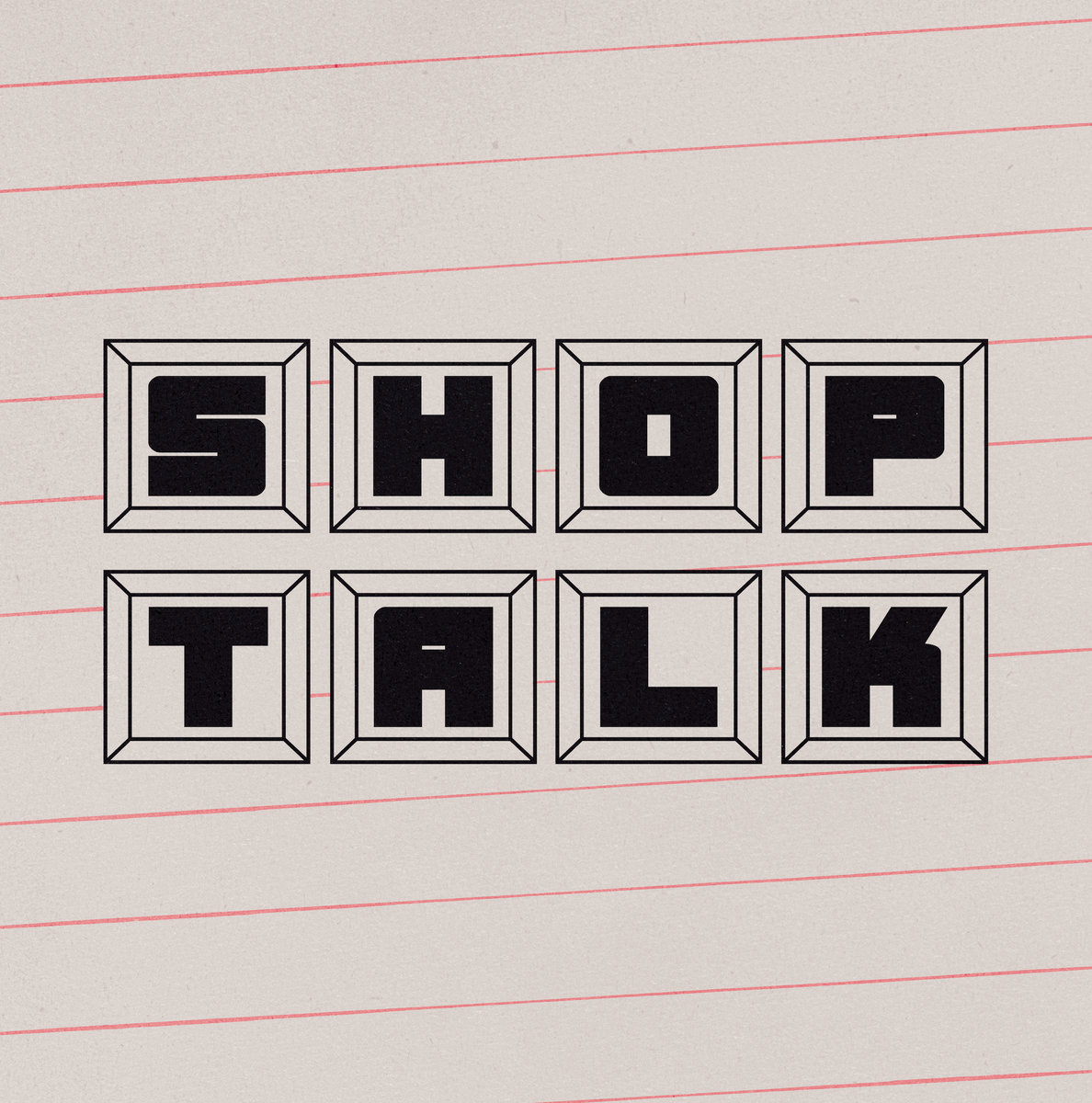
Shop Talk’s self-titled record arrives with the kind of concise conviction that suggests a band uninterested in excess and entirely committed to clarity of intent. Across ten tightly constructed tracks, the trio of Jon Garcia, Tristan Griffin, and Alexander Perrelli craft a record that feels immediate without being careless, economical without sacrificing personality. Each song lands with purpose, shaped by a recording process split between Nashville’s 302 Sound and Ridgewood’s SciLabs, yet unified through Garcia’s steady hand in the mix and Mikey Young’s unobtrusive but defining mastering touch.
“Ramona” opens the album with a brisk, melodic insistence, Garcia’s vocals riding just above the instrumentation with a tone that balances urgency and restraint. It establishes a central dynamic of the record: guitar lines that feel both deliberate and unforced, bass that anchors without overstatement, and drums that propel rather than dominate. The transition into “SOS” sharpens this approach, with Griffin’s bass carving out a more pronounced presence while Perrelli’s drumming leans into a clipped, almost conversational rhythm. The track feels like a transmission sent quickly, aware of its own brevity.
“Peddlers of Hope” compresses its ideas into under two minutes, yet it avoids feeling slight. Instead, it functions as a distillation of the band’s aesthetic; direct, unembellished, and assertive. “Black Friar” follows with a darker tonal palette, Garcia’s guitar work sketching a mood that is less about atmosphere and more about implication, leaving space for the listener to fill in the emotional contours. The album’s center finds its most immediate hooks in “Love Dart,” a track that pairs a nimble melodic sensibility with a rhythmic backbone that never settles into predictability.
“Saltillo” shifts the perspective slightly, its arrangement suggesting a more reflective stance without losing the forward motion that defines the record. Here, the interplay between Griffin and Perrelli becomes especially apparent, the rhythm section operating with a kind of intuitive cohesion that feels earned rather than rehearsed. “Camp Hero” arrives quickly and departs just as fast, a brief but memorable vignette that underscores the band’s understanding of proportion. Nothing lingers longer than necessary, yet nothing feels underdeveloped. This sense of balance carries into “Golden Afternoon,” the album’s longest track, where the band allows itself a bit more space to explore texture and pacing. Garcia’s vocal delivery here feels particularly nuanced, threading through the arrangement with a quiet confidence.
“Mirage of Love” returns to a more compact form, its structure tight but not rigid, while “Terra Damnata” closes the album with a sense of resolution that resists grandiosity. Instead of building toward an obvious climax, it settles into a measured conclusion, as if acknowledging that the album’s strength lies in its consistency rather than any single defining moment. What ultimately distinguishes ‘Shop Talk’ is its refusal to overstate its ambitions. Recorded with care but without indulgence, and performed with a clarity of purpose that never tips into self-consciousness, the album presents a band fully aware of its strengths. Garcia’s dual role as frontman and mixer ensures a cohesive sonic identity, while Griffin and Perrelli provide a rhythmic foundation that is both steady and subtly expressive.
The result is a record that invites close attention not through spectacle, but through precision. Each track contributes to a larger whole that feels thoughtfully constructed yet entirely unpretentious. ‘Shop Talk’ does not seek to overwhelm; it persuades through focus, leaving an impression that lingers not because it demands it, but because it earns it.
Learn more by visiting Shop Talk | One Track Mind | Bandcamp | Instagram.