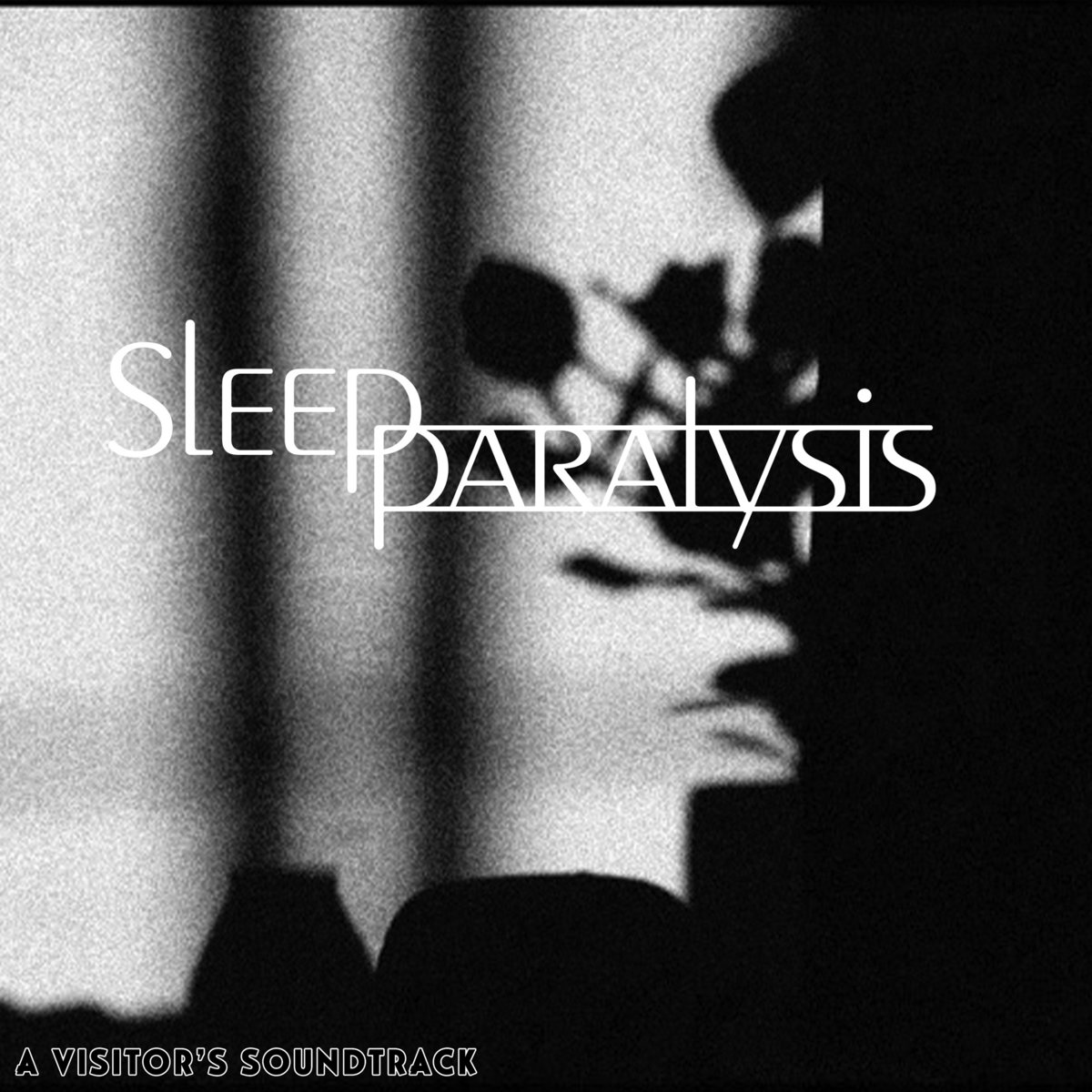
The debut offering from Sleep Paralysis, titled ‘A Visitor’s Soundtrack,’ functions as a startlingly lucid document of instantaneous creation. This is music stripped of the safety net of post-production, favoring instead the raw, unpredictable energy of single-take free improvisation. By centering the dialogue around the visceral pulse of drums and the primordial hum of a Moog synthesizer, the project constructs a sonic environment that feels both extraterrestrial and deeply subterranean. It is a work that demands a surrender of the listener’s traditional sense of time, replacing it with a fluid, surrealistic landscape of live sound.
The record opens with “Binaural Beats of the Esoteric,” a piece that immediately establishes the project’s fascination with the fringes of perception. Here, the electronic textures do not merely sit atop the rhythm; they seem to emerge from the very friction of the percussion. The inclusion of the Walaphone introduces a distinct acoustic complexity that separates this release from the predictable frequency profiles of standard industrial noise. While conventional noise frequently relies on the high-gain saturation of digital oscillators, the Walaphone operates through a combination of fluid dynamics and metallic resonance. This adds a variable harmonic quality to the midrange that traditional synthesizers cannot easily replicate, creating a liquid texture that feels alive.
As the record moves into “Baptised By Electro-Magnetism,” the conceptual link to the early pioneers of experimental electronica becomes clear. Yet, Sleep Paralysis avoids the academic coldness often associated with the avant-garde. The interplay between the Moog and the drums is physical and reactive, mimicking the unpredictable fluctuations of a living organism. This rhythmic philosophy owes a significant debt to the percussive traditions of free jazz innovators like Milford Graves or Sunny Murray. Rather than serving as a metronome, the drumming functions as a conversational partner, emphasizing a non-linear approach to time where the beat is felt as a shifting internal pulse rather than a rigid external frame. Unlike the brick-wall limiting found in much harsh noise, these naturally decaying transients allow for more air in the mix. This prevents the masking of subtle frequency modulations, maintaining a sense of spatial depth that is often lost in high-decibel recordings.
Mikey Young’s mastering provides a necessary clarity to this density, ensuring that even the most frenzied bursts of sound retain a sculptural quality. The concluding piece, “The Pulse of Transmutation,” serves as the definitive statement of the album’s improvisational philosophy. It captures the essence of operating in a state of pure presence, where the distinction between the performer and the instrument begins to blur. The piece oscillates between cavernous silence and a wall of sound that feels like a physical weight, echoing the conceptual foundations of free jazz without mimicking its specific structures. Here, the organic low-end fluctuations of the percussion interact with the sub-bass of the synthesizer, creating a more unpredictable resonance than a standard drum machine could ever achieve.
‘A Visitor’s Soundtrack’ is a courageous exploration of the unknown. Sleep Paralysis has succeeded in creating a debut that feels entirely unburdened by contemporary trends, opting instead for a path of rigorous spontaneity. By embracing the limitations of the single take and the unique character of their chosen instruments, they have produced a record that is as intellectually stimulating as it is sonically overwhelming. It is a rare glimpse into a creative process that is as much about the act of listening as it is about the act of playing.
Find out more by visiting: Bandcamp | Feel It Records