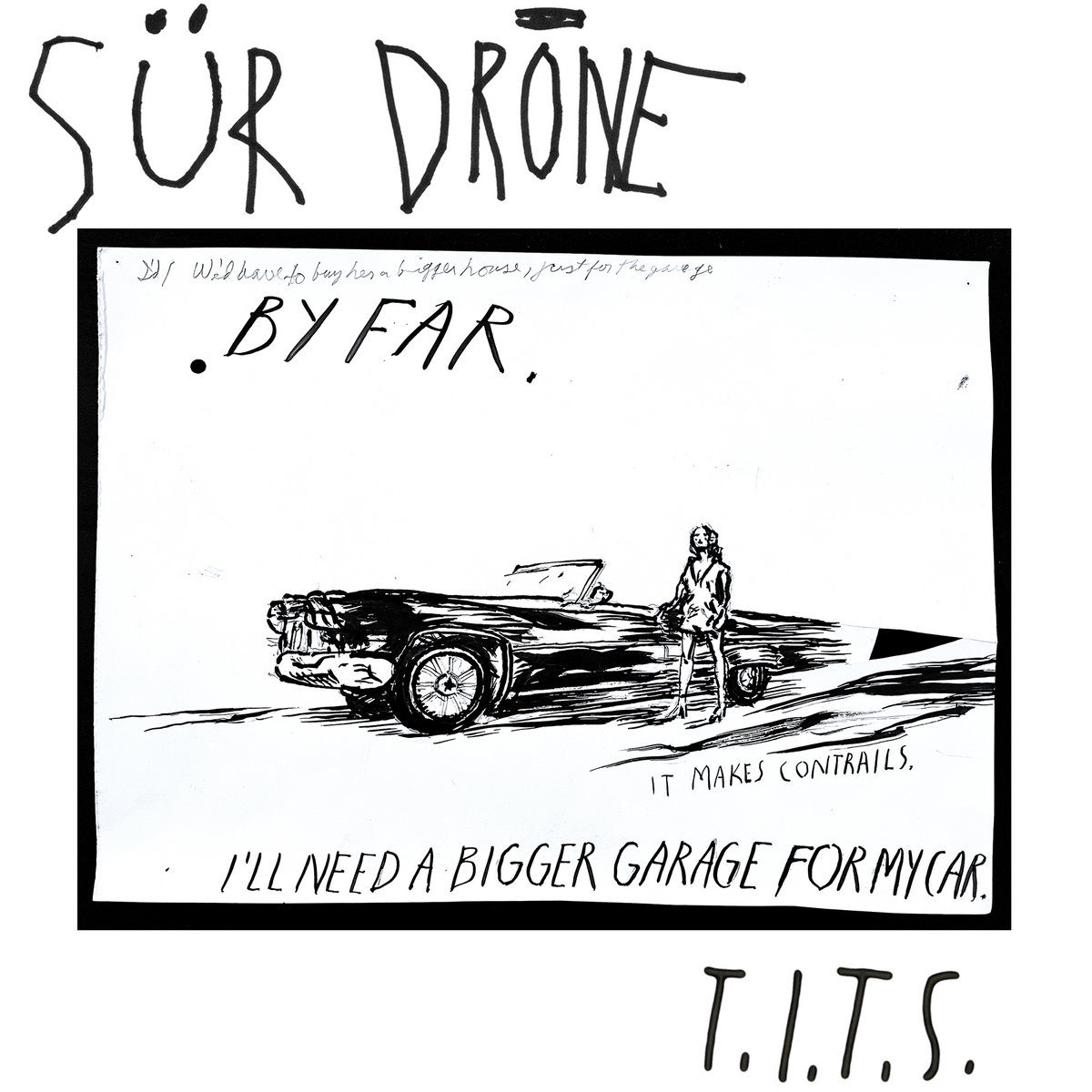
Sür Drōne’s debut full-length ‘T.I.T.S.’ arrives with the kind of cultural detritus that lesser artists mistake for provocation, yet Raymond Pettibon and Daniel Adams transform vulgarity into an unstable form of poetry. The record functions as a cracked mirror held up to American excess: sleazy, funny, diseased, sentimental, juvenile, and strangely erudite all at once. Pettibon’s decades-long fascination with the grotesque underside of California mythology collides with Adams’ instinct for cinematic arrangement and scorched-garage melodicism, producing an album that behaves like a lost transmission from a parallel Los Angeles where surf music, public-access television, beat poetry, and grindhouse cinema never stopped contaminating one another.
What distinguishes ‘T.I.T.S.’ from novelty or retro pastiche is the seriousness beneath its absurdity. Pettibon has spent much of his artistic life exploring the language of failed heroes, washed-up masculinity, and cultural self-destruction, and these songs carry that same sensibility. Adams, recording to 24-track analog tape, gives the material a physical warmth that keeps the record from slipping into irony. Every distorted guitar stab, every malformed vocal cadence, every sudden melodic detour sounds committed to tape with a conviction that digital sterility could never reproduce. The production possesses the oily glow of midnight boulevard neon reflected on wet pavement.
“Wacky Sensation” introduces the album with all the dignity of a bar fight spilling into a television studio. Adams’ guitar work ricochets between surf delirium and primitive punk propulsion while Pettibon half-sings, half-spews imagery that sounds scribbled onto diner napkins during a psychotic episode. The track establishes the album’s central method: cartoon depravity masking genuine social observation. Sür Drōne understand that comedy and disgust share the same nervous system.
“Booty Girl” pushes further into sleaze-rock parody while refusing to settle for parody alone. The rhythm section lurches with drunken swagger, but Adams threads the arrangement with unexpectedly elegant melodic turns, as though the ghosts of forgotten AM-radio hooks were trapped beneath layers of cigarette ash. Pettibon’s vocal performance is particularly effective here because he never performs like a traditional frontman. He sounds instead like a failed prophet ranting from a collapsing carnival ride.
“King Rat Pack” may be the album’s sharpest fusion of conceptual art and gutter-rock instinct. The song satirizes masculine coolness while simultaneously reveling in its seductive stupidity. Adams builds the track around snarling guitar phrases that evoke decayed Hollywood glamour, while the lyrics turn celebrity mythology into rodent infestation. Pettibon’s long-standing fascination with corrupted American iconography finds a perfect musical counterpart in Adams’ scorched arrangements. The brilliantly titled “Maroon Cocksucker Lipstick” condenses the album’s worldview into barely two minutes of deranged elegance. Unlike many contemporary experimental rock acts that mistake ugliness for depth, Sür Drōne understand pacing, structure, and release. The song detonates quickly and vanishes before its poison dissipates, functioning like an overheard obscenity that lingers in memory longer than polite conversation ever could.
“MOTA” introduces a narcotic haze into the record’s bloodstream. Adams layers woozy guitar textures beneath Pettibon’s deadpan vocal mutterings, creating a sensation akin to stumbling through sun-bleached alleyways after three consecutive sleepless nights. The humor remains intact, though it grows more corrosive here, less cartoonish and more existential. “Dragstripper” stands among the album’s strongest achievements because it reveals how deeply Adams understands motion in music. The song surges forward with chrome-plated velocity, recalling hot-rod culture viewed through a malfunctioning projector reel. Pettibon’s lyrics transform automotive fetishism into erotic apocalypse, and the result resembles early punk stripped of political slogans and rebuilt around psychic collapse.
“Sunset Plaza” acts as the album’s nearest approximation of melancholy, though even its sadness arrives smudged with nicotine and satire. Beneath the warped glamour lies a portrait of Los Angeles as both dream factory and spiritual landfill. Adams’ guitar lines shimmer with genuine beauty here, allowing the listener brief emotional access before the song corrodes its own sentimentality. The sprawling “Sagitariass’uh” represents the album at its most adventurous. Adams stretches the sonic palette into drone-inflected abstraction while Pettibon drifts through associative imagery that recalls beat literature rewritten by someone trapped inside late-night cable television. The track avoids indulgence because its instability feels intentional; every strange transition contributes to the sensation of cultural hallucination.
“Dream Team” arrives like a demented pep rally anthem for societal collapse. Its brevity works in its favor, presenting triumphalism as pure absurd theater. Pettibon’s writing consistently weaponizes stupidity without mocking the people trapped inside it. That distinction matters. Sür Drōne are not sneering from a distance; they are immersed in the same collapsing spectacle they document. “Space Mutha” channels science-fiction camp through blown-out garage psychedelia. Adams’ production choices are especially inspired here, balancing cosmic absurdism with primitive rock immediacy. The track resembles a transmission intercepted between underground comic books and public-access sci-fi reruns.
“Thumbtrucker” slows the pace just enough to reveal the album’s surprisingly sophisticated architecture. Beneath the vulgarity and chaos lies careful compositional intelligence. Adams understands how repetition can induce hypnosis, and the song rides its central motif into increasingly delirious territory. Pettibon responds with one of his strongest vocal performances, sounding both detached and emotionally cornered. Closing track “Charles In Charge” provides no redemption, no clarity, no false transcendence. Instead, Sür Drōne exit in a cloud of absurdity and damaged Americana. The song plays like the final scene of a forgotten exploitation film screened in an abandoned strip mall theater. What remains after the record ends is not shock but recognition: Pettibon and Adams have captured the psychic debris of contemporary American life with alarming precision.
The supporting personnel and engineering team deserve considerable praise for preserving the record’s unstable chemistry without sanding down its rough personality. Engineers Michael Melnick, Ruddy Cullers, and John Newkirk maintain the volatile balance between chaos and control, while Dave Cooley’s mastering preserves the analog density essential to the album’s atmosphere. The production never fetishizes vintage recording techniques for their own sake; the analog format becomes part of the album’s psychological texture, emphasizing decay, warmth, and imperfection.
What makes ‘T.I.T.S.’ compelling is not merely its willingness to offend or bewilder. Plenty of records accomplish that with little imagination. Sür Drōne succeed because the album recognizes vulgarity as a language through which cultural truths often emerge more honestly than through refinement. Pettibon and Adams approach trash aesthetics with intellectual rigor and genuine affection, allowing the ridiculous and the profound to coexist without hierarchy. Few albums in recent memory sound this committed to their own bizarre internal logic. ‘T.I.T.S.’ does not ask for acceptance, relevance, or critical approval. It exists like graffiti sprayed across the walls of American pop consciousness: obscene, hilarious, unsettling, and impossible to ignore.
For more information, please visit Frontier Records | Bandcamp