
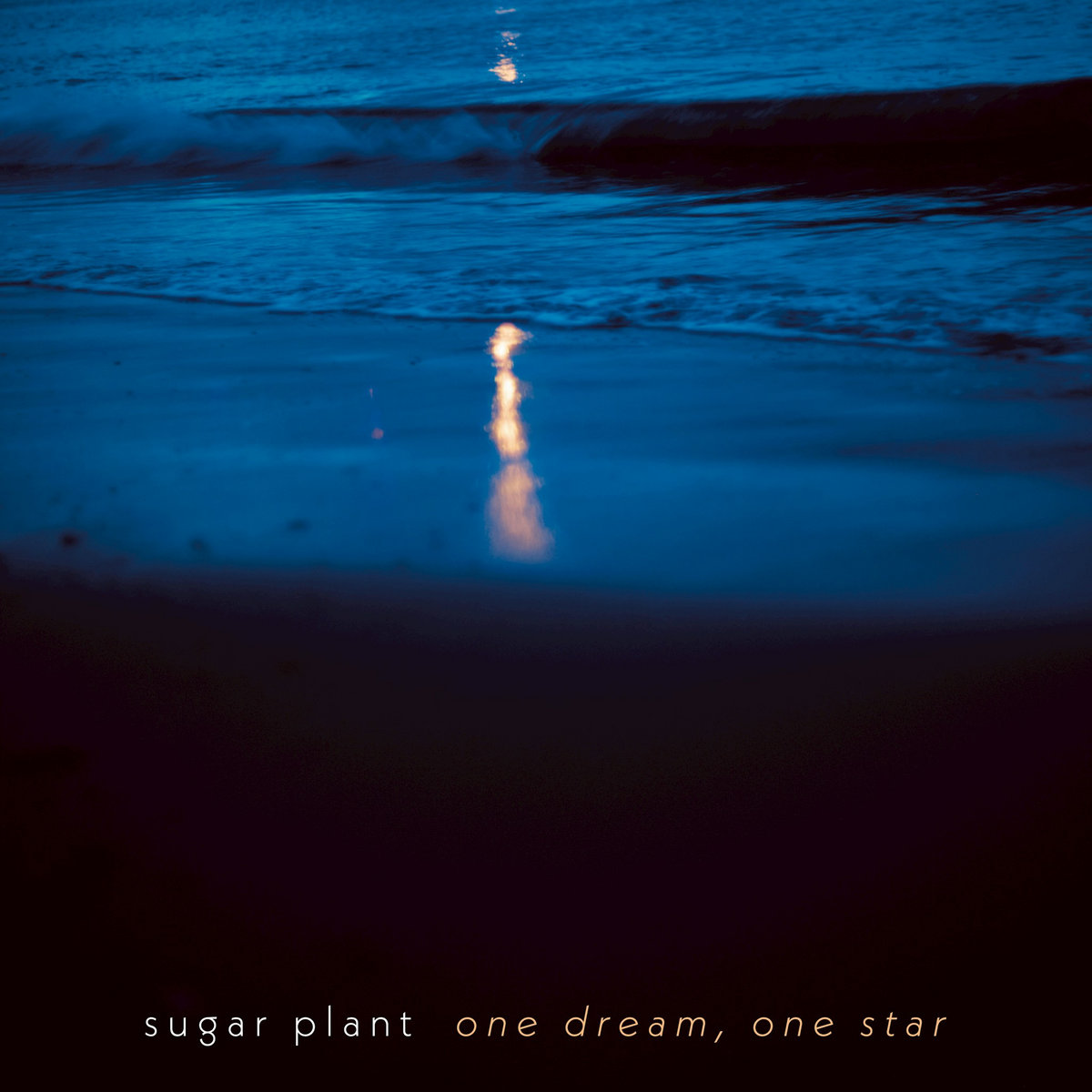
Sugar Plant’s ‘one dream, one star’ arrives not as a nostalgic gesture but as a lucid summation of a band that has spent three decades refining a language of understatement. Rather than announcing its significance, the album radiates a quiet authority, the sound of artists who have long since dispensed with the need to prove anything. Shin’ichi Ogawa and Chinatsu Shoyama move with unforced confidence, shaping an atmosphere that is intimate yet spacious, grounded yet faintly otherworldly.
The opening piece, “sunrise,” immediately establishes this equilibrium. Ogawa’s guitar lines drift with gentle precision, never hurried, while Shoyama’s voice enters as if already mid-thought, soft but assured. The presence of Yuji Sashizawa on drums is felt in the restraint; his playing does not propel so much as steady the current. Harunobu Aoki’s keys and Hiroshi Fujiqui’s synthesizers create a delicate lattice around the core, allowing the track to glow rather than build.
“calling” follows with a slightly more defined melodic contour, its refrain hovering just out of reach. The arrangement suggests a conversation between distance and proximity, with Shoyama’s bass anchoring the song even as the upper registers shimmer. There is a subtle sophistication in how the band avoids obvious climaxes, letting phrases resolve in unexpected places. With “anything,” the album deepens its emotional register. The interplay between Ogawa’s composition and Shoyama’s lyrical sensibility becomes especially striking here, aided by the inclusion of Japanese original lyrics penned by Ogawa himself. The track carries a sense of inward reflection without lapsing into introspection for its own sake. It is measured, deliberate, and quietly affecting.
“flow (Album Mix)” lives up to its title in the most literal sense, its structure guided by a seamless continuity that resists segmentation. Aoki’s keyboard textures are particularly vital, providing a soft-focus glow that merges with Fujiqui’s synthesizer work. The engineering by Soichiro Nakamura ensures that each element occupies its own space while contributing to a unified whole. The album’s midpoint, “sunlit rain,” offers a subtle shift in tone. There is a brightness here, though not an overt one; rather, it suggests illumination filtered through memory. Sashizawa’s drumming becomes slightly more pronounced, introducing a gentle pulse that complements the track’s understated momentum. “only to know you” pares things back further, almost to the point of fragility. Shoyama’s vocal delivery is at its most direct, carrying an emotional clarity that the instrumentation wisely leaves unadorned. Ogawa’s guitar lines feel conversational, responding rather than leading.
The expansive “blue submarine (Album Mix)” stands as one of the album’s most immersive moments. Its length allows the band to explore a more extended form without abandoning their core sensibility. Fujiqui’s synthesizers are particularly evocative here, creating a sense of depth that suggests movement beneath a calm surface. The track exemplifies the group’s ability to sustain attention through nuance rather than overt variation. Closer “travelling” functions less as a conclusion than as a continuation beyond the album’s boundaries. At over seven minutes, it encapsulates the record’s ethos: patient, unhurried, and quietly assured. The ensemble—Ogawa, Shoyama, Sashizawa, Aoki, and Fujiqui—operates with a cohesion that can only come from long familiarity, each musician contributing without overstatement.
Across ‘one dream, one star,’ the production by Ogawa, alongside Hyuga Kashiwai’s mixing and mastering, achieves a clarity that never sacrifices warmth. The album does not seek to reinvent Sugar Plant’s sound so much as to refine it to its essence. What emerges is a work that feels entirely present, neither bound by its influences nor detached from them. In marking thirty years since their debut, Sugar Plant have created something that resists easy categorization. It is neither retrospective nor overtly forward-looking, but instead occupies a space of quiet certainty. The album’s strength lies in its ability to articulate a fully realized aesthetic without excess, offering a listening experience that is both immediate and enduring.
Learn more by visiting Sugar Plant | KiliKiliVilla | Bandcamp.