
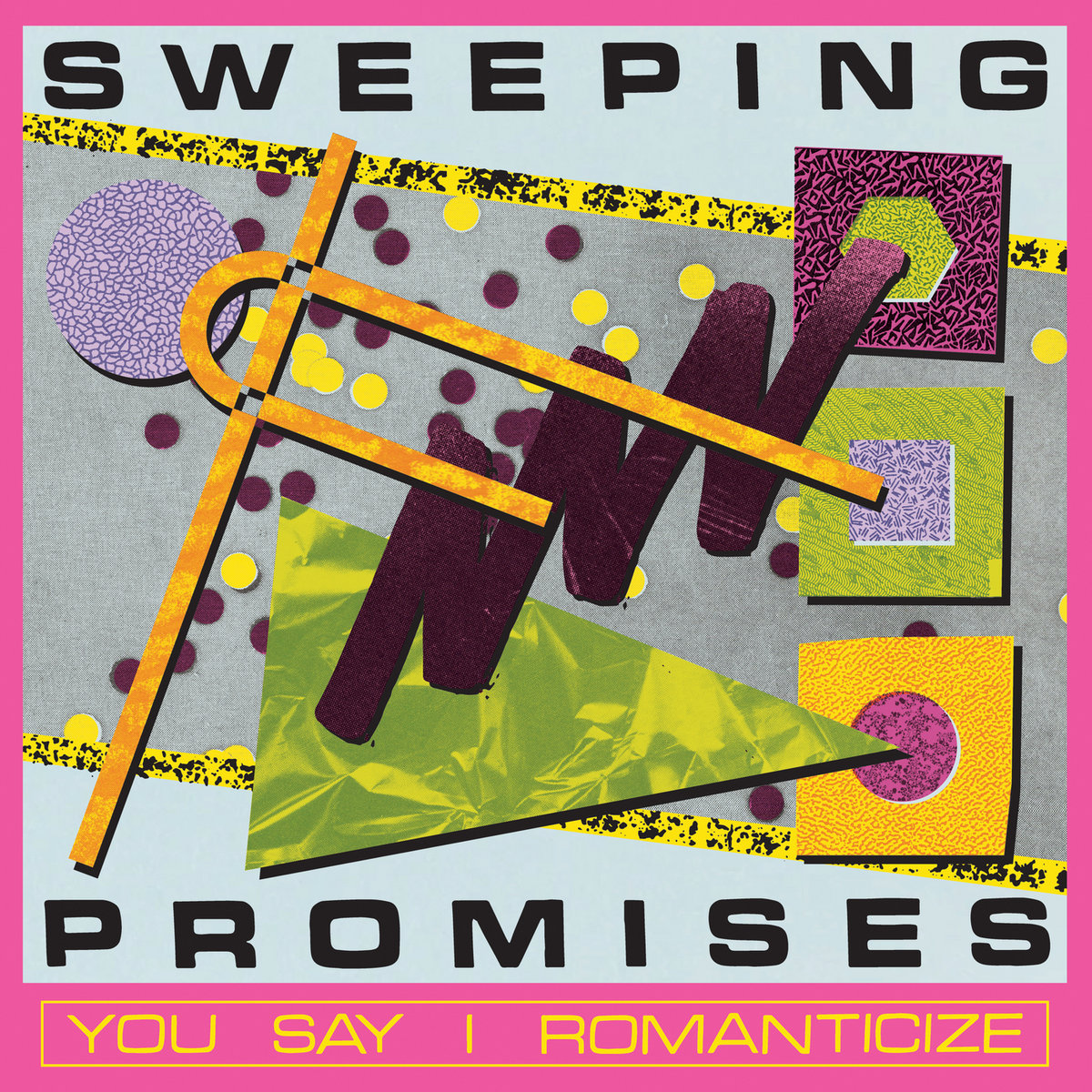
Few contemporary bands have managed to make art-punk feel as immediate and alive as Sweeping Promises. Since the startling arrival of ‘Hunger for a Way Out’ and the acclaimed expansion of their sound on ‘Good Living Is Coming for You’, the partnership between Lira Mondal and Caufield Schnug has consistently balanced intellectual curiosity with visceral momentum. Their songs have always contained ideas worth unpacking, but those ideas never arrive wrapped in academic distance. They come racing out of the speakers, propelled by urgency, melody, and a restless desire to interrogate the world. With ‘You Say I Romanticize’, the duo delivers their most conceptually ambitious and emotionally charged work yet, transforming stories of outsiders, obsessives, dreamers, and isolated creators into a thrilling examination of how identity survives under pressure.
Recorded over an extended eighteen-month period and brought fully to life with the addition of touring drummer Spenser Gralla, the album captures a band embracing instability rather than resisting it. The circumstances surrounding its creation seem embedded in the music itself. Every song sounds as though it is fighting for space amid noise, distraction, expectation, and uncertainty. Yet rather than appearing fragmented, the record derives much of its power from that very friction. This is music animated by creative struggle, by the belief that meaningful expression often emerges from imperfect conditions.
The opening track, “Shooting Shadows,” wastes no time announcing a shift in intensity. Mondal’s vocal performance is extraordinary, pushing beyond the sharp-edged delivery that has long defined Sweeping Promises into something more physically demanding. Her voice lunges, strains, and erupts across the arrangement, embodying the album’s fascination with people struggling against confinement. Schnug’s guitar work and production create a dense, immersive backdrop that mirrors the song’s themes of pursuit and elusive meaning. Shadows cannot be caught, yet the compulsion to chase them persists. “My Friend’s An Entomologist” introduces one of the album’s recurring concerns: the obsessive personality. The title initially suggests whimsy, but beneath its surface lies a study of fixation and categorization. The song examines the human desire to understand the world by dissecting it, collecting it, naming it. Sweeping Promises approaches this impulse with both affection and skepticism, recognizing its intellectual appeal while acknowledging its limitations.
“Last Man” stands among the album’s most fascinating achievements. Inspired by Mary Shelley’s visionary novel, the song transforms literary influence into something entirely contemporary. Musically nervous and emotionally volatile, it captures the psychological effects of isolation without reducing them to simple despair. The arrangement pulses with anxious energy, reflecting a mind attempting to remain intact as familiar structures collapse. In many ways, it serves as a microcosm of the album itself: intellectually rich, emotionally immediate, and relentlessly kinetic. One of the most impressive aspects of ‘You Say I Romanticize’ is its ability to balance historical and literary references with contemporary concerns. The characters that populate these songs may draw inspiration from distant eras, but their struggles feel intensely relevant. Sweeping Promises understands that alienation, longing, obsession, and creativity are not confined to specific periods. They are recurring features of human experience.
That understanding becomes especially vivid on “Rapture, Or…” The title’s unfinished quality suggests uncertainty regarding revelation itself. Is transcendence possible, or are people merely projecting meaning onto chaos? The song refuses to answer definitively. Instead, it inhabits the space between belief and doubt, constructing an atmosphere where certainty remains perpetually out of reach. “Abduction On Camera” shifts the focus toward spectacle and perception. Modern life increasingly transforms private experiences into public performances, and the song explores this phenomenon with characteristic intelligence. The idea of witnessing extraordinary events through mediated images rather than direct experience becomes a powerful metaphor for contemporary existence. Schnug’s production excels here, creating layers that seem simultaneously immediate and distant, mirroring the song’s thematic concerns.
“My Anchoress,” is one of the record’s most compelling compositions. Drawing inspiration from Julian of Norwich (medieval English Catholic anchoress), the song explores the paradox of self-imposed isolation. Historically, anchoresses withdrew from society to pursue spiritual insight, yet their influence often extended far beyond their physical confinement. Mondal inhabits this contradiction brilliantly. The performance captures both devotion and yearning, suggesting that withdrawal from the world may deepen one’s relationship with it rather than diminish it. The album’s emotional center arrives with “Cocoon.” Smoldering and intense, the song examines transformation not as a graceful process but as something painful and uncertain. Cocoons represent becoming, but they also represent enclosure, vulnerability, and waiting. Mondal’s voice reaches some of its most striking moments here, conveying both fragility and determination. It is one of the album’s most memorable tracks precisely because it embraces contradiction rather than resolving it.
“Accent” continues the record’s fascination with identity and perception. Language functions as both connection and barrier, revealing origins while inviting assumptions. The song explores how individuals are defined by characteristics they may not fully control, transforming a seemingly simple concept into a nuanced meditation on belonging and difference. The wonderfully titled “Does He Want To Be The Weatherman?” injects a dose of absurdist humor into the album without sacrificing thematic depth. Beneath its playful premise lies a consideration of authority, prediction, and the human desire to impose order upon uncertainty. Weather forecasting becomes an unexpectedly rich metaphor for modern life, where certainty is often projected long before it can be justified.
As the album approaches its conclusion, “Write Lightly” emerges as its defining statement. The song examines the compromises demanded by professionalism, questioning what is lost when self-expression becomes subordinate to expectation. For a band whose career has been built on independence, experimentation, and creative autonomy, the subject carries particular weight. The track serves as both personal reflection and broader cultural critique, asking whether authenticity can survive systems designed to standardize and commodify expression. Throughout ‘You Say I Romanticize’, the contributions of all three musicians prove essential. Mondal delivers the most dynamic vocal performances of her career, moving effortlessly between confrontation, vulnerability, exhilaration, and introspection. Schnug’s guitar work and production remain central to the band’s identity, constructing a distinctive sonic environment where density and clarity coexist. Gralla’s drumming injects a newfound physicality into the material, grounding the album’s conceptual ambitions in rhythmic force.
‘You Say I Romanticize’ refuses to treat romanticization as a weakness. The title suggests an accusation, yet the album responds by examining why people romanticize in the first place. Dreamers, writers, visionaries, eccentrics, and outsiders populate these songs because imagination remains one of humanity’s most powerful tools for resisting conformity. Sweeping Promises recognizes that romanticization can distort reality, but it can also preserve hope, curiosity, and individuality. ‘You Say I Romanticize’ is a record about people who exist slightly outside accepted norms and who continue creating meaning despite that position. Through ten brilliantly crafted songs, Sweeping Promises transforms marginal figures into central characters, celebrating obsession, creativity, and intellectual restlessness without losing sight of their complexities. The result is their most complete artistic statement to date: fierce, thoughtful, exhilarating, and deeply humane.
Releases August 14, 2026
For more information or to pre-order, please visit:
Sub Pop Records
Bandcamp
Link Tree