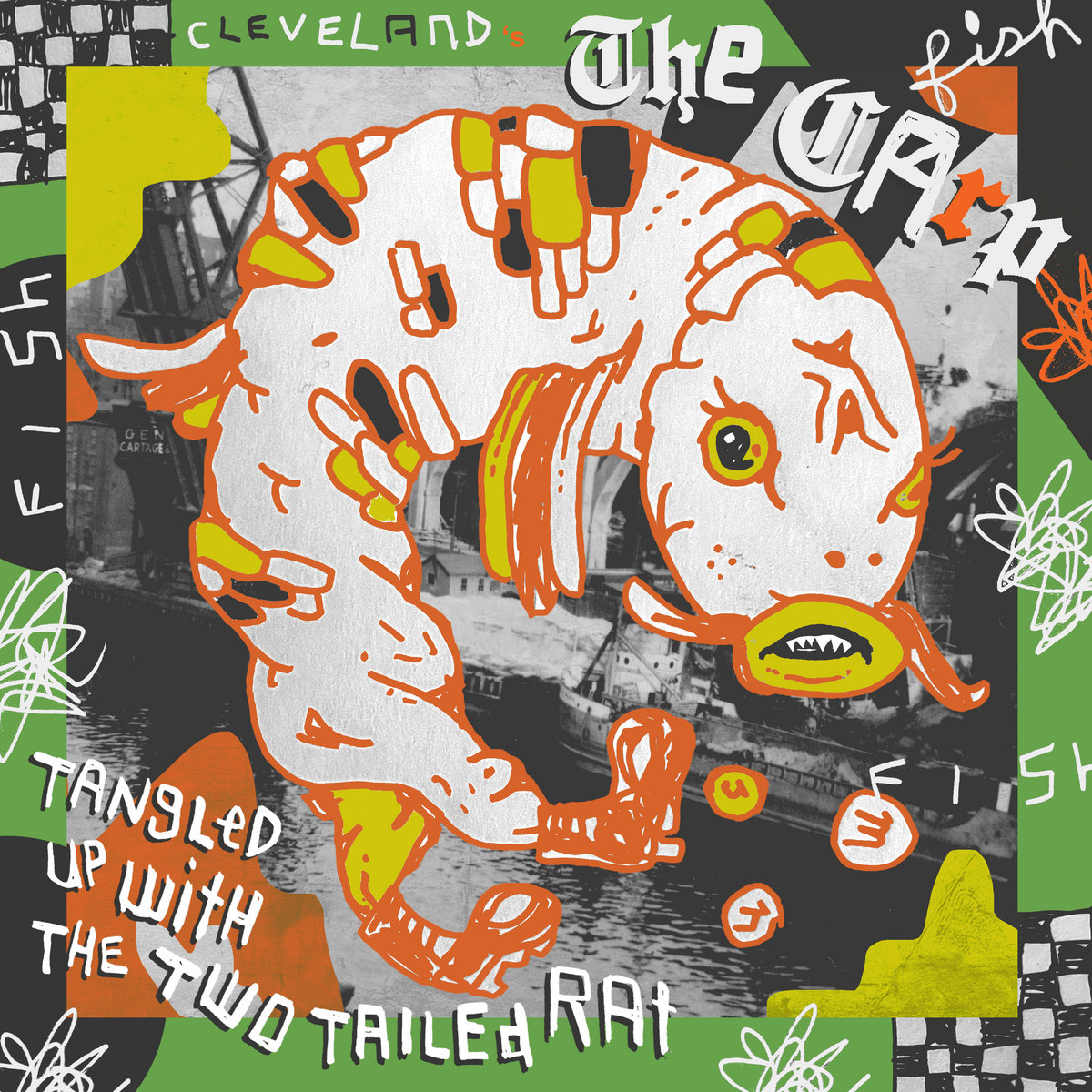
The Carp’s ‘Tangled Up With The Two Tailed Rat’ arrives with the kind of blunt-force clarity that punk has always reserved for moments when polite language has become useless. Across ten compact tracks, Cleveland’s Nathan Ward, Michael Gill, and Jo Coone turn street punk and Oi! into a vehicle for contemporary disgust, mixing gang-vocal immediacy, wiry guitar attack, hard-driving drums, and a dry, almost absurdist sense of humor. Ward handles guitar and vocals, Gill contributes vocals, and Coone drives the songs from behind the kit, a combination that gives the record the feeling of a small crew operating with a very large grievance.
The album’s great strength is that its politics never arrive detached from its music. These are not lectures disguised as punk songs. They are songs that understand anger as a communal activity: something to shout, laugh about, dance to, and carry into the street. “Fish Militia,” at barely a minute and forty seconds, establishes the premise with hilarious seriousness, transforming the increasingly bizarre landscape of data centers, surveillance technology, and disappearing farmland into the recruitment literature of an imaginary aquatic resistance movement. The joke works because the indignation beneath it is genuine. The fish imagery is ridiculous; the circumstances being mocked are not.
“I Crave The City” pushes the record toward a more recognizably working-class frustration. Its title sounds almost romantic until the implications settle in. The city is something to desire, inhabit, and belong to, yet contemporary urban life increasingly feels designed around people who already own it. The Carp understand that contradiction instinctively. Their songs are short because the problems they address do not require elaborate introductions. Housing costs, technological expansion, corporate power, and economic precarity have become so omnipresent that a punk song can simply point at them and yell.
Then comes “Fuck Alex Karp,” perhaps the record’s most obvious lightning rod and its funniest act of direct address. The song takes aim at Palantir’s billionaire CEO with precisely the lack of reverence that punk was invented to provide. What could have become a predictable political broadside instead becomes a gleefully memorable chant, converting an emblem of surveillance capitalism into the villain of a barroom singalong. There is intelligence in that reduction. Billionaires depend partly on abstraction: corporate structures, algorithms, investment portfolios, institutional language. The Carp drag the argument back down to the human scale, where one can simply point at the person at the top and say: no.
“Please Don’t Be Like That” and “Didn’t I Try So Hard” broaden the album’s emotional vocabulary. The former carries the bruised exasperation of interpersonal disappointment, while the latter suggests the weary self-questioning that accompanies political exhaustion. The Carp are not interested in presenting resistance as an immaculate moral posture. Their characters are irritated, compromised, confused, and occasionally ridiculous. That makes the record more convincing. The band knows that surviving a broken social order involves more than slogans; it also means negotiating disappointment, fatigue, resentment, and the nagging suspicion that individual effort may never be enough.
That suspicion becomes the central question of “Nothin’s Gonna Help Nothin,” the album’s longest track at just over four minutes. Its expanded length gives the band room to linger over an idea that the shorter songs fire past: what happens when ordinary people recognize the machinery around them but cannot find an obvious lever with which to move it? The answer is not resignation. The Carp’s response is closer to collective refusal. Even when the lyrics acknowledge futility, the performance itself contradicts it. A band making this much noise is already an argument against helplessness.
“Modern Man is so Ungrateful” sharpens the satire, taking the familiar language of technological progress and social convenience and turning it inside out. The modern world promises abundance while quietly making basic security harder to obtain. The Carp’s genius here lies in refusing the solemnity such a contradiction might invite. Their humor is not an escape from their politics; it is one of their political weapons. Ridicule punctures the grandiosity of institutions that expect ordinary people to accept every new intrusion as inevitable.
“Rapid Station” brings the record back to movement and place, its title conjuring transit, temporary refuge, and the anonymous spaces through which working people pass every day. “How Did You Get Knocked Down” turns that movement into something more personal, asking how people become battered by circumstances that often seem too large to fight. The question has no easy answer, which is precisely why the song works. Punk has always been particularly good at making complicated social realities emotionally legible without pretending they are simple.
The closing “Don’t Jump Off The Bridge” provides a striking final gesture. Against a backdrop of economic anxiety, political absurdity, and social alienation, the song offers something resembling direct human concern. Its title could sound bleak in isolation, but within the record it becomes unexpectedly compassionate. The Carp have spent the album mocking the powerful and cataloging the humiliations of contemporary life; here, the impulse is not merely to rage but to keep someone alive long enough to rage another day. That gives the album a moral dimension without turning it sentimental.
What makes ‘Tangled Up With The Two Tailed Rat’ memorable is the precision with which it balances outrage and amusement. Ward, Gill, and Coone understand that punk does not need to choose between political seriousness and sheer fun. Their music is confrontational without becoming ponderous, melodic without becoming tame, and funny without surrendering its convictions. The songs move quickly, but their ideas are larger than their running times suggest.
The Carp have made a record for a moment in which absurdity and dread are difficult to separate. Billionaires acquire enormous influence, technology burrows into everyday life, cities become prohibitively expensive, and the future arrives carrying both a sales pitch and a threat. Rather than respond with despair, The Carp form a ridiculous little army of fish, plug in their amplifiers, and start shouting. It is a wonderfully punk response: laugh at the bastards, name the problem, find your friends, and make enough noise that somebody else realizes they are not alone.
Releases August 14, 2026
For more information or to pre-order, please visit Total Punk Records | Bandcamp