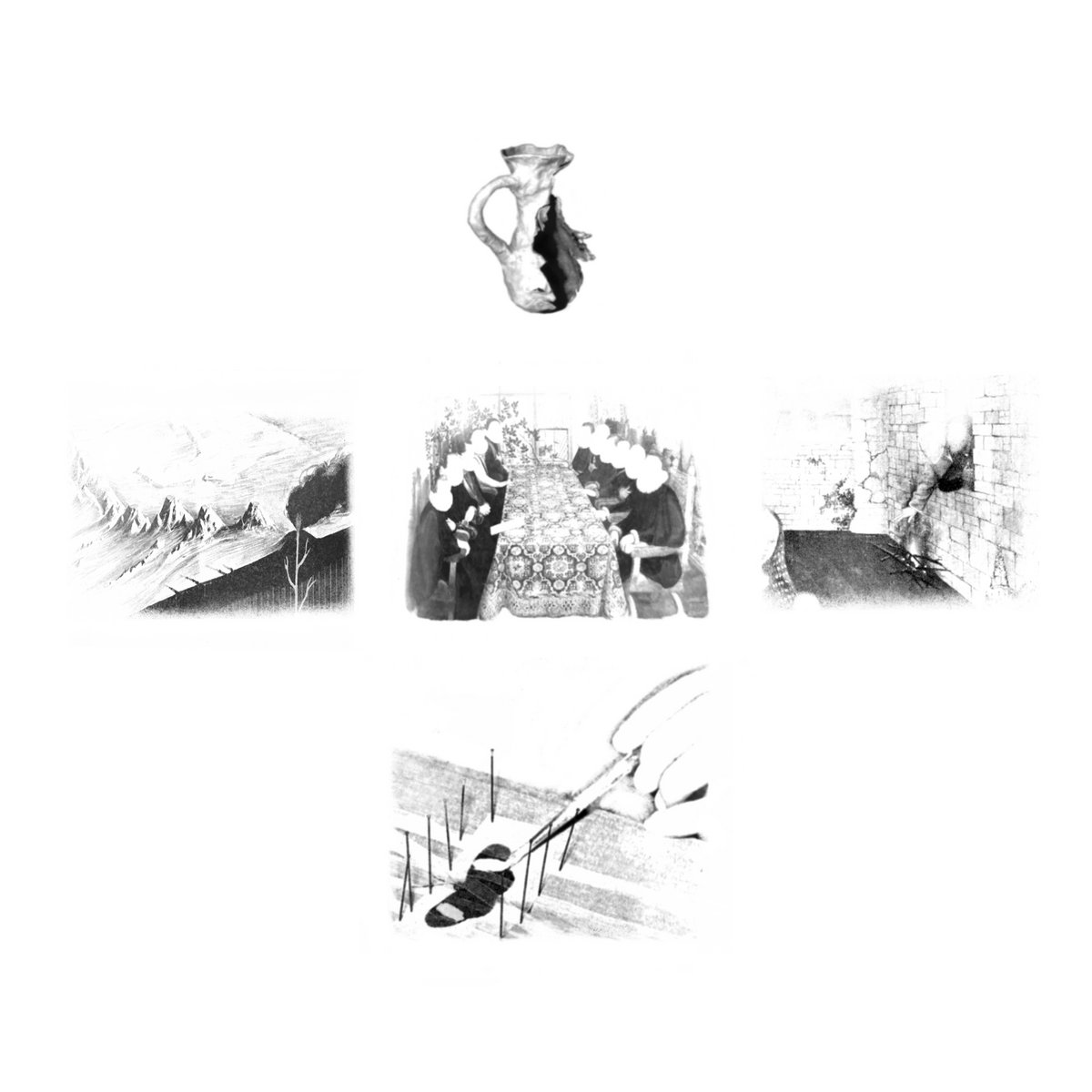
The Drin have made a record that seems to distrust the idea of arriving anywhere. ‘I Lost My Way For Centuries’ isn’t interested in neat beginnings, middles, and ends. The album handles memory like a box of waterlogged photographs. Some images show up repeatedly, some vanish, some return looking different, and a few run together with moments that might never have occurred. Across twenty-three tracks, the Cincinnati group packs that murk with saxophones, guitars, bouzouki, synths, drums, and voices, until the order of things can’t be trusted anymore.. You don’t solve this album. You step inside it.
The Drin pursue a similar transformation through sound. “The Sky Has Lost the Smile” establishes the album’s peculiar weather, conjuring a world that appears familiar but has somehow slipped a few degrees away from reality. The song’s title alone carries a mournful absurdity: the sky has not disappeared, but something essential in it has. “Haven’t Lived it Yet” sharpens the record’s fascination with uncertain time. The phrase suggests a future already remembered, a life experienced in anticipation or perhaps misremembered before it has even occurred. That kind of temporal confusion becomes one of the album’s most distinctive pleasures. The Drin are not simply telling stories; they are examining how we actually manufacture memories out of stories.
“Moths to the Light” and “The Port” deepen the sensation of movement without providing a conventional destination. The saxophone, one of the record’s most important voices, acts almost like a guide through these shifting environments. The reed instruments narrate in their own language, wandering through arrangements that can feel simultaneously earthy and cosmic. On “Prophets of Doom,” the band brings a sharper edge to its surrealism. The title plays into familiar apocalyptic tropes, but the album isn’t interested in forecasting a catastrophe. Instead, it holds up a mirror to our own obsession with the end of days. “Fatal Charade” and “Cannery Action” continue the record’s strange collision of menace and playfulness. The Drin possess a sense of humor that prevents the album’s darker ideas from becoming self-important. A title can sound ominous, ridiculous or both, and the music leaves room for that ambiguity. This is important because beneath the strange surfaces of ‘I Lost My Way For Centuries’ is a band making very deliberate decisions about rhythm, timbre and repetition.
“Come and See V3” feels appropriately cinematic, as though the listener has walked into a film already in progress. The suffix in the title reinforces the album’s recurring sense of iteration: this may be a version of something that has already existed, or simply another branch of a story with no definitive original. “…And They All Strummed” pushes the idea into something almost comic, reducing the grandeur of musical myth to the humble act of everyone picking up a guitar. Yet that modest gesture is precisely what makes the song feel human. The middle stretch, from “Bozo Theatre” through “Body Double” and “That Kind of Water,” is particularly effective at creating a world in which identity is unstable. A body double implies substitution; water reflects without necessarily telling the truth; theater suggests performance. A reoccurring question persistent throughout the album asks where the authentic self exists when memory, role-playing and perception are constantly interfering with one another.
“Ward Them Off (Apotropaics)” introduces a more explicitly ritualistic dimension. Apotropaic objects and gestures exist to turn evil away, and the title suits an album so absorbed in phenomenon it can’t quite explain. The music keeps reaching toward meaning without promising that any will show itself, and that uncertainty is where the record gets much of its psychological pull. “Take This and Don’t Forget” sounds almost like an instruction passed between generations, while “Switched On Solar Lightning” jolts the record into something more electrically charged. That mix is typical of The Drin. They’ll move from something like the bouzouki, which sounds centuries old, to synths and aerophone without a hint of culture clash, as if every instrument already belonged in the same room. Everything belongs to the same strange continuum and carries equal weight.
“Under Magnolia” is one of the album’s more evocative moments, grounding its surrealism in a specific natural image. “Forfeit My Will” then turns inward, its title suggesting surrender to forces that have been accumulating throughout the record. By the time “Lost My Way For Centuries” arrives, the album’s title no longer sounds exaggerated. It sounds almost literal. The listener has spent so long moving through fragments of time that centuries have become less a measurement than a state of mind. “I’m Not the Door” is a particularly intriguing statement because doors are traditionally symbols of access, transition and possibility. Refusing to be the door is to reject the responsibility of serving as an entrance into somebody else’s understanding. “The Cell” takes that refusal in a darker direction, suggesting enclosure and isolation. Yet The Drin do not make confinement entirely bleak. Their arrangements remain active, crowded with sonic details and strange pathways.
“Sweet Sweet Sickly Music” may be the album’s most self-conscious title, acknowledging both the seduction and danger of music itself. Sound can comfort, intoxicate, distort and manipulate. The Drin seem fully aware of that power. “Spent” follows with a feeling of depletion, as though the long excavation of memory has finally taken its toll. The closing “It Will Call Me in Some Time” leaves the record exactly where it belongs: somewhere between departure and return. Whatever has been lost has not necessarily disappeared. It may come back in another form, through another memory, another song, another iteration. The musicians behind this sprawling construction are The range of instruments—bouzouki, 12-string acoustic, tenor and alto saxophone, aerophone, bass, electric guitars, drums, synthesizers, tambourine, harmonica and shakers—gives the album an unusually broad vocabulary without making it feel cluttered. Everything seems to belong to the same weather system.
‘I Lost My Way For Centuries’ is a remarkably ambitious record because its ambition is not primarily about scale. It is about uncertainty. The Drin (Eric Dietrich, Dylan McCartney, Dakota Carlyle, Ryan Sennett, Luke Cornett and Cole Gilfilen, with Jamie Morrison adding bass and vocals to “Cannery Action” and Rosie Bentley contributing vocals to “That Kind of Water”), understands we have to accept that memory rarely keeps a perfect record of the past, and identity refuses to stay put. “The Sky Has Lost the Smile” opens a door that “I’m Not the Door” later refuses to become. “Lost My Way For Centuries” gives a name to the disorientation, while “It Will Call Me in Some Time” leaves open the possibility of return. Between those points, The Drin creates a musical world where the past leaks into the future and every road seems capable of bending back toward its own origin.
Learn more links: The Drin | Feel It Records | YouTube | Bandcamp | Instagram