
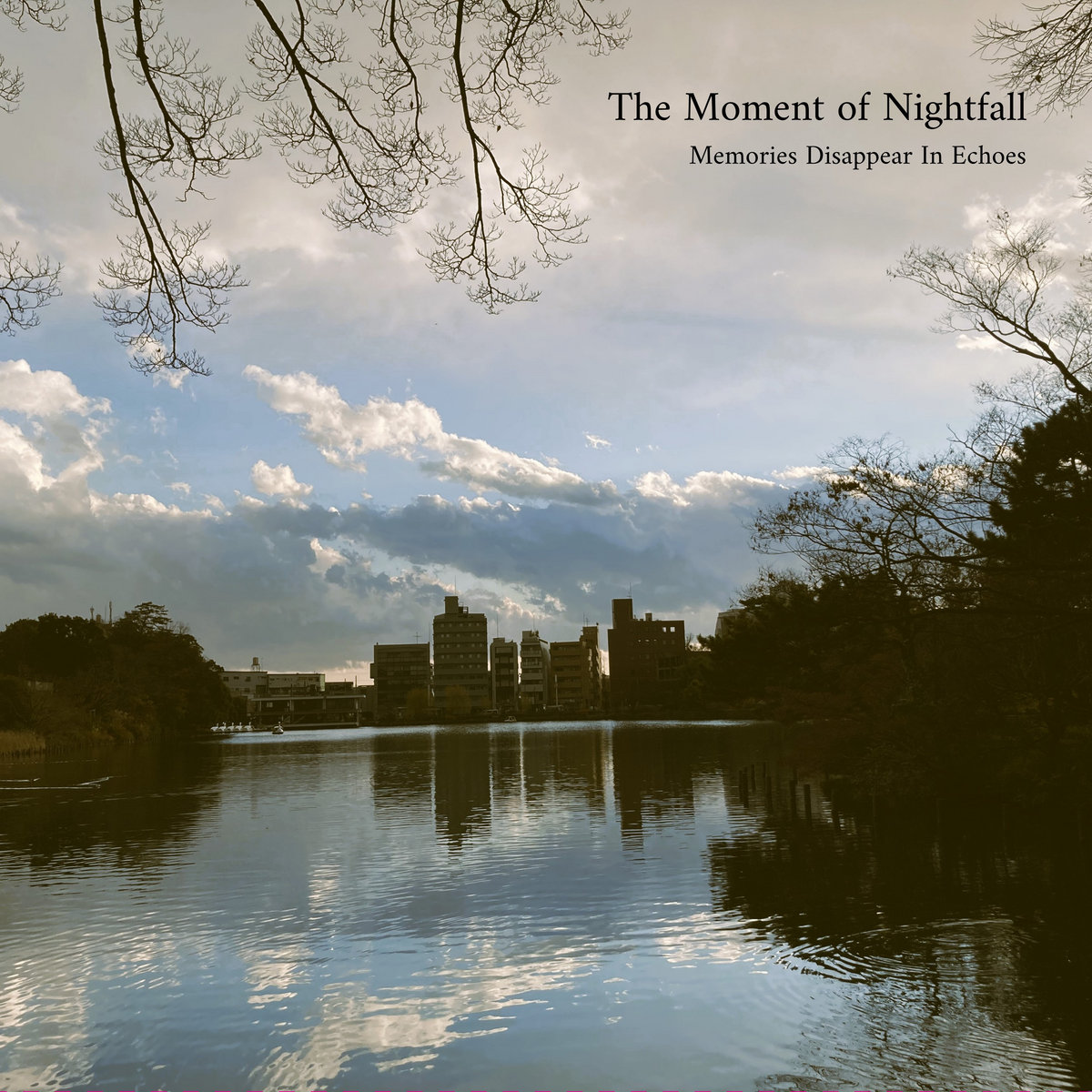
Memory is rarely as orderly as we imagine it. It arrives in fragments, attached to smells, weather, voices, places we can no longer quite locate. The Moment of Nightfall understands this instinctively on ‘Memories Disappear In Echoes’, an album that treats recollection not as something preserved intact but as something continually altered by distance. Across seven songs, the Japanese ensemble creates music of misty beauty and quiet disorientation, drawing dream pop, ambient music, chillwave, psychedelic folk and garage psychedelia into a private sonic language that seems to exist somewhere outside ordinary chronology.
The band’s personnel alone suggests a fascinating network of underground musical histories. Masato Saito of Pervenche contributes guitar, vocals and programming; Yoko Satori of Penny Arcade adds vocals; Yuji Usui of Red Go-Cart supplies bass and synthesizer; Miki Hirose of Ko-kyū, Smokebees and Red Go-Cart plays guitar and keyboard; and Tomomi Usui provides vocals, grocken and pianica. Their collective sound is delicate without becoming insubstantial. Instruments seem to emerge from shadows rather than announce themselves, while the vocals often appear suspended within the arrangements, giving the songs an elusive quality that makes their emotional content feel discovered rather than declared.
“December Wind (complete version)” establishes this atmosphere beautifully. Tomomi Usui’s lyrics and the band’s subdued instrumentation evoke a landscape in which winter is as much psychological as meteorological. Saito’s guitar and programming create a soft electronic haze, while the vocal presence retains a human vulnerability that prevents the song from drifting entirely into abstraction. The idea of a complete version is almost amusing given the album’s fascination with fragments and disappearance, yet the song itself feels intentionally unfinished in the best sense: open to memory, weather and interpretation. “Over The Rain” shifts the perspective without dispelling the album’s muted melancholy. With lyrics by Yuji Usui, the song carries a sense of looking beyond an obstruction that may be temporary or permanent. Yuji’s bass and synthesizer work provide a gentle foundation beneath the guitars and voices, and the arrangement has the strange sensation of moving forward while remaining suspended in place. This is one of the album’s most appealing paradoxes. The music does not demand attention through dramatic gestures; it draws the listener closer through suggestion.
The seven-and-a-half-minute “Everyday Rehome (extended version)” is where the record’s psychedelic dimension becomes especially pronounced. Miki Hirose’s guitar gives the piece a hypnotic, krautrock-inflected quality, turning repetition into a form of altered perception. The extended duration allows the music to behave less like a conventional song and more like a changing environment. Layers accumulate gradually, creating the impression that the band is not simply performing a composition but wandering through it. The title itself suggests the daily business of finding somewhere to belong, and the music makes that process sound simultaneously comforting and strange.
“Maybe Gone” carries a more immediate sense of absence. Its title could refer to a person, a feeling, a period of life or even a version of oneself that has slipped beyond retrieval. The Moment of Nightfall wisely refuses to specify. Instead, Saito, Satori and the rest of the ensemble allow ambiguity to become part of the song’s emotional architecture. The vocals have an almost spectral softness, while the instrumentation remains warm enough to keep the piece from collapsing into despair. “Twinkle” introduces a subtle change in emotional temperature. Its title suggests light, but this is not an uncomplicated brightness. The album’s aesthetic is too steeped in uncertainty for anything to shine without qualification. The song feels like a small illumination glimpsed through darkness, a reminder that tenderness can survive even within an atmosphere of doubt. Tomomi and Yoko’s vocal contributions are especially important here, their contrasting presences giving the music a sense of intimacy without turning it into conventional duet territory.
Then comes “Taking Tiger Mountain,” the album’s most conspicuous connection to another musical lineage. The Moment of Nightfall’s version of Brian Eno’s composition makes sense within Saito’s artistic history, since the song has long been part of his solo repertoire. Rather than treating the cover as an exercise in reverence, the band absorbs it into their own dreamlike vocabulary. Its presence also clarifies one of the album’s larger ambitions: to make old music feel newly strange. The Moment of Nightfall does not attempt to recreate the past so much as allow it to pass through the group’s present-day sensibility. “Blue Moon” closes the album with an appropriately elusive final gesture. The title invokes one of pop music’s oldest symbols of longing and unreality, but here it feels less like a grand romantic image than a distant object glimpsed briefly in a changing sky. The band’s first use of drum programming on this release becomes part of the record’s broader blending of organic and electronic sound. Saito’s programming does not dominate the arrangement; instead, it quietly alters the pulse beneath the guitars, keyboards and voices, reinforcing the sensation that these songs inhabit a place between remembered performance and reconstructed memory.
The album’s production history mirrors its themes. Saito initially recorded a rough song sketch on an MTR in November 2024 and shared it with the group, after which Yuji Usui began layering arrangement ideas onto it. That collaborative process matters because ‘Memories Disappear In Echoes’ sounds genuinely assembled from individual perceptions rather than imposed from a single commanding viewpoint. Recorded by Yuji Usui, Miki Hirose, Yoko Satori and Masato Saito, then mixed and mastered by Saito, the album retains the intimacy of its origins even as its sonic palette expands.
What lingers most strongly is the record’s refusal to separate nostalgia from invention. The Moment of Nightfall clearly understands the allure of music associated with other decades, but ‘Memories Disappear In Echoes’ is not a museum piece. Its hazy guitars, understated electronics, psychedelic repetitions and fragile vocals transform references to the past into something personal and contemporary. This is music for the uncertain territory between remembering and imagining. The songs seem to ask whether a memory remains meaningful once its details have dissolved, and whether music might be one of the few places where disappearance can become another form of presence. ‘Memories Disappear In Echoes’ offers no easy answer. Instead, it leaves behind seven carefully blurred impressions, each one fading at the edges while becoming more vivid in the mind. In that contradiction lies the album’s quiet power.
Learn more links: