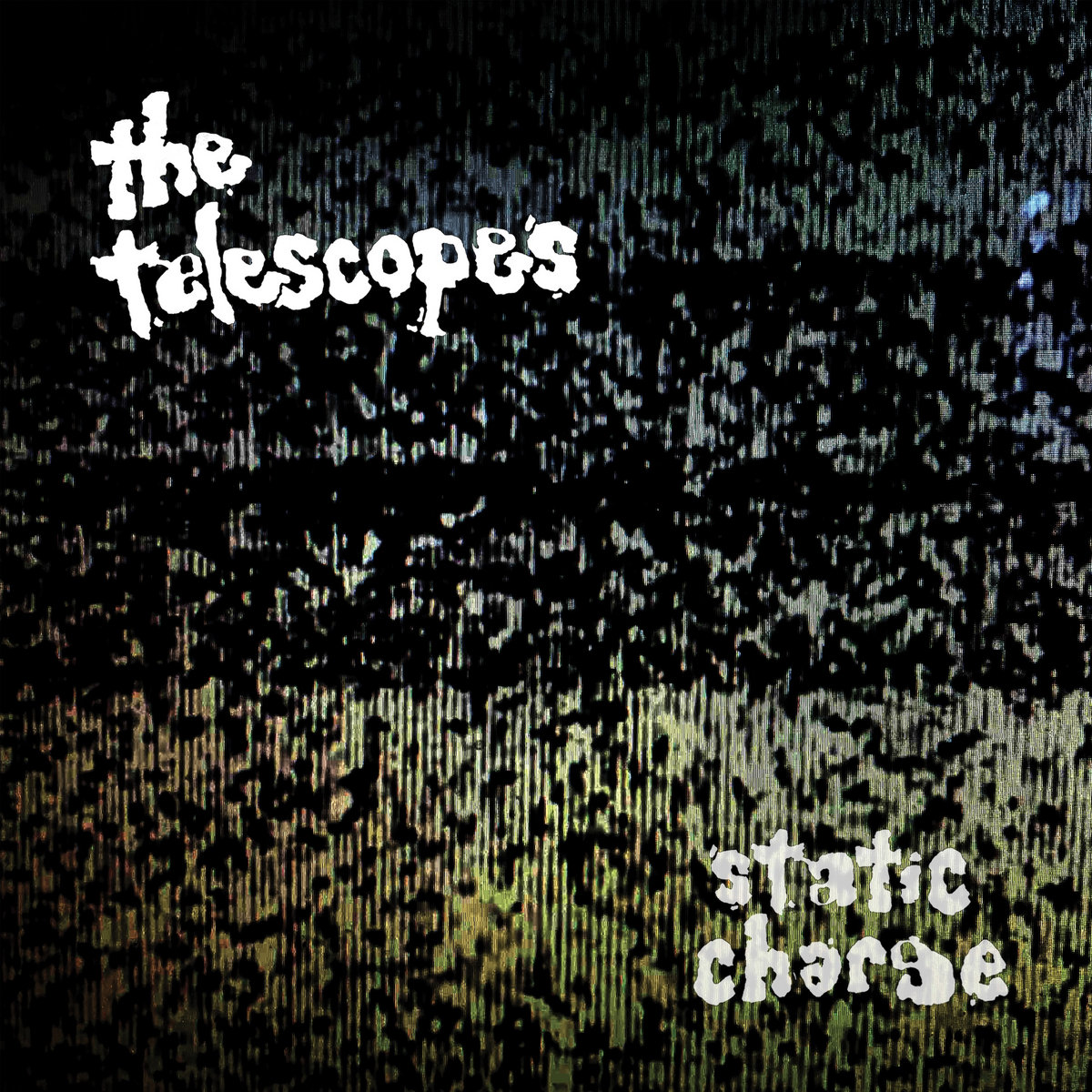
Few bands have treated noise as a philosophical condition as consistently as The Telescopes. Across nearly four decades, Stephen Lawrie has pursued distortion not simply as sonic aggression but as a means of altering perception itself, searching for moments where melody dissolves into pure sensation and then somehow reforms again. What makes ’Static Charge’ so compelling within that long trajectory is its sense of reduction. Rather than expanding outward into increasingly elaborate psychedelia, the album strips the music back to primal components: repetition, volume, pulse, atmosphere. The result is one of the most focused and emotionally absorbing records in The Telescopes’ vast catalog.
Recorded largely live with Darrell Carter, Robert Prest, and John Lynch, the album captures a group operating less like a conventional rock band than a single mutating organism. Lawrie’s description of the record as “stone age” music proves unexpectedly accurate. The rhythms move with blunt physicality, relying on hypnotic insistence rather than technical flourish. Lynch’s drumming avoids virtuosity entirely, favoring massive, repetitive patterns that anchor the music in something bodily and instinctive. Prest’s bass playing becomes the gravitational center of the album, holding together compositions that frequently threaten to drift into abstraction. Above this foundation, Lawrie and Prest layer guitars that shimmer, corrode, and spiral outward in waves of ecstatic disorientation.
“White Noise” establishes the album’s central paradox immediately. Noise here is not used to obscure meaning but to reveal hidden emotional states inaccessible through clarity alone. The song emerges from a dense fog of feedback and repetition, yet beneath the distortion lies remarkable compositional discipline. Lawrie’s vocal delivery barely separates itself from the surrounding sound, as though the voice itself has become another unstable frequency. The piece channels the narcotic repetition of vintage space rock while retaining the psychological abrasion that has always distinguished The Telescopes from more decorative psychedelic acts.
“28 Grams” deepens the record’s fixation on physicality and excess. The title carries obvious implications of weight, addiction, and consumption, and the music responds with suffocating density. Rob’s bass dominates the mix with almost tectonic force while the guitars oscillate between drone and collapse. The arrangement feels simultaneously loose and immovable, a quality The Telescopes have refined over decades. Many bands mistake loudness for intensity; Lawrie understands that true intensity comes from endurance. The song does not explode. It persists.
“Revolutionary Blues” functions as the album’s ideological centerpiece. The title suggests political exhaustion refracted through psychedelic decay, and the track captures precisely that sensation. Rather than delivering overt protest music, The Telescopes create the sound of revolutionary consciousness trapped inside contemporary paralysis. The motorik pulse recalls German experimental rock traditions, yet the atmosphere remains deeply British in its weary skepticism. Lawrie’s guitar work becomes especially effective here, allowing sheets of distortion to rise and recede like emotional weather fronts.
“Come Around” introduces one of the album’s most melodic moments, though melody in The Telescopes’ universe always arrives partially damaged. The song circles obsessively around its central riff, creating a hypnotic effect that borders on devotional. Prest’s guitar textures flicker at the edges of the composition like unstable light sources, while Lynch’s drumming maintains relentless forward movement. The track captures one of the album’s recurring themes: repetition as transformation rather than stagnation.
“Still Nothing” may be the emotional core of the record. Few contemporary bands understand emptiness as profoundly as The Telescopes, and the song transforms negation into atmosphere. Lawrie’s vocals sound distant even within the mix’s intimacy, communicating emotional fatigue without theatrical despair. The arrangement is remarkably sparse by the band’s standards, allowing silence and resonance to carry unusual weight. Rather than chasing catharsis, the track lingers inside emotional suspension.
“I Dream Of Fever” pushes further into hallucination. The song’s swirling guitars and narcotic pacing evoke altered states without romanticizing them. Fever here becomes less a metaphor than a perceptual condition. The music seems to warp time itself, stretching moments into elongated psychological spaces. Carter and Lynch deserve enormous credit for the track’s effectiveness; their rhythm section remains patient and unwavering while the guitars drift toward near-total dissolution above them.
Closing track “Desolation” arrives not as climax but aftermath. The composition strips away much of the album’s earlier propulsion, leaving behind scorched ambience and slow-moving melodic fragments. Lawrie has always excelled at endings that refuse resolution, and “Desolation” may be one of his strongest. The song captures the peculiar beauty of emotional exhaustion, where collapse produces unexpected clarity. As the drones continue lingering long after the structure itself has faded, the track transforms into pure atmosphere. Not emptiness, but residue.
What makes ’Static Charge’ especially remarkable this deep into The Telescopes’ career is how little interest it shows in legacy maintenance. Many long-running experimental bands gradually soften into self-curation, polishing familiar aesthetics for loyal audiences. Lawrie continues resisting comfort. The album sounds raw not because it lacks sophistication, but because sophistication has been deliberately stripped away in pursuit of immediacy. The live recording approach preserves instability, allowing tiny imperfections and spontaneous interactions to shape the emotional character of the music. The record also demonstrates how deeply The Telescopes influenced multiple strands of underground music without ever fully belonging to any of them. Elements of shoegaze, drone rock, space rock, noise, and psychedelia all appear throughout ’Static Charge’, yet none adequately define it. Lawrie’s long-standing refusal to settle inside genre boundaries gives the album unusual freedom. The music operates according to instinct rather than scene expectations.
At its strongest moments, ’Static Charge’ suggests that noise can still function as revelation rather than mere aesthetic decoration. The distortion, repetition, and overwhelming volume are not barriers separating listener from emotion; they are the emotional content itself. Lawrie, Carter, Prest, and Lynch create music that destabilizes ordinary perception while remaining profoundly human underneath the amplifier roar. Nearly forty years after The Telescopes first emerged, Stephen Lawrie continues to pursue transcendence through disintegration. ’Static Charge’ captures that pursuit in its purest recent form: hypnotic, bruised, obsessive, and strangely beautiful in its refusal to resolve into certainty.
Releases July 26, 2026
For more information or to pre-order, please visit:
Tapete Records
The Telescopes
Bandcamp
Instagram
Facebook
Twitter