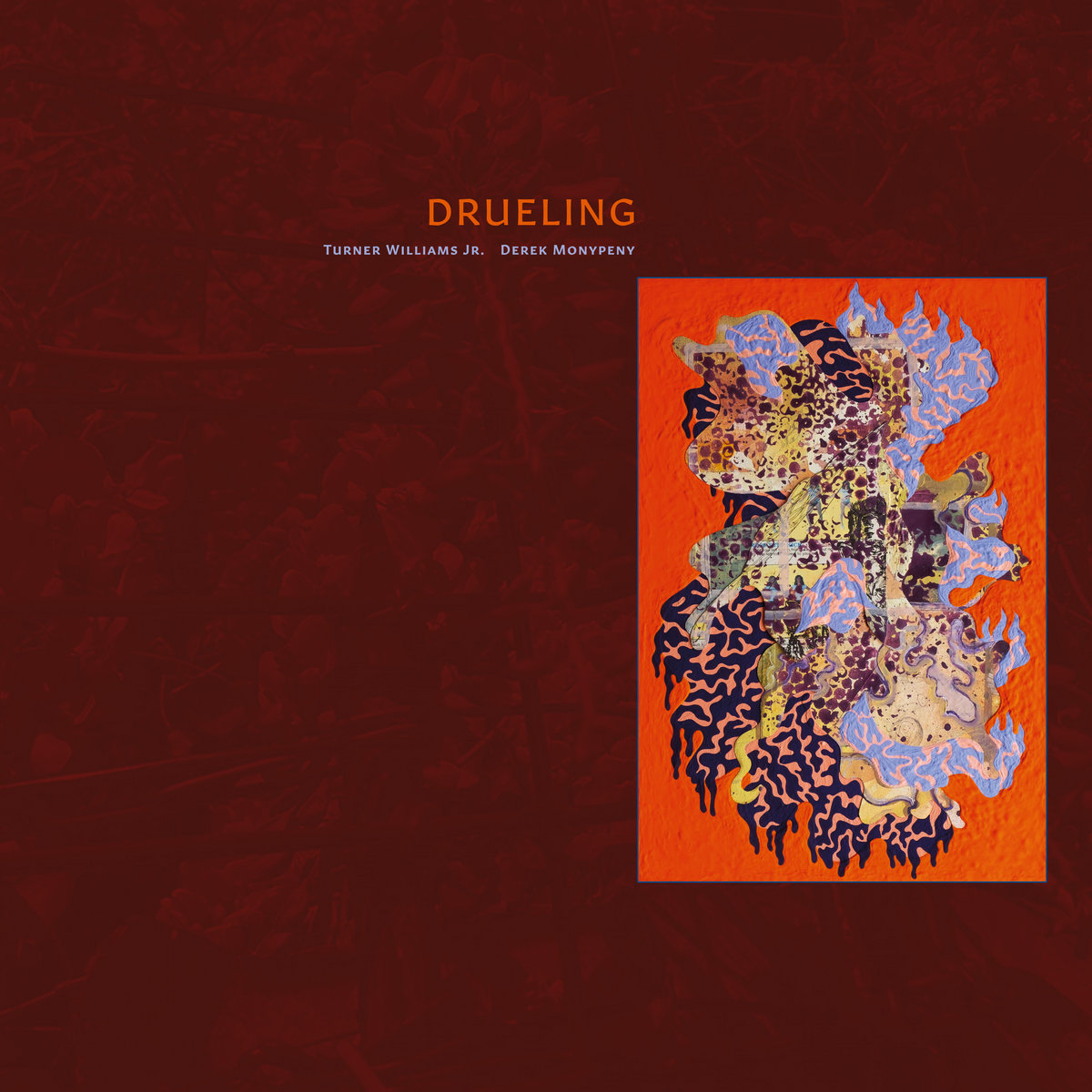
‘Drueling’ by Turner Williams Jr. and Derek Monypeny occupies a singular space within contemporary improvised music, not least because of its instrumentation. The shahi baaja, already an instrument of expanded resonance and tonal ambiguity, becomes here the sole vehicle for expression, multiplied and refracted through two distinct sensibilities. What emerges is less a duet in the traditional sense than a constantly shifting mirage, where identity, authorship, and sonic function blur into a shared field of inquiry.
“Free Deliverance” establishes the album’s core dynamic with striking immediacy. The paired shahi baajas generate a dense lattice of vibrating tones, their sustained pitches interacting in ways that produce phantom overtones and elusive harmonics. Williams approaches the instrument with an exploratory insistence, pushing its electronic extensions into territories that feel almost volatile, while Monypeny counterbalances with a more measured yet no less probing sensibility. The interplay suggests a negotiation of space, each musician carving out a presence without ever fully separating from the other.
“Calanque I” introduces a more restrained approach, though restraint here does not imply simplicity. The piece narrows its focus to subtle gradations in timbre and amplitude, allowing the listener to perceive the fine details of touch and modulation. The coastal geography implied by the title finds an analogue in the music’s ebb and flow, its gradual shifts suggesting erosion rather than abrupt change. Williams and Monypeny operate with acute sensitivity, each adjustment in tone registering as a meaningful gesture.
With “Space Prophet Dogon,” the album expands outward into a more expansive, almost ceremonial register. The sustained drones acquire a gravitational pull, drawing in fragments of melody that appear and dissipate without warning. The two players seem to engage in a form of parallel invocation, their lines neither fully converging nor diverging, but existing in a state of charged proximity. The result is a sonic environment that feels both immense and intricately detailed, a balance that defines much of the record.
“Pylône Song” channels the physical context of its creation more directly. The presence of transmission towers, their implied electrical hum, seems to resonate within the fabric of the music. Williams leans into sharper, more articulated figures, while Monypeny responds with elongated tones that stretch across the sonic spectrum. The contrast generates a sense of verticality, as though the music were tracing lines between ground and sky, between material presence and unseen currents.
“Calanque II” revisits the terrain of its earlier counterpart but with a subtly altered perspective. The familiarity of certain gestures is offset by a deeper exploration of their implications. Where “Calanque I” suggested observation, this second iteration feels more immersive, the duo allowing themselves to dwell within the sound rather than merely shape it. The distinctions between foreground and background become increasingly porous, reinforcing the album’s overarching concern with continuity and transformation.
“Radio Gazelle” concludes the record with a piece that synthesizes its various approaches into a cohesive yet open-ended statement. Rhythmic pulses emerge more distinctly here, though they remain embedded within the broader field of sustained tones. Williams and Monypeny engage in a dialogue that feels at once playful and deliberate, their exchanges hinting at structures that never fully solidify. The title’s evocation of transmission and movement is reflected in the music’s restless energy, its refusal to settle into a fixed form.
What distinguishes ‘Drueling’ is not merely its use of an unconventional instrument but the depth of exploration it achieves within those constraints. Williams and Monypeny treat the shahi baaja not as a novelty but as a complex system capable of generating a vast range of sonic possibilities. Their use of effects further expands this palette, creating layers that challenge the listener’s perception of source and origin.
Recorded live over the course of a single day in Marseille, the album retains the immediacy of its circumstances while revealing a level of cohesion that suggests a deeper, perhaps intuitive alignment between the two musicians. Their prior correspondence seems to have established a foundation that allows for both freedom and focus, enabling them to navigate the uncertainties of improvisation with confidence.
‘Drueling’ ultimately functions as an exploration of duality without opposition. Rather than framing the two players as adversaries or counterparts, it presents them as co-inhabitants of a shared sonic environment, one in which boundaries are continually negotiated and redefined. The result is a work that invites sustained engagement, rewarding listeners who are willing to attune themselves to its subtle complexities and shifting forms.
Learn more by visiting: Bandcamp and 2182 Recording Company.