
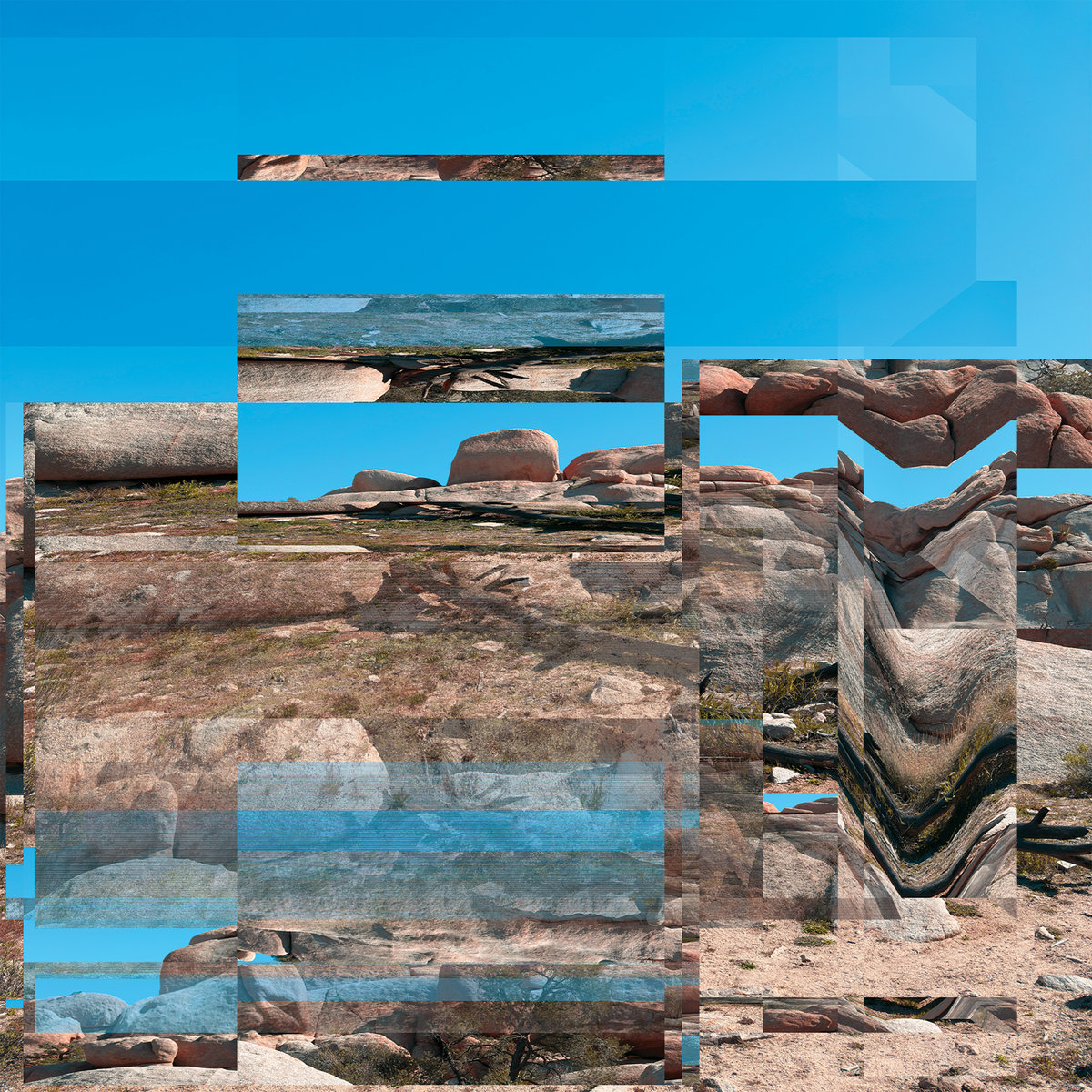
Tyler Pursel’s ‘In the Pasture of Obsolete Suns’ starts from a modest idea: sound can make decay beautiful without pretending decay is anything but loss. In ten compact tracks, the Philadelphia musician and visual artist constructs a world from sampling, synthesis, organic textures, unstable generative processes, and electronic residue. Ruined technology and fragile landscapes share a single climate. Pursel composed, mixed, and mastered everything himself, and that single hand gives the record a steady atmosphere.
“Laandgrave” sets the scene through pressure, not announcement. Low frequencies gather under surfaces already starting to corrode, and synthetic tones come and go before they can settle into anything recognizable as an instrument. Pursel has no interest in presenting electronics as spotless machinery. His tools are allowed to pick up flaws, ambiguities, and traces of how they were built. The effect turns oddly organic. What first sounds artificial starts to resemble weather, sediment, or some tiny process working beneath the visible world. “Chimayo” shifts the view without breaking the spell. The title names a real place, yet the music refuses to paint it literally. Pursel invents a geography from resonance and repetition, with sounds hovering at different distances, as if the listener were crossing land whose borders keep moving. There’s a quiet sense of dislocation, though it never turns merely ominous. Curiosity runs through how these textures are arranged, a willingness to let uncertainty be a resource instead of a problem to solve.
That quality deepens on “Mist Rotations,” one of the album’s most evocative pieces. The title describes his method neatly: mist hides things, rotations repeat, and neither gives you solid ground. Loops circle familiar territory while their character slowly shifts. A sound that felt warm a moment ago can turn cold just because another frequency has stepped into the frame. Pursel knows repetition can change what you perceive even when the material barely changes.
“Five Pyramids” adds an architectural streak. No two sounds sit at the same height, and the whole thing is already coming apart a little. Pursel has no use for the sleek, tidy shapes electronic music tends to love. He works with forms that look thrown together, half-buried, or left behind mid-excavation. Every piece is placed with care, yet the ground never feels steady, and that odd mix helps the track. “Motherbored” pushes the technology closer to the front. The pun in the title links circuitry to biological inheritance, and the music plays in that gray area. Synthetic sounds move almost like bodies, while something organic seems to grow out of the machinery. Pursel doesn’t set technology against nature. What interests him is how thoroughly the two have tangled together in daily life, memory included, which is now stored, copied, corrupted, compressed, retrieved, and sometimes lost.
“Resinframe” is more intimate. Its sounds feel enclosed, as though something fragile had been sealed inside a clear substance. That image fits an album so occupied with archival remnants, because preserving something also pulls it out of its original setting. Pursel’s sounds often sit in that strange state between survival and suspension. They haven’t vanished, but they aren’t what they were either. With “Buselik,” the record turns more melodic. Tonal relationships get easier to grasp, yet the uncertainty from earlier tracks stays. The melody sounds weathered, like something remembered imperfectly. Here the album’s emotional intelligence shows. Pursel doesn’t spray melancholy on as decoration. He treats it as a way of perceiving, one that lets ordinary sounds carry unexpected weight.
“Dataset” is a fitting title for a record so concerned with fragments and accumulated information. A dataset promises order, but the album keeps showing how incomplete any archive is. A sample is never the whole of its source. It’s a piece cut from a larger continuum, and Pursel turns that incompleteness into material. The track suggests a digital archive where categories have started to collapse, leaving the relationships between sounds more important than their labels. “Litho” brings physical matter back to the foreground. Time and again, Pursel wonders how a passing experience might leave a lasting mark.
Then “Encode,” the shortest piece and a fitting finish. At barely a minute and a half, it simply leaves the listener with the process behind the whole album: turning experience into another form. To encode something is to keep its information by changing its language, and Pursel has spent nine tracks doing just that, translating decay into rhythm, memory into texture, technology into atmosphere, and uncertainty into composition.
The record won’t pick a side between ruin and beauty, and that’s its staying power. Both fit in the same frame without canceling each other out. Pursel finds a way to talk about decay without sentimentality or despair. He lets the sounds he creates weather, smear, fracture, and wander off, then pays close attention to what’s still there. The album’s deepest subject isn’t extinction. It’s persistence, the stubborn ability of form, memory, and beauty to survive after the conditions that made them have begun to disappear.
Learn more links:
Tyler Pursel
Mystery Circles
Bandcamp