Nash the Slash was never particularly interested in behaving like a conventional rock musician, so it is fitting that ‘Nash The Slash – Covered’ is not like a conventional tribute album. Rather than smoothing out the peculiarities of James Jeffrey Plewman’s music, this collection of fifteen interpretations treats his catalog as a field of possibilities. The musicians come at these songs from different directions, but the album still hangs together through a shared curiosity. It’s as if everyone involved knows that Nash the Slash’s real gift wasn’t a particular sound but a kind of permission: music could be strange, theatrical, melodic, abrasive, funny, ominous, and beautiful, and it didn’t have to pick just one.
Nash was an original. Instrumentation such as electric violin, mandolin, synths, keys, and glockenspiel were his tools, and he used them to build a sound that steered clear of guitar rock. The constraint was the point. He could nod to prog, electronica, new wave, soundtracks, and pop, and it still came out unmistakably Nash. ‘Nash The Slash – Covered’ understands that imitation would miss the point. These musicians are not attempting to impersonate the man behind the bandages; they are discovering what his compositions reveal when removed from his particular sonic mythology.
Lightmares opens the record with “In A Glass Eye,” immediately establishing an atmosphere of mystery rather than reverence. The title alone points to Nash’s fixation on distorted perception, artifice, and the creepy space where people blur into machines. Lightmares updates the track but keeps its strangeness intact. The cover does not treat eccentricity as a costume. Instead, it recognizes that Nash’s compositions were often surprisingly sturdy underneath their theatrical surfaces.
Eiyn Sof’s “Animal Magnetism” pushes further into the shadowy side of the catalog. Their interpretation emphasizes the hypnotic qualities within Nash’s writing, drawing attention to repetition and atmosphere rather than merely reproducing arrangement. That quality becomes especially important when considering how much of Nash’s music existed somewhere between song and sound design. His instrumental imagination often seemed to anticipate a film that had not yet been made, and Eiyn Sof allows that cinematic quality to remain visible.
Dearly Beloved’s “Shock Treatment” brings a more aggressive charge. The title suggests both physical impact and dark humor, two qualities that frequently coexisted in Nash’s work. Dearly Beloved recognizes the melodic intelligence underneath the absurdity, turning the piece into something immediate without sanding away its unusual contours. Alex Wroten’s “RSVP,” meanwhile, introduces another shade of electronic experimentation. Wroten approaches Nash as a composer of textures and structures, demonstrating how naturally these songs can be relocated into contemporary electronic language.
Alan Beeson’s “Life In Loch Ness” offers an intriguing change in scale. Nash knew how to pick a title that builds a world before the music starts. Beeson plays up that quality without spelling everything out, and Brian Poole’s “Vincent’s Crows” shows off the same storytelling instinct in Nash’s instrumentals. Even without vocals, these pieces feel crowded with presence: characters, places, threats, and mysteries all seem to drift through the arrangements.
Ian Blurton’s Future Now tackles perhaps the most immediately recognizable piece in the collection with “Phasors On Stun.” The song has always occupied an unusual place in Nash’s catalog, combining propulsion with an almost science-fiction sense of wonder. Blurton’s interpretation gives the composition a muscular rock presence while preserving its futuristic personality. It is a useful reminder that Nash’s rejection of guitars never meant a rejection of rock’s physical force. He simply found other instruments through which to generate it.
Ronley Teper And The Lipliners take on “Wolf,” bringing out the song’s theatrical instincts. Teper’s approach is particularly suited to Nash’s willingness to inhabit heightened emotional states without becoming trapped by conventional seriousness. Nolan Cook’s Nifnar’s “Citizen” similarly emphasizes the absurdity and alienation that could coexist in Nash’s work. The song feels especially resonant in a collection that repeatedly demonstrates how much expressive territory remained inside his unusual compositions. Brian Ruryk’s “Masquerade” is another natural fit for an artist whose entire public persona was built around concealment and performance. Nash’s masked identity was iconic, but the deeper idea was more interesting: he understood identity itself as something that could be manipulated through sound, costume, technology, and spectacle. Ruryk approaches “Masquerade” with that conceptual dimension in mind, allowing the song to retain its ambiguity.
Barnyard Drama’s “I’ll Wait For You” gives the album a bigger emotional sweep, running close to six minutes. *Kitzler’s “Reactor No. 2” is the opposite: compact and intense, leaning into Nash’s fixation on machines and sci-fi. Rebecca Hennessy’s “Children Of The Night” reworks the song so its after-dark feel comes through in a whole new way.. Across these performances, the tribute increasingly resembles a conversation between generations of experimental musicians rather than a straightforward collection of covers.
The longest piece here, Andrew Noseworthy & LMNL’s nine-minute “Womble,” is especially revealing. Its duration allows the composition to become an environment rather than simply a song, giving its performers room to investigate its internal possibilities. That willingness to linger is important because Nash’s catalog frequently rewarded musicians willing to treat his pieces as starting points rather than finished instructions.
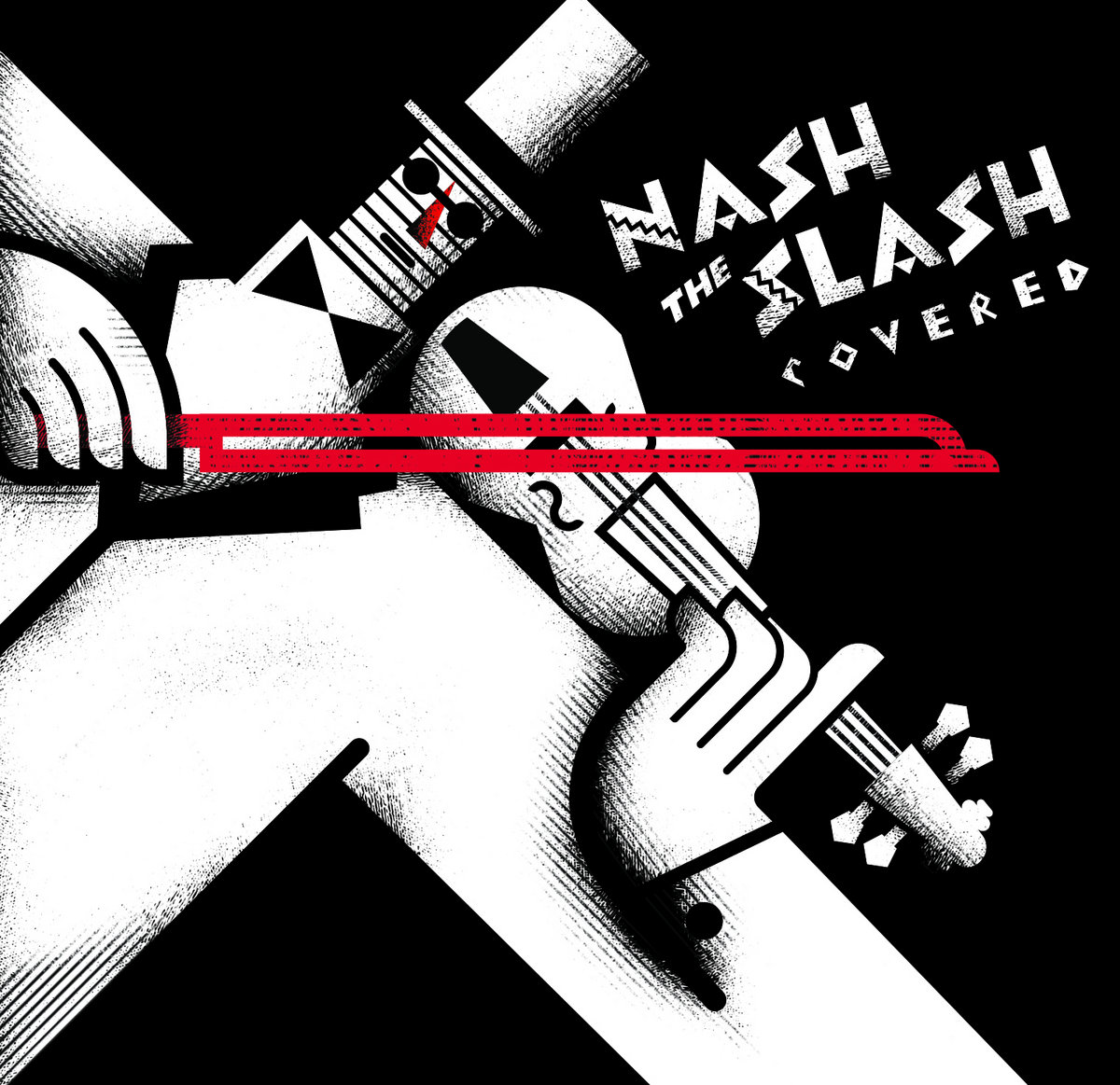
Frank Pahl closes the collection with “Pilgrim’s Lament,” a title that sounds almost archetypal. The performance brings the album toward a contemplative conclusion, reinforcing the sense that Nash’s music was never confined to one period or genre. Even at its most eccentric, his work possessed a remarkable emotional vocabulary. Friendly Rich Marsella deserves particular credit for bringing the project together as producer. The album’s diversity could easily have resulted in fifteen disconnected interpretations, yet the sequencing creates a convincing arc from experimental atmosphere to rock propulsion, theatricality, electronics, and reflection. Greg Dawson’s mastering gives the collection cohesion, while Matthew Daley’s design and illustration complement the album’s visual sense of otherworldliness.
‘Nash The Slash – Covered’ is therefore more than an archival salute. It shows that Nash the Slash’s songs were strong enough to outlive the man who made them famous. The mask, the electric violin, the cinematic concerts, and the no-guitars rule made him unforgettable, but the songs are why he’s still worth remembering. The fifteen musicians gathered here do something more valuable than recreate his past. They allow it to mutate. “In A Glass Eye,” “Shock Treatment,” “Phasors On Stun,” “Masquerade,” “Children Of The Night,” and “Pilgrim’s Lament” emerge not as museum objects but as living compositions capable of taking on new accents and new meanings. That is perhaps the most convincing tribute Nash could receive: not preservation through imitation, but continued transformation through imagination.
Learn more links:
Klang Galerie
Bandcamp
Facebook