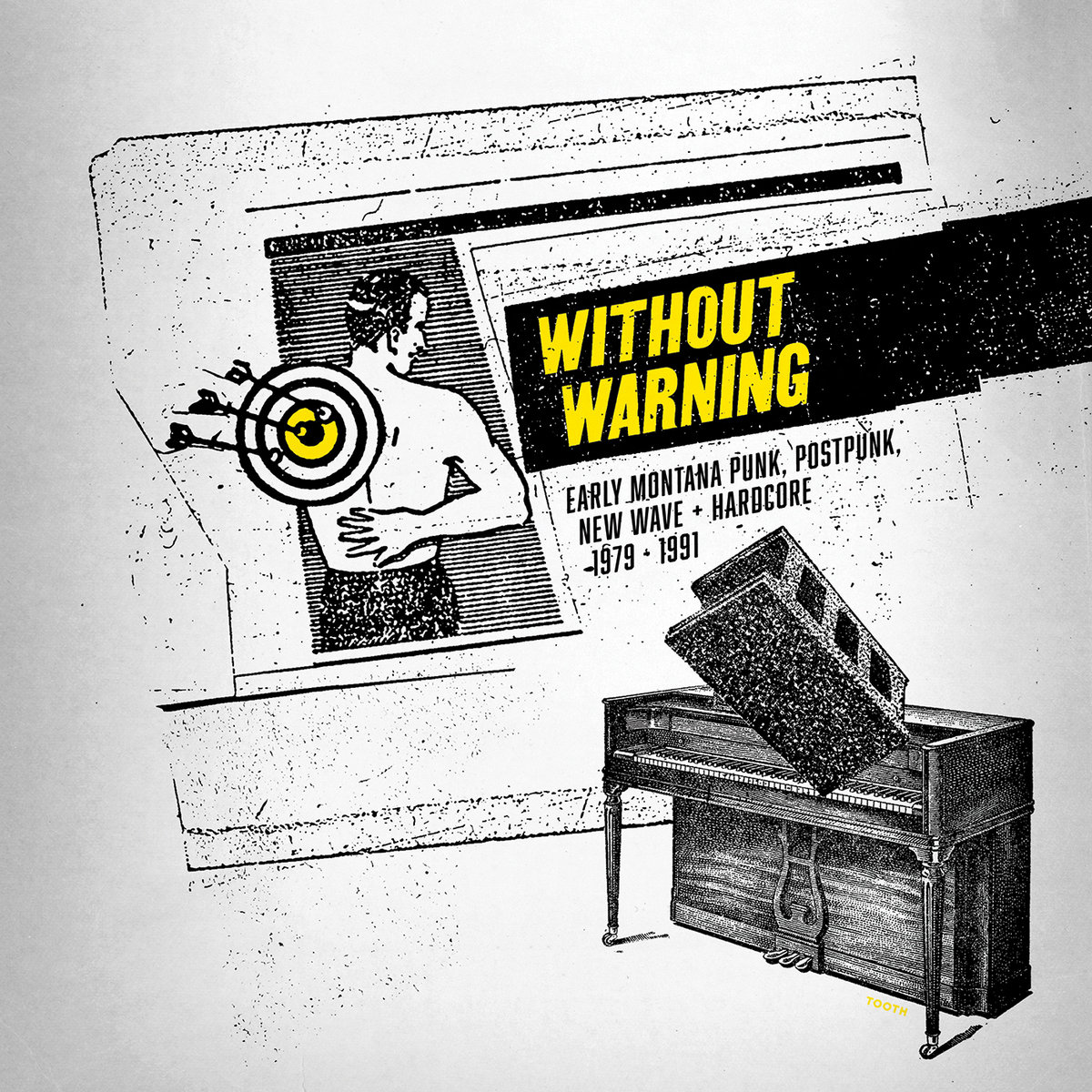
Somewhere in a closet, a shoebox of cassettes is slowly losing its argument with time. Multiply that box by twenty bands, a decade of American weirdness, and a handful of obsessive collectors willing to dig, and the result is ‘Without Warning: Early Montana Punk, Postpunk, New Wave & Hardcore 1971 – 1991,’ a double-LP, 24-track excavation of music that almost nobody heard the first time around. Reading the list of names is a pleasure in itself. Hearing the songs is better, because a compilation like this one lives or dies on one question: were these bands overlooked because they were mediocre, or simply because nobody was paying attention? The answer, track after track, is the second one.
The timeline matters here. Over roughly ten years, American underground music passed through several rapid transformations. New Wave crept into the mainstream, punk got louder and faster as hardcore, and post-punk threw out the rulebook for rock and punk alike. By 1985, the scene was drifting toward something cleaner and easier to sell: indie rock. Most compilations stick to one lane. This one roams across all of them, and that’s what makes it work. Bands that never played the same bill end up side by side on the tracklist, and the clash keeps you listening.
The famous names offer an easy entry point, though they hardly dominate. Steve Albini, long before his reputation as a recording engineer and his work in Big Black and Shellac, appears with Just Ducky on “New Metro Stomp” and “Dog Food,” two brief blasts that open the collection at under three minutes apiece. Hearing a future legend as a young unknown carries a certain charm, like finding a teenage photograph of a person you only know as an elder statesman. Jeff Ament, later the bassist for Pearl Jam, turns up with Deranged Diction on “Aspirin,” barely a minute long, and “Periscope,” which stretches past three. Reggie Watts, today better known as a comedian and loop-pedal wizard, contributes “Bed of Roses” with Autumn Asylum. The sheer improbability of that credit is worth the price of admission.
Still, the celebrity cameos are the least interesting part. The real discoveries are the bands nobody knew to look for. The Pugs offer “True Love” and “Last Time,” two compact pieces that sound like they were written in a hurry and rehearsed in a garage with a leaky roof. Surfer Ruth’s “Anzio Surf” is a tidy two minutes of beach-town daydreaming dropped into a collection otherwise preoccupied with suburban dread. “Talkative Zone,” from Boy Toast, has the kind of title that suggests a sense of humor, and it fits nicely beside The Details and their pointed “Middle Class Punks,” a song title that doubles as a social diagnosis. Who Killed Society follow with “Suburban Hope” and a blink-and-miss-it “Nothing New,” which at one minute and eight seconds proves that punk always understood the value of leaving early.
The middle stretch is where the compilation grows ambitious. Ernst Ernst’s “Persecution Plan” runs nearly five minutes, a generous allotment on a collection otherwise dedicated to brevity, and it hints at the post-punk instinct to stretch and distort. Panache offer “Fugitive Colours,” a title with a faintly romantic ring. Then comes Steel Pole Bath Tub with “This Town,” a Bay Area band whose reputation for noisy extremity makes their inclusion a welcome jolt. Circle 7 answer with “Say One Thing,” a sharp little burst that vanishes before it can be argued with.
The title track, “Without Warning,” by Ein Heit, sits sixteenth and its placement is well chosen. Arriving after a run of short songs, it lets the compilation catch its breath and reminds listeners that these bands were not merely chasing speed. Some wanted atmosphere, some wanted a long slow burn, and some simply had more to say than a hardcore clock would allow. Rust & Smuts follow with “Photogray,” Dashing Catholics bring “Penitentiary,” and Sheryl & The Spineless Yes-men add “Pitter Patter,” a song title so gleefully small it borders on a dare.
Silkworm’s “Pearl Harbor,” the compilation’s longest track, makes a forceful case for the band’s reputation as a beloved cult act. That reputation is deserved. Sitting near the end of the set, the song carries the weight of a closing argument, steadier and more patient than most of what surrounds it. Donovan’s Brain follow with “Lowlands,” Autumn Asylum with the aforementioned Watts showcase, and Beat Nothings with the wonderfully deadpan “Bit of a drag.” The Banned close out the record with “South Canada,” just over two minutes of what sounds like geography as a punchline, and a fittingly offbeat sendoff.
The physical package deserves its own paragraph, because the people behind it clearly care. The set arrives with a booklet containing a foreword by Kirk LeClaire, an essay by Tom Kipp, rare photographs and band histories, along with a link to a related documentary. For a project built on forgotten music, the paper trail may be the most valuable part. Each band gets context, a face, a story. Faceless names on a spine become human beings who once stood on cramped stages and believed that someone, somewhere, might be listening.
That belief is the emotional core of the whole thing. Every track here represents a bet that did not pay off, at least not on schedule. Most of these musicians never signed with a major label, never toured with anyone famous, and never stayed on a record store shelf for long. They made the songs anyway because they couldn’t not make them.
Lovers of American underground history will find this essential. Casual listeners may find the range disorienting, since the shifts between styles come fast and without apology. But the disorder is honest. It mirrors how the music actually lived, scattered across towns and scenes and tape-trading networks, connected by attitude more than sound.
This compilation honors that mess instead of tidying it, and the loving curation is evident in every sequencing choice.
Despite its release several years ago, ‘Without Warning: Early Montana Punk, Postpunk, New Wave & Hardcore 1971 – 1991,’ is worth the revisit and further mention here. A fine compilation does more than collect songs. It rescues them. This one pulls two dozen overlooked recordings out of the shadows and sets them down in the light, dusty and imperfect and thoroughly alive.
Learn more links:
Lost Sounds Montana
YouTube
Soundcloud
Facebook