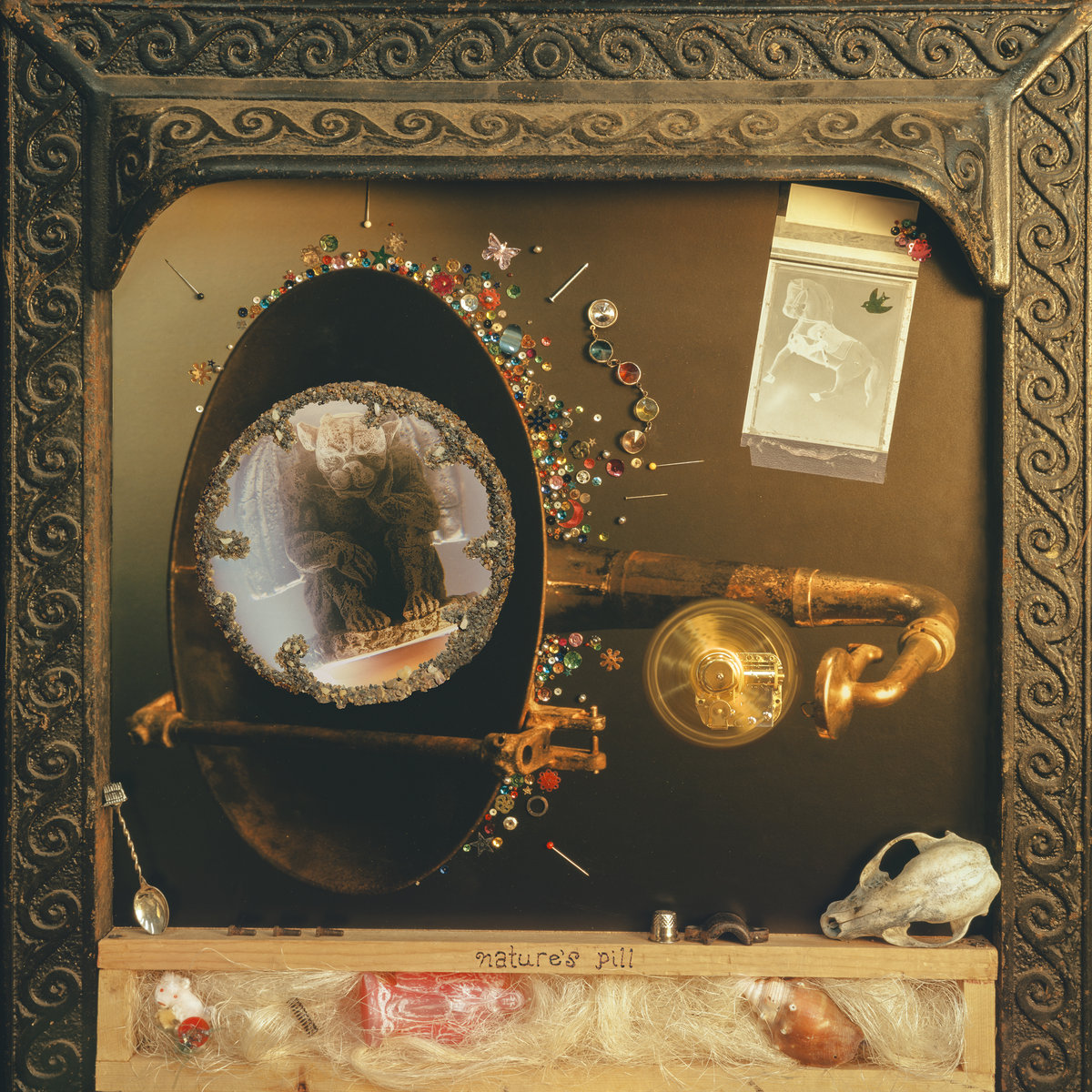
Wishy’s ‘Nature’s Pill’ arrives with the assurance of a band that has already learned how to translate momentum into identity, turning the rapid creative succession of their early years into something more expansive without abandoning its instinctive charge. Following the momentum of ‘Triple Seven’ and the stylistic sketches of earlier EPs, the Indianapolis group lean into a more collaborative construction here, with Kevin Krauter and Nina Pitchkites sharing vocal and compositional space alongside Dimitri Morris on guitar, Mitch Collins on bass, and Conner Host on drums. The result is a record that treats cohesion not as uniformity but as a negotiated balance between exuberance and clarity.
“All The Rage” opens the album with a bright assertiveness that feels less like declaration and more like ignition. Krauter and Pitchkites trade vocal lines with a buoyancy that is sharpened by the full-band interplay, where Morris’s guitar work and Collins’s bass lines create a forward-leaning harmonic bed. Host’s drumming holds the track together without making it feel stiff, letting the song always seem like its about to speed up without going far. “Covergirl” stays just as airy, but the lyrics are more thoughtful and aware of themselves. The harmonies play off one another, and each one shifts how the other lines land. It feels fresh because every part of the music is easy to hear but it also mixes in ways that convey a lot of emotion on top of being sonically intense.
On “Sensational”, Wishy lean into their affinity for melodic saturation. The song is an excellent example of the contrast between the gauzy way Pitchkites sings and Krauter’s grounded vocals. This contrast creates a dialogue that feels like a conversation even when the lyrics are abstract. Ben Lumsdaine’s production style highlights this track. He provides clarity for the song that keeps all the layers cohesive but also ensures the emotional tone of the track never feels forced.
The song thrives on contrast between Pitchkites’ airy phrasing and Krauter’s grounded delivery, creating a dialogue that feels conversational even when abstract. Lumsdaine’s production sensibility becomes especially evident here, shaping the track with a clarity that preserves its layered arrangement while keeping its emotional tone unforced. “Shift” introduces one of the album’s more dynamic structural pivots. The band lets the music change by shifting the rhythm and the harmony rather than reliance on abrupt change. The guitar textures from Morris sparkle around the vocals like a corona of light while Collins and Host maintain a rhythm that feels steady but also a bit bouncy. The track suggests motion as a state of reorientation rather than departure.
The lyrics on “You’re Not Serious” bite a little harder, but the music stays upbeat and never sours. The melodies are bouncy while the words are disillusioned, and somehow the two sit together fine. The dual vocals operate here with precision, each voice circling the other in patterns that suggest miscommunication without dramatizing it. “Mona Lisa” slows the record’s forward propulsion, allowing space for tonal nuance to surface. The band’s interaction feels like an atmosphere. Krauter and Pitchkites focus more on the tone of their notes rather than trying to emphasize them. Morris uses the guitar to sketch out shapes instead of attempting to fill up every empty space. The rhythm section stays hushed but never strays from the music. The band’s interplay becomes more atmospheric, with Krauter and Pitchkites leaning into phrasing where tone outshines emphasis.
“Lovesick”, one of the record’s focal points, distills Wishy’s approach into its most concentrated form. The track carries a heightened sense of romantic intensity without sacrificing structural discipline. The chemistry between Krauter and Pitchkites becomes especially central, with their voices blending in a way that reinforces the song’s immediacy. Production duo Lumsdaine and Krauter ensure that it never tips into excess, instead maintaining a carefully managed surge of melodic contours. “Freak 99” introduces a more playful distortion of tone. The band’s penchant for shoegaze-adjacent textures and alt-rock propulsion surfaces in subtler form here. Collins and Host provide a rhythmic foundation that allows the guitars to project outward, while the vocals maintain a buoyant parlando.
“Headscratcher” embraces ambiguity as compositional principle. Rather than resolving its harmonic questions, the track lingers within them, allowing Morris’s guitar work to drift across shifting tonal surfaces. Krauter and Pitchkites maintain a vocal approach that prioritizes phrasing over resolution, reinforcing the song’s reflective uncertainty without turning it inward.
“Blitz” marks one of the album’s most concentrated bursts of energy. The full ensemble tightens into a more direct configuration, with Host’s drumming taking on a propulsive urgency and Collins’s bass locking into a firm melodic line. The guitars pierce through the mix cleanly rather than reliance on distortion-heavy weight, suggesting velocity defines the track rather than volume. “Kiss Kiss Kiss” leans into repetition as expressive device, using its titular refrain as structural anchor. The dual vocals become more rhythmic, while the instrumentation shifts between bright & floating to deep & steady. Lumsdaine’s production ensures that the repetition slowly builds rather than remaining static, with each texture or emphasis slowly altered.
“Party World” closes the album with a sense of collective release. Rather than presenting conclusion as closure, Wishy allow the track to function as an open-ended gesture, where the ensemble’s chemistry becomes the primary focus. Krauter, Pitchkites, Morris, Collins, and Host converge into a sound that feels less constructed than inhabited, shaped by shared intuition rather than strict arrangement. Across ‘Nature’s Pill,’ the production moves Wishy through a mix of ’90s dream pop, shoegaze shimmer and early-2000s alt-rock without ever slipping into pastiche. The band treats their influences as raw material, shaped by their vocal interplay and by letting the group’s playing decide how the songs are arranged. Chaos here isn’t something that throws the record off balance. It’s what the songs grow out of, with melody, rhythm and voice constantly trading places inside the same frame.
Learn more links: Winspear | Bandcamp | Instagram | Twitter