
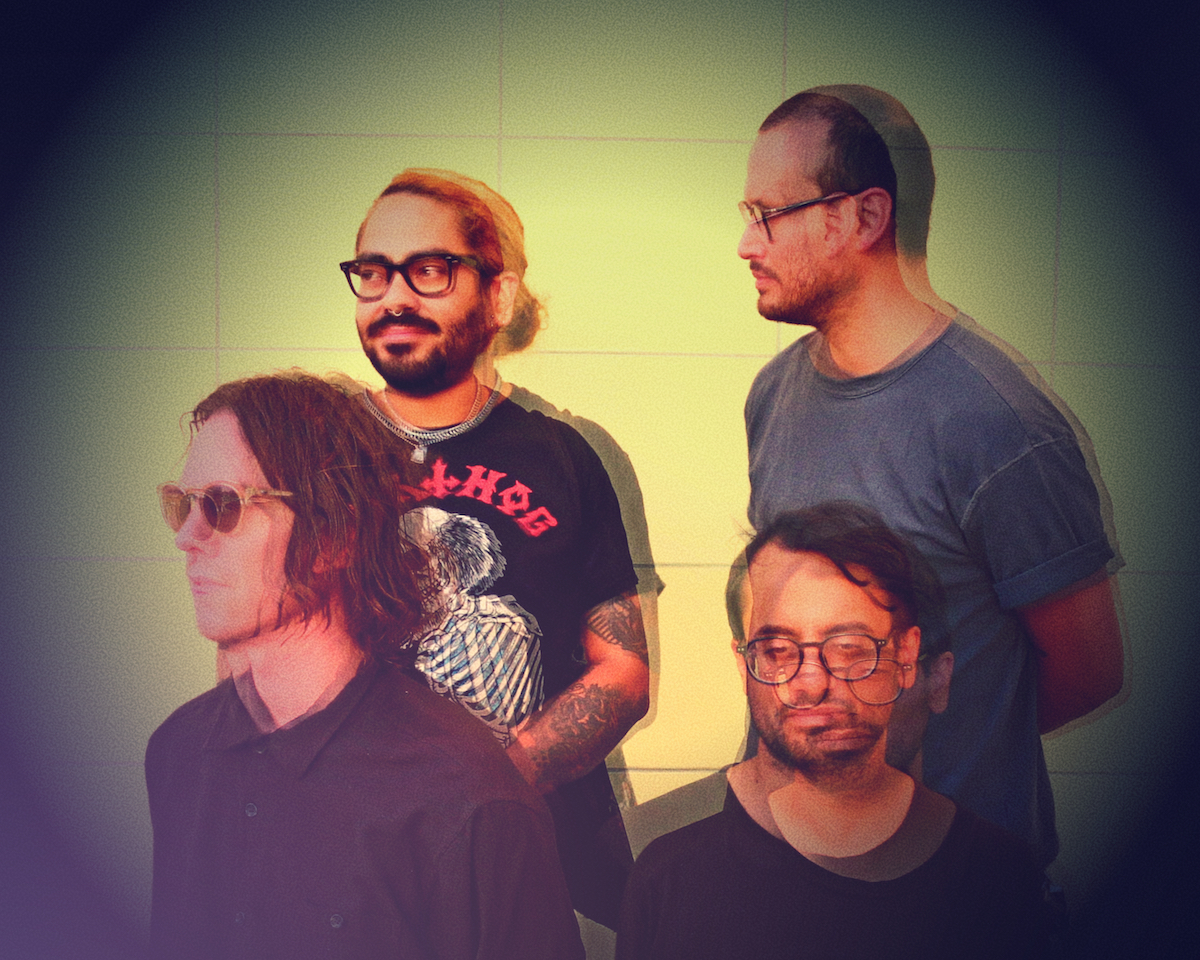
All photos by Hannah Farley
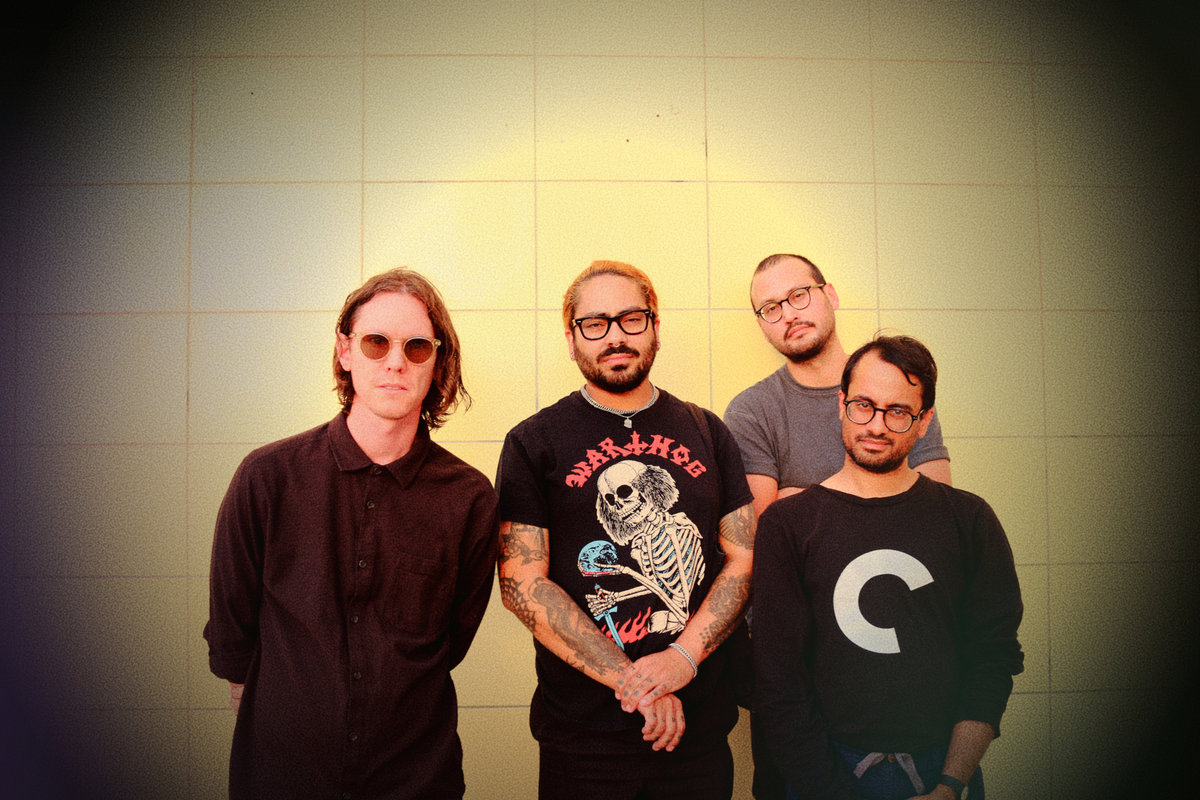
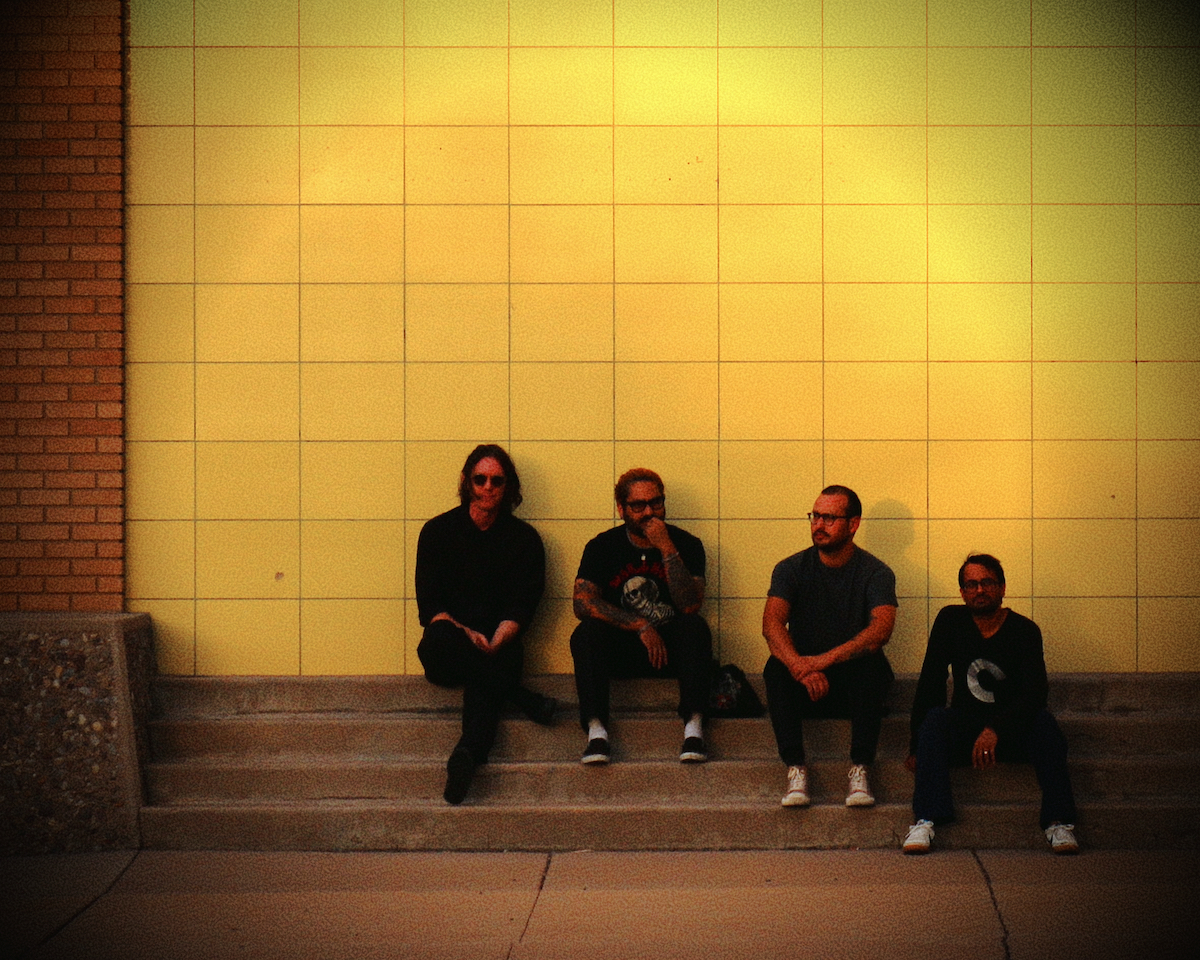
There is something intrinsic about a band that refuses to explain itself too quickly. Tucson, Arizona’s Mute Swan (guitarist/vocalist Mike Barnett, bassist/vocalist Prabjit Virdee, drummer Gilbert Flores, and guitarist Ryan Chavira) welcome a different kind of attention. Their latest effort, ‘Skin Slip,’ (Hit The North Records), arrives with the feeling of a work meant to be experienced before categorization. It is a record that beckons listeners to lean in, stay curious, and allow its meaning to emerge somewhere between the familiar and foreign.
Tucson is a fitting place for a band like Mute Swan. The city has always carried a peculiar creative tension: vast spaces of the Sonoran Desert alongside boundless artistic energy, beauty that counters an inhospitable climate, isolation alongside community. It is a landscape where contrasts coexist without needing to be resolved, and that same tension seems particularly appropriate as a way into ‘Skin Slip.’ The album’s title alone suggests transformation, vulnerability, decomposition, and renewal. It evokes the moment when an outer layer no longer fits and reveals what lies underneath.
That sense of exposure makes Mute Swan an especially interesting subject for conversation at this point in their story. A new album is never simply a collection of songs. It is evidence of where a band has been, what it has questioned, what it has outgrown, and what it is willing to leave unresolved. In that respect, ’Skin Slip’ represents another chapter, but it also creates an opportunity to look backward and forward simultaneously; to consider how a band’s identity changes when the music begins to push beyond the limits that once contained it.
That notion feels particularly relevant to ‘Skin Slip.’ The album marks a moment of transition, but transition rarely happens cleanly. It can be anxious, awkward, disorienting, and ultimately revealing. That is part of what makes Mute Swan worth listening to now. Rather than treating a new release as a finish line, ‘Skin Slip’ is an invitation to examine the process itself: the shedding, the uncertainty, the reinvention, and the possibility that something more honest might emerge once the old surface gives way.
This feature is dedicated to the memory of Thomas Sloane whose artistry, passion, and unforgettable sound continue to inspire.
James Broscheid: I know ‘Skin Slip’ had been a long time in the making. How long did it take to actually finish the record?
Michael Barnett: We had a many ideas we wrote during COVID times so we picked the best ones, polished them and recorded them in my bedroom. We brought those 5-ish songs to Ryan Bram in town to mix and from there it would be like, “Here’s some songs that are ready,” and he would start mixing those. While he was working those tracks, we would finish writing and recording the next one or two songs. It was also a process of, once you hear everything together, you decide, “Oh, this instrument doesn’t sound quite right,” so we would scrap it and record it again. A lot of the recording process was re-recording guitar or vocals into a little hand cassette recorder and layering that in there. We would do different things to muddy up the some of the sounds. There are also a lot of samples mixed in through the album that took time to figure out.
JB: Do you personally sit with Bram while he was mixing?
MB: Yeah, there were a couple songs I asked if we could sit and work on the mix together. He would send back a mix and I decided it would be faster if I explained what I was going for in person instead of typing it all out in an email. Or sometimes I wasn’t sure how it should sound so I needed to hear it a few different ways, which is easier if we sit there and figure it out together. Most of the songs we mixed through email, though. He’s really good at what he does.
JB: I truthfully wasn’t expecting another Mute Swan album, especially in light of losing Thom and now, over a year later, here we are.
MB: We finished it right before Thom passed. It took some time to figure out what we wanted to do but eventually we agreed, we can’t let it fizzle into Bandcamp non-existence. We wanted to give it as big of a release as possible. We watch some bands and that’s all they do. Maybe they put it on YouTube, or just put it on Bandcamp and post about it on Instagram, that’s it.
JB: And then it disappears.
MB: (Agrees) We didn’t want that to happen. And so, all that time of internet silence, there’s me sending emails and DMs to everybody we knew who could help release the album. Luckily, we were put in touch with Hit The North through our friend, CJ Simonson, at PIAS, who did a college radio campaign for our last record. Tom Churchill, who runs the label, liked the record a lot and did an amazing job with the release, especially on the PR side of things.
JB: I remember when I first heard the previous record ‘Only After’ and being blown away by all the nuanced layering. Was it tough replicating those types of sounds between you and Thom when the band played live?
MB: (Laughs) Yeah, but we have a rule that there’s a live version and there’s a studio version of our songs and it’s okay for them to not sound the same. Originally, I tried to get two guitarists to fill Thom’s spot. That’s really what’s on the record, double-tracked leads. But it ended up being too ambitious for the time frame with the release date set for March (2026). Trying to get people who have full-time jobs to learn these songs was just too much. Luckily we were able to get Ryan, who we’ve played with a lot in other projects. Maybe down the road we can get another guitar player because it would sound really cool to double up all those parts on stage.
JB: And there’s quite a few bands out now that utilize three guitars.
MB: Yeah, absolutely. I still want to do that some day. Actually, there were a couple other people I had in mind if Ryan couldn’t play. I was teaching them to Kage (Krol). Do you know the band Kryge in Tucson?
JB: No.
MB: They’re a really heavy prog duo (along with Ryan Petersavage on drums, synthesizer, tape – JB) and they have a practice space down the hall from us. So, I started teaching him the parts, but he decided he was too busy to commit but the potential to do it is still there.
JB: Is Ryan Chavira good to go now?
MB: We practiced last week and it was the first practice we all felt it come together. We played the whole set and we’re 100% ready. He can play the parts that could have been a show. I’m not going to say it is exactly like Thom, but it feels really good.
JB: He is settled in with the band now, and everybody feels good?
MB: Yeah. We started off with just the two of us practicing and learning the songs. There were only a couple of times where he had to re-learn a part in a different spot but otherwise, he got it pretty quickly. A lot of the parts are not that hard on the guitar, it’s more the effects, and getting all the tonal stuff correct that makes it more difficult and the bending and the whammy bar stuff that makes it harder. The rest of the band had to get used to the songs again too but it came together pretty quick.
JB: Is he at liberty to add sounds of his own?
MB: Yeah, absolutely. I’m really not insisting that he stay accurate to the recordings at all. I like his style and I think it’s more fun to play around with the parts than try to rigidly replicate them.
JB: I didn’t check the last album, but you have Prabjit doing a lot of background vocals now, but is this new one the first time you leaned on his vocals?
MB: No. He’s always been doing them. Sometimes his vocal parts sit really low in the mix, so you can’t really tell that it’s him. You can’t tell whose voice it is. It’s mainly reinforcement for the lead vocal parts. It comes through a lot more on stage.
JB: Any ideas as far as next album? I know it’s early days.
MB: Yes, but I don’t know if they are concrete ideas quite yet. You’ve probably seen how popular the shoegaze revival has gotten, which is great, but it’s starting to feel like beating a dead horse. I can definitely see us exploring other sounds.
JB: That’s one of the reasons why I like Mute Swan so much, even with the last album. There are shoegaze elements, sure but there’s more to it than that, and it’s not like everything else.
MB: Thanks. The shoegaze bands I like are really inspiring but most of what I like isn’t shoegaze.There’s only a small handful of shoegaze bands that I actually like.
JB: That’s not surprising.
MB: My Bloody Valentine obviously. I like Tanukichan a lot. Ringo Deathstarr especially the production. Peel Dream Magazine is probably my favorite lately. I’m probably forgetting a few but I don’t listen to much loud guitar stuff anymore. One of the main influences for the new record that might be surprising was Boards of Canada. We were trying to combine them with My Bloody Valentine. Not sure how much we succeeded but that was the thought. That’s why the new record has those little bumper tracks and sampled speech, etc. We also play a lot of three chord parts, which came from them.
JB: I really enjoyed Tanukichan when they played La Rosa here. Were you there?
MB: No I missed it.
JB: They were so good.
MB: Yeah! We were asked to play that but Gilbert was going to be in Japan and I’m not sure Ryan would have been ready. But we opened for Tanukichan three or four years ago.
JB: That was at Club Congress right?
MB: Yeah.
JB: I was there. I think I sent you a shot I took of Thom from that night.
MB: Oh cool, that makes sense. Yeah, I like her (Hannah van Loon) stuff a lot.
JB: I thought they were a great opener for Alison’s Halo at La Rosa.
MB: We became friends with Roger (Brogan), the drummer from Alison’s Halo (also Spectrum and Dean Warham / Britta Phillips among others – JB), because we played a venue he works at in L.A. a couple times. He did sound for us both times. He liked us a lot and gave us a heads up when Alison’s Halo played Rialto, so we got to chat with him a bit when he was here.
JB: What venue does he work at?
MB: Harvard & Stone. It’s small, but it’s a really cool spot.
JB: I wanted to bring up Tony Parsons in regards to the Mute Swan track, “Phantasms Of The Living.” How does his concept of the individual “self” being an illusion, and that there is no separate path to enlightenment, translate into your songwriting process?
MB: I was watching and reading Tony Parsons a lot when I wrote that song. He’s definitely not for everybody but he talks about non-duality or “Advaita,” which I find really interesting. The idea is that most people experience a feeling of separation from the world around them, like I am “in here” and the world is “out there.” Non-duality basically says your sense of self, your thoughts, your body, everyone and everything are all one unbroken thing. And the nature of that “thing” taking on billions of forms throughout the universe is a complete mystery. Without over-explaining the lyrics, “Phantasms of the Living” is about a person grappling with the concept of non-personhood. It can be a weird skin-crawly feeling when you play with the idea that you and everyone you’ve ever known aren’t what they think they are. But I think everyone kind of has that feeling that there’s something more going on here. The title of the song came from a book from the 1800’s about people seeing ghosts of living people, which I thought was a cool parallel.
JB: Speaking of lyrics, how do you approach songwriting? Is it music first, or do you start with lyrics and build the track around them?
MB: The lyrics are always the hardest part and take a while. Usually, it starts with a loop of a single part, like the drums, the chords and a melody or a vocal idea without the lyrics. I’ll bring a demo to the band and build it out from there, usually finishing the lyrics last.
JB: Going back to Parsons, shoegaze/dream pop to me personally, are closely aligned with spirituality.
MB: I can see that. I don’t know. I guess my reference point is Kevin Shields who mainly writes love songs. I think most people’s access to spirituality is through love and usually that means romantic love, so you can write to a wider audience if you veil a spiritual song as a love song. Not sure at all if that’s what he was trying to do but he leaves a lot of space for interpretation. For me, it’s just something I’m really interested in and sometimes feels like the only thing worth talking about. There’s a world inside of yourself and most people have never heard of it. It has nothing to do with religion or yoga classes or anyone else. That urge to go inside of yourself could be the connection to shoegaze I guess. To lose yourself. A lot of shoegaze can be depressing though, which is absolutely beautiful in its own way. Some of the best art in the world is tragic. When I write songs I like to get high on the stuff that pulls me up. Playing chords that make me high. So, the spiritual lyrics are what ends up fitting for me. And I guess it feels good to let people know that world exists.
JB: Sometimes I find comfort in music that will reinforce my depression because it’s relatable. Other times, it’s important to be uplifted.
MB: Yeah, and I understand going through certain phases. Like, if you’re going through a breakup and have that breakout album. If you feel it, feel it all the way, as long as you move on to something else without making it your identity or getting stuck in it forever.
JB: Another Parsons question. He often speaks about the seeker falling away and leaving only what is (Mike agrees). I wanted to ask you about the record title ‘Skin Slip.’ Does it represent a shedding of the individual self and is the album an attempt to capture that boundless state where there is no me and you?
MB: Right. And to be clear, Tony Parsons isn’t the only one who says this. But yeah much of the lyrical content for this album deals with identity on multiple levels, not just the ego-dissolving spiritual seeker side. Like the track “Cocteau Swan” is more about your sense of self in the context of a relationship, who you are to them, who they are to you. The album title, ‘Skin Slip,’ comes from something our friend (Angelica Pedrego from Citrus Clouds) told us one time about her job, which is pretty gross but also interesting. She works in a forensics lab that helps with homicide investigations and sometimes if they’re unable to identify the body they remove the skin of the hand and carefully put it over their (gloved) hand to get the fingerprints from it. That’s called a skin slip. It stuck with me for years because that’s what it feels like to be a person sometimes. You’re inside someone’s skin trying to figure it out.
JB: Is songwriting more a stream of consciousness then? Maybe lyrics appear rather than being crafted?
MB: I wish it came out in a stream. There’s two ways that I write lyrics. Sometimes I record myself singing babble to the song’s melody and then turn that into words, which is kind of a way for subconscious stuff to come up. “Burnt Almonds” from the last album, was written that way and “Another Simple Pleasure” from this one. If the lyrics are trying to say something it can take a lot longer, lots of revisions and editing. The lyrics can ruin a song so you have to be careful. One of the songs on the new record, I probably wrote 20 different vocal melodies before the final one stuck. It feels like solving a puzzle, which is really satisfying, but you have to get out of your own way for the missing piece to come to you.
JB: Like in a meditative state?
MB: Sometimes maybe, but mostly I’m sitting there with a rhyme dictionary, scratching out one word over and over.
JB: Would it then be difficult for you to approach writing lyrics first and melody coming second?
MB: I don’t know. I’ve heard other songwriters do it that way, like building a song around a lyric, but I’ve never done that. It makes sense though since most listeners think of a “song” as the lyrical content. That occurred to me pretty late in the game that most people are just listening to the words. I like songs with vocals a lot but the actual lyrical content is very secondary to what’s going on musically. I’m reminded of that when a friend sends a band to check out and I can’t understand why they like it, then I realize “Oh, they’re listening to this for the lyrics.” I can appreciate the skill of lyric writing but it’s further down my list. One band who’s lyrics I like a lot is The Sea and Cake. Do you know them?
JB: Yes.
MB: I love how vague his (Sam Prekop) lyrics are. He has different lines that stick in your head, but you don’t necessarily know what the song is actually about, which gives you that space to inject your own meaning into it. I think it’s more important that the feel of lyrics, however vague, match the mood of the music.
JB: That makes sense. We talked about Thom earlier, would you consider ‘Skin Slip’ a tribute to him and then, how do you perceive ‘Skin Slip’ now that it has been released?
MB: Absolutely, the release of this album was very much a tribute to Thom’s memory. He was a complete wizard of a guitar player and we wish we could have made dozens more records with him. But for a last record, he knocked it out of the park. We just wanted to hold up his last work to as many people as we could to say, “Look at how amazing our friend Thom was!” It’s the most important part of the album, that the world lost this guitar player and this was his final work. And he was our best friend! He was so awesome, those guitar parts are unreal. On the other side of it, Thom did a lot of work with booking and merch and social media. I can’t understate the hole it left and the effort it took to come back from that emotionally and just practically as a functioning project.
JB: I wouldn’t have thought Thom would have been a big driver on that side of the band, you know?
MB: Yeah, he always did a really good job with that. Very organized for an artist and always willing to help.
JB: Hell of a guitar player too. You said earlier that you consider this record to be Thom’s best guitar work (Mike agrees). Was there a specific moment when you two were working together and had a collective breakthrough for this record compared to ‘Only Ever’?
MB: There were a bunch of cool moments making this album. I was always amazed at how good he was at making noise tracks. After recording his lead parts, I would ask him, “Do you want to put down some textural noise stuff?” And he could pull out the coolest stuff on command. He just used basic pedals too, no fancy boutique stuff. He was just really good at it. And for any of the songs we used those noise tracks, it added a lot. It wasn’t noise for the sake of noise. On the writing side of things, I remember writing, “Phantasms” together and thinking that was going to be really good. I had a simple demo for it with just the guitar parts and drums but we finished it all together at our practice space. Even the vocal parts, which are usually a solo effort were done there on the spot. That was probably the first song we wrote after Gilbert joined the band on drums so it was kind of the beginning of a new era. We released that one as a single before thinking about ‘Skin Slip’ as an album mainly because we were so excited about how that song came out. We had a plan to release stand-alone singles for a while. Did you know about that?
JB: Yes, we talked about that after one of your shows at Club Congress a few years ago.
MB: Oh yeah! We were just impatient to put that song out. I used different chords that changed the vibe a bit. New vibe, new drummer, it was probably that excitement that fed the rest of the album.
JB: You had a different drummer for ‘Only Ever’ right?
MB: Yeah, that was Roger (Reed).
JB: Gilbert played live right after ‘Only Ever’ came out because I’ve never seen Mute Swan with a different drummer.
MB: Yeah, Roger is a really good drummer. Totally different style. Very precise and intentional. Once he works out a part, he will play it the same every time and really lock in. Gilbert comes from hardcore music so it’s more about energy, which was really interesting to see how that affected our sound.
JB: Is Roger still in music?
MB: Yeah, he plays with La Cerca now. They’re really good.
JB: Who else locally should I be listening to?
MB: Droll is great. Pep Talk is really cool. They opened for our record release show at La Rosa. Ryan Chavira, he’s our new guitar player, his solo stuff is probably my favorite in town right now. He does ambient music with tape textures.
JB: You’ve described your music as a way of finding inner peace through noise. Does this mirror the non-dual idea that everything, even chaotic natural chatter, is already wholeness?
MB: Yeah, I could see that. I think that comment was about the first song on the record “Hypnosis Tapes.” I don’t remember exactly what was going on when those lyrics came about but it treats the meditation routine like cleaning out your closet. You have a mounting feeling that there’s too much stuff in there and you need to do something about it. It’s different in that you aren’t organizing your thoughts at all. If your thoughts are chaotic you sit there and let them be chaotic. There’s a thought that says, “This chaos, everything that’s weighing down on me or giving me anxiety, is a huge problem.” Not necessarily, that’s just another thought. Just sit and let things be however they want to be. The dishes are dirty, there’s a hole in the ozone layer, late stage capitalism, etc. All the good stuff too: ice cream, nature, good movies, small victories, whatever. You can put everything down and let everything be for a while. It’s not an escape either because when you take things as they are, you allow them to come closer. You’re not pushing anything away. But yeah, easier said than done.
JB: The new record moves between meditative pauses and high energy walls of sound. How do you manage the headroom of an album so that the quiet moments feel as heavy as the loud ones? Did you have a hand in producing this album?
MB: It was just about making the moods match from song to song. We didn’t want to make an album that was a wall of sound the whole way through because the loudness loses its effect after a while. It gives your ear a break you’re also anticipating there might be another loud one coming up, so that tension is exciting. I feel like the bumper tracks make more of a world for the other tracks to exist. Also, it was an opportunity to use song ideas in their most raw form. What you’re hearing on some of those are phone recordings with very minimal overdubbing. Sometimes when you re-record a song it loses a bit of the magic it had in the demo. So the idea of putting those in there raw was very exciting for us. Also, when we’re putting a setlist together we think about what’s happening between songs. Do we and the song immediately count into the next one? Do we let feedback ring out for a while? Do we start a pre-recorded playback of something? Or is dead silent, cricket chirping while we tune our guitars? Those thoughts carried into making this album for sure.
JB: Creating ambience between songs?
MB: Yeah, the thing that I keep thinking is you might feel awkward as a performer when it’s silent, but that’s not a reason to not let it be silent. The audience probably doesn’t feel awkward at all. You can sit there and be quiet. So, part of it is trying to figure out, “Do I feel awkward because it shouldn’t be silent or do I feel awkward because it is?” It takes a lot of shows to figure it out.
JB: From a technical perspective, what were some of Thom’s go-to methods for creating those tones? Were there any like specific pedals or signal chains that define the ‘Skin Slip’ sessions?
MB: The magic of Thom was in the way that he was using his pedals because he didn’t really have anything too special. Mainly he was tweaking a Line 6 DL4 and a Boss Digital Delay to make most of the textural stuff. A lot of what he was doing was just between those two. Other than that he had a vibrato pedal, chorus pedal, big muff fuzz, boss overdrive, and a rat. There are a few I’m forgetting but that’s mostly it.
JB: That’s pretty incredible considering some players have more than one pedal board these days!
MB: Yeah, for sure. The other thing that we did a lot of when recording was to cut his pedal board down to only the pedals he was using, which maybe they do that a lot in studios, I don’t know. We were usually stacking 4 guitar takes of the same part, so I was trying to get it as clean as possible. There can be a good amount of hum with a long signal chain like that. The other thing that he did a lot was called “Cocking the wah.” Instead of Jimi Hendrix moving his wah pedal (or “Cry Baby” – JB(, over the whole range, you use it as a tone adjuster where you put it in a certain position you like and leave it. That then becomes part of your tone. A wah pedal is basically a spike in the EQ but this seems like it does more than that. It will always be a little bit different every time too, which can either be a good thing or a bad thing.
Even from take to take it would be a little bit different because he was always tinkering with it. So, I would get a take out of him and then I would turn around, and he would have changed some stuff. When I’m trying to get a left channel and right channel performance the left and the right might be slightly different. Which is probably for the best. It’s more interesting when they’re a bit different. The other thing we were always trying to get was the tremolo speed to match the song, which is really hard with just a little knob to work with.
JB: Pretty time consuming stuff?
MB: Yeah, but for us, that’s our favorite thing. Sometimes that meant, “Hey, by the end of the song, the tremolo’s off. So, it’s not realistic for you to be able to dial this in.” I would just record his performance without the tremolo and use a plug-in and do it that way. There was a lot of sitting there, strategizing stuff that you wouldn’t be able to do if the clock is ticking in a studio. I think I mentioned it but, sometimes we would record a whole idea. We would sit there and tinker all day, get a take and then a week or so later I would decide we needed to start over and do it from scratch for this or that reason. He was always down to do the work.
JB: You don’t hear of many bands utilizing studios these days, really.
MB: No. I could see if the focus of a band is the playing. If you have really good musicians and you can get a really good performance out of everybody every time. I can see that. Just go in, know what their tone is going to be, and they nail a performance. But we don’t want to waste the engineer’s time sitting there and doing what we do.
JB: Yeah, they love that! (Both laugh) Back to ‘Skin Slip,’ given the dense layers of guitar, how did you work with them to ensure the vocals, especially with Prabjit, don’t get lost in the noise, but rather feel like they are floating inside of it. It’s like the vibe you had with the previous record.
MB: That’s really a good question for Ryan (Bram). Without getting overly technical, when you have tracks that occupy the same part of the frequency spectrum, you decide which track is going to be a priority in a certain frequency. You would make a cut, for example, around 3 kHz in the guitars and leave that space for the vocals to come through clearer. Same idea for the kick drum and the bass, which are always competing in those lower frequencies. So, either you make a cut in one to make room for the other or you can use side-chain compression. That’s when the signal of one instrument triggers a dip in volume of another instrument. A lot of pop music uses that, but it’s good in rock music for making the kick punch through. There are a ton of techniques for how to get kick and bass as well as guitar and vocals to balance well in a mix and one might work with one recording and not another. That’s why I try not to do as much mixing anymore. It’s a constantly evolving science that you can devote your all your time to. I’m much more interested in the songwriting, composition, arrangement, and production side of things and am happy to hand the mixing side off to people like Ryan, who make it their focus.
JB: Is the mix in the back of your mind when you’re putting songs together?
MB: Sometimes the broad strokes of it. One thing I made a conscious decision for is having narrow drums so the guitars could sit wide in the stereo field. So when we recorded drums (also in my bedroom by the way), I didn’t spread the overhead mics out, I did an XY setup. But it’s mostly based on feel, which is another reason I like to hand off the technical stuff. Once you’re in that mixing stage, it helps to not be thinking about which plug-in you used or how you used some new trick from YouTube. It’s best to be able to just sit and listen to see if anything sticks out that needs to change. That’s it. The technical stuff can change the way you hear it or lead to hyper-fixation on details that don’t actually matter too much. I think overall, Ryan did a really good job on the new record for sure (James agrees). For the last record, I was living with Frank (Bair), who recorded it and we were mixing it together. So, we were chipping away at it all the time at his desk. He gave me the password to his computer so I could make changes on my own time and he would come in and make his own changes. Mostly I was making production decisions and he was making mixing decisions. I learned a lot from that. So going into ‘Skin Slip,’ I tried to give Ryan tracks that were as close to what I wanted as possible. That saves a lot of back and forth.
JB: Is there discussion up front where you might say, “This guitar tone is exactly where I want it with maybe a little room to mess around?”
MB: No, I think the less you say, the better. If I can just email the stems over, then I feel like it’s a statement of, “I trust what you’re doing. I picked you for a reason.” Preparing the guitar tone (and everything else to a degree) ahead of time avoids that discussion. Trying to explain anything to him would be harder than just giving him tracks that are pretty much there already.
JB: I’m sure there are times where he has an idea that you maybe didn’t think of and it comes out better than expected?
MB: Yeah, absolutely! I guess that’s the other thing. If you give too much direction, then he might feel like, “I don’t have as much freedom to include my own ideas. They have a very specific thing that they want, so my input is on the back burner.” I want him to feel like he can have fun with it and I like to be pleasantly surprised by unexpected mixing decisions. It’s still a balance that I’m trying to figure out. It was the same process working with my other band (Forest Fallows) and John Mcentire who is a legendary mixing guy. He’s one of my favorite producers and mixers that I was listening to in high school and college. So, to try and give mixing notes to one of your heroes is pretty crazy (laughs). You have to think in terms of getting it as close as possible to what you are imagining and let them make it even better. That is the idea. Just assume that he’s going to make it even better or try to hear what his thought process is and the decisions that he made and also being open to something I didn’t imagine yet and seeing how it works. There’s definitely a few songs like that on the Mute Swan record where I let Ryan’s interpretation change my original vision of a song.
JB: Is there a lot of back and forth during the mixing process, no matter who is mixing?
MB: Yes, it depends on the song. Some will go back and forth a lot and some don’t take much to get it right. Usually you email back a bunch of notes like, “This guitar has to go way up, etc.” Then after however many emails, your notes are very small changes like, “Bring down this one word of the vocal in the second verse.” It eventually turns into very small, nitpick-y things but they’ll drive you crazy later if you don’t say something.
JB: Just amazing to me the level of detail that goes into it. This record features collaborations with Lisa Sonoda and Citrus Clouds. How did those arrangements come about?
MB: Sonoda is a friend of ours, who we met just by playing shows in L.A. and I think it was through whoever organized the show. They’re all in a friends circle and so we became friends. I had a realization at some point in making this album that female vocals would make a lot of sense. Most of the shoegaze we like has female vocals. We were making a shoegaze record, so we wanted to get that element. Similar to imagining any other instrument that might lend to a song to round out the sound. But female vocals seem important for shoegaze.
JB: Goes hands in hand really.
MB: (Agrees) Originally, I asked the singer of Wednesday (Karly Hartzman). She sounded like she was down to do it, but it was right as they were signing to their label (Dead Oceans), and the rocket ride was just beginning for them. So, I think our correspondence got buried and I didn’t hear back, unfortunately. I can only imagine how that would have gone with her vocal style. We were lucky to get Lisa on “Phantasms” though, that came out awesome. She has a very dreamy, whispery singing voice that worked perfectly. She also has a really cool lisp, like the way that she pronounces stuff is really cool. I sent her the vocal idea and the lyrics and she got back really fast with multiple takes! For Citrus Clouds, I knew that it would be easy to go up there (Phoenix) and get her (Stacie Huttleston) to sing on “Cocteau Swan”. We’ve been friends for years and her voice is great. I used a Tascam Portastudio to cassette for that. I think it came out really good.
There is actually another lady who sings on the record. Our friend Hannah McCain from Sonya Blade, who only had a very short run, but they were really good. It was our drummer’s other band and Hannah was the singer. Before they broke up, I got her to come over and sing on “Like a Chump,” that’s her singing at the end of the song. We were going to credit it as (featuring Sonya Blade) but they broke up before it came out. So, it’s credited as Hannah McCain vocals on track two.
JB: One thing I wanted to ask about is the reverse vacuum cleaner (Mike laughs). What is your philosophy on using non-musical sounds to build texture and do those sounds help ground the atmosphere into something physical that makes sense?
MB: When you’re working on music all the time, you start getting in the habit of keeping your ear open to interesting sounds. So, one time I turned the vacuum off and I thought it sounded incredible (both laugh). I remember, I used to work at a grocery store, and there was a refrigerator in the break room, that hummed a major third, and so every time I was in the break room, I was just like, “Wow …!” (More laughter) Anyway, the vacuum cleaner is just an inside joke for shoegaze fans. People have compared My Bloody Valentine to the sound of a vacuum cleaner (more laughter).
JB: I’ve never heard that comparison.
MB: It’s from Reddit and Instagram memes. It sounds like it could be a synthesizer though or a guitar in reverse. It almost sounds too good for the joke to come across but it’s more like an easter egg for us. Anyway, I hope someone out there laughs besides us.
JB: You mentioned Forest Fallows earlier. ‘Palisades’ (Fort Lowell Records, 2024) was really damn good. Is that project still active? I remember you opened for Chris Cohen (Deerhoof) at Club Congress back in 2019 because it was one of the first shows I went to after moving back to Arizona.
MB: Thanks. Yes, we have been rehearsing with a full band the last several months and we’re hoping to start playing shows in the fall. Forest Fallows is a studio project with my long-time friend, Alex Morton. It’s taken some time to adapt and teach the recording to other musicians but it’s been really fun. The sound is kind of like the lighter side of Mute Swan. It’s maybe the same amount of psych as Mute Swan but with acoustic guitars and keyboards and percussion. That’s the project that John McEntire mixed a record for. We haven’t played those songs in probably seven or eight years so i’m pretty excited for that.
JB: There’s two records?
MB: Yeah, two records (debut LP ‘At Home’ was released in 2014 on Joyful Noise and PIAPTK Recordings – JB). Very, very small following, but people get very excited about those records. Sometimes more than Mute Swan for a couple people (chuckles). There’s definitely some cool songs.
JB: I don’t think I ever asked you how Mute Swan formed.
MB: The first band that I had after I moved to Tucson was called Mombasa that started around 2011. Roger (Reed) was on drums, Alex (Morton) played guitar, and Prabjit joined later on synthesizer. It was some kind of psych rock and was pretty fun for a while. We all lived in a house with a practice space in the dining room. It eventually ran its course and I had the idea of splitting it into two different bands. I asked Alex, “Do you want to start a new thing that’s more acoustic and more a classic rock kind of a vibe?” We were listening to a lot of Steely Dan and the Beatles at the time. Then I asked Roger and Prabjit if they wanted to make a more modern psych-rock thing, and so those projects became Forest Fallows and Mute Swan. One of the songs on the first Forest Fallows record was a Mombasa song. Alex and I were focusing more on making a cool record and writing songs that didn’t always need a full band. We played (and hosted) a bunch of house shows as just an acoustic duo and invited a bunch of our friends who played acoustic stuff, like Casey Golden, Hannah Yuen, Jess Matsen, and June West. We were writing our first songs for Mute Swan all through that time.
JB: How did you meet Thom?
MB: I saw Thom and Prab’s band, Peaks, at the same time I was playing in Mombasa. Those guys met at the U of A and I think bonded over similar music taste. I saw their show and I thought that they were good. Then I heard their drummer moved away so, I asked if I could sit in on drums and we played as a trio for a while with me on drums.
When I had the idea to split Mombasa up, Peaks was part of that equation too. So, I asked Prab and Thom if they wanted to play with Roger on drums and that became Mute Swan. That question involved asking to basically dissolve Peaks obviously, which I felt a bit guilty about but I think they were excited about the new idea. It allowed for me to play guitar with Thom, which worked really well from the beginning, and Roger to take over drums, who played better than I could. Roger played drums for Forest Fallows for a while, too, once that became a full band. The music scene in Tucson is very incestuous. A lot of musical chairs and the same people in different bands.
JB: Is that a good or bad thing?
MB: (Laughs) I think it’s just an inevitable thing because everybody wants the best drummer but also just due to the size of Tucson and its music scene. Everybody’s at the same shows and parties, and so you just end up talking and asking, “Do you want to jam sometime?” and then that turns into something. People quickly figure out who is really talented and who is reliable or which combinations of people might be good.
JB: Did you consider ending Mute Swan when Thom passed?
*MB: Yes, absolutely. The conversation then was, “Are we going to throw this record up on Bandcamp and just say, ‘Here it is, goodbye?’” or are we going to try to do a big PR push? We agreed pretty quickly we were going to try to give it as big a release as possible no matter how much time and energy it took. A big part of that decision was our love for Thom. I don’t know if any of us believe he’s watching down on us but there is that thought and maybe that was a motivation. But I feel like the bigger one was to show people through the music how great he was. Just showing as many people as we can and keeping his legacy going.
Learn more links:
Bandcamp
Hit The North Records
YouTube
Instagram
Facebook