
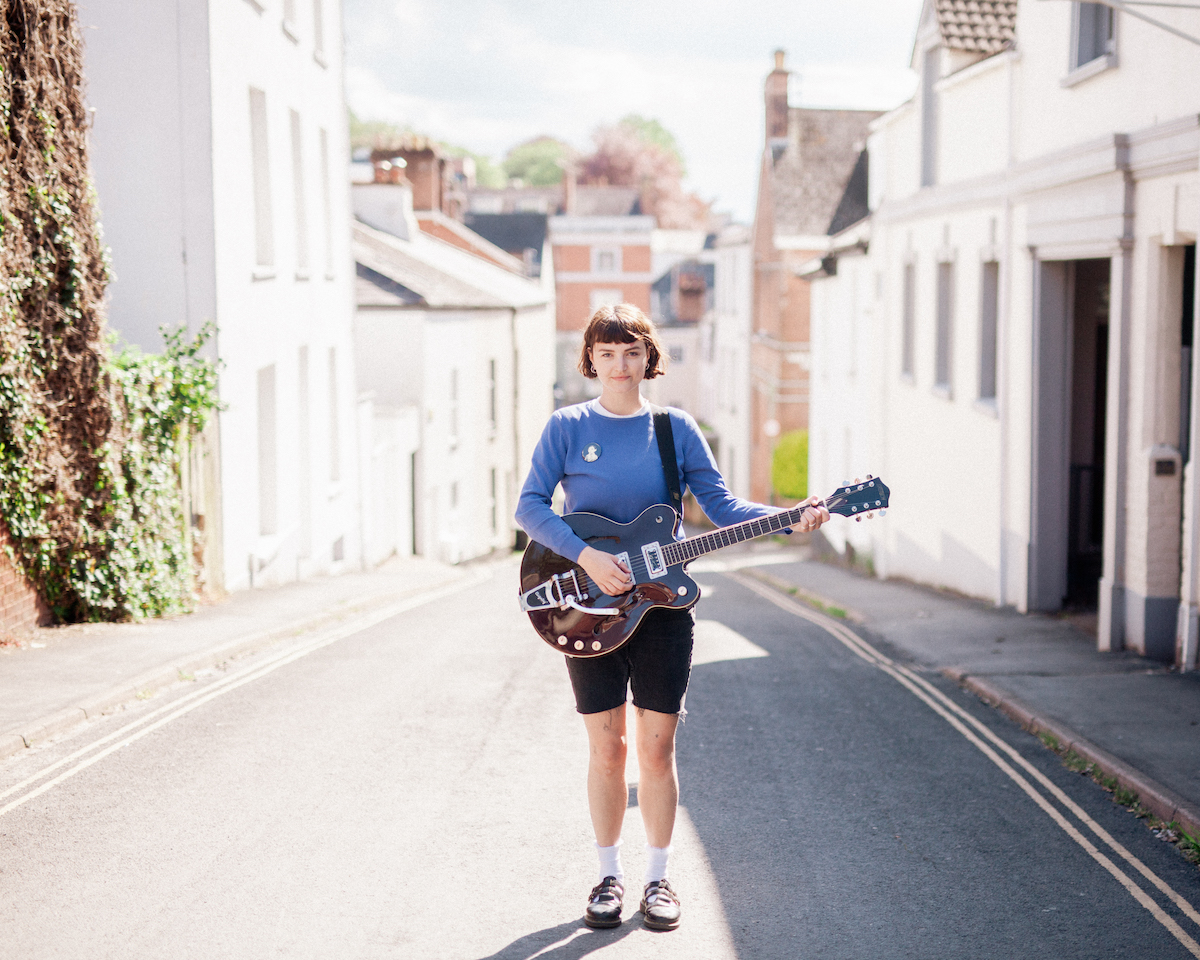
All photos by Robin Christian
To interview Lande Hekt is to engage with a songwriter who has spent over a decade masterfully documenting the friction between personal evolution and political stasis. Rising from the DIY fertile ground of Exeter’s punk scene, Hekt first captured our attention as the frontwoman of Muncie Girls, where her punchy, incisive lyricism served as a blueprint for modern British indie-punk.
However, it is in her solo trajectory that we find Hekt at her most luminously vulnerable. Since her 2021 debut,‘Going to Hell’ (Get Better Records, 2021), she has traded the safety of a full-band wall-of-sound for a more intimate, crystalline architecture. Across the introspective ‘House Without a View’ (Get Better, 2022) and into the expansive warmth of her 2026 release ‘Lucky Now,’ Hekt has transitioned from a voice of a generation to a voice of the self, navigating themes of queer identity, climate anxiety, and the quiet triumphs of everyday survival.
Her latest work on Tapete Records marks a definitive chapter of artistic maturity, blending the melodic sensibilities of classic 80s indie with a contemporary, searing honesty. Here, Lande discusses the transition from the collective energy of Muncie Girls to the singular path of a solo artist, and how she continues to find luck in a world that often feels anything but lucky.
Thanks to Sean Newsham and Matthias Kümpflein with Tapete for the support and to Lande for her time.
James Broscheid: Given your history of writing as a form of “procrastination” or catharsis for anxieties, was it more challenging to find a creative spark in “proper happiness” than it was in struggle?
Lande Hekt: I have always written about things that I’m experiencing at the time, and that’s almost always come quite easy to me. I haven’t consciously found it any harder to write while I’m feeling more positive and less anxious. I guess the notion of having to be low to write poetry or songs could be a bit of a myth after all!
JB: You’ve mentioned this album is about returning to your hometown of Exeter and to parts of yourself previously left behind. In “Coming Home,” you capture specific sensory details like familiar smells and faces; does being back in a quieter corner of the world change the physical rhythm of how you write songs compared to your time in Bristol?
LH: I wrote half of this record while I was living just outside of Bristol and the other half in Exeter. I have always moved around and haven’t noticed a big difference in how I write compared with where I’m based at the time. The only exception to that is when I was living in London, I think the busyness of the city helped me to write songs at record speed! I would finish one song or riff and then move onto another one. That could also have been down to the fact that I was smoking cigarettes out on the rooftop which gave me lots of thinking time. I was chain smoking songs! If I’m honest, the process of writing songs has always been a bit of a mystery to me. One way or another I always seem to get enough songs together for another record.
JB: Working with Matthew Simms, the album incorporates more jangle-pop influences like The Bats and The Chills. You’ve transitioned from being primarily a bassist to a multi-instrumentalist; does the guitar now feel like your primary “voice” for communicating complex emotions?
LH: Guitar does definitely feel like my primary instrument these days, despite as you said, being a bass player originally. I have only really felt confident in playing the guitar in the last few years and even still, not quite as confident as I was on the old four strings! Playing guitar is really hard and every mistake you make is extremely noticeable.
This is the first record I’ve made where I feel that it sounds pretty bang on how I wanted it to. I love indie music and because of my “confessional” style of lyrics, I’ve so often just ended up with almost emo sounding music. I had to make a real effort from the instrumentation to the sound of every guitar part to come across a certain way – and the attention to detail paid off in the end for me.
JB: Did Matthew’s background in more experimental/post-punk music encourage you to lean into “prettier” melodies, or did it push you to find more “distorted” ways to frame your honesty?
LH: I would say that we leaned into distorted guitars on this record. Matt is very learned about guitar pedals and amps and we had a lot of fun pushing the guitars in different directions. We kept the cymbals to a minimum/minimum volume (apart from in choice places) in order to hold space in that frequency to hear the crunchier guitar tones. It was a great process. I also tried to write some pop melodies to go over those guitars.
JB: “Middle of the Night” is a standout for its spare honesty and subtle use of banjo. Does introducing more folk instrumentation allow you to express a different kind of vulnerability than the electric, distorted arrangements of your earlier work?
LH: I think taking a moment in the middle of the record with a song with lots of space in it is a nice way to affect the dynamics of the tracklist. I wanted to add some banjo, in all honesty, because my guitarist Alex found one online and we decided to go halves on it. So, I was excited to add some in somewhere on the record. It feels a little bit like a reset moment on the record, and it does feel like a more vulnerable song than the others as the lyrics are so audible and so plentiful!
JB: You’ve recently spoken about the danger of seeing political engagement as “embarrassing.” In “Circular,” you write about being pawns getting played. How do you view the relationship between the extreme personal joy of this record and the unavoidable angst of the current political climate?
LH: Since I don’t write with as much intention as a lot of people seem to, or even as much as I probably should, I don’t so much notice a relationship between my personal thoughts and my political thoughts. Of course, the two things are so often interconnected, and feeling hopeful on a political level can help you to feel hopeful in your own life and probably vice versa. But what is slightly odd is the way that there has been so little political hope recently for a leftist with dreams of equality, and the fact that I was in a better place personally when I wrote this record. So, I’ve just had to hope that the two opposing themes have sat together comfortably within the album.
JB: Some critics have noted that your vocal delivery on this album is more “measured” and “cool.” Was there a conscious effort to step back from embodying the feelings in order to talk about them more clearly?
LH: I think I probably did make an effort to consider the sound of my vocals in a way that I haven’t done before, given that I’ve never considered the way I sing before this record. I also think that perhaps the style of the songs and the way they sound impacts the way that the vocals come across, as well as the lyrics themselves. When I was in my old band Muncie Girls, I used to sing as loudly and with as much gusto as I could muster. There were barely any moments in that band where that wasn’t my main aim. I do try to include some vocal dynamics these days and probably feel slightly more control over my singing in general. Sometimes though when I’m singing live, the old belting returns whether I mean it to or not!
JB: You’ve previously described your songwriting as a confessional journal used to process feelings you don’t always understand. On the title track, you explicitly link a drinking problem to the loss of a local venue. Now that you are writing from a place of long-term sobriety, does the “mystery” of where songs come from feel more manageable? Do you find that being sober and “in control” makes you a more critical editor of your own work compared to the “flurry of chaos” from earlier years?
LH: I definitely think that being sober makes me a better editor of my songs and helps me to link up how I want my songs to sound and how I’m able to present them sounding. But as I’m nearly at nine years of sobriety, my whole solo project has been pretty deep into my sober life. Things were different in Muncie Girls and I was a lot younger and in a different situation collaborating with my bandmates. I think that songs do still come out of wherever they come out of and most of the time without my say so, so that hasn’t particularly changed. But as I’m a bit more calm and settled in my own life, what’s coming out is a bit less emotionally chaotic.
JB: Speaking of your Muncie Girls era, you noted that political lyrics felt “black and white,” driven by a young, exciting anger. On songs like “Circular” from the new LP, you still tackle protecting democracy against fascism. Does activism feel different to you now, less like a “shouted” manifesto and more like a quiet, “grey-area” meditation on how we survive within a broken system?
LH: I think when I referred to my older political lyrics as ‘black and white’, I meant that if I felt something then I’d say it. I was less concerned about researching every area of a topic before I spoke about it and there was a greater sense of urgency in that. I don’t feel that we should survive in our broken system, I feel that we should destroy our current system and build a new one. My views haven’t become any less radical, I’d say I’ve moved further to the left as things have become worse and worse. I just haven’t got that black and white confidence that I used to have when it comes to shouting about things. I now need to work harder on getting that confidence back, as lots of us do. It’s not just an inevitability of getting older that has done this to me, it’s the mortal blow that many of us felt at the end of 2019 when socialism didn’t win in the UK election.
JB: You’ve mentioned that being a visible queer artist is a priority. Given the relaxed ease of ‘Lucky Now,’ do you feel that writing songs about simple domestic happiness and pets (“Lola” from 2022’s ‘House Without A View’) is its own form of political resistance or choosing joy in a world that often demands queer trauma as the primary narrative?
LH: I think that’s a really interesting point and one that I would love to be true, but I wonder if in this time that we’re in whether choosing joy isn’t actually resisting anything. Only actual resistance is resistance. Boycotting, protesting, campaigning. None of which I do enough of! Being openly queer is certainly important to me and I feel very lucky to be able to be who I am publicly when so many other people aren’t in that position. It’s been so nice to write about more calm moments in my life and I can look back and wonder how I ever lived in such disarray. I find it funny to think that playing in bands and releasing music has been the one constant in my life for the last fifteen years.
Learn more by visiting Lande Hekt | Tapete Records | Bandcamp | Instagram | Facebook | Twitter.