
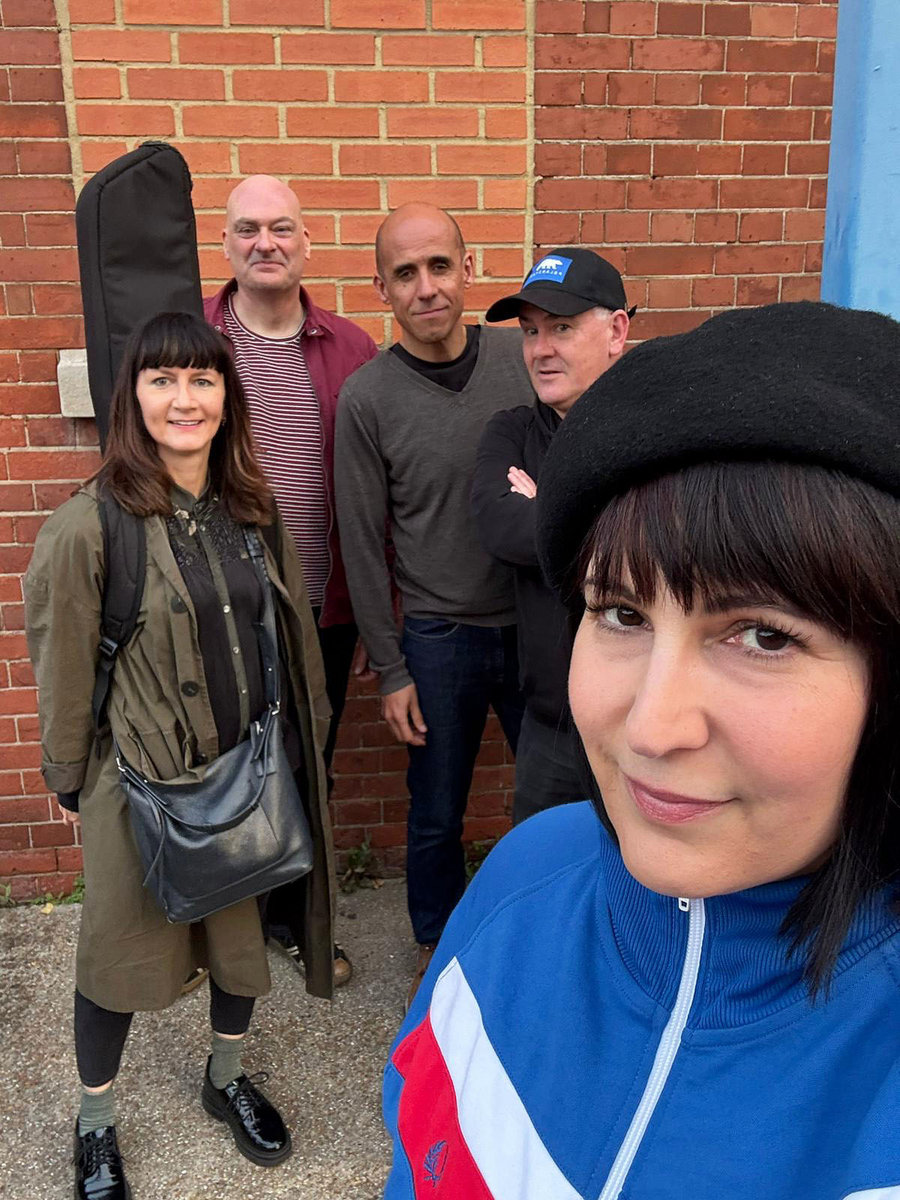
Photos courtesy of Jetstream Pony and Crashing Through Publicity
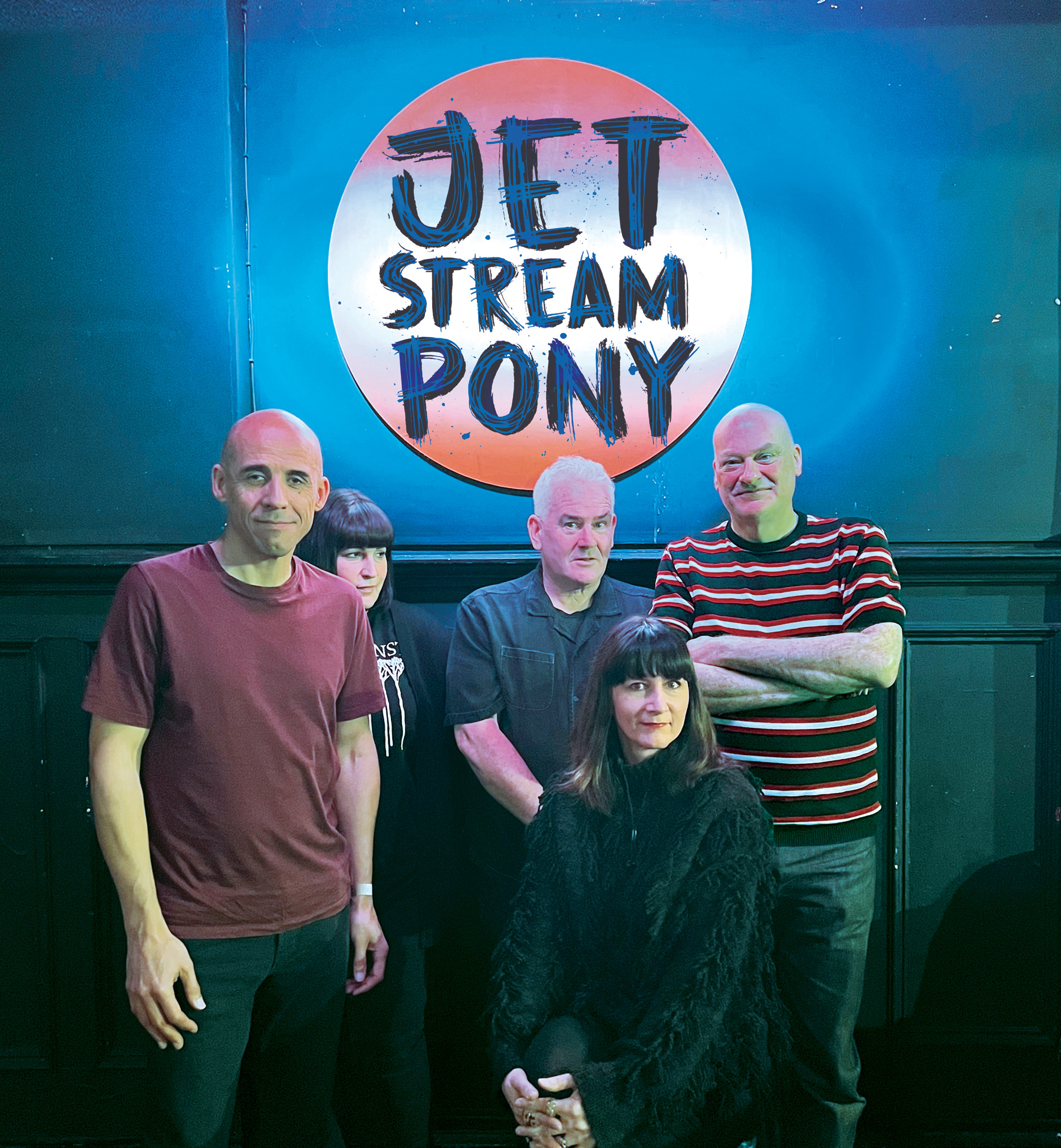
Jetstream Pony have always occupied a curious and compelling space within independent music: a band composed of lifers whose collective past might easily overshadow their present, yet who persist in sounding restlessly engaged with the act of making something new. What distinguishes them is not merely pedigree, though that runs deep from Beth Arzy’s long lineage through indie pop’s more introspective corners to Shaun Charman’s roots in guitar-driven urgency, but rather the way those histories are folded into a living, evolving conversation between five musicians who remain alert to possibility.
That conversation finds one of its most expansive expressions on their recent LP, ‘Bowerbirds and Blue Things’ (Spinout Nuggets / Shelflife Records), a record that refines the band’s long-standing fascination with melody and propulsion while allowing for a broader emotional and sonic range. Alongside Arzy and Charman, the contributions of Kerry Boettcher on bass and Tom Levesley on drums form a rhythmic foundation that is both insistent and elastic, capable of driving a song forward while still leaving space for nuance. The addition of Mark Matthews on guitar deepens that palette further, introducing textures that subtly shift the band’s internal dynamics without disturbing their core identity.
What is striking about ‘Bowerbirds and Blue Things’ is its sense of expansion without excess. Songs like “Bubblegum Nothingness” carry a bright immediacy that belies their careful construction, while tracks such as “Tendrils” and “Bonanza 2 Tango Sierra” suggest a willingness to complicate that brightness with darker tonal undercurrents and unexpected structural turns. The album does not present itself as a reinvention so much as a recalibration, a reminder that evolution in music often occurs through subtle shifts in emphasis rather than grand gestures.
If the LP captures Jetstream Pony in a state of considered development, then the subsequent ‘Riley & Coe Session 09.04.25’ EP (Precious Recordings of London), offers a complementary perspective: the band in motion, responding to the immediacy of performance. Recorded for a BBC session shortly after the album’s release, the EP revisits key material with a renewed sense of purpose, alongside a return to their earliest days with “Had Enough,” a song that predates even their debut. The session format strips away any lingering studio artifice, placing emphasis on interplay and instinct. Here, the group operates less as architects and more as conversationalists, each member responding in real time to the others’ phrasing and energy.
There is a particular clarity that emerges in this setting. “Bubblegum Nothingness,” reinterpreted in the session, feels less like a carefully arranged composition and more like a shared impulse, its melodic core sharpened by the immediacy of execution. The rhythm section of Boettcher’s bass and, in this context, the subtly driving percussion that occasionally includes additional players such as Hannes Müller, anchors the performance without constraining it, while the guitars weave around Arzy’s voice in patterns that feel both deliberate and spontaneous. The presence of collaborators like Matthews, and in the session context even auxiliary contributions such as Lee Grimshaw’s understated additions, reinforces the sense of a band that remains open, porous, and collaborative at its core.
To speak with Jetstream Pony now is to encounter a group that has quietly resisted stasis. Their music suggests an ongoing negotiation between past and present, between instinct and intention, between the private language of long-standing collaborators and the public act of performance. ‘Bowerbirds and Blue Things’ and ‘Riley & Coe Session 09.04.25’ are not simply successive releases but complementary statements, each illuminating different facets of the same creative ethos.
Much appreciation to Beth and Shaun for their time.
James Broscheid: ‘Bowerbirds and Blue Things’ has been described as an evolution. A bowerbird builds elaborate structures not just for utility, but for a specific aesthetic to attract a mate, often obsessing over blue objects. To what extent did the title reflect a new, perhaps more obsessive “curatorial” approach to your sound on this record compared to the “rough-hewn” iPad demos of your debut?
Shaun Charman: Beth got the name from her friend Buddy (Brett Ascott, drummer) from The Chords who posted it on social media; “Bowerbirds and Blue Things make my day”. It doesn’t really have anything to do with the songs on the album but it’s a great phrase, and an interesting bird! Most of the songs were written together over a single few weeks so there is something more curated about it. I was struggling with a block for a while, but Beth sent me several sets of lyrics, I hit a seam and it all came together very quickly.
JB: While Beth’s vocals are one of the band’s hallmarks, Bowerbirds features Kerry (Boettcher) on the lead for “Tendrils” and guest vocals from The Fall’s Eleni Poulou on “The Relativity of Wrong”. How did these different vocal textures change the way you approached the instrumental space? Did you find yourselves playing to the ghostliness of Kerry or the post-punk “youthful misbehavior” of Eleni?
SC: Kerry’s idea for “Tendrils” included both vocals and music, it is her song. It was very short though, I just expanded it a bit. The music for “Relativity of Wrong” came first. I always wanted to write a Fall style song where the parts fit together but not conventionally, I’m really pleased how it came out. Eleni is a friend of hers, Beth had the idea of seeing if she could do it and it all came together. It’s probably my favorite song on the album, I can’t believe we produced something sounding like that, with someone who used to be in my favorite band!
JB: You are frequently described with the German word schrammelig (raw/rough/unrefined). Yet, the Precious Recordings of London session for Marc Riley and Gideon Coe has been praised for its “charged intimacy” and “pared-down immediacy”. Does the live radio format strip away the schrammelig charm, or does it actually reveal a more disciplined core that the studio fuzz sometimes masks?
SC: I’d say live should mean more schrammelig, but I was really pleased how tight we were on the night. Schrammelig originally came from a review of a chaotic but great gig in Hamburg, saying we were “shrammelig-er” than Beth’s other bands. Google translated it as “crappier” which made it even funnier, though it actually refers to a raw, unrefined classical music, played in Austria back in Mozart’s day. We were going to name our first album that, though Ronny (Pinkau) from Kleine Untergrund Schallplatten (KUS) pointed out we’d actually made a well produced album, that wasn’t schrammelig at all. It has continued more as a band in-joke than anything, especially if anyone makes a mistake live.
JB: For the recently released Riley & Coe session, you chose to re-record “Had Enough,” a track dating back to your very first 2017 single. Shaun, you mentioned in the sleeve notes it was a chance to record it properly after the demo-only release. Now that it exists in this BBC-sanctioned form, does the original iPad version feel like a distant relic, or is there a specific magic in those early recordings that you find impossible to replicate even with current technology?
SC: There is a particular quality to the early iPad recordings, the “accidental magic”. Both Ronny (Pinkau) from Kleine Untergrund Schallplatten and Lee (Grimshaw) from Spinout Nuggets have always really liked them, and have suggested we should release them. We are planning to do that at some point, hopefully later this year. At the same time, the BBC studios are great. We wanted to do something different for our fourth session song, a cover or something like that, as used to be the tradition with some Peel Sessions, but settled on the updated version of “Had Enough” as the arrangement has developed over the years.
JB: For the single “Bubblegum Nothingness,” given the title’s juxtaposition of the disposable (bubblegum) and the existential (nothingness), are you making a statement about the permanence of indie-pop in an era of digital transience?
SC: Beth took the title from her favorite author and close friend, Ken Hollings, quoting something she’d read in ‘The Trash Project’ (Strange Attractor Press, 2020), a three-part series of personal reflections on trash and trash aesthetics. It’s not a statement about music or indie pop, but a song about an attention seeking girl in a band she’d taken a dislike to!
JB: Beth, with sourcing titles and ideas from friends, writers, and artists close to you, how important is taste (in knowing what to borrow) to your songwriting identity?
Beth Arzy: I’m not sure I understand the question but “taste” doesn’t come into anything I do, wear, sing or action. I wouldn’t know how to have good taste if I had an instruction manual and not sure I really know what it is.
JB: With the addition of Mark (The Dentists) on guitar, has the band’s internal geometry shifted from being a “dream-pop” unit to something maybe more aggressive and/or rhythm-focused?
SC: Mark has made our sound much bigger live, which is great, but there hasn’t been any deliberate shift. My favorite band is The Fall, and I’m originally a bassist and was then a drummer, so I’ve always been interested in the rhythm section (probably annoyingly!). I’ve always liked songs built around bass and drums, so it’s always going to come out sometimes!
JB: Shaun, you’ve mentioned that Beth provides “fag packets” of lyrics and prose that you then edit to fit the music. For ‘Bowerbirds and Blue Things,’ did you find yourselves writing music specifically to accommodate the more introspective, downbeat nature of Beth’s lockdown-era lyrics, such as on “Sit and Wonder,” or did the music come first, forcing the lyrics into a more propulsive frame?
SC: Not really. I have a collection of music tracks, and flick through the fag packets to see what fits best. I then send back the idea to Beth to re-edit, in case I’ve changed the sense of what she wanted to say. “Sit and Wonder” are actually my lyrics, I don’t find writing lyrics easy but do write them sometimes as well.
JB: Beth, you’ve jokingly called Shaun a “lean, mean, songwriting machine” and admitted to being easily overwhelmed by his output. When preparing for the Riley & Coe Session, how did you curate the four-track setlist?
BA: I can’t really remember as it was probably the others who curated it, or more specifically, Shaun. Then I probably just said “Yeah, yeah, fine…” I’m sure I wouldn’t have wanted to do “Bonanza” as it’s not easy for me to sing, (very high in places), but was probably out-voted so just went along with whatever the others wanted to do, and as they say, was alright on the night.
SC: I can’t really remember either. Away from the session, I’d say my output isn’t always full on. I go through phases when I don’t produce anything! It tends to be in bursts, when I get on a roll!
JB: Beth, how do you balance trust in the collective with protecting your own comfort? Especially vocally?
BA: Balance trust in the collective to protect my own comfort? Well, I can be a bit neuro-spicy and my own comfort comes first so if I don’t want to do something, I don’t do it. Life is too short.
JB: Shaun, On “Only If You Want To,” the dual vocals between your lower, casual delivery and Beth’s “hazy” tones are described as perfectly in sync. Does this vocal interplay represent two different perspectives within the song’s story, or is it purely a textural choice to ground the dream-pop elements in something more grounded?
SC: On many of our demos, there’s an initial version with me singing, so sometimes if my vocals stay on a song, it’s because Beth says “Oh, that sounds good already!” Sometimes I don’t even re-record, my vocals are the demo vocal track. I like the call and response though, like on “If Not Now, When?” (Spinout Nuggets, 2020). It seemed to work on that one, so that’s how we did it.
JB: When your demo vocals stay on a track, does that feel like vulnerability sneaking in through the back door or just efficiency winning out?
SC: Neither really, maybe efficiency. It’s generally thinking the combination of our voices sounds good when Beth records her vocals, so we don’t change it. Often our recording process is to record over the demo again (which is to a drum machine). So, if something sounds good, we can just leave it there. The flip side is that the BBC session does have a spark from being totally live.
JB: With Mark now providing guitars, how has the technical setup for your live performances, like the Riley & Coe Session, changed? Are you finding that the extra guitar allows for more of the layers found in the studio to translate live?
SC: There has generally been two or more guitars on our recorded songs, so it’s just adding another amp on stage! As our songs matured, they did start to depend more on two guitar parts, though I’ve always been worried about filling in all the gaps. Mark and I are both happy just to stand there not playing as well, dynamics are important.
JB: In this contemporary world of indie-pop, how do you discipline yourselves to maintain those dynamics and silence without the songs losing their momentum?
SC: Many of the arrangements are done at the demo stage, rather than playing the songs live immediately, so it’s possible to focus on what the whole song sounds like.
BA: I think my gap filling has to do with my worry about being a one trick pony. I don’t like the cookie cutter, verse chorus verse chorus. Here’s the guitar bit and here’s the bass bit, sing here. I think I feel the need to fill gaps so people don’t get bored. I don’t think there is a conscious effort to maintain dynamics and silence but maybe it’s something to think about?
SC: There is a conscious effort from me, I am happy to not play all the time, if everything is always at 11, you can’t have those moments when a guitar comes crashing in, thinking early Jesus And Mary Chain.
JB: The Riley & Coe Session was mastered in 24-bit/48kHz by Jim Riley at Ranscombe Studios. Given your roots in iPad demos, is there a tension between the high-fidelity expectations of a BBC release and the guitar sound you’ve built your identity on? How do you ensure the polish doesn’t buff out the punk-cured commotion?
SC: We have been much better produced since our first album, so I don’t think there’s a tension there. Ronny from KUS noted that we’d produced something that wasn’t actually “schammelig”, though we have our moments at gigs sometimes! The BBC studio gave us a chance to capture our live sound really well recorded. We’re not over-thinking it.
JB: You’re often described as splitting time between Croydon and Brighton. Does this geographic split provide a specific “commuter energy” to the music? Does the laid-back, creative saturation of Brighton act as the “Blue Thing” (the aesthetic curator) while the grittier, industrial vibe of South London provides the “Bowerbird” (the structural builder)?
SC: This is over-thinking it. It just means Beth has a trek to get to practices! We’re all influenced by more locations than Croydon and Brighton. Beth is very influenced by the Medway and Glasgow scenes, Kerry and Beth are both from American backgrounds, though have both lived in the UK for 20 years plus, I have influences from living in Leeds and still have an affinity with the North.
JB: Beth, both the Medway and Glasgow scenes are famous for their DIY ethos and a lack of pretension. How much of your vocal delivery is a conscious nod to those specific regional sounds versus a natural byproduct of the fag packet editing process?
BA: My vocal delivery doesn’t have anything to do with Medway or Glasgow or else I’d be singing with a Glaswegian accent, which would be nice! I’d love to read an interview where you ask Billy Childish these exact questions; that would be a hoot! I’m stuck with what comes out and just trying not to sound shit.
JB: Local Brighton contemporaries like DITZ have noted that the city’s scene is becoming oversaturated and hyper-competitive. As musicians who have navigated this landscape for decades across various projects, do you find that atmosphere forces you to refine your stagecraft, or do you navigate it in some other way(s)?
SC: I don’t think we’re really connected to a Brighton scene, though there are loads of bands here. We’re a different generation to those coming up. I’m actually old enough to remember before there was much of a Brighton scene (aside from bands like The Chefs), it has changed a lot over the years.
JB: Do you find that being outsiders in your own city gives you more freedom to ignore indie-pop standards and stick to the aesthetics you actually care about? Are there any Brighton bands who have caught your ear lately?
SC: I don’t think there is an obvious “Brighton scene,” just Brighton bands, though I’m a completely different generation so maybe I just don’t know about it! Asking our new music expert Kerry, she mentioned Swallowtail, I’d add Ciel. Kerry goes to far more gigs than I do these days. Beth too, though she lives in London, she goes to them there.
JB: Your music videos and live visuals often involve Innerstrings (Chris Tomsett), a staple of the Brighton psychedelic/indie scene. How integral is this specific “Brighton visual language” to the way you want audiences to perceive the more brooding tracks like “3am” or “Tendrils”?
SC: Chris is a mate, and would need to answer for himself, but he’s based outside Brighton in Lewes, Sussex. He’s a big shoegazer. I don’t know whether he would consider the fantastic videos he makes as Brighton visual language. He worked brilliantly with Kerry on the video for “Tendrils,” they had a lot of fun with that. He didn’t make the video for “3am” which was a compilation of clips from a fantastic trip to Norway.
JB: After the charged intimacy of the Riley & Coe Sessions, are you approaching club sets with a different mindset?
SC: Not really. I think we’ve stepped up as a live band over the last couple of years. Mark has made the live sound beefier, the session just confirmed we could play well live when we need to.
JB: As you look toward 2026 dates, are you finding it difficult to reconcile the charming rough-hewn iPad-era tracks with the new arrangements of ‘Bowerbirds and Blue Things’? Is it logistically out of reach to plan any U.S. dates?
SC: Again, we’re not over thinking it. Our songs have have always had more than one guitar, the first album too. With Mark in the band we are better able to replicate our recorded sound. In terms of U.S. dates, it’s difficult at the moment. U.S. working visas are very expensive for UK bands (not replicated the other way round). It would be great and logical to play in the U.S., but what is happening in the States at the moment is also more than concerning, so not sure. One day it’ll be easier, hopefully!
JB: Agreed. Given the concerning political climate and the prohibitive costs, do you feel that the internationalism of the indie-pop scene is at risk? Does this make the German and European connection feel more vital to the band than ever before?
SC: Postage has become crazy expensive across any borders, from the UK to EU or U.S., it’s becoming almost prohibitive to sell records to different countries. I do love continental Europe though, I just like being there. It would be great to come to the U.S., we have two Americans in the band, I have been many times in the past, but I wish things were different there at the moment.
JB: Given your history with German label Kleine Untergrund Schallplatten and recent shows in Berlin and Kassel, do you feel your music is understood differently by European audiences who specifically champion the schrammelig aesthetic compared to the UK’s more refined indie-pop standards?
SC: I don’t think Germans have a different understanding, but we were on a German record label for the first few releases so we do have a following there, and have been many times. I’ve always had a big interest in the country, culture and football scene, watching St. Pauli when I get the chance. It’s always lovely when Germans (many of whom are now friends), turn up at random gigs, we’re always really pleased to see them!
JB: 1. FC Union is my team! My wife and I were married in Berlin so there is a great affinity for Germany here! Does the cult status of a club like St. Pauli parallel the way you view the band’s relationship with Kleine Untergrund Schallplatten and Jetstream Pony’s music in general?
SC: I’m actually watching them on TV now, Union against Eintracht Frankfurt! Whenever I’m on holiday, I will normally sniff out live football, so I have been to the Alte Försterei many times as I do love Berlin. When I was learning German, I used to listen to football commentaries. I could say, “Off the bar, that was close!” but not be able to order a coffee. I don’t think of us as deliberately cult, KUS are very bound up with Augsburg in my mind, an oasis in an otherwise quite conservative Bavarian town. They have an amazing scene there of great indie bands though.
JB: When German fans turn up unexpectedly, does it remind you/confirm for you that records travel further than scenes ever do and will last long after scenes move on?
SC: I don’t know about that, as it is a scene in itself. Many of our German friends know each other, and go to gigs of other bands on similar labels. It’s a scene, but an international one.
JB: Several tracks on ‘Bowerbirds and Blue Things’ carry a more inward, observational tone. Did lockdown change what you wanted to write about, or just how closely you were willing to look?
SC: Beth is a magpie for words and phrases and pulls them together really well, though I don’t think it had anything to do with lockdown. I actually had a bit of a block during lockdown, it was almost having too much time! Kerry also writes for her songs, Tom wrote the lyrics for “Birdland ’74,” there are some different perspectives in there.
JB: Since the Riley & Coe Session, are you now more likely to record as a full unit to capture that live energy rather than layering parts individually?
SC: I would like to do that, but you need very expensive studios, which the BBC has. There was a definite spark to that BBC session, it has made me think about how we can record “more” live, even if we can’t do it completely.
To explore Jetstream Pony’s latest work, including ‘Bowerbirds and Blue Things’ and ‘Riley & Coe Session 09.04.25,’ head to Bandcamp | Spinout Nuggets | Precious Recordings of London | Facebook for further details and purchasing options.