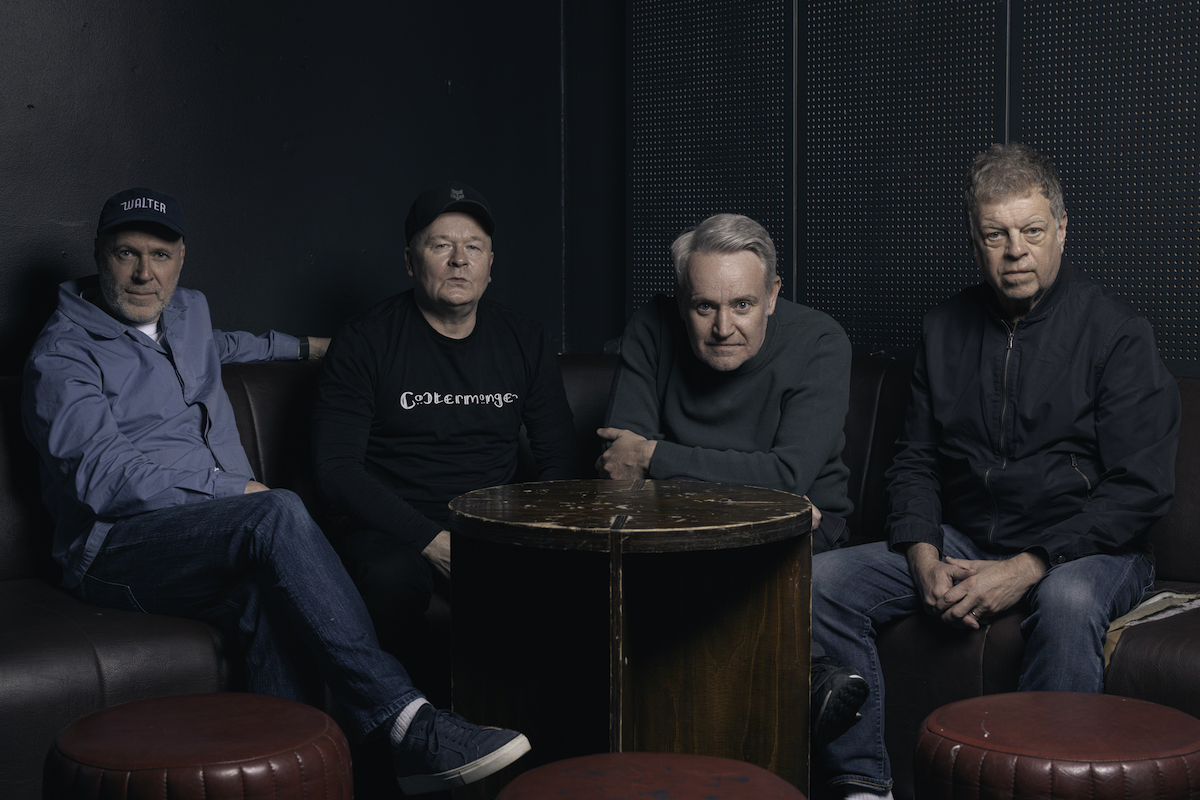
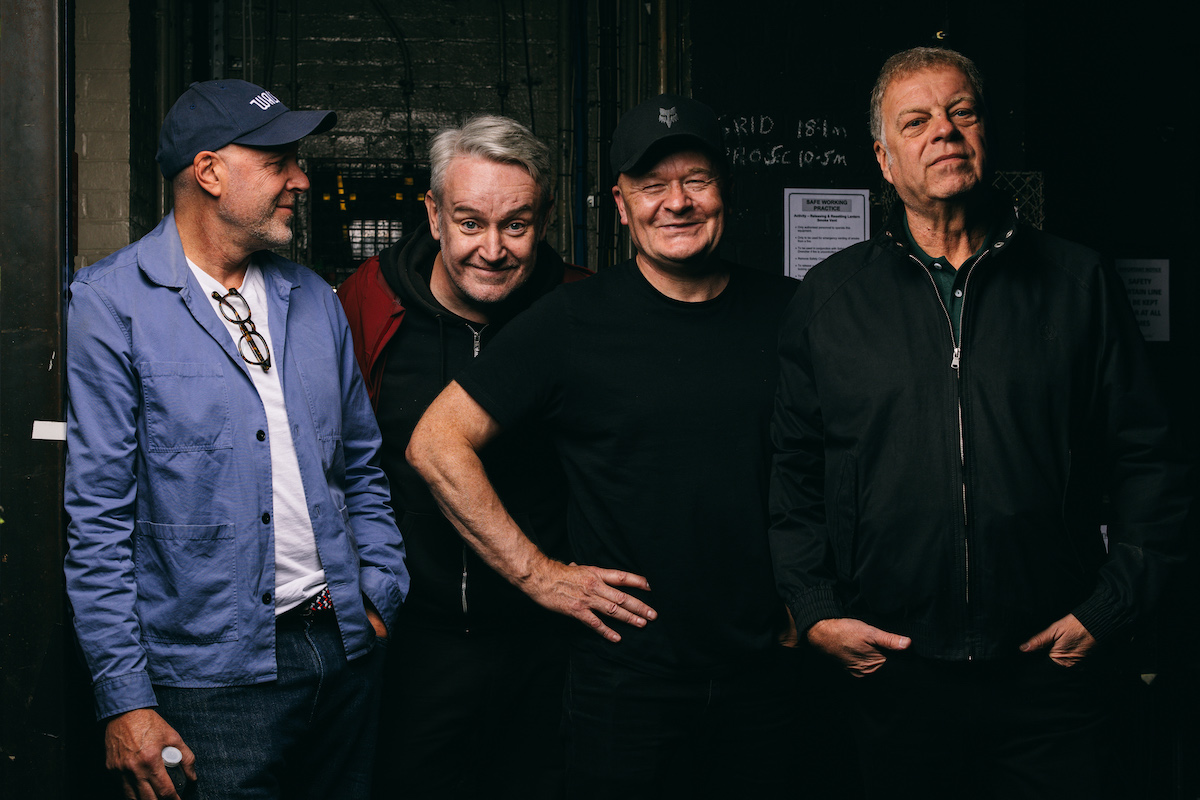
All photos by Jim Mitcham
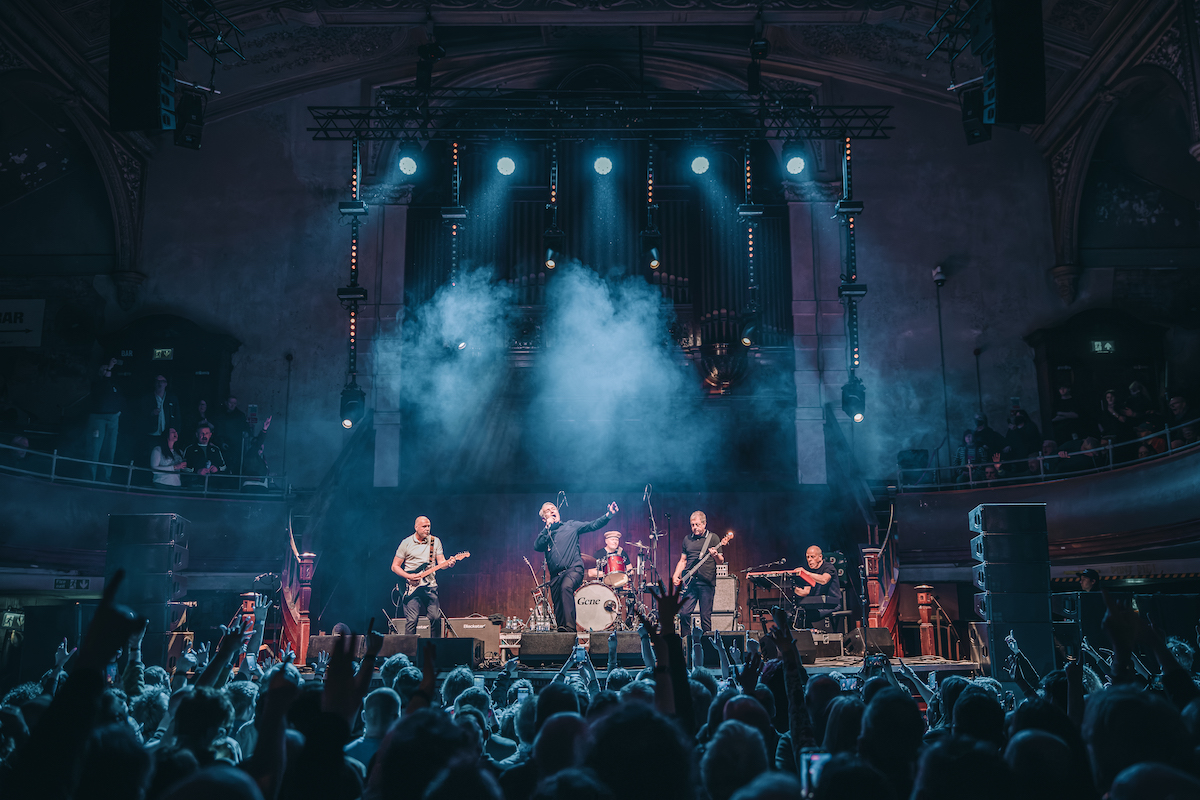
There’s a particular kind of silence that falls over a room when a band that has been gone for two decades walks back on stage. It’s a few thousand people quietly checking that what’s happening is real. In October 2025, at London’s Eventim Apollo, Gene stepped into that silence and, within a bar or two, completely broke it.
For anyone who came of age in the mid-nineties, Gene were never the loudest name on the bill, and that was part of the appeal. They formed in London in 1993 and arrived in the thick of Britpop’s swagger, but they were a band for the person standing at the back of the party. Martin Rossiter’s voice was the reason. He was dramatic, but never fake, and hurt without ever seeming fragile. The comparisons to Morrissey came quick, and though that shortcut sold Rossiter a bit short, it wasn’t hard to see where it came from. He sang about heartbreak like it deserved real attention, and his choruses could land as a call to arms with equal intensity.
But a voice like that needs something to push against, and Gene had it in spades. Steve Mason’s guitar work gave the songs their ringing, urgent shape, bright enough to lift a chorus and sharp enough to cut through it. Kevin Miles on bass and Matt James on drums were the engine room, the part of the band that made all that emotion feel built rather than spilled. Four people, each essential, and none of them replaceable.
Then, in 2004, it ended. A farewell show, four albums, and a long quiet that stretched far past what anyone expected. Rossiter eventually wandered into solo work, writing quieter, more personal songs, and became known as one of the most disarmingly funny and candid people in music (you will read why below). The idea of Gene returning became one of those wistful maybes that fans traded online, half hope and half superstition.
What changed? According to Rossiter, it took some gentle persistence from Alan McGee, the Creation Records founder who has never been shy about telling musicians what he thinks they should do. Add the thirtieth anniversary of their debut, ‘Olympian’ (Costermonger / Polydor, 1995), and a rehearsal room where, by his account, old habits and old chemistry returned almost embarrassingly fast. The sold-out London shows turned into a live album, then a run of dates across the UK and Ireland, and now North America.
Reunions can be cynical, a victory lap with a merchandise stand. They can also be something quieter and braver: four people in their fifties deciding that the songs they wrote as young men still have something to say, and that they might finally be old enough to play them properly.
The conversation below took us through the long gap and what filled it, about meeting your younger self through your own lyrics, about nerves, ego, friendship, and what it means to be asked for the old songs by people who’ve grown up alongside them, amongst other present-day dilemmas. Rossiter is generous with a story and not remotely precious about himself.
Special thanks to Jo Murray for the arrangement and to Martin for the great conversation.
James Broscheid: The last time I saw Gene, you came through Tempe, Arizona, and played Nita’s Hideaway in 2002. It was a very small club and the band did a full set and then disappeared very quickly afterwards.
Martin Rossiter: Oh, sorry, maybe we had to get somewhere. I do remember that. I think we’ve been to Arizona four times and I think my Welsh-ness impacted the weather because it rained three of those times. So, I’m claiming some sort of special power there.
JB: Come back to Arizona, please. We always need the rain!
MR: Yeah, okay. Maybe people could pay me as a sort of personal cloud seeder.
Like the cloudbuster in “Cloudbusting” by Kate Bush (off ‘Hounds Of Love’ released by EMI in 1985).
JB: It is the same for everyone out west. Not enough water. Some are really worried about climate change and others think it is a hoax or now, deregulate. Whether you believe it or not, what is the problem with treating the Earth better?
MR: I follow American politics really closely, actually. Partly because I’m interested and partly because I’ve got family over there. I saw a thing recently where (OpenAI co-founder) Sam Altman, who’s a living embodiment of evil, was asking people to consume less water so he can make more AI slop.
JB: In Arizona, one of the big sticking points in the gubernatorial race was water. Do we continue to allow the Saudi Arabian government to farm alfalfa over here where one plant takes 20 gallons of water to grow? Our current Governor is really pushing back on foreign investment in land and using up valuable water resources.
MR: You could have said gubernatorial, then I still would have known what you meant.
It’s not a word that we have, but I follow closely enough to get the lingo!
JB: (Laughs) On to Gene! Martin, I never thought this day was going to happen!
MR: Nor did I, I’ll be honest with you. I said in my normal sort of pithy way that I’d rather fry my testicles with some fava beans than do this, (James laughs). You know, I think one’s allowed to change one’s mind so here we go. When we originally met up back in January last year, it was fascinating to watch the same dynamics return within 10 minutes between us. Albeit in a far gentler way. On tour, I always used to share with Kev, so he and I would be in the same room, and we have a similar sense of humor. So, the joking started almost instantly, and I thought, “Oh, this might actually work!” At the first rehearsal, all of us were glancing at each other, and had this realization that, although, of course we were rusty, the songs were still so strong. That was a lovely moment. I don’t think we were particularly of our time, which is to our benefit now.
JB: I agree.
MR: The songs sounded as fresh as the day they were written. It was quite a magical experience, actually.
JB: Sounds like the four of you just picked up where you left off?
MR: It pretty much was that. I mean, collectively, maybe we were 100 pounds heavier, but ostensibly, yes, it was exactly the same. I remember having little knowing glances with Kev that were identical to the knowing glances we had when we were young, slim, and fabulous, (both laugh).
JB: Yeah, and being away from Gene for 20 years, you built a life in which you were no longer defined as a front man for a band it. What did you discover about yourself during that time that made a return to Gene possible?
MR: That’s a really good question. Well, I’ve been teaching for 20 plus years, and it’s only in the last year that I haven’t been teaching, one of the things I learned very quickly is that any reputation you have is, certainly within the realm of teaching, not worth the paper it’s written on. In the sense that, if I had a new cohort of students, I’d never tell them anything about what I’ve done. My reputation as an educator, I suppose, relied on me being good at that job. Gradually people would Google all their teachers and discover my work in Gene.
It was interesting because when Gene first started in 1991, I’d done loads of different musical projects before that. I tried DJing and I’d been a keyboard player in what can be best described as a galloping gay disco band. I’ve done lots of things and, like almost any music fan, my taste is wide, and it’s varied. It goes from some house music to a lot of hip-hop. At that time, I was massively into the 3rd Base, Queen Latifah, De La Soul, Monie Love, Jungle Brothers era of hip-hop. I love the lyricism of it.
But I was also listening to Hüsker Dü and the Pixies and that whole Seattle thing at the same time along with lots of other things, of course. And so, quite often, I think people assume that you only listen to the sort of music that you make. Actually, if that disco band got off the ground, which it didn’t, I might be perceived as the keyboard player in a disco band. If my DJing, which was quite horrific (both laugh), had worked, who knows what I might have ended up doing. It’s just the fact that the first musical project I did that gained some traction was Gene, and so there’s this assumption that that’s all you can do. So, going back to the question, it was interesting with my students because they didn’t know what I did. I worked with people who made hip-hop, I work with people who are folk singers, I work with metal bands and a whole range of other things. And so, it was rather lovely to be perceived by all those students over the years, some of them I’m still in touch with, some of whom have supported us, some of whom have gone on to have really good careers, they don’t perceive me as the front man of Gene.
They just perceive me, hopefully, as a musician who helped them get a little bit better. That is the primary thing that I learned about myself as a musician and other people’s perspective of me. I know a rapper from Bristol who would always love to work with me just because we bonded over lyrical dexterity. Even though I don’t make hip-hop, I love hip-hop, I would be the person he would come to for advice. We’d talk about rhetorical devices and all sorts of rhyming schemes and different flows and all that stuff. So, I’m perceived as a much wider musician by all those people now. I’ve done soundtracks for the BBC, I work with pop artists and Gene, which I love so don’t get me wrong, but it is not everything I do. Obviously, it is a huge facet, and it’s something I deeply love. I’m really proud of and now obviously it’s forward-facing, again. The really interesting thing about our band is that we’ve got such a weird mix of influences. If you take the vocals off there are moments where it’s a little bit Simon and Garfunkel, there’s moments where it’s quite Queen, there’s moments where it’s very Small Faces. Matt’s a massive reggae fan, so there’s reggae moments.
It’s that lucky thing of the four ingredients somehow working. And I think sometimes that’s just all it is. If you look at John Lennon, Paul McCartney, George Harrison, and Ringo Starr, if one of them hadn’t been there, maybe there’d be this sort of small band that only a few people remember from the ’60s. Sometimes you have to be honest, it’s just chance. It’s like choosing the right herbs and spices to work together for a dish.

JB: Back in the 90s, we had we had alternative or grunge going on over here and in UK, there was Britpop taking off. I don’t think Gene really fits under that label.
MR: No we didn’t. To be honest, that’s probably why we didn’t sell as many records as not all, but some of our contemporaries. Don’t get me wrong, I’m not whinging here. You know, if I had to get up at six in the morning and clean somebody’s office, then yeah, I’d have the right to whing. I don’t want to give that impression but a lot of those bands and artists worked because, and this isn’t a criticism of them, it’s just an observation that their records did what they said on the tape. So, I always use my sister. My sister is the archetypal music buyer in the sense that she’s quite often the last person to come to something. I remember, saying to her, “Oh, I heard this wonderful artist called Adele a year and a half after Adele had been selling millions of records. It comes to her in terms of if you imagine your audience is a target, she’s one of the outsets where she’s worth two points rather than ten. She likes a record where, if she puts it on shuffle, she knows what she’s going to get emotionally. So, whether that’s an Adele record or a Coldplay record or a jazz record or whatever it might be, you put anything off from a Coldplay album, and you’re going to get that sort of emotionally mid-tempo, spacious, sometimes some great melodies, but that’s what you’re going to get with every song, and that wasn’t the case with us. I think, in some ways, that hindered us a little bit, but I also think that’s what makes us quite special.
JB: I agree. Listeners can latch onto a sound like Coldplay because they can recognize a Coldplay song immediately, whether it was off the first album or the last album. That familiarity, I think, drives what people like, which is a huge mistake because, ultimately, they’re missing out on so much.
MR: You have to remember that most people who have money to spare on music, whether it’s through a Spotify subscription or still going out and buying vinyl or whatever it might be, are not necessarily huge music fans. Like my sister, who I talked about, she loves art. She loves going to the Tate (Britain, museum for British art from 1500 to present), and Tate Modern (museum of international modern and contemporary art), and she really understands art in a way that I don’t.
If you flip that around, I understand music in a way that she doesn’t. So her consumption is very different from mine, and most people are like my sister when it comes to music. You do get some people who you know, for instance, are attracted to a certain type of melodic or harmonic thing. They might not be able to analyze what that is or, like a friend of mine’s mother self describes his liking as crashy bashy music, certain people like things. For drum and bass fans for instance, it’s all about whether they can dance at half time, and that’s why it appeals to them. There are lots of different reasons why people like music, but most music consumers don’t know what that is. It just is what it is, and only nerds like me and you analyze the stuff.
JB: Yeah, you learn about your favorite bands and what turned them on, enabling you dig further back. I assumed everybody did that, but they don’t. I have found that, as we age, hopefully we mature, and as we mature, we get more curious. We become more intellectual because of that curiosity, and I’m just amazed by people that remain
stagnant in their thoughts and tastes.
MR: Yeah, true. When I was a kid, you self-identified through what music you liked. You’d go to school and you’d try and copy, with a felt pen, the logos of the bands you liked on your school books (James agrees). That was a way of finding other people who were like-minded. That’s grown. Now, people identify through video games or they’re skaters or whatever they’re into. But we only had music. That’s all we had, and so that sort of gang mentality has been diluted, I think a little bit.
Although, having said that, the flip side of that, I mean, I know a lot of young musicians who are far more collaborative than we ever were. They’re far less tied to a particular genre or approach. I mean, I’ve never understood why record shops organize their music by genre. Why don’t they organize it by songs that make you cry? Then you could then you could have Carol King next to the Smashing Pumpkins next to, I don’t know, Jimmy Cliff. For some reason, we’ve decided to categorize music by one group of quite narrow criteria.
One of the things that makes Britain traditionally punched above its weight is our geography. We are a small enough island where we could have National radio. What that meant was because we had Radio One, which for any American reader, Radio One was a radio station that covered the whole country, and so it was hugely varied in the sort of music it played. It would have specialist shows so you could go on to Radio One at a random time and listen to Bulgarian folk music one minute Mariah Carey the next and Iron Maiden another time. What that meant was the British listener wasn’t siloed into genre-specific listening. Whereas in the states you have country radio, you have R&B radio or you have hip-hop radio. Quite often that’s all that people hear. I mean, one of the reasons I think Prince was so amazing was because he grew up in Minneapolis. It had quite a small black population, so he got jazz from his father, and R&B and hip hop from his community, but the main thing there was rock radio. He had the opportunity of merging those influences. In the UK, we all had that opportunity of merging those influences and the younger generation now, they’ll listen to anything. I think that is really healthy, although I have to admit, I do miss the idea of us against the world!
JB: Yeah, I get that. I’m originally from Cleveland, so I know exactly what you’re talking about with the Midwest in the U.S. Genres were limited to radio stations that catered to them. The only diversity that you could find was tuning into college radio College radio is exactly like what you were saying about Radio One, because they would have different DJs doing different forms of music every hour.
MR: Though college radio wouldn’t play the pop hits of the day would they?
JB: No. College radio would rarely play Top 40.
MR: That’s the thing. With Radio One you would have the pop hits of the day, but you would also have country, R&B, alternative … all on one station.
JB: That’s where you’d have artists over here like R.E.M. who would cross those boundaries. They came up on college radio and then that transferred to mainstream radio. College stations would still play R.E.M., even when they did get popular.
MR: We would also have Britney Spears next to R.E.M. I think that’s really healthy. I think that’s genuinely healthy. So, it’s an accident of our geography and the size of our country and the fact that we have the BBC, which is a license payer-funded organization. That political will to create the British Broadcasting Company plus the size of our country is the reason that we’ve punched above our weight.
JB: On top of that you had John Peel (1939 – 2004).
MR: Yeah, John Peel was Radio 1, Andy Kershaw (1959 – 2026), was Radio 1 but so were DJs like Bruno Brookes who would just play the pop stuff but that meant you heard it all. I should write a book about this because it’s quite an interesting topic, that sort of accident of geography but I’m too lazy, sadly (both laugh).
JB: Coming back to the Gene reunion, was there something from your musician days, before you started teaching, that you’d talked yourself out of wanting, but that you’ve realized you miss now that it’s back in your life?”
MR: Yes, actually writing songs. I didn’t stop writing music, but I did stop writing songs. I work with a friend who’s a 30-year-old German producer who produces lots of people’s pop records. I mean, he’s currently in the states working with writers over there. He’s brilliant, but he’s making pop. I’ve worked with him, and sometimes he calls me in to help with toplines for artists, just certain melodic shapes.
The stuff I did for the BBC was quite left field rock for this weird kids drama about football. I’ve done lots of library music instrumentals, ranging from kids music to moody piano in a Nordic Forest-type stuff.
I’ve made some hip-hop instrumentals. I’ve done all manner of stuff, but I did stop writing songs, and we’ve just started writing songs. I feel like I’ve got something to say again. Maybe I needed that time to feel like I’ve got some bile to spit out into the world or a little love.
JB: Did you notice any change in the way you communicate with Steve, Kevin and Matt coming back to Gene?
MR: Um, yes and no. The no is we are essentially the same people. None of us, and myself included, have changed that much, but the one change we have made is we’re learning which hills to die on. Whereas we would die on every hill, all of us, when we were making a record. We could fight about the placement of one hi-hat hit, but sometimes I think there’s a modesty that comes with age in the sense that, I quite often sit back and think to myself, “Well, I don’t know if my opinion is more valid than anybody else’s.” We never had that sense of reflection when we were younger. Sometimes you sit in rehearsal and think, “Well, I think this and that person, who I trust, thinks that. Who am I to say that what I think is right?”
JB: How would the band reach consensus then?
MR: Oh God, we were the world’s worst democracy and the fact there were four of us … the number of times it was a 2-2 vote! Now you know sometimes. It’s the beauty of deference. Just deferring to somebody thinking, “You’ve made some good decisions about this in the past.” I instinctively don’t necessarily feel it’s right, but it would be arrogant to think that just because you feel it, doesn’t mean you’re right.
And who’s to say who is right? If the four of us were to put together a Spotify playlist of our favorite 12 Gene songs, they’re going to be four very different lists. And that’s not to say any one of those lists is more valid than the other.
I suppose we’re embracing this subjectivity of the music making process and that’s what makes us, like I said, are these four weird people who for some reason when it does eventually come out the other end through somebody’s speakers hopefully, most of the time, it makes an interesting noise.
JB: What classes did you teach?
MR: My official job title was Principal Lecturer of Songwriting. I worked with students who are in the Songwriting Department, but I did more than just songwriting. I taught some music business, quite a lot of performance skills as well, but songwriting was what I did. I used to have a lot of one-on-ones every week with writers and we just sat in a room with a guitar and a keyboard.
They would come in saying, “This is my song, what you think? or “This is my song and I don’t like that bit. Have you got any ideas of what I can do to change it?” Quite often it’s a tiny little change that can make a huge difference.
I used to take “In My Life” by The Beatles (from ‘Rubber Soul’, 1965) and play it diatonically. Music theory people will know what that means. Basically it is playing it, but without any of the notes that aren’t in the key in it. When you play “In My Life” diatonically, it’s okay, and three or four small changes, going back to the original chord plan of what The Beatles did, where they used things like secondary dominant chords. So, in other words, notes that are outside of the key it was written in, and then it’s a masterpiece.
Quite often, people will write a song, and it will be two or three small changes away from being brilliant. That’s what I think a lot of writers need to understand, is that your song isn’t necessarily finished after the first draft.
JB: So this was at the college level?
MR: Yes, degree level or what we would call university. You call it college and we use all manner of different words to describe our educational system (both laugh), basically because of the history of it. I mean you, if you go to Oxford, you go and study at college, but you’re at university.
It’s terribly confusing. A bit like a city that’s been built up over generations. If you go to Split in Croatia, you can see the Romans split, the medieval split, the 19th century split, the modern split. It’s a little bit the same with our education system. I’m not going to quibble over this (more laughter). When I do interviews, I’m like a river, but I often break my banks and go off in an entirely different direction (laughs).
JB: Going back to Brit pop, it was an era when British guitar music was increasingly packaged. I thought Brit pop reduced music to personality, fashion, and commercial accessibility over music.
MR: I’ll tell you what it was. It was capitalism. The British music industry traditionally, when they don’t know what to do, they revert to what they know which is predominantly (not exclusively), white men with guitars. We’re not as racially diverse as the United States, although we are fairly racially diverse. So, the British music industry will flirt with garage music, not garage music as in Iggy Pop, but garage music in the form of dance music. It’ll flirt with it and fifteen years later, it flirted with grime (fast-paced electronic/hip hop). The gatekeepers in the British music industry are predominantly white men, and so they revert back to what they know.
Britpop was a period where that happened. It reverted back to white blokes with guitars, and it spent the money on it. Three years earlier there were bands like The House Of Love, it would have been a triumph for them to get a Top 40 hit. If they scraped in at number 38, the enemy would be singing to the high heaven’s gate, “One of our bands has broken the top 40!” Then three years later, the industry decided, “Well, it’s guitar music for the next four years.” So here we go, and we’ll give it a name. A few years ago, I did an interview for Kevin Cummins, the photographer had a book coming out about that era with photographs he had taken of us, Pulp, Blur, Oasis, all the usual suspects (‘While We Were Getting High: Britpop and the ‘90s,’ Cassell, 2020). And for a few of the people who are in the book, he gave us an email set of questions to answer which features in the book. While I was looking at these, I went back and I looked at, I might have the year wrong, it was ‘95 or ‘96 but around that time, I looked back at all the NME covers from that year. If my numbers are one or two out, it doesn’t really matter because the point stays the same. I think 49 out of 52 covers had men on the front. I think there were only three or four people of color on the front, maybe seven women on the front.
It was like a roulette wheel where 90% of the holes where the ball goes in were white and male. And that was, again, about the gatekeepers. So, if the music publishers are white and male, if the music press is white and male, if the people in the record companies are white and male, if the producers on most of the radio stations are white and male, guess what is going to happen? There are some great records that came out during that time, and I’m white a male. I was in one of those bands with three other people who were white and male. I have to accept that we probably got our chance because of the timing.
And that’s not to say there weren’t some really great records made. I look back, and I listened to something like “Beetlebum” (off Blur’s 1997 self-titled album, Food Records_/_Parlophone). What fantastic record that is. What a wonderful, wonderful record. I think it would have been a richer period of music, even if it was still called Britpop, if it actually reflected Britain.
JB: Especially in light of what Britpop and the UK music press did to other bands in the UK at the time.
MR: Well, I just like more diversity. Not just diversity in terms of race or color or ability or gender or sexuality, but just diversity in sound. I think this is why people love The Prodigy so much who were running parallel to Britpop. Oh my God, how exciting were they? They were really genre bending and breaking loads of rules. Dance kids like The Prodigy, indie kids liked The Prodigy, metalheads like The Prodigy because they did that British thing of really throwing the pot in rather than just listening to a few old Kinks records. I see it now. Of course, I didn’t see it like this at the time but I say it now, as a product of the economic conditions and the bias within capitalism.
JB: You mentioned teaching earlier. I wanted to get your impression on, from then to now, how you have seen the music industry change?
MR: It’s utterly different. I mean, Napster changed everything in the early 2000s with the ability to file share. Then streaming changed everything after that. So they are the two major moments in changing how people consume music. So, the initial model is broken. The three majors that are left are rather like massive oil tankers because they take a hell of a long time to turn around. Universal have just announced I think 5,000 job cuts even though their income is still going up, but it’s not enough for the shareholders. It’s all politics and it’s all economics. It’s rather heartbreaking. One of the things that I was reading yesterday actually, is that songs have started to get longer again because two things have happened recently.
We’re looking at the data people have noticed that I think it’s something like, and this might just be a UK figure, but I’m sure it applies to the states as well, that 70% of music listened to now on streaming services is over 5 years old. So, this is making it a lot harder for new artists to break. Spotify was shortening songs and literally changing song structure. You know, getting rid of any of middle-aged bridges, pre-choruses, just go verse-chorus-verse-chorus bye. No intro, no outro bang gone. I think the audience is craving a little more substance and so songs are starting to get longer again. You’re starting to see a shift towards people enjoying a narrative. Even something like “Messy” by Lola Young, whether you like it or loathe it, I actually think it’s a really good piece of songwriting, but there’s something actually being said in that.
That resonates with people even sort of younger people who still want Pup per se, but I’d much rather they were listening to that than something that’s been reduced to one minute 50 where all that really matters is the 20 seconds that gets linked on Tik Tok. I see it with artists that I know that I’ve taught over the years who are just having to constantly remake the 20 seconds or rebroadcast rather, the 20 seconds of the track that’s the hook for Tik Tok or Instagram streams and do it 30 or 40 times in different contexts. I know these people and they don’t want to do it. We were lucky we did. People can talk about content. Young artists now are not going to succeed unless you’re really good at film editing and filming and understand lighting and search engine optimization and understand algorithms on various platforms. I mean, it’s hideous for them. I taught this amazing songwriter called Natalie Nadelkovich who was from Sweden. She was one of the most naturally gifted songwriters I’ve ever met in my life and other people who heard us said the same thing. She’s astonishing. She would leave people in tears in the room, but she didn’t have that organizational mouse that is required because nobody’s going to be like, “I’m going to put the 40 hours a week into managing you when I’m not going to see a return for three years.”
So, it’s a great shame that you know the idea that the cream rises to the top is nonsense. Because if the cream was just how good you are writing a song, you could perhaps squeeze out an argument for that. But when the cream involves your ability to afford the right camera, those ring lights, knowing how to frame yourself, know color theory … it’s knowing how self-promotion works. Music is about ninth on the list. Wherever anybody’s reading this, there will be somebody in your town who is fantastic and maybe a bit shambolic who is not going to make it, and that’s really heartbreaking.
JB: Martin, where do you think AI lands in all this?
MR: That’s a very good question. I think about this a lot. (French streaming service) Deezer claim that 3% of the music on their site is AI-generated and they’re trying to get rid of it. At the moment, a lot of the music that’s identifiable as AI, it’ll be for those study playlists or moody piano playlists. The problem we have is that people making records will use AI to generate ideas and eventually won’t use any of the original source material. I know that for a fact, this is happening. People are getting AI to write the songs, and then they’ll tweak and re-record them so none of the AI-generated sounds appear on the recordings. But I know, because producers have told me that people are doing this, and that’s horrifying to me because what they’re doing is they are betraying their co-workers essentially. To me, I don’t know if you use the word scabs in the states for those who cross union lines?
JB: Yes, same meaning here.
MR: But they’re scabs and shame on them. It’s happening all the time, more than people know, because great, yeah, if you get good at prompting, I could go on to Suno, Sono and write a Gene-style song around a tempo like this and lyrical content around that and it could generate me an album of Gene songs, which I could then take and go, “Oh yeah, actually quite like that bit,” but I’m not going to do it because it’s destroying the fucking planet.
JB: That is a huge bone of contention over here for the mid-term elections, especially living in the desert Southwest. The fight to keep data centers from being built.
MR: The stories I’ve heard about what’s happening in Memphis with the data centers there for Grok are horrific (Elon Musk’s xAI data centers are causing severe air, noise, and water pollution concerns, leading to major federal lawsuits and local protests – JB). It was literally poisoning people. I think they’ll come a moment when producers of various things will find it becoming marketable to say we’re proudly anti-AI. I don’t think that’s happened yet, but people are getting so fed up with it. Something will break because if people don’t have water, that’s when people riot. Something will break around the world. What it will mean is that companies who say, you know, have employed a CRM to answer their phones or whatever it is they’re doing. We’ll be like, “Oh shit, everybody’s boycotting us.” And I hope that day comes really quickly.
JB: Yeah, it’s the same with politics over here. When will that day come?
MR: Even some Republicans are suddenly stepping back. They know that they’re electorate, really don’t like what they’re doing. I could rant about feudal capitalism (both laugh).
JB: I thought we passed the breaking point in 2016 but soon discovered there are a myriad of breaking points. When it’s going to be too late to turn around?
MR: If I knew that, I’d be the Nate Silver (American statistician) of AI. I’m showing you how much I know about American politics now (James laughs). I think within music, I don’t think the audience realize how much people are cheating, but I know it’s happening quite a lot.
JB: If you watch a video on YouTube, videos have commercials now as do most streaming services (unless you pay more to go ad free). Most of those videos are either Tik Tok related, or they’re generated by AI, and you can clearly see the difference.
MR: Yes. The problem is we won’t be able to in about two or three years as it gets more advanced. It’s rate of progress is quite frightening and I know, for a fact, there are artists who are perceived as credible who are using AI, but just replacing all the source sounds and tweaking it. Sorry to be the bearer of bad tidings, but it’s happening and that’s the stuff you can’t spot. Because if you recreate everything, AI isn’t in the recording process, it’s just in the writing process, and you can ‘humanize’ it by changing the odd word here or it might spark an idea off there, but AI is creating the source material for some of your favorite bands, folks.
JB: There’s also the discussion of robots, and when are they going to be taking over.
MR: I know. I mean, I’ve got a 13 year old daughter and I’m thinking about encouraging her to study scaffolding rather than computers. You know, blue collar work will be the last to go. They’re not going to bother creating AI robots, yet, to unplug the drains. They are going to make AI robots to draft your legal contract or to teach your kids. They haven’t made them to put up scaffolding yet. It’s terrifying, it’s terrifying. I’m going to go and take some arsenic into bathroom (both laugh).
JB: Not yet! I’ve got to see Gene in Los Angeles first.
MR: I’ll wait until after that. Maybe I’ll do it ceremoniously on stage, “Goodbye everyone! It’s been fun but, I’m scared of the AI overlords!” (Uproarious laughter).
JB: My daughter is 16. She makes sure we’re using AI-free search engines like DuckDuckGo and gets really upset if someone uses Google, ChatGPT, etc.
MR: Well, they’re forcing it upon you now, aren’t they? They’re literally forcing it upon you. Soon you’ll go to the library and you’ll click to open up the complete works of Shakespeare, and there’ll be a screen giving you a summary of ‘Macbeth.’ I should have said the Scottish play, then, because I’m probably going to break my leg in a minute (laughter).

JB: Going back to Gene. Was there any reluctance to picking up where you guys left off?
MR: Well, yeah, there was at the start. We initially just decided to rehearse and see how it went because we could have gone into a room and there could have been no chemistry at all. No joy! But there was, and so it’s been a gradual progress and now we’ve started writing, and in fact. What interested me is the shows, I don’t think they, feel nostalgic. The only thing that’s given me any sense of nostalgia now, perversely, is writing new material, which is just sending me back to my mum’s bedroom. When I couldn’t afford to move out of home when I was 22, writing the lyrics to “A Car That Sped” or whatever it might be, on the floor of my childhood bedroom. That’s what the nostalgia for me is now, writing again. Nostalgia is spending two weeks going, “I’ve got this thing I want to say, and I do not know how to say it,” and then eventually finding the way to say it. Finding that turn of phrase because writing isn’t about the subject. Writing is about how things are said. That’s what makes people resonate with songs. I’ve used this example before, but it just springs to mind. You could have a lyric that is fairly generic that says, “I’m going to hold you tight all night baby,” or, you can have a lyric. that says, “I’m gonna take your arms and tend you like a vine.”
Hopefully most people will think that the latter is a more emotive way of saying the same thing. Okay, “Let’s dance all night till the morning light.” Any songwriter who writes that should be literally marched up to the gallows immediately (both laugh). Right? You can say that by saying, “Let’s drink till we stink and dive headlong into the night.”
It’s saying the same thing. Let’s just go out and have fun. But there are ways of saying it. The reason Shakespeare was so amazing was because he was taught, in the British English grammar school system, all the rhetorical devices, you know? Your basic ones like rhyme and alliteration, or (storytelling principle) the rule of three. The Greeks codified all these rhetorical devices that some people count them differently, but there are roughly around 50. The way Yoda speaks is a rhetorical device. And it’s got a name, which I’ve now forgot. It’s got a Greek name (anastrophe – JB), which I’ve never forgotten, but but Shakespeare was taught that.
The reason Shakespeare is so good isn’t just the stories. It’s the way they were told, and it’s the same with writing. There’s a reason. I’m stealing a lot of this from a brilliant writer who wrote a book called ‘The Elements of Eloquence’ (Berkley / Penguin Random House, 2013), and I’ve forgotten his name (Mark Forsyth – JB), but he talked about all the rhetorical devices. He did this wonderful “Ted Talk” and he makes a point of why is the number one most beloved line from any film is, “The name’s Bond. James Bond”? Where all he’s doing is telling you his name! But it’s brilliant.
JB: No matter who’s portraying James Bond, it’s the same.
MR: Yes! So, writing is not really about what you’re writing about. Writing is about how you write about it. There are a million love songs. Why are there three that resonate with people and move them so deeply? This is what I’m always saying to young songwriters, “Why that song? Why does that song make you cry? Or why does that song make the hairs on your arm stand up at 1 minute, 33 seconds? What’s happening?” Everybody knew a kid who used to like to take things apart. They’d take their grandma’s clock and get a screwdriver and disassemble it and try and put it back together. I like doing that with music.
2026 North American Tour Dates
November 12th: San Francisco, CA – The Fillmore
November 13th: Los Angeles, CA – The Regent Theater
November 14th: Huntington City Beach, CA – Darker Waves Festival
November 16th: Chicago, IL – Bottom Lounge
November 17th: Toronto, ONT – Danforth Music Hall
November 19th: Washington, DC – Howard Theatre
November 20th: New York, NY – Sony Hall
2027 Tour Dates
May 1st: Bristol, UK – Gigantic All Dayer
Learn more links:
Gene
Instagram
Facebook
Twitter
Spotify