
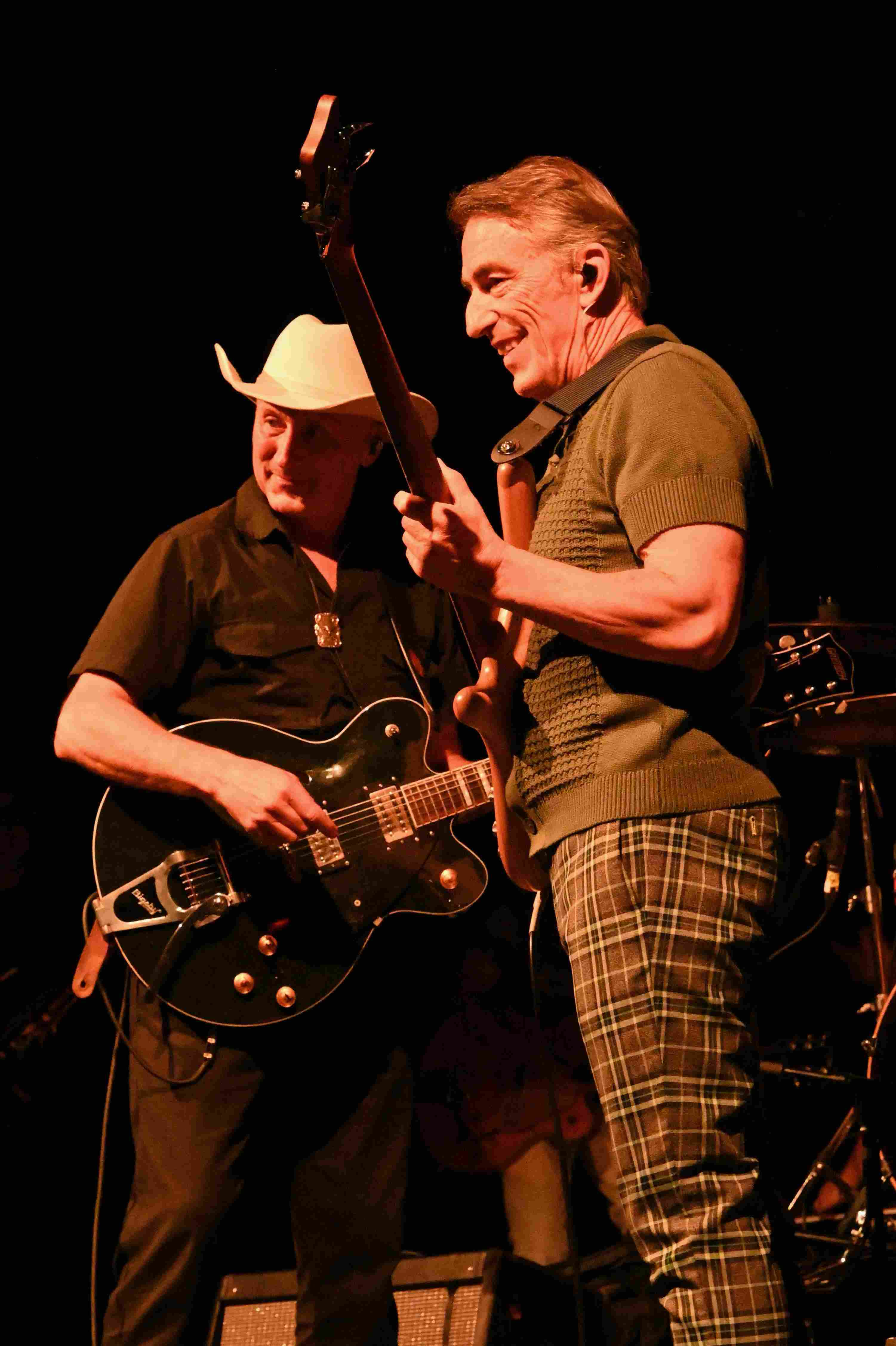
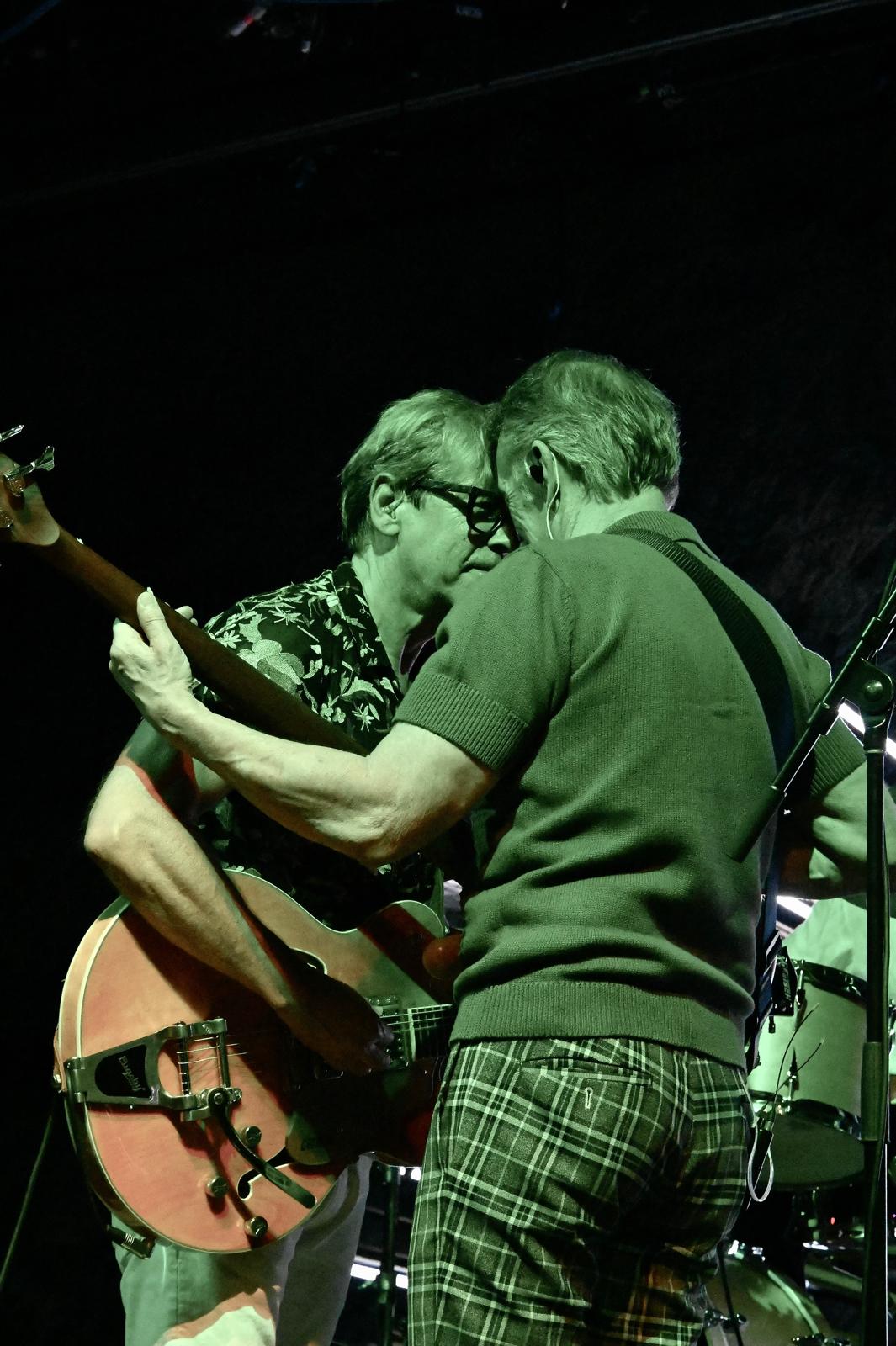
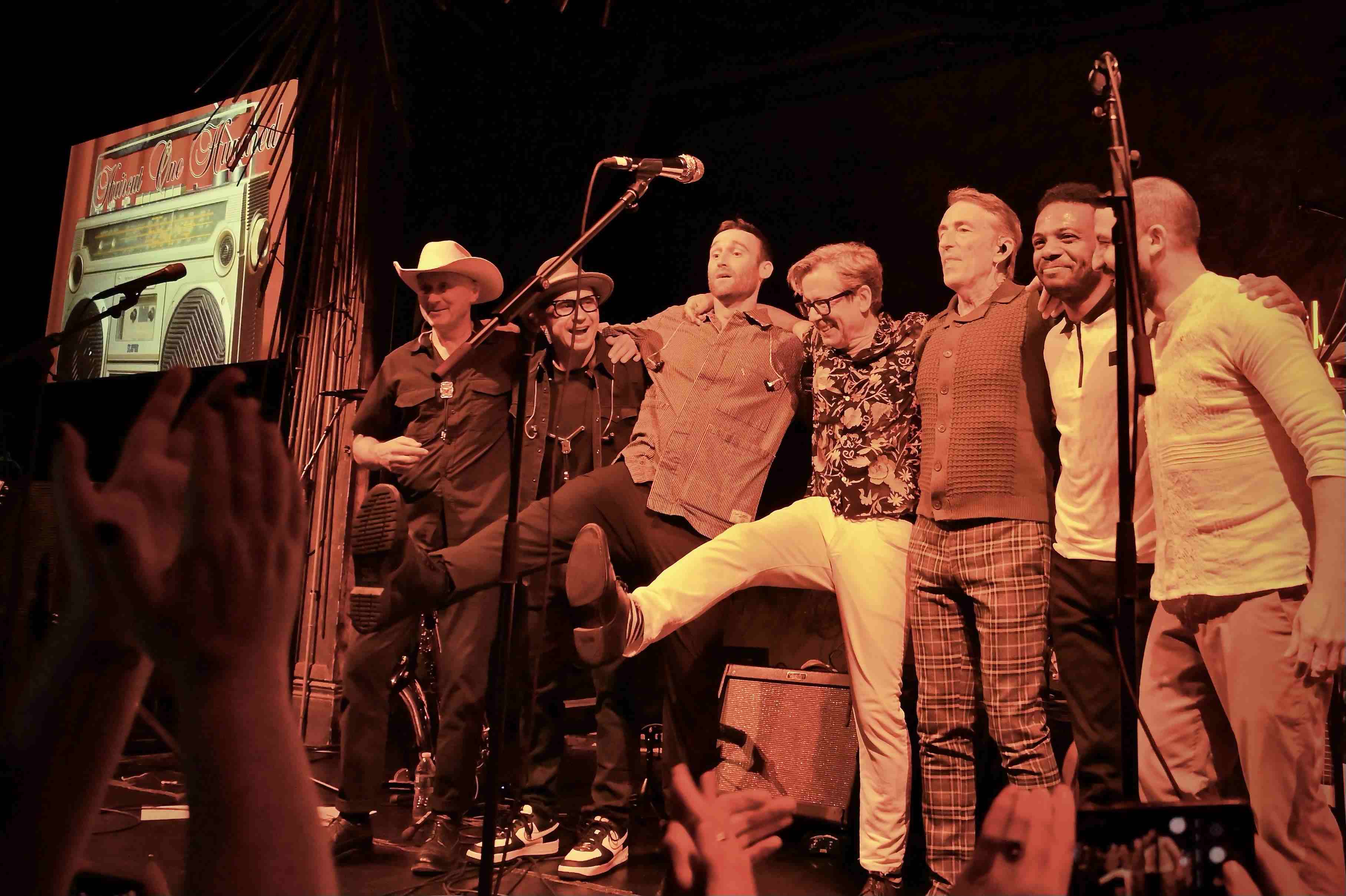
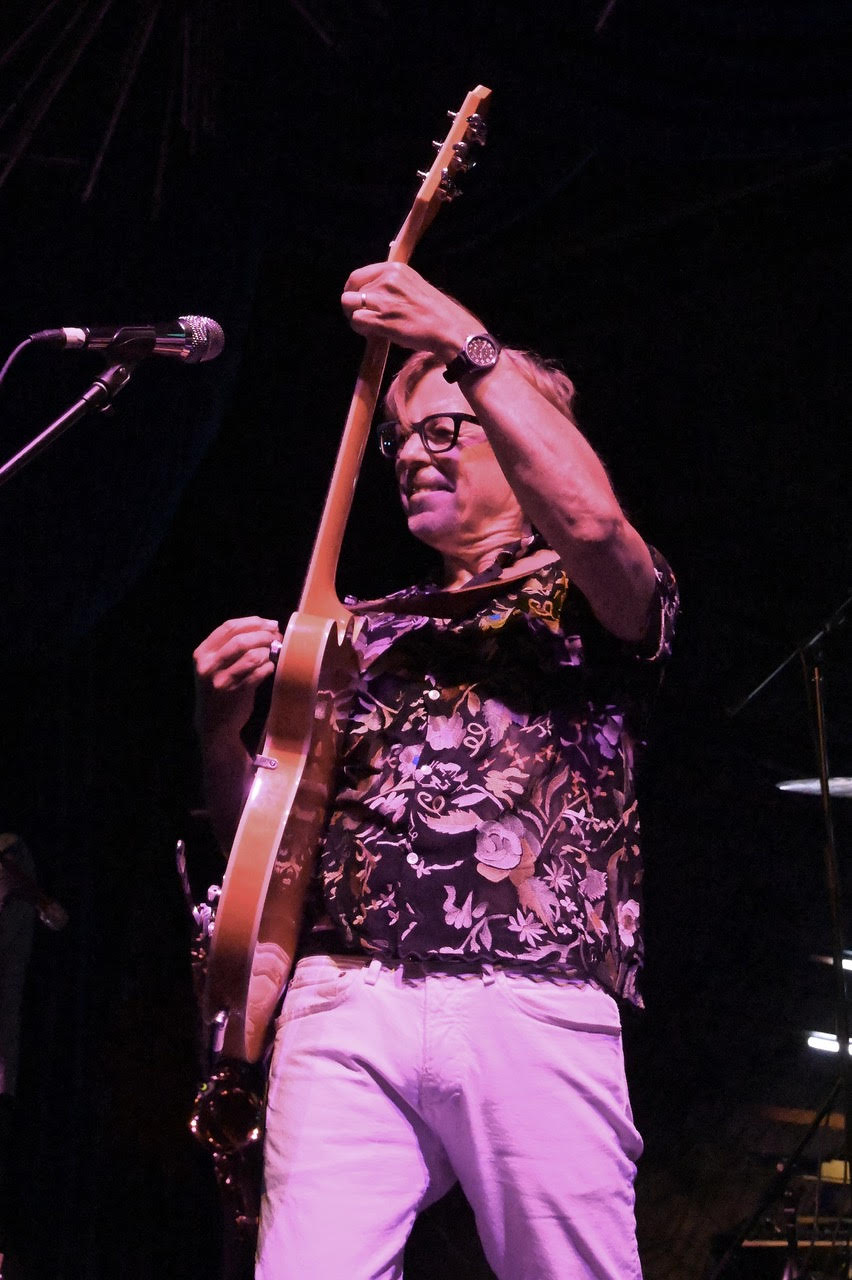
Live photos from Haircut 100 at Sony Hall 2025-09-24 by Stephanie F. Black
Beckenham, London-originated Haircut 100 has always been a band that defies expectations. The three white English founding members Nick Heyward (lead singer, guitarist, lyricist, primary songwriter), Graham Jones (guitarist), Leslie Nemes (bassist) formed the band out of close friendship and a variety of influences (David Bowie, The Who, The Jam, XTC, Talking Heads, The Clash, Faces, Earth, Wind, & Fire), and, after meeting Blair Cunningham, a Black drummer from an illustrious musical family in Memphis, Tennessee who had played with some Stax artists in his teens (his older brother Carl Cunningham played on many of the classic Stax ‘60s records as a member of house band The Bar-Kays, including those of Otis Redding, with whom he tragically perished in 1967), in 1981, quickly coalesced into pop chart mainstays as a colorful comet in the fertile-yet-dour British post-punk scene with a joyfully irrepressible punk/funk/power pop sound spackled in sweeping horn charts and percolating percussion.
Heyward’s guileless vocals, breezily singing his sometimes impressionistic, sometimes direct lyrics, while he and Jones super-strummed Gretsch guitars with clipped pattern precision to the liquid funk groove distilled in dance-inducing sync by the rhythm section of Nemes & Cunningham were the key components that led to the still astounding debut LP Pelican West, which reached #2 on the U.K. charts, packed with top 10 U.K. hits “Love Plus One,” (also a U.S. Top 40 hit), “Favourite Shirts (Boy Meets Girl),” “Fantastic Day,” and standout non-singles, including the shimmering flow jams “Marine Boy”, “Baked Beans”, “Calling Captain Autumn”, and the hypnotic & elliptical “Lemon Firebrigade”, as well as indie pop gems “Milk Film”, “Snow Girl”, and “Surprise Me Again”. Subsequent Top 10 single “Nobody’s Fool” made 1982 quite the year to remember for Haircut 100.
But nearly as quickly as the group became ubiquitous, the strain of such overwhelming success led to an implosion as the band worked on a follow-up LP, with a planned single “Whistle Down the Wind” postponed as Heyward abruptly departed in January 1983. Heyward soon released his own majestic version of the song as his debut solo single in March 1983, which charted in the U.K. Top 20, and followed it up with the glistening sophisticated pop of North of a Miracle produced by Geoff Emerick (The Beatles, Elvis Costello), which featured several other songs that were meant to be on Haircut 100’s aborted 2nd LP (these sessions are thankfully now available on the 40th anniversary deluxe reissue of Pelican West, which also includes excellent instrumental versions of Heyward solo hits “Blue Hat for a Blue Day” and “When It Started to Begin”, originally titled “Coming Home”).
The rest of Haircut 100 continued to work on new material, eventually releasing Paint and Paint in 1984, an LP that has the excellent groove of the debut (the peppy “Infatuation” was even possibly ripped off by indie popsters Kero Kero Bonito on their 2016 banger “Trampoline”), but is generally missing Heyward’s gift for idiosyncratic, memorable hooks, and the album didn’t even chart.
Heyward continued to release a steady run of solo LPs in the ‘80s & ‘90s that gradually moved in a more power pop direction with some continued chart success, while Nemes worked with Hugh Masekela, China Crisis, and Rick Astley, Jones with Glen Matlock’s Big Livin’, and Cunningham had stints with Sade, Paul McCartney, and Pretenders, but the old friends remained in touch, eventually coming together for occasional Haircut 100 reunion gigs starting in 2004.
Flash forward to 2023, with the comprehensive Pelican West reissue leading to a 2023 U.K. tour that featured new material, including a cracking new single “The Unloving Plum” (released in 2024), and suddenly, Haircut 100 are fully back. Amazingly, I finally get to see one of my favorite bands (albeit without Cunningham, who had some health issue that prevented touring, but he will be on the drum throne for the upcoming summer U.S. tour opening for their inspiration Squeeze and Adam Ant, which arrives in NYC on August 29 at Radio City Music Hall) as they tour the U.S. for the first time in 42 years, with the same inscrutable lightning-in-a-bottle alchemy of locked-in band members creating unique music that can’t be replicated without each other. That lightning continued in September 2025 at Sony Hall, where I saw their first New York City headlining show since 1982, with a setlist that featured the entire Pelican West while they planned for the release of their long-awaited proper follow-up LP with the teaser of perky new single “Dynamite”.
And now, here we are in 2026, with last week’s release of a sparkling new Haircut 100 LP, Boxing the Compass (with a sleeve by London designer Simon Halfon, whose artwork memorably graced releases by The Jam/The Style Council/Paul Weller, George Michael, and Heyward), the first album by the original group in 44 years. Boxing the Compass is the rare reunion LP that offers a full revival of the group’s legacy, handily surpassing the low expectations of a nostalgia cash-in with a remarkably brilliant pick-up in sound and song quality as if they had recorded it immediately after Pelican West, alternating between indie/power pop magic with “Come Back to Me”, “Raincloud”, “The Unloving Plum”, “Someone”, “A Wonderful Life”, and the brassy funk groove of “Vanishing Point”, “Soul Bird”, “Sunshine” (a perfect summer anthem), and “Dynamite”, with “That’s a Start” bridging the two styles.
Last month, in a generous two-hour video conference interview with Heyward and Nemes during a brutally hot week in London, I discussed the old & new Haircut 100 eras (including all the zany band names they tried before settling on the shears name), gleaned more insight into why it took so long for the band to arrive at this happy reunion point, learned about both the songwriting & LP recording processes, and thoughts about being a working band in this music idustry era of streaming and AI, while witnessing the warm and humorous dynamic between the two longtime friends after nearly 50 years of making music together.
Thanks to the current Haircut 100 manager Sara Heyward and their publicist Erika Tooker for arranging this conversation. For a full list of upcoming tour dates, including the North American tour that starts August 18, with ticket purchase links, go to the official Haircut 100 website.
This interview has been edited & condensed for clarity, with (parentheses) for in-interview non-verbal glosses & [brackets] for post-interview glosses.
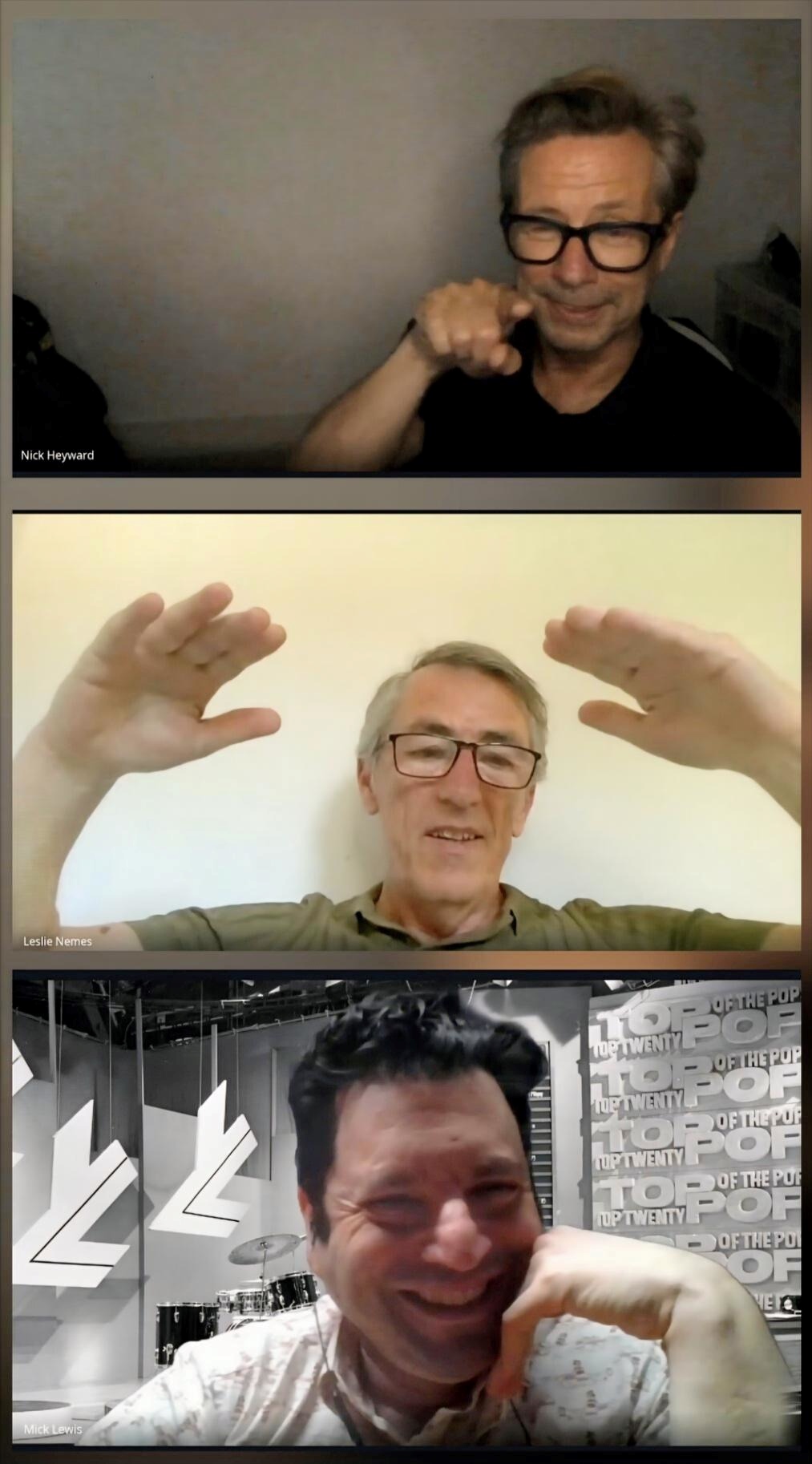
Nick Heyward: (referring to the background screen) Wow, look at that, you got Top of the Pops!
Mick Lewis: That’s especially for you. I thought it’d be a fun background to use because you’ve been there, although not that set.
Nick Heyward: No, I never remember them looking that cool. In 1982, there were very colorful things with lots of dancers and loads of dry ice. They wanted to make it look like a lot of people, but it wasn’t. They would have eight to nine people around to make it look full in the room. It was a large room as well, like an aircraft hangar, and they just made it look like it was very full of people at BBC Broadcasting House. It was a huge room where they used to do a lot of filming for TV shows like that.
Mick Lewis: And it was freezing because of the studio lights.
Nick Heyward: Well, that’s why we were wearing jumpers, because it was freezing and it was November, I think.
Mick Lewis: It inspired the jumper look.
Nick Heyward: Yeah, it did. We had worn them in the run-through [but then took them off], and our publisher, Bryan Morrison, came down to see it, because he was very excited about the fact that his “boys” were playing Top of the Pops—he used to smoke a big fat cigar. He said, “My boys are on Top of the Pops. I’m going down there. “ And he would get in anywhere, Bryan. He turns up in his Aston Martin, big furry coat, and cigar, and he walks in, watching the monitors, and then he says, “Put your jumpers on!” We had just recorded “Favourite Shirts” and “Boat Party” [the A-side & B-side of Haircut 100’s October 1981 debut single].
Mick Lewis: So you were still developing the look and the vibe, even though the sound was there from the beginning.
Nick Heyward: Yeah, it was. We’d been in the studio with Bob Sargeant [the late English producer, who by then had produced many John Peel Sessions, as well as LPs by The Ruts, The Fall, and The English Beat]. We’d made the single, and we were very excited about starting the album; very excited!
Mick Lewis: How many times did you end up playing Top of the Pops?
Nick Heyward: Ooh, it felt like it was weekly, and every time we had a song out, it would be on Top of the Pops, probably three or four times, every single. “Favourite Shirts” was on a lot, and then [in January 1982, 2nd single] “Love Plus One” was on more, and then [in April 1982, 3rd single] “Fantastic Day” was on lots. So it did feel like we were on all the time. Then only once, maybe twice, with [in August 1982, 4th and final single from the original lineup] “Nobody’s Fool”. [According to the TotP Archive, Haircut 100 made their first of 12 Top of the Pops appearances on October 29, 1981, performing “Favourite Shirts (Boy Meets Girl)”.]
Mick Lewis: So those were separate appearances each time, because they were still in the charts. Wow. And was that back when the full band played, or was it just the singing?
Nick Heyward: It was full mime.
Mick Lewis: So no singing, even. The easiest gig in the world.
Nick Heyward: Yeah, it was. I loved miming, I mean, even though I couldn’t mime. I’d rather it was done live because I could sing live, but miming seemed to be a real problem. I just couldn’t get my head ‘round it; I couldn’t get to grips with it at all. It seemed very odd, but they played the videos after a while. It was really good to get your video on Top of the Pops; just as exciting to watch your video on Top of the Pops as it was to be on there, because you’d grown up with this TV show. I suppose it was like American Bandstand and Solid Gold in America.
Mick Lewis: I enjoyed your Paul Weller Fan Podcast interview, where you talked about how you were such a big Paul Weller fan that you avoided any interaction with him when you happened upon him walking down the street, and then you later end up knowing him and even playing a show on the same bill and singing a song with him [in upstate New York in 1993; they performed The Beatles’ “Dr. Robert”], that must have been incredible for you!
Nick Heyward: It was. Because I’d been diving out of the way of Weller, hiding behind pillars down in Victoria Station. And then, a year later, I’m being signed to the same publisher as him with Bryan Morrison [of And Son Music, who also published The Jam’s catalogue], and then I know people that know him. Then I am meeting him, and he’s talking about the band. Then The Jam had a song that sounded a bit like Haircut [possibly 1981 single “Absolute Beginners”, 1982 single “Precious”, or the calypso rhythms on The Gift LP’s “The Planner’s Dream Goes Wrong”?]. And there were lots of bands that were getting influenced by Haircut. I remember. That was a huge compliment when we started.
Mick Lewis: Did you find out whether he was influenced to move in the more horn-heavy direction that ended up in The Style Council through what Haircut was doing at that point?
Nick Heyward: I think it was an influence. Lots of other bands were an influence. It’s all like brothers borrowing each other’s record collection, so to speak. Some people take that as stealing, and they get a bit strange about it. Other people are glad; they’re quite confident in the fact that they’ve got an abundance of ideas anyway, and not getting upset about somebody who’s wearing a similar hat or jacket to you. It’s a compliment that somebody’s inspired by you. These bands are playing around each other at the same time, and they all suddenly look and dance in a similar way, it becomes a youth movement. It was not an accident.

Mick Lewis: It’s actually how scenes grow because bands are on similar wavelengths, and then people appreciate the unity in the scene. Speaking of brothers, I heard you mention on the Rockonteurs podcast that your older brother [Peter Heyward, who was a member of ‘70s Bromley, London punk bands Mother’s Ruin and Unorfadox] played guitar, and that he was an influence in sharing his record collection. Did you ever play music with him? Is he still playing music?
Nick Heyward: No, he died last Christmas.
Mick Lewis: Oh, I’m sorry to hear. I was listening to a podcast from three years ago.
Nick Heyward: No, no. Yeah, he’s no longer with us. My family all had emphysema. They all smoked, so they’re all not with us now; hence I don’t smoke. But his record collection was a huge influence because he was a pioneer. I mean, we played together a bit, but I think the age difference, though it was only 18 months, was huge when you’re growing up together. I think the way families are arranged, it’s like, okay, you are going to be the person with the memory of a fish, so you write your own songs because you can’t remember anybody else’s and work them out. And you are going to be the brother that can work out everybody’s songs, but you have got a longer memory, and you memorize, and you learn through other people’s stuff. This one has to make it up. I think that’s where you get brothers or sisters in bands, because of the way that family is, it’s made one quite opposite to the other one, but they complement each other quite well.
Mick Lewis: So you never ended up playing music with your brother, apart from in the house? It’s interesting the way you described how you became a songwriter—
Nick Heyward: Yeah, I think we could have had the band together, and it nearly happened. We had two separate bands; we had two guitars, Graham Jones and me, but there was a moment when it could have happened, but I think I’m glad that it didn’t because of the tempestuous relationships that brothers have. Just look at the list now with The Kinks and Oasis. I mean, I suppose there are success stories with it. Pete and I were prone to having a bit of a bash-up, so maybe it wouldn’t have worked. It wasn’t in the cards anyway, because Haircut was born out of Les, Graham, and me being three very close friends. So we were friends beforehand; that was the key to the beginning of the band: Les, Graham, and I being all single and all focusing on not being single, and through that process, living together, socializing together, being in a band, and really taking the band seriously together, living and breathing being in the band.
Mick Lewis: It’s like Small Faces.
Nick Heyward: Well, we were The Monkees. The real Monkees. We’d grown up looking at that program and taking it for real. If you’re a band, you live together. So we were friends, and we lived together as The Monkees. And when the New Musical Express came round to interview us, it was to interview us as a band. I remember Adrian Thrills doing it like a pop magazine: “What’s your favourite color?” And this was at a time when it was still really quiet; you had [Factory Records band] A Certain Ratio, and it wasn’t that long since Joy Division. Why the N.M.E. was still doing the interview like that was probably indicative of how the music business was going anyway. The early electronic/industrial stuff with analog synths was very Kraftwerk. But suddenly, Depeche Mode and The Human League were going commercial and starting to write pop songs.
Mick Lewis: And OMD went more pop…
Nick Heyward: Yeah. Beforehand, it was very introverted, wasn’t it? It was like that Manchester scene; it was still a bit like that, “Electricity”, but it was starting to go more commercial and get more dancey, you could tell. And we were part of that influence, although we weren’t electronic. We were more funk, part of a little funk culture that was happening in London, with a group of us that included Funkapolitan, ABC, Spandau Ballet, 23 Skidoo, and PigBag. You listen to those records now… I was thinking, why wasn’t 23 Skidoo massive? That record [1981 single “Last Words”, co-produced with Cabaret Voltaire] is really good. The DJ played it when we were doing one of our gigs not long ago. I said to him, “What was that you played? That was brilliant!” He said, “Oh, that’s 23 Skidoo.” And I went, “No way. Why wasn’t that massive? Why did “Favourite Shirts” take off?” And that record by 23 Skidoo did, but didn’t; it wasn’t on Top of the Pops. Because we were bands with numbers, Level 42, Haircut 100, Heaven 17, 23 Skidoo. So it was just what was happening at the time. I mean, I thought Haircut 100 was a very normal name at the time. It was, Why not [a band name] with a haircut? The most important thing in life right then was hair and the way it was styled and the way it was cut. If you didn’t get your hair right, your whole life was fucked! (laughs)
Mick Lewis: Well, it’s a good thing you still have your hair! That’s a blessing for a band called Haircut 100. You don’t have to suffer through those jokes. (laughter) (Nemes joins the call.) How are you doing, Les?
Les Nemes: Hot. It’s too hot here, just west of London. West of London is 36 degrees [~97°F]. Well, that’s why we both look like we’re going to burst.
Mick Lewis: And Nick, you’re also West of London right now?
Nick Heyward: Yeah, Les and I are quite close. I’m in Henley. So we’re literally about 15 miles away from each other.
Mick Lewis: Almost like when you were living together in the same flat in the early days.
Nick Heyward: Well, I pick up Les now. He used to pick me up in his Volkswagen Beetle because Les was the only guy with the car back in the day.
Les Nemes: It’s his turn to drive now.
Mick Lewis: That was an important feature of a good bandmate, the one who has the car.
Nick Heyward: Yeah. You were way ahead of us.
Les Nemes: As opposed to when Nick got in the car and decided to drive it. I didn’t close the door properly. So the door fell open as he was driving down the road, and I was running alongside it to stop the door from hitting all the parking meters as it went past all the parking meters.
Nick Heyward: That was my first driving lesson with Les.
Les Nemes: Charlie Chaplin would’ve been proud.
Mick Lewis: So let’s go back to when you first met in those early days. How old were you? You’re both about the same age.
Nick Heyward: Yeah, I think it was at Jason’s party in about ’78.
Les Nemes: Yeah, 17, 18 [years old], somewhere around there.
Mick Lewis: Who was this Jason [surname Gilbert]? Was he a music connector?
Nick Heyward: He was our friend and boffin [British slang for “technical expert”], and he had a detached house, which was amazing to know somebody who had a detached house. And it was up a lane by the railway, and it backed onto some playing fields, so you could rehearse in his garage. He had an H&H amplifier and a little sound system. So we could make noise. And we did make noise, didn’t we, Les? We played so much stuff in that garage.
Les Nemes: Jason was a real boffin. He was always fixing something, soldering something to something else, and inventing things.
Mick Lewis: So he was an engineer of sorts, but also played music.
Nick Heyward: No, he just was a fan of music, and he had a really good record player. The inside of the house was quite mid-century modern, and there were lots of nice ceramics around. He had glasses that were falling apart, and he had cellotape here (points to the bridge on his eyeglasses). So we knew he was a boffin, and it was very entertaining. He ended up working for the gas board as well, fixing the gas meters.
Les Nemes: He thought we were hilarious, so he liked having us around his garage because we made him laugh.
Mick Lewis: So there was a comedy element to your early music.
Nick Heyward: Right from the off. I mean, when I met Les, I picked up an iron on the wall, and—do you remember that, Les? (Heyward & Nemes laugh) Jason had an ironing board, to put an iron on the wall, and I picked it up and said, “Hello?” to speak to him on that, because we didn’t know what it was going to be like. I mean, I was told, This is the best bass player in the world, and I really should meet him. And he’s going out with Kate Jenkins, he was [her brother] Tim Jenkins’s friend, and Tim ended up in the band for a bit as well. We were trying loads of people out. We’re all trying to be a band and trying to be our heroes at that particular time, which were Talking Heads and XTC.
Mick Lewis: And this was the early version of the band, called Rugby?
Nick Heyward: Well, Rugby was a bit later. I think around Jason’s garage time, I remember getting a cassette, and we were BC Clet [as in bicyclette, the English-originated diminutive for bicycle] for a while. Bly Fly. Do you remember Bly Fly, Les? Or was Bly Fly before you?
Les Nemes: God. Were we ever Smacky Robodandy?
Nick Heyward: For about a week. Yeah, Captain Pennyworth as well.
Les Nemes: Napkin Man.
Nick Heyward: Joy Stick.
Les Nemes: (Laughing) Stick. Joy Stick.
Nick Heyward: Quick Cereals.
Les Nemes: That’s a great name, but I love Joy Stick. They don’t know it yet, but next year we’re recording a prog album. We are definitely doing it… and I want to call it Joy Stick.
Mick Lewis: You heard it here first. Well, I look forward to the prog album. Just let me make sure I have your name pronounced correctly because I’ve heard many people pronounce it differently.
Les Nemes: ‘Nemesh’. As though there were an “h”.
Nick Heyward: Hungarian. Yeah. Well, when I first met Les, he had bear marks all over him, and I said, “What are they? What are these? He looks like you’ve been in a fight or something.” And he fought bears.
Les Nemes: I used to wrestle with bears.
Mick Lewis: Really? This sounds apocryphal.
Les Nemes: My t-shirts had “Nemes: strong, like bull.” (Heyward & Nemes laugh)
Mick Lewis: Nick mentioned the XTC and the Talking Heads, but what were your influences, Les?
Les Nemes: Well, Nick introduced me to XTC and Talking Heads, and I was absolutely blown away, especially by Talking Heads. And Tina Weymouth very quickly became my favourite bass player because when she joined, she’d never played bass before. She was [drummer] Chris Frantz’s girlfriend. So they said, Well, let’s get her in the band. And she said, Well, I’ve never even seen a bass. Yeah, you’ll be fine. Stick it on. And sure enough, boy, was she fine! Because she didn’t know the rules. She wasn’t classically trained, and there was no one telling her, You can’t do that, you can’t play that note in that chord. She just did what felt good, and that’s what we did.
Mick Lewis: Were you trained at all?
Les Nemes: No, not at all.
Nick Heyward: Only bear fighting.
Mick Lewis: The bears don’t teach music well, from what I know.
Les Nemes: I can’t think of anyone who has been a major influence on me who was classically trained. Nobody I love was classically trained. They all just—
Mick Lewis: Paul McCartney wasn’t classically trained. I don’t know if he’s an influence on your bass.
Les Nemes: Ah, you went off early then! (laughs) As David Coleman used to say, “He’s gone too early.” You don’t know David Coleman. He was a 1960s sports presenter on TV, and he’d get really excited, and his voice would go (imitates a trilling voice) really high like this. And when there was a runner doing the 10,000 meters, he’d always question whether the runner had gone to it too fast. “I think he’s gone too early!”
Mick Lewis: I think Alan Partridge imitates him.

Nick Heyward: He did! Yeah, that was an influence on that.
Mick Lewis: It sounds familiar to me because I’m a big Steve Coogan fan, especially for his character of Alan Partridge. Do you end up crossing paths with Talking Heads during your first era of Haircut 100?
Les Nemes: Unfortunately not.
Nick Heyward: I crossed paths with XTC a lot. I was walking down Conduit Street to Albemarle [Street] to Berkeley Square. This was around 1978, I was a commercial artist, and I was delivering a parcel to Grey’s Advertising. Andy Partridge came to my left, Terry Chambers came to my right, and I was like, “Good hell!” And then I turned around, and the whole of XTC were walking down the street! And for a brief moment, I was in XTC— imagine being a massive fan, and suddenly I’m walking down the street with the band in unison!
Mick Lewis: And you didn’t say anything to them?
Nick Heyward: But that was many a time… I went with my best mate at that time, Austin Parker, to the Marquee, and Austin can get anyone anywhere. He got us back to see them afterwards, and XTC was so nice. They showed us their amplifiers and what strings they use, and talked to us for hours about the band. And we were just kids sitting there enthusing about the band, yet they could be bothered to do that. They said, Oh, anytime in the future you want to come backstage, just let us know. And we were like, Oh my God, this is amazing. So I always remembered that: be good to the people who are enthusiastic. These kids who care about your amplification and what strings you use, these are your people.
Mick Lewis: Yes. That ended up being rare, because they stopped playing live [in 1982]. I got to interview XTC when they released the Apple Venus album in ‘99, it was just Colin Moulding and Andy at that point, but we had an amazing multi-hour conversation. I did ask Andy about our shared musical obsession, Nick, Paul Weller, because I was curious to hear what he thought about his music. And he said, “This is going to be off the record,” so this retelling will also be off the record… (tells Heyward & Nemes what Partridge said; they laugh uproariously).
Nick Heyward: But that’s how quick Andy Partridge’s mind was. And everyone who was a fan of XTC couldn’t believe how vibrant the music and the lyrics were. Even Andy has said those early songs were teenage songs. Well, they were to him, in hindsight, but to us, those teenage songs were everything, like “Science Friction” [from 1977 debut EP 3D], “Neon Shuffle”, and “Statue of Liberty” [from 1978 debut LP White Music], and all that. White Music was just unlike anything. It was a bit like Cockney Rebel had suddenly been electrocuted.
Mick Lewis: And it kept going with [1979 U.K. Top 20 single] “Making Plans for Nigel” and [1980 single], “Generals and Majors”, and so many great songs to follow. Are you still in touch with Andy?
Nick Heyward: A little bit, yeah. I went around his house, Thomas Walsh [the Irish singer-songwriter known as Pugwash, who is influenced by Andy Partridge and has collaborated with him] took me around to see him, and Andy gave me a massage, which was an amazing thing. I’ve got pictures.
Mick Lewis: Is this true? True ecstasy/XTC.
Nick Heyward: Yeah. Andy’s massaging me, probably pretty close to the place [in his hometown of Swindon, England] where he wrote “Ladybird” [from 1983 LP Mummer] and it’s like I was in XTC again, literally! (laughter)

Mick Lewis: We haven’t heard much music from him lately, so I guess he’s been pursuing more of the bodywork.
Nick Heyward: Well, it’s funny, I’m not name-dropping here, but I’m going to name-drop. I did a gig a couple of days ago where Rod Stewart was there at the party. I was telling Rod, because we all have a moment in music where we go, This is my moment. I know this is what I want to do 100%, that our bass player, Les, had that at the Lewisham Odeon, didn’t you? What year?
Les Nemes: ’74.
Nick Heyward: ’74. So I said to Rod, “Les had a moment in the early ’70s when he said, That is it. That’s the moment you get stars in your eyes, and you go, I know exactly what I want to do.” Rod was saying, “Oh, I remember those gigs. They were fantastic, just rolling on stage.” I said, “Well, you guys rolling on stage like that without a care in the world, having a few drinks, and the ramshackle way you were playing was exactly the reason why Les wanted to be in a band and do music forever.”
Mick Lewis: So that was Faces [at a November 1974 residency at the South London theater]? Not solo Rod.
Les Nemes: Absolutely.
Nick Heyward: Didn’t he, Les? Huh? That bass playing.
Les Nemes: Yeah. When I saw Ronnie Lane, I was like, Oh my God. He’s up and down the fretboard, all over the place, and everything is so musical and so relevant. And then while he’s doing it, he sings as well, and it’s like, Oh my God, how does he do that? And from that moment, every time we come up with a song, and I have to come up with a bassline, the first thing I think is, what would Ronnie Lane play on this?
Nick Heyward: Look at that connection where I’m starting bands from… God, I can’t remember. I was always starting bands. I started one with Rob [Stroud, a drummer who later co-founded goth band Sex Gang Children] at work. We’re looking for a bass player, and then you get this word that there’s this strange guy in Croydon who’s in this band called Heavy Syrup.
Les Nemes: Heavy Syrup.
Nick Heyward: And it’s like the word comes through that, oh yeah, you guys would really get on. And Les had stars in his eyes from seeing the Faces at Lewisham Odeon, with Ronnie Lane, and we get together, and it’s just this amazing musical moment where I’m looking for my Colin Moulding, and Les comes through, and he is Ronnie Lane, and we just have this connection. And then, there, the songs take off, and we have our band!
Mick Lewis: I listened to Moving England [the incarnation of the band with Stroud immediately preceding Haircut 100], the single, both the A-side “Moving Back” and the B-side “Stretching Rack (Part 3)” last night.
Nick Heyward: You mean “Whistle Down the Wind”? (laughs)
Mick Lewis: Yes. “Whistle Down the Wind”. But there’s a little bit of “Favourite Shirts” and “Fantastic Day” in it as well.
Nick Heyward: Well, it’s funny because I’m always writing either setlists or album compilations for songs. Sara, my wife, says I still do it now. I’m always putting the songs I’ve written or a new song, or a song idea, into a list to try and make an album. And because I’ve been gathering loads of memorabilia to write about memories from the band, I found a lawyer’s letter that I’d completely ignored, and instead, I’d written an album list with the second album on the back, because I was more interested in that. I can’t be dealing with all the business shit… and so I’d written it on what I thought was, oh, a bit of spare paper! “Look at Ruby” was on there for the second album. “Look at Ruby” was “Moving Back” that then morphed into “Look at Ruby” once Phil [Smith, the original Haircut 100 saxophonist] —do you remember Phil played on it at, what was that studio that Joe [Dworniak, the bassist in Shake Shake!, the band that Blair Cunninham was in when Heyward & Nemes first saw him play] and Duncan [Bridgeman, also of Shake Shake!] had?
Les Nemes: Moody.
Nick Heyward: Moody Productions. And then it was “Look at Ruby” up until it was going to go on the second Haircut album because it hadn’t made the first album. Because the funk scene had died down a bit, hadn’t it, Les? That’s why we were doing more songs like “Club Boy at Sea”, which was going to be on there because the second Haircut album was either going to be called—because I was already working on this, even though I was in this home for pop stars that have lost their marbles (laughs) —I was still writing setlists. It was either going to be called Club Boy at Sea or Blue Hat for a Blue Day. “Look at Ruby” then turned into “Whistle Down the Wind”, which we recorded as it was developing in the studio. When it was “Look at Ruby”, it was alongside a song called “Blue Penguins”. Do you remember “Blue Penguins”, Les? (Nemes nods.) That was one of the songs that we gave to Adrian Thrills, to get him and the New Musical Express interested in the band. He’d say, Well, okay, you’re called Haircut 100. I like that. What are some of the songs? And so we’d just make them up, or say them: “Look at Ruby” and “Blue Penguins”. That’s why I think he came around to the flat, didn’t he, Les?
Mick Lewis: Yeah. It sounds like a Dada art project! (Heyward & Nemes laugh) For those songs for the second album, how much recording did you actually do? Where can we hear the Haircut version of “Whistle Down the Wind”?
Nick Heyward: It’s on The Junction [the 3rd disc on the 2023 Pelican West 40 box set reissue]. It was part of the 40th anniversary; let’s get it all out there and start again. It was going to be Blue Hat for Blue Day or Club Boy at Sea, because we’d had a photograph session down at the seaside, with lovely moody pictures of us by the beach. And then we had another one that was taken by this guy, which I’ve just got hold of, Les. So the pictures when we went down to do a date in Cornwall at the Coliseum, I think it was, just before we… (pausing while reflecting on the band’s breakup). Yeah… yeah. I’ve actually recalled all this stuff… It’s amazing, the Haircut story is quite something.
Mick Lewis: Is there a documentary in the works?
Nick Heyward: Well, we’ve done one, haven’t we, Les, but it’s more from a fan’s view of the band. Steve Kemsley, lovely man, a Haircut 100 fan since the beginning; he was always around at rehearsal studios and at gigs. [Kemsley also directed the video for Heyward’s solo single “Perfect Sunday Sun” from 2017.] Yeah, over to you, Les. You love the documentary, don’t you?
Les Nemes: Yeah, it’s good. It’s finished now. I think he was waiting for approval, for everyone to watch it. He’s touting it around at the moment. I think he’s talking to Netflix, Amazon, and BBC, but apparently, he wants to hold the BBC back for a little bit because you only get one go with them, apparently.
Nick Heyward: But also, it’s quite expensive doing a documentary because he’s got to get all the footage cleared, all the images, which is costly, very much like us with the new album; this is all homemade. We’ve paid for this while we had nearly zero budget to do the album.
Mick Lewis: Do you own your rights now to the original Haircut 100 recordings?
Nick Heyward: No. We’re not really earning out of the past Haircut 100 material. Our old royalties are closer to a few hundred [pounds] a year. We don’t earn out of streaming, and we haven’t broken even yet on live work. So all this is the labour of love. We paid for the album out of the live work that we did get. So that’s why we haven’t earned anything out of that.
Mick Lewis: Wow.
Les Nemes: So if you’ve got any cash.
Mick Lewis: The real truth of being a working band, even if you once had illustrious, near-chart-topping success.
Nick Heyward: Well, we’re not a unique story at the moment. The music business is going through a transition, with people working out how many artists can continue to do it. I can’t imagine a life without Andy Partridge, David Byrne, and all the people that we grew up with. They were our therapists. We didn’t have therapy back then; we had music, and we got through stuff by listening to music and escaping. And so we’re old school, and that’s why we are making that music now, but we’re not making it with the same budgets. We’d love to go into the equivalent of The Roundhouse [where Haircut 100 recorded their debut LP] with a producer for two, three, four weeks or The Manor [the legendary Oxfordshire, England studio where Split Enz, Public Image Ltd., and XTC recorded LPs] like we did with the second album when we started it. We went there, didn’t we, Les, to be like XTC and record at The Manor. But we just realized that we probably needed Hugh Padgham and Steve Lillywhite to sound like XTC, because we went in with Bob Sargeant, and it would probably have been better to stay at The Roundhouse, because that was the sound that we had there.
Les Nemes: But it was an incredible experience, a residential studio where you got food 24 hours a day, seven days a week. You just sit there, just inventing and creating, and you don’t know what you’re going to come up with. And it’s summertime. I just remember sitting in the grounds; there was a swing, and it was twilight in summer, which is my favourite time of a summer’s day. And the sun was just going down. The sky was rare. You could see all the green of the trees in the distance, and it was lovely and warm. I was with my best mates. I was doing what I love doing more than anything. And I just remember sitting there thinking, well, if the old boy upstairs said it’s my turn, I have to say I can’t complain. It’s been incredible so far. It’s just a shame that it took us 40-something years to go in and do it again. Hopefully, we’ll all survive it.
Nick Heyward: Someone came up to me in The Ultra Theque in Glasgow when we were playing there [in 1982] and said he was a huge fan of Pelican West and he said, “What’s your secret? How’d you get that sound?” And I just said it was Blair Cunningham. That was it, wasn’t it, Les?
Les Nemes: Some of the people that we aspire to, Blair has played with them. So he’s the real deal. He’s actually been there, done it, he’s gotten the T-shirt, and then he comes to England. Suddenly, we have this amazing Stax drummer who’s played with them all. How can you not sound good with him behind you? You could play just one note, and it would sound amazing.
Nick Heyward: An authentic American drummer from Memphis who played with all those Stax artists!
Mick Lewis: How did he end up playing with you? Because I know you had a different drummer [Patrick Hunt, who later played with Aztec Camera] for the first single.
Les Nemes: There was a band, Shake Shake!, who were some people that Phil knew, actually. They were Phil’s friends, and they became our friends because they produced one of our demos. They were playing in London, and Blair was their drummer. I think Phil said, “You should go down and check out this drummer because he’s really good.” So we all went down there—
Nick Heyward: It was just you and me, Les.

Les Nemes: Yeah. Standing at the front, because he was just incredible. And then we went up to him and said, “We got a record deal. Do you want to join our band?” And he went, “Okay.” And that was it.
Nick Heyward: Yeah. He just said, “Yeah, I’m in.” And that was it. He was in.
Mick Lewis: How’s he doing now? Because I know he had some health issues, he hasn’t come over for the American tours.
Les Nemes: No, he’s match fit. He’s match fit, and for the recent U.K. tour, he owned it. He played really well.
Mick Lewis: So, he will be coming over for this summer tour? That’s great! Although the drummers you had were excellent. I know Ismael Baiz [who also played percussion with the final touring lineup of Blondie] as well, who drummed when I saw your first New York-area show in 42 years at The Paramount in Huntington, Long Island.
Nick Heyward: Izzy’s in the band, too!
Mick Lewis: Oh, he’s playing percussion.
Nick Heyward: Yeah. Isn’t that great?
Mick Lewis: Yes, it’s wonderful. So, are you going to have a full horn section this time?
Nick Heyward: The budget isn’t quite there for a trombonist. If we keep going, we’ll get more than 25 minutes at some point as well, and we’ll be able to do a full hour or two-hour show all over America. I mean, that’s the goal, just to keep going and to get to that point, like with the album, just keep turning up. Because we know what it’s like to stop.
Mick Lewis: Speaking of when it stopped, I’m curious about this, Les: Nick went on after he left Haircut 100 and released North of a Miracle, which had many hits, similar to Haircut 100 [indeed, some were intended to be Haircut 100 2nd LP songs], but the rest of the band continued with Paint and Paint and didn’t have hits. What was your feeling back then, Les, about—
Les Nemes: What are you saying? You’re saying we were shit. Is that what you’re saying?
Mick Lewis: No, no. Actually, I’ve listened to the album, and the Haircut sound is there.
Les Nemes: I’m joking with you. Well, all I can do is speak from my own personal point of view. I think I was at my absolute playing peak on that album, played the best that I ever had. So I was really, really happy.
Nick Heyward: You just needed me.
Les Nemes: Yeah, we just needed—
Nick Heyward: I needed you, and you needed me. What a waste of all that virility, that bass virility.
Les Nemes: When I toured with Rick [Astley in the late ‘80s], I played pretty well.
Nick Heyward: We were in our prime in the ’80s, with and without each other. It’s hard to look upon that time and not think that it was wasted, what we could have been achieving through that time. But that’s the thing, you only take the present moment with you. And so we just thought, why don’t we just not leave it as a tragic moment and keep that tragedy going? And it’s funny, but when you are back, people tend to forget those years that you’re not together. They’ve done it with Duran Duran, they’ve done it with Squeeze. Maybe they’ll do it with the 44 years lost at sea with Haircut. I mean, once we’ve established ourselves again, people are already like, Oh, well, they’re just back. So why dwell on the past? Because there’s nothing we all can do about it. It’s just…
Mick Lewis: Well, that’s a good segue to the reunions at different points in time. I know, Nick, you stopped releasing as many albums after a great run in the ‘80s and the ‘90s. So when you came back together, I guess it was originally for that VH1 Bands Reunited series [in 2004], but what was different each time? Were there discussions at different points where you said, Oh, we have this bond. We sound unique together in a way that no one else sounds like, and we don’t sound like that when we’re apart. Because you played every few years. So what made it stick this time?
Les Nemes: Management.
Nick Heyward: The wonderful Melvyn Taub, whose dream was to manage Haircut, not his only life goal; he was a wonderful man, and he’d tour-managed Oasis and been in bands [co-founding ’80s mod revival power pop group The Jetset]. He was working with Hall or Nothing, a brilliant management company that looked after Manic Street Preachers, Wet Leg, The Script, and Del Amitri. He called us up and said, “Do you want any help?” And we were like, Oh my God, this is amazing. We were getting all these brilliant offers, like the BBC Piano Room [the Radio 2 show, where Haircut 100 played live with an orchestra in 2023] called up and heard that we were together. There was such goodwill for the band because people had grown up with these songs. It was a lot less of a struggle than usual. We tried to get back together before, but there wasn’t this kind of help.
As Les says, the universe was saying, Well, we’re going to keep you together this time. But Melvyn sadly died. He got us up and running, and he got us away in America. And while we were in America [on the 2024 tour opening for Howard Jones and ABC], he was diagnosed with pancreatic cancer. It was tragic and so emotional. We came back for his funeral in London, and it was a testament to how loved he was, [Manchester early punk scenester & Simply Red singer] Mick Hucknall, the Manics, and everybody that he’d worked with were there. He was such a lovely man, wasn’t he, Les? (Nemes agrees) Such a brilliant guy. And we couldn’t believe our fortuitous luck. It was like a dream to work with Melvyn, and he loved managing the band; that’s what kept us together. We’re almost continuing in his honor sometimes, because it’s not easy. It’s not easy keeping it together since he’s gone. Hall or Nothing are not with us now.
Mick Lewis: So he was instrumental in pushing for recording the new LP?
Nick Heyward: He got us together with Sean Read to try and start the demos because we originally were going to do demos and get a record deal. That was the plan, but we couldn’t get a record deal. So we decided to continue with Sean, who’s a band guy anyway, with Dexys Midnight Runners and Edwyn Collins. And so we just got back in the studio with him and continued. And we’d recorded in 2010 with my son Oliver [Heyward, a recording engineer who collaborated with his father on 2017 Heyward solo LP Woodland Echoes], who was in his early 20s. And so we had “Raincloud” and “A Wonderful Life” recorded then, and they had a magic about them that we wanted to keep. So this LP is our recordings from 2010 and a little bit from getting back together for the demos, and then continuing. And then songs like “Someone” came when we went into a studio called Hive with Ollie recording.
Mick Lewis: So this is really a much longer journey that really ties into all the different reunions that were leading to this permanent one. Were there songs from the original era that were building blocks? Did you revisit anything that you had from the ’80s? Or was everything new?
Nick Heyward: No, from the ’90s, wasn’t it? Because Jonesy really liked “The Unloving Plum”, and that was about ’99?
Les Nemes: Yeah, I think so. Yeah. I had a couple from that unreleased album that I’d like to have seen on this new one, but there were other complications, which meant that they couldn’t really happen. Maybe one day. There were a couple of songs on there that I really loved that I’d love to—
Mick Lewis: Because of rights issues?
Les Nemes: That thing. Yeah.
Mick Lewis: So you need a good lawyer to resolve some of these things.
Nick Heyward: Yeah. I mean, artistically, you just want to finish them off. You just think, It’s easy.
Mick Lewis: Which songs are those for the future? Maybe they will come out?
Les Nemes: “Together”. Well, they’re on The Junction compilation on the box set. “Club Boy at Sea”, which was our version because Nick did a version, didn’t he, on North of a Miracle?
Nick Heyward: The Haircut version was finished off. It’s really good, on The Junction box. It’s the most finished song.
Les Nemes: And then the other one was “Rainstorm”, which I really like. A bit moody, not so—
Nick Heyward: It was a little bit like Radiohead, wasn’t it?
Les Nemes: Yeah, really good.
Mick Lewis: So, how does the songwriting work with this new version of the band?
Les Nemes: Same as always.
Nick Heyward: Yeah, same as always. Random. We’ve got completely different ways, but sometimes we’re in the studio. “Come Back to Me” was when we went back to rehearsal studios around London Bridge, like when we were originally playing together and coming up with new songs. So we thought we’d try and do it that way again. Sometimes I have something prepared and sometimes nothing prepared, and we go in, and we’re writing on the fly, so to speak, and “Come Back to Me” came from a moment in a studio up the road from you, Les, right now, isn’t it?
Les Nemes: Which one was that? Oh yeah, yeah. I remember. Next to the Italian deli.
Nick Heyward: In High Wycombe. It was a lovely, hot day a couple of summers ago. We’d rather be anywhere but in a low-budget rehearsal studio playing music. But we’re twiddling around with things and then going out for a cup of tea. I think you were smoking at that point. So you’d be going out for a fag, and Blair and I would be going out for a cup of tea, and we’d have a long chat and think, Oh, should we go and do another thing? And we’d go in and start playing. And we had this moment where I was going, “Nah, nah.” And you were going (Nick sings a low bass line similar to “Holidays in the Sun”) It sounded like the Sex Pistols a bit, and do the sort of Stax thing, and it was a moment.
I was recording it on my phone, so then I’d take it home for a bit and go, I think there’s something there. And then starting the process of… I think I’m singing “Come back to me, come back to me.” And normally I’m singing something because of something that’s just happened. I had just watched [2007 Joe Wright film] Atonement, with that clip of Keira Knightley saying to James McAvoy, “Come back to me, come back to me.” And she puts her hand on it because of the disapproval from the family and all that they’d been through and everything. And it was probably resonating. Who knows what goes on in the subconscious mind where you’re thinking things, and Atonement, and then that happens.
And with “Someone” when we are funking, we needed to do more funk, didn’t we? So we got into this studio called Hive, and we were funking away with Oliver, and then it was like, okay, we got to rehearse it today, and then record it tomorrow. So when we’re recording it, we’re just putting it down, and I’m just making up something to sing. I was putting down a guide vocal. I think the first day didn’t go so well because I was singing and we weren’t feeling it.
And the second day, I had a conversation on Instagram with a guy from Scotland who said, “Just writing to you, I actually was there when you met your wife.” And I was at the bar, in between the mixing desk. And I wrote down, “I think I met her at the party afterwards.” This was Marion [Killen, Heyward’s first wife, a Glaswegian and former fashion model]. I’m sure we met at the party. Do you remember the party, Les?
Les Nemes: No. (laughs)
Nick Heyward: At the [‘80s Glasgow nightclub] Maestro’s. We had met up in Scotland when we were up there. This is where the three of us always used to meet three women. They were friends, and we were friends. So we met Marion, Jackie, and Aileen, and you were going out with Jackie, weren’t you? Graham was going out with Aileen, and I was going out with Marion. Well, I wasn’t really then, but I’d met her. So this guy was saying, “You met at the bar, and I was going … “
So when I was going in to do the vocals, that was probably with my phone, as I am doing it; it’s all mixed media—you get it from everywhere—you’re trying anything to just make the song. So I’d put that down, and I had to sing something. “No, could it be, later tonight? Could it be, I met her at the party, flying up to Glasgow, in fashion?” And much as I tried to write a new lyric, the guide vocal was actually the best time I sang it. So that song is about Maestro’s and our early funk days in 1981, but recorded last year.
Mick Lewis: “Come Back to Me” also had this element of speaking to yourself as a band, which works well.
Nick Heyward: Yeah. It’s just standing in a room together. That’s all we’ve got to do, isn’t it, Les? That’s the most important thing.
Les Nemes: Keep turning up.
Nick Heyward: Keep turning up and playing in a room together. It’s the thing that resonated with me so much when I watched Get Back [Peter Jackson’s marvelous 2021 documentary about The Beatles recording what would be released as their final LP Let It Be] at the end of COVID. I thought these guys, all they have to do is turn up in a room and get together. This is what they do. That’s what a band does; that’s all we need to do. We know it, and it’s sometimes the hardest thing to do for bands, to just turn up regularly to the place and keep doing it, but if you do, something will happen.
Mick Lewis: It’s actually remarkable that without the big budget to record it, the LP picks up exactly where you left off on Pelican West in terms of the vibe, the sound, the groove is all there, but also the power pop & indie pop element. How do you decide which songs become the XTC/Jam power pop-type and the ones that go more in the funk/soul groove direction of Earth, Wind & Fire/Average White Band/Chicago/Chic?
Nick Heyward: Well, I suppose we needed to do that, and we’ll evolve from that, like Les said, to be more prog. I mean, he’s jesting, but also quite serious because we need to evolve as a band, don’t we, Les? Yeah. And that’s where we get excited.
Mick Lewis: I didn’t mean it as an insult. It’s fantastic!
Nick Heyward: No, it’s true. We want to evolve as a band. We want to actually be like a band because of those bands that we grew up with, they’re not, anymore: The Jam aren’t together, Genesis aren’t together, all the bands that we grew up with. We’re together, so we want to continue to get to the position where we get budgets and go to the studio and actually have time where we’ve got more than a day to get it down, where we’ve got more time to actually evolve the sound and sit in a rehearsal studio for a month where we can turn up and have somebody record everything and evolve as a band. That would be an amazing thing, wouldn’t it, Les? Because we just had a day here and there.
Les Nemes: I think it’s time for us to grow up a little bit, too, maybe act our age a bit more when it comes to writing and playing.
Mick Lewis: I feel like everything sounds very mature, grown-up, and sophisticated on this album, especially the horn arrangements. Who does the horn arrangements?
Nick Heyward: We have Sam Ewens [a trumpeter who’s worked with Primal Scream, Gorilla Biscuits, & Suki Waterhouse], who’s in the band, who is our brass arranger, but also sometimes he doesn’t hear anything for a specific song. So on “Dynamite”, it was a joint thing. While I was writing, I was thinking of melodies, and brass lines were coming into my head. And then it’s a process of editing, isn’t it, Les? You are always like, The less brass, the better?
Les Nemes: At the moment. Only because we relied on it so heavily for so long. I don’t know. I’m in the stage where I just like to keep things really simple and open.
Mick Lewis: Elemental. Well, I guess you lost on this album because there are a lot of horns.
Les Nemes: Yeah, yeah. Oh, I still love it.
Nick Heyward: But you are a minimalist, aren’t you? I mean, you would like it to be more like the early days of The Police or The Cure.
Les Nemes: Yeah, absolutely. Absolutely.
Nick Heyward: I think you were saying to keep it like early Talking Heads was your goal.
Les Nemes: There is one that didn’t make it called “Riverside”, which is very much like that. That’s one for the next one, but that’s really—
Nick Heyward: We got lost and overly colored it in. So it’s got the beauty of it.
Mick Lewis: How many extras are there? Because it doesn’t seem like there are B-sides released for this one.
Nick Heyward: I’d say about four or five that could have gone on this album, but…
Mick Lewis: So that’s half an album coming up.
Nick Heyward: Yeah. Yeah, we already have Side A.
Mick Lewis: You’re scribbling on the back of another old lawyer’s letter again.
Les Nemes: It’s beginning, though, because it’s a prog album, so it’ll be a triple gatefold, three-album set.
Mick Lewis: You can get Alan Parsons to produce!
Les Nemes: Yeah. And the first disc is my bass solos. That’s it. Why are you laughing?
Mick Lewis: I’m not laughing. I’m excited. Your bass is great. I’m excited to hear where it goes. You mentioned Sean Read, who played with Dexys and Edwyn Collins. I’m also a big fan of Edwyn Collins & Orange Juice. It seemed to me that a lot of what you were doing at that time matched what was going on in the Glasgow scene with Postcard Records. And was that an inspiration, or was it just great minds thinking alike at the same time?
Nick Heyward: I think it was in the water, so to speak, generally. Everybody was influencing everybody. We were all influencing each other, but Scotland was going through a great time with Postcard Records. We went to see Orange Juice, Josef K, and Aztec Camera at the ICA [Institute of Contemporary Arts in London].
Mick Lewis: Wow! [I wish I had seen that show! According to a poster I found, it was Orange Juice, Josef K, and The Blue Orchids at the ICA, January 4, 1981.]
Nick Heyward: Do you remember that? I said, “You’ve got to come and see…” I bought [Orange Juice 1980 2nd single] “Blue Boy”, and there was an element of fun in it because there was humor in those early records, because it sounded so ramshackle, but that was the only side that we didn’t resonate with the stuff that was going on in Glasgow and Postcard, the ramshackle side of it, musically. We were aspiring to be really tight musicians. We were probably aspiring around that time to be more like Level 42, UK Players, and Lynx, than we were Orange Juice.
Mick Lewis: Well, eventually Orange Juice got to the same place, where they were very tight on [1982 LP] Rip It Up…
Nick Heyward: Yeah, but that was evolving quickly as well. I mean, because you played with [early ’80s Glasgow new wave group] Friends Again for a bit, didn’t you, Les?
Les Nemes: Yeah, I did a studio session because Bob Sargeant was producing them, and it was really, really weird. I went in there, and I didn’t know them. I got the bass on and started playing, and one of them was sitting there just watching me. It was their debut single [the delightful “Honey at the Core”]. I found out afterwards that the guy was the bass player, which was terrible. You didn’t even get on the first single. They got some weird session bloke in to do it.
Mick Lewis: A Pete Best moment for that bassist [surely an inauspicious start for Neil Cunningham, who doesn’t seem to have been in any bands after Friends Again split in 1984, with lead singer/guitarist Chris Thomson later forming chamber pop band The Bathers]. Did you end up interacting with Edwyn Collins or Orange Juice at any point?
Les Nemes: We met [later Orange Juice and early Style Council drummer] Zeke Manyika, didn’t we, on the tour?
Nick Heyward: We saw Zeke at Bexhill [at the East Sussex gig Haircut 100 played in May] the other day.
Les Nemes: He came down to watch the show. Lovely man.
Mick Lewis: Yeah. Amazing drummer, also with Paul Weller.
Mick Lewis: Speaking of looking to the future, a lot of bands are connecting with younger fans through newer bands who are big fans. I just went to a Slide Away fest, a shoegaze festival started by this band called Nothing, who are big fans of the ’90s shoegaze bands from England, but they’re from Philadelphia. They had Swervedriver last year for the festival; this year Hum headlined, and they brought back Chapterhouse for their first U.S. shows in 15 years. Shoegaze is the new grunge. Grunge was big in the ’90s, but shoegaze, even though it started in the late ’80s/early ’90s, not as many kids responded to it then like they did to grunge. But now, the crowd was mostly under 25 years old, yet they were singing along to all these songs from the ’90s because they’re reliving nostalgia for an age that they just missed because they were born right after it.
Nick Heyward: Yeah, I know Rachel Goswell [of Slowdive], they have got a completely new audience. And so that might happen to Haircut in the same way because when we’re going out on the [tour] dates, there are people that weren’t born or alive, and they’re coming along and we’re seeing that more and more, probably because—
Les Nemes: They’re going with their parents, aren’t they? Their parents are dragging them along.
Nick Heyward: Sometimes not, though. Sometimes they’re coming on their own. It’s like they’re just discovering music, and they don’t mind because they’re coming for the music. They’re not coming for us. And then that’s the power of streaming. So it’s the good side of the new music world where everything’s opened up. And this is why I’m in two minds about the new music business, because as a punter, I’m like, wow, I can visit all this music that passed me by when I was growing up that I couldn’t afford to get and listen to and discover. And that’s happening with everyone. So there are loads of people getting our music for the first time. Then the music that you thought was gone. Once an album came out, you just thought once the record company dropped you, like Paint and Paint, it’s like, oh, it’s gone. Oh, that’s it. But the thing is with streaming, it’s out there for everybody to discover, and that is that. You’re out there with everyone. So new people are actually listening to your music, and you can become big in India!
Mick Lewis: Right. You’re one TikTok hit away from having a whole new audience. I don’t know if you know Heavenly as well.
Nick Heyward: Yeah, like Heavenly. I know them as well.
Mick Lewis: Yes, “P.U.N.K. Girl” is now their big hit for a lot of their TikTok-derived audience who are under 25; they all love that song. So I’m hoping that happens for Haircut sooner rather than later.
Nick Heyward: That wouldn’t happen without streaming. So, you’ve got the double-edged sword of being the artist on that side, is that streaming has us all making music and then giving it away to streaming companies, and they’re buying yachts, meaning it’s wrong. It’s unfair. But the fair side of it is that all this music is getting out there that was dead and buried, and that is now being heard, and things like the wonderful thing that is happening to Slowdive, Heavenly, and lots and lots of other bands.
I mean, I was talking the other night to [saxaphonist/multi-instrumentalist] Steve Norman from Spandau Ballet and he’s saying that their streaming is really taking off now and that they’re getting good revenue because they did get their songs back, I think, and they did get their masters back, unlike Haircut. So if you do have that, then it’s quite good. You’re like an independent artist again. And so their streaming numbers are way up. So that’s just happening to them. And that could happen to Haircut, too. Our streaming numbers could suddenly just go up because we’re back together. I think that actually really does help the fact that we’re doing it and we’re together as a band. So, another incentive just to keep going and keep being a band because there doesn’t seem to be any benefits from not doing it. And like Les said, why haven’t we been doing this for the last 40 years? But we are now. And when we’re doing it, it’s really, really enjoyable, isn’t it, Les? As much as we struggle, like you struggle on tour with social interaction.
Mick Lewis: What do you mean by that?
Nick Heyward: Well, explain, Les.
Les Nemes: I’m comfortable in the company of other people, and I can hold my own, but then all of a sudden I just think, That’s it, no more, I need to get out of here, and I just need to get away and be alone. I like to be alone. And I found the tour bus difficult because you have 12 people crammed into a little box that’s hurtling down the road, so you can’t get off. And there’s no privacy, there’s no routine, and it’s a bit difficult sometimes. If we’ve got a day off and hit a hotel, that really helps because then I’ve got my own space and I can do my own thing. I’m not unsociable. I’m just insular. I’m happy in my own company, put it that way. So the thought of six weeks on a tour bus with 11 other people is a bit daunting, but it makes up for it when we get on stage; that’s the fun bit. And there’ll be fun times in between, I’m sure. Like the last time when we broke down in the middle of the desert, that was fun.
Nick Heyward: Yeah. It’s funny, I love touring more now than I ever did. I wasn’t a fan back in the day. I mean, I liked touring the beginning bit, all the early stuff. That was amazing. But then the whole “carry on touring and touring and touring” and the lifestyle of it.
Mick Lewis: It seems like you play a lot of shows, though, for someone who doesn’t like touring as much.
Nick Heyward: No, I’m up for it; it’s just something I’ve done. I’ve just accepted it, and I love it now. Oh yeah. So I’ve been touring a lot because I enjoy it more, but I struggled with nerves. And I could not be doing the music; that was the power of the music. And if it’s nervous energy in the music, I could not be that nervous energy, say, of Haircut 100. So you take “Favourite Shirts”, which sounds similar to XTC in those early songs, quite teenage, quite nervous.
Mick Lewis: Almost hyperkinetic.
Nick Heyward: Yes. And so I couldn’t work out how to do that, be that, be the music, and then just switch on for it and then switch off.
Mick Lewis: That sounds like a similar parallel path to Andy Partridge, except he didn’t go back to performing; he just kept it to the studio.
Nick Heyward: No, and he came off the help because he was on, what was it, Valium, and then he stopped that, and then he had strange side effects from that. But I’ve never dealt with it from any medication at all. So I’ve just dealt with it. And pretty much lately, I’m sleeping before events and immediately afterwards. Just this last U.K. tour, I slept like a log on the tour before and after gigs. I was going back to the hotel, and just going to bed, and then waking up in the morning. I don’t even do that at home.
Mick Lewis: That’s something I’ve never experienced as a performer myself. The adrenaline usually keeps you up till four in the morning afterward.
Nick Heyward: Yeah. And I’ve seen people dealing with it with alcohol. They go back to the hotel. They can’t switch off until two o’clock, three o’clock, and they use alcohol to get off to sleep, and then they do it again and again, and that wrecks them. It wrecks them physically and spiritually.
Les Nemes: Did you have a nap before gigs?
Nick Heyward: Yeah, I was having naps, naps beforehand, and naps in the car on the way there.
Les Nemes: It’s the Spanish way of doing it.
Nick Heyward: I was really relaxed, and it’s like, I enjoy this. And I was looking forward to going to see Les, Graham, and Blair at the next gig. And it’s like you turn up and your mates are there and you get to play these songs and funk out and then knowing that you’re going to sleep as well and you see them for breakfast.
Nick Heyward: So were you napping, Les, on the tour?
Les Nemes: No, but I would’ve done it.
Nick Heyward: Do you normally nap? On the first tour, you were napping.
Les Nemes: When I was in Spain [where he lived for two decades after moving there in 2003 before returning to England], I napped every day. At two o’clock, I’d have a couple of hours on the sofa. Yeah. But I didn’t know the option was there to nap on tour. I would’ve gone back to the hotel with you and had one. Not with you, of course.
Nick Heyward: Yeah. Well, maybe we could write that into the American Tour and have—
Mick Lewis: A nap room with massages from Andy Partridge. That sounds like the perfect tour.
Nick Heyward: Andy the masseur! (laughter)
Les Nemes: I can wrestle the bear afterwards. (laughter)
Mick Lewis: Well, it seems like all of your habits have kept you young. You both look young and alive and connected to the music. Nick, I have a few separate questions. I interviewed Saint Etienne in 2006, and I know you were on their final album for a duet with Sarah Cracknell on “The Go Betweens”. Could you talk a little bit about how that came together and your thoughts about the band The Go-Betweens? Another Postcard Records band that I’m a big fan of.
Nick Heyward: Bob [Stanley, the Saint Etienne co-founder and music journalist] got in touch, and I was on tour, and I left it to the last minute. He called up and said, “It’s okay, but it would just be nice…” Because he sent some music, and I wasn’t listening to it because I knew that the first time I listened to it, if I heard something, then it’s there. If I don’t, it’s not. So I said, “Bob, I’m going to… “ He said, “Well, it’s coming out soon. So you’ve got a few days if you’re going to listen to this song and do something with it.”
And I put it on at the Premier Inn in the morning, and I saw this couple in a clandestine relationship somewhere, probably in, I’d say, Switzerland. A lot of stuff had gone on between them, and they couldn’t be together. Then, maybe, they were spies during the war or something, but they were in this hotel that was a bit like Wes Anderson’s [2014 film, The Grand Budapest Hotel] and it had a view over a lake. That’s why I think it was the Swiss scene. It could have been Italy, could have been on the border, maybe between Switzerland and Italy, and they were meeting in secret, but it was actually more of an indie thing, because at the beginning of [Heyward’s wife] Sara and my relationship, we were always meeting in cafes and she was very indie. So it was an indie relationship that we had going, and there was always this Primrose Cafe that we’d meet in Bristol with a gingham tablecloth. And so it was a mixture between the two, and we were always looking on the Internet at what we were planning out our life together already. We weren’t even together until five years later, but we’re always on the Internet. What would happen if we were together, because we weren’t in a proper relationship at all. We just knew each other. And so it was an idealistic utopian dream of the future, planning out our lives together. And this all came out just in the hotel and the car.
And I got home, and I had a computer with [recording software] Logic, and I thought I’d get something over to them. So I took a little bit of music and edited it up a bit and… I thought that’s the chorus. I really liked the guitar line that was on it, because there was another writer [Bradford, England synthpop composer Augustin Bousfield] involved musically, and then felt like there was something there, and then the chorus, (singing) “The go betweens reaching out across the table.” I saw it really clearly; they’re still with me now, this clandestine couple that’s like, I can see them so well in a Wes Anderson movie, and I sent it over to Bob. And I didn’t know what he’d think, but he liked it. So then they took that vocal, and she sang with it, and that was it.
Mick Lewis: So you wrote and recorded it in a very modern way; you didn’t go into the studio with them at all, it was all done through files. It also ties into how you often talk about how you’re inspired by films when you’re looking for song ideas.
Nick Heyward: Films have been a massive part of the Haircut 100 story! Cinema plays a big part in the dialogue.
Mick Lewis: Were you also a fan of The Go-Betweens?
Nick Heyward: Well, it’s funny with The Go-Betweens. I’ve yet to really dip into their whole catalogue. I’ve known their brilliance. Again, this is the whole thing about the Internet, and you can discover people’s catalogs because I just never had… because you’ve only got a limited budget. You can’t buy everything. And everybody used to assume that you had everything and you knew everything. But I never had everybody’s record. I never had every Orange Juice record. The only Orange Juice record I owned was “Blue Boy”. And then I never bought anything after that. I was interested in that first single, and then my Orange Juice phase went. It was very, very quick. I thought, I really like that. I like the hats, [the coonskin cap Collins wore]. And, Oh, they’ve got similar guitars. Brilliant. That’s great. There were elements about it, but I didn’t like it all. It wasn’t like XTC for me, Talking Heads. It didn’t have what Talking Heads had. I mean, I loved [Scottish-born] David Byrne’s lyrics so much. He’s a pioneer and always has been and always will be.
Mick Lewis: Definitely. Are there newer bands that you’re into?
Nick Heyward: Well, I’m an NPR fan and Tiny Desk. So I’ve been listening to NPR for ages, and I feel like that’s the healthy part of the way the music business is at the moment. There are so many brilliant new artists and bands. I mean, that was where I first discovered Cory Wong and Joe Dart [both of whom play with Vulfpeck]. And so, musician-wise, I think it’s never been as healthy as this with musicians just becoming world-class and touring as well. They’re filling up Madison Square Garden by being fantastic musicians. And I think that’s wonderful, the evolution that made it happen, the music. You don’t need to go through this whole getting a record deal, making a hit, having another hit, having another hit, then another hit. And if you don’t have another hit, then it’s gone, and then you’re never going to. Now you can just go straight to the Internet, be a brilliant musician, and then you’re just selling out Madison Square Garden with your brilliant musicianship, for the ones for whom that is happening.
And so it’s opened up so many different ways of actually being an artist now, and I think that’s really healthy, and so many artists now that I discover—see, I’m not from a record company, so I don’t care how many followers they’ve got if I like them. There was a woman on Instagram having a conversation with a cat, and it became part of a song, and Pete Townshend liked it. And because Pete Townshend doesn’t know the power of Pete’s little finger, and suddenly she sang, “Pete Townshend likes this.”
Mick Lewis: Pete Townshend’s a very powerful influencer.
Nick Heyward: Yeah. The powerful Pete finger. And I’m listening to this and going, Oh, that’s great. And I’m liking it. And she’s only got 9,000 followers, then, just watching her sing to this cat. What’s the name of the cat? I mean, this is the whole example of the Internet; it’s like it was two months ago, so you can’t remember the cat’s name. It’s like that’s our information. You can only retain it for a certain amount of time. [Readers: if you know who this woman singing to a cat is, please let us know!]
Mick Lewis: Have you interacted with Pete Townshend, speaking of another fave of mine. Was he a Haircut fan?
Nick Heyward: Well, funny enough, he saw the Haircut gigs at Hammersmith Odeon. His daughter was into the band. So he said he used to take his daughter to see us at Hammersmith, and I think he quite got into the band that way.
Mick Lewis: Because I think there are parallels when he had his Deep End Live! band in the mid-’80s, that big band with horns. There was a lot of the funk aspect that Haircut 100 has.
Nick Heyward: Yeah, there was. And I think I saw a picture of him in braces sitting on a chair with a semi-acoustic [similar to the look Heyward sported in the early ’80s]. And fast forward to when I was recording in ‘92 with Bob Sargeant for what turned out to be the demos for the album From Monday to Sunday. We were recording it a bit in his boat; he had a barge on the Thames next to his studio, where Ian Broudie [of Lightning Seeds, and early Echo & the Bunnymen producer] was in that barge sometimes making stuff. And then it was the Cocteau Twins that had the studio at the top, on the roof terrace.
And then Pete had his secret room where the synth for recording “Won’t Get Fooled Again” was in. And he bought one of his guitars out from inside, to me, it felt like Doctor Who’s TARDIS [an acronym for Time And Relative Dimension In Space, which is the time machine and spacecraft in the British science fiction TV series], this was Doctor Who, and he was bringing it out. And he used to come by for chats while we were recording. He told some amazing Who stories about why he wrote Tommy; he was just a lovely, approachable person. And because we’d had the connection back in the early ’80s, I think he had a fondness for my music. And I remember him saying, “Do you want to buy this semi-acoustic? It never really worked for me.” And I really did, but I didn’t have any money at the time, and I couldn’t say yes. And I kicked myself that I could have just bought that guitar. It would’ve been lovely.
Mick Lewis: How much was it?
Nick Heyward: Semi-acoustic. It was a Gretsch. I think he was probably going to give it to me, but my pride wouldn’t take it—
Mick Lewis: He could have been your Paul Weller giving a guitar to Noel Gallagher.
Nick Heyward: It was, yeah, that moment. And just to have one of Pete’s Gretsch guitars, because it was that thing of these were giants, people growing up, Rod Stewart, Pete Townshend.
Mick Lewis: Did you see The Who in the ‘70s with Keith Moon?
Nick Heyward: No, I didn’t. I had the Live at Leeds album, it was such a favourite. For me, that sounded like every concert you ever wanted to see; it was the zenith, that was the top of what you aim to sound like, the excitement. And I’ve always resonated with the power that The Who generated; that drama in the music was like an opera, every song was like a mini-story about someone. So that is always something that I’ve aspired to. Intros were really important. I mean, the beginning of “Marine Boy” sounds like “Pinball Wizard” in that way. It’s like the whole thing of holding down those [suspended] chords that sound like that. And all these pioneers that have gone before, because that’s all you can be inspired by, is David Byrne with all the odd Aspergers, call it what you like, it’s now understood as that. But at the time, we were just thinking, This guy is from out of space, he’s not from this planet. We just love him for it. He’s odd and twisted, and why is he writing about these things, and why is he obsessed with suburbia, American suburbia, so much? And it was wonderful to get it into pop songs. That’s why I love Squeeze, because [1979 U.K. #2 single] “Up the Junction” was our kitchen sink drama put to music. That had been the first time that had ever happened. It’s the influences, isn’t it? Obviously, [Squeeze lyricist and rhythm guitarist] Chris Difford was so influenced by The Who growing up. And then he gets to do his bit because then he’s of age where he’s Pete Townshend’s age, and then you’re suddenly going, “I’m doing this seriously.” And then Squeeze write “Up The Junction”. And by the time Haircut are doing our thing, we were writing “Favourite Shirts”,“Love Plus One”, and “Fantastic Day” to be our “Up the Junction” and “Pinball Wizard”.
Mick Lewis: That love of pop music history comes through in your songwriting, especially in your lyrics. There seem to be many references with dual layers of meaning, like on the new LP closer “A Wonderful Life”, with “teenage kicks and dazzle ships” [a tip of the cap to The Undertones classic 1978 debut single] and in “Come Back to Me” with pointers to The Jam, The Beatles, and Nina Simone. And in [1995 single] “The World”, you segued into [the David Bowie referencing lyric] “The man who sold you the world”, and “Caravan” [from 1993 solo LP From Monday to Sunday] was obviously about The Jam.
Nick Heyward: I’m a pop fan. I’m always referencing pop, sometimes literally like that, and sometimes you wear your influences because they’re there. I think to myself, I’ve got to have an intro that is exciting and grabs you like “Pinball Wizard”, or the first time I heard “Seven Seas of Rhye” by Queen, my fist and arm went up and wouldn’t stay down. It was up all afternoon! It’s like, It’s going to be up until I stop listening to this record! When you hear that intro (sings the complicated guitar riff), the whole song is one rousing intro. And so you think that you stand there. I stood there throughout the ’70s in my bedroom learning to play and sing at the same time so that I could have a band, and I could do that. I wanted to be Andy Partridge or David Byrne or Pete Townshend, and you just hoped that you could do something like this. And so you’re drawing from that. So when you think, well, what do they have? Well, they have really exciting intros.
That’s the whole point, to be able to stand on stage and have an exciting intro. I mean, it was great to stand on stage on this last tour and play “Raincloud”. And as soon as you start playing the beginning of that now, and the band kicks in, you can see the whole place start to move. And it’s that you’re having your pop moment where you’ve got stars in your eyes, and maybe there’s somebody in the audience that is going, “I’d like to do that. “ Because that’s what I had. I had that moment where I saw Andy Partridge at the Croydon Greyhound [on January 22, 1978, two days after XTC released debut LP White Music] and the band all stopped on “Neon Shuffle”, (singing) “Neon shuffle and shuffle into outer space.” And they’d all stop after “Now that the power’s stopped.” And they’re starting again, that whole song blew me away.
But I’d already been blown away beforehand with other music and just kept getting blown away with music because, as I said, it was our therapy. What would the world be without that? Is somebody going to program in an amazing intro like Pete Townshend, put it in, and it comes back like “Pinball Wizard”, probably a similar chorus, and somebody’s going to go, Yeah, well, that will do for that. And it’s already been done. The whole point about music is, yes, it comes from an influence and a subconscious influence, but it also comes with an element of brand new about it because it’s through you as a human being. You get it wrong, but you get it right. It’s a new you, wrong-right. It’s a mistake that’s actually something new. It’s like chaos theory. When a human being falls, they don’t fall in the exact same place every time. They fall in a completely new way, a different way.
Mick Lewis: Well, a lot of the history of pop music is a U.S.- to-U.K. dialogue, and other countries, as well, where U.K. bands are playing songs in their own voice that were influenced by American bands, and then American bands hear the U.K. bands, they do their own version of that as well, and it goes back and forth.
Nick Heyward: Yeah. And if that stops being the thing, and the evolution stops, I think that humanity is going to suffer.
Mick Lewis: That’s why AI music isn’t really compelling to me. Using some of these tech tools to make it easier to record new music, that’s great. But for actually coming up with something creative, if you’re just drawing from what happened before without the human spirit element, you won’t get something new, like the experience you had being backstage with XTC gave you the exuberance to write “Love Plus One”.
Nick Heyward: Yeah. I still draw on that now. That’s human energy. I went to see ABBA Voyage [the 2022 and ongoing show where the Swedish hitmaking quartet are represented by their digital avatars] and that’s an AI show, but it’s got a live band of musicians on stage that get a huge cheer when they come out and start playing because, although you’re definitely clapping for the brilliance of the songs and the great sound system, it’s amazing music that you’re hearing live. It’s the best gig sound you’ll ever hear because it’s purpose-built. And then to see the AI because they’re not going to be together, and to see them there feels very real, it’s great.
Mick Lewis: It’s the combination of the live music and the emotions you brought to it from your growing up with ABBA and everything that they went through. So to me, it’s about the context of history that brings you to the point of writing those songs, which makes it meaningful rather than some computer paint-by-numbers thing, which is not compelling.
Nick Heyward: Yeah, exactly. They’ve created a show around that, and that’s the energy of the music that you’re doing, the songs that they came up with. And so it’s continuing. I was sitting there going, I’d love to see the XTC Voyage. I’d love to see The Rolling Stones show, The Beatles show. These artists have got to continue their legacy, because it’s not just ABBA, who’ve been brave and bold to do it, to build your own gig somewhere where everybody comes to you. What a great idea to build a gig on a piece of land and then planning to knock it down after and sell the land for building. I mean, I hope it becomes an ABBA Garden, that they rewild this piece of land like a little Swedish island, something positive can come out of that, because music is a human experience, it is organic, and it does come from ‘Nowhere Land.’ John Lennon dipped from it. ‘Nowhere Land’ is that special place where we all create from because we don’t know where it comes from. Yes, it’s not all just the conditioned mind, is it? Collective conditioned mind. It’s somewhere else. It’s some mystical place that isn’t really a place, but it’s definitely a mystery of where it comes from, why it sounds the way it does. I find that fascinating.
Mick Lewis: Like those shivers you feel when you’ve hit upon a musical sequence ending on that right chord.
Nick Heyward: Yeah. And that’s why Paul McCartney isn’t still writing “Michelle”, why I’m not writing “Fantastic Day”, why Squeeze aren’t writing “Up The Junction”, because it comes out when it comes out in the time period, and then it’s evolving. Radiohead aren’t writing the music that they were writing back then; it’s evolving. When Thom Yorke was at the [2026] Ivor Novello awards ceremony in London, he was saying, “Where’s the new catalog going to come from?” For the record companies and Spotify, where is the new catalog going to come from? Is it still going to be our catalogues, or are things going to evolve? And to have a healthy music business, it’s got to be fairer. It can’t continue this way. It’s putting too much stress on the grassroots level. And certain countries have got to look after their arts because in the countries where they do, it’s a lot healthier. ∎