
Photo by David Stuart
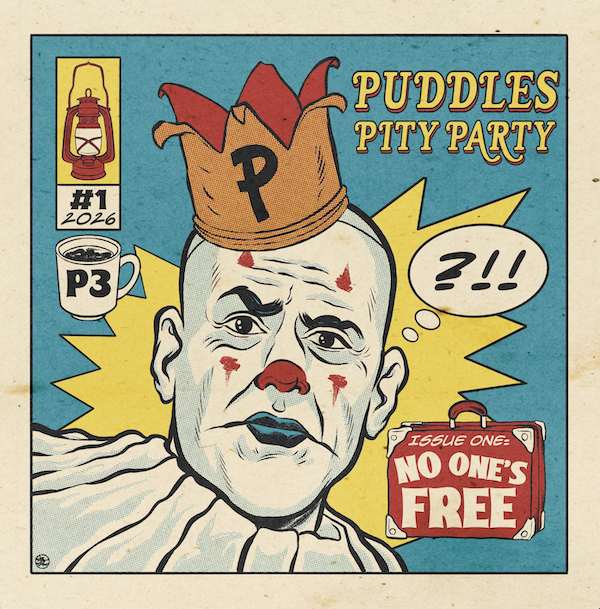
It’s undoubtedly safe to say that Puddles Pity Party is one of the most original acts you’re likely to find. A 6’8” clown with an astounding voice (but who is mute otherwise), he is at once formidable and endearing. Known for his emotive and innovative covers of a wildly disparate collection of cover songs – including “War Pigs” by Black Sabbath, “Royals* by Lorde, “Where Is My Mind?” by Pixies, and many more – he has also just released an album of original material, No One’s Free, which can be bought or streamed at the outlets listed here: puddles.lnk.to/links
Puddles is based in Atlanta, but he’s currently in the midst of an extensive North American tour as the opening act for Weird Al” Yankovic. He is also planning his own headlining tour starting next February, with dates TBA. Besides showcasing his extraordinary voice, these shows highlight his penchant for offbeat humor and lots of audience interaction, as well.
Mike Geier, the man behind Puddles (or, if you will, Puddles’ “representative”) recently spoke with The Big Takeover about the new album, winning over skeptical audience members, and how Puddles has affected him – and others.
For anyone reading this who does not know who Puddles is, can you give an overview?
MIKE GEIER: I mean, there’s the obvious: Puddles is a clown. Puddles is a clown that feels everything, and sort of indulges in feeling everything, and often expresses himself through a song and also interaction with an audience. All of these different feelings, and all of these phases of how people feel things – and it’s all things. He’s often been called a sad clown. He’s sad sometimes. But he’s not only sad. He’s not only happy. He’s not only absurd. He’s all of those things simultaneously. I’ve always resisted trying to explain Puddles because the moment I say something, it’s like, “Well, that’s not really it, either.” From his perspective, Puddles is like, “I don’t care; say whatever you want.” He’s going to do what he wants. So I’m not trying to be difficult or obtuse or anything about it, but it’s hard to describe. But also, I think that not everything needs an explanation, which kind of goes against a lot of things, especially if commerce is related to it. There’s so many dimensions to it. I feel like it’s something you really have to experience firsthand [at a show].
Normally, performers tell stories between songs, and talk with the audience – but because Puddles doesn’t speak, only sings, is it ever difficult to get his point across?
MIKE GEIER: He, and we, try to create mechanisms through song, and also the way Puddles will deliver a song. And visuals. And also, I think establishing a rapport with an audience early on. There are these bullet points that he likes to hit, but he likes to begin with, “Okay, this is going to be weird,” and then begins in earnest in authentically presenting these emotional themes. So Puddles has no problem with any of that sort of navigating or negotiating, “Am I being understood or not?” Because Puddles also believes that, “You guys are with it. You showed up here, so you must be curious and you want to know about this.” So we give the audience lots and lots of credit for being already halfway there when he begins. So I think establishing kind of an absurdity right off the top allows Puddles to do it his way. He doesn’t worry about making sure anyone understands. He believes that you’re going to understand.
The biggest news in Puddles’ world is this new album. How did he know it was the right time to do one with original material instead of continuing to do cover songs?
MIKE GEIER: Andrew Douglas Quinn is the songwriter of all these songs, and he’s a dear friend of ours. And I work with some other guys that worked with him for many years, other musicians, and Tim Delaney, who engineered the record and played on quite a bit of it, was in a band with Andrew. We were having this conversation one day about Andrew’s songs. One of the guys, Brad Lewis, who is one of the producers of it, said, “I hear Puddles singing these songs.” A lot of the songs that Puddles has done in the past are very recognizable covers, but when Puddles first started being known to people, quite a bit of his material were not well known covers. They were interpretations of songs of people that he or I knew, [such as] Glyn Styler from New Orleans, and Dexter Romweber of Flat Duo Jets, who was a friend of ours. Those were the songs, and they were interpretations of these songs, I think much in the tradition of Linda Ronstadt, for example. Linda Ronstadt did other people’s songs in these brilliant ways. She was an interpreter of songs, and I feel the same way about Frank Sinatra and Barbra Streisand. Céline Dion is an interpreter of songs, as well. So we kind of looked at it in that way, as opposed to “cover artist.” So we’re doing these things, a David Bowie song or a Queen song or whatever, and Brad was like, “Why don’t we do Andrew’s songs? They’re brilliant songs.” And so we approached Andrew, and he agreed with it. So we said, “We’re just going to take them and run with them.” And we did, and we discovered that a lot of the elements in the songs didn’t really need that much interpreting. He has all of these pop sensibilities, and those are things that Puddles hasn’t really explored that much in the past, so it was a great opportunity to take some creative and artistic risks, and also change it up musically from what has happened before. The other thing is, thematically, these songs fit nicely within Puddles’ idea of feelings. Personal relationship feelings, but also relationships within culture, especially culture within this country.
How did Puddles realize he had such an exceptional voice in the first place?
MIKE GEIER: You know, it just came out. And a lot of experimenting happened along the way. There’s a term that we like to use called “failing forward.” It’s about the potential for failure, and also actually failing, and through that process, discovering new perspectives. Or, it often will steel your resolve about, “Okay, I tried doing it a different way and it blew up in my face. The way I was doing it [before] was the right way.” Or you discover a new way of doing things. It seems like a fundamental process to me, in that way.
Is it vindicating when Puddles has won over a skeptical audience?
MIKE GEIER: The thing about Puddles is, he’s very sensitive. He wears his feeling on his sleeve; you can tell how Puddles feels about things. But he [also] has this quality that is a little, “Oh yeah? Hold my beer” type of idea. And I think the audience having doubts or reservations, that’s energy they’re bringing in from the outside world, which is a protective thing that we do. We get in a car and we put on the seat belt and the red light and all this stuff that’s going on every second of us being out in the world, and we have to have this armor. So you park the car, you go into the venue, and all of that is coming with you. And Puddles is super aware of that. So his idea is, “I’m just going to do the thing and let’s give the audience a chance to catch up.” And it just seems to work. Some people walk away and it’s not their bag. That’s totally cool. And some take longer than others. But there was definitely an indulgent sense of euphoria when Puddles finished his show at Madison Square Garden and they all stood up and it kind of freaked him out. He gets very emotional in those moments. That’s what happened on AGT when the audience cheered. [Puddles appeared on the 12th season of the America’s Got Talent television show, in 2017.] I can imagine it was pretty weird for the audience: “Wow, what’s this going on? Who’s this stupid goon on stage? What’s he going to do?” And then that happened and they accepted him. They felt it. And so he gets very emotional about that. So there’s more of a sense of, sometimes I use the word fellowship, but I don’t mean it in like a religious way. I mean, everybody gets connected.
I’m glad to get the word out about this album and Puddles in general, because I feel like more people should know about him. I think the world needs more empathy and understanding, and I think that Puddles is good for that.
MIKE GEIER: I couldn’t agree with you more. I feel like Puddles is just doing what Puddles does. I’ve very intimate knowledge of everything [he does], and it still feels like, “Where is this going?” And I try to stay out of its way. I just let Puddles go where Puddles needs to go, and I just want to play a supportive role in doing that. But I’ve learned a whole bunch of stuff from doing this, and I think it’s affected me in an incredible, positive way, especially when it comes to understanding and inclusivity and empathy and compassion. I don’t have any suggestions for how anyone else is supposed to do anything in their life. I just know how it makes me feel through all of these experiences that I would have never experienced without Puddles. It’s pretty incredible.