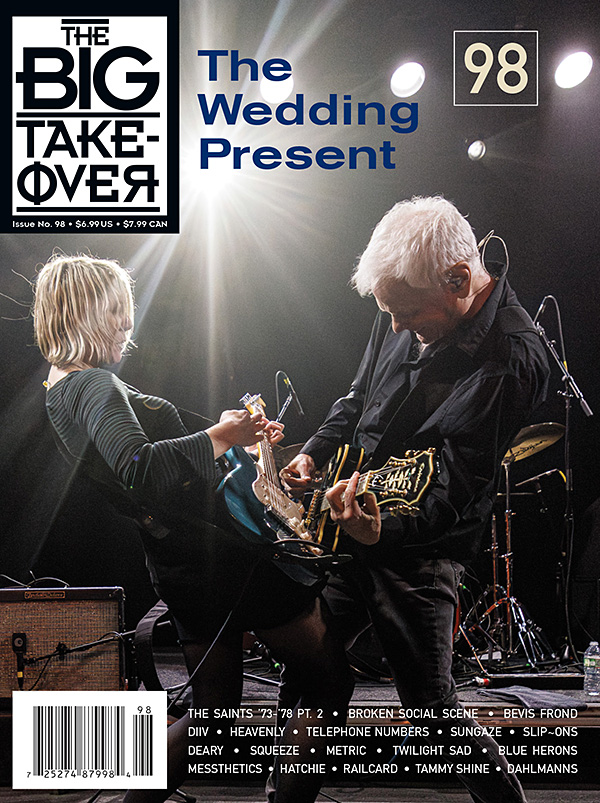

Photo by Gary Orona
For four decades and counting, Steve Stevens has been one of the most acclaimed guitarists across multiple musical genres. Besides releasing three successful solo albums, he’s also worked with a vast array of famed artists, including Michael Jackson, Ric Ocasek, Michael Monroe, Robert Palmer, Thompson Twins, and Devo.
His most celebrated collaboration, though, has been with Billy Idol, with whom he has worked since the early 1980s. Together, they’ve created massive hits such as “White Wedding,” “Rebel Yell,” “Eyes Without a Face,” and “Flesh for Fantasy,” among many others. This year, Stevens and Idol will be inducted into the Rock and Roll Hall of Fame.
Stevens has also been busy creating his own signature guitar with the highly esteemed French Canadian company, Godin Guitars. It first became available for sale in June at authorized Godin Guitar dealers worldwide.
Calling from his Las Vegas home, Stevens tells The Big Takeover his thoughts about all of these things, as well as reflecting on his career overall.
Congrats on your new guitar series – can you give people an overview of what makes this guitar that you’ve created so special?
STEVE STEVENS: It covers two ends of a completely opposite spectrum because it’s a nylon string guitar, so people associate that with classical and flamenco, but it also has the ability to work with guitar synthesizers. So it’s modern and traditional at the same time. A number of years ago, I did a record called Flamenco a Go-Go [1999], where I combined flamenco style guitar with beats and loops. I was listening to a lot of things like Massive Attack and Chemical Brothers at the time, and I had this crazy idea to combine the two [musical styles]. I heard about this company that made this guitar that had one foot in each genre. I approached Robert Godin, the head founder of the company, and explained what I was looking for. He said, “Yeah, we do make a guitar like that.” And here we are 25 years later: a personal version of that same guitar. It’s a bit more flashy. It’s got a beautiful purple stain to it. Updated electronics. Purple tuning pegs. Completely blacked out case with a purple lining. I think rock guitar players, if they’re looking for another kind of sound palette to work with, this certainly opens up a lot of possibilities for them.
How did you know that now is the right time to create this guitar?
STEVE STEVENS: They approached me. You know, 25 years—to have a guitar endorsement with the company for that long is kind of crazy. They said, “You’re our longest-standing artist, and we’d like to celebrate that somehow. What would you like to see that we don’t currently make? What could you come up with?” I was honored and I said, “Okay, let’s do such and such,” and here we are.

25th Anniversary Steve Stevens Signature Model ACS Multiac Guitar
The music business is not known for cultivating long-term relationships, usually, but you’ve done that with this company and also with Billy Idol and others. What is it about your personality that enables you to make connections like that?
STEVE STEVENS: Well, my parents stayed married up until the days of their passing. That was a good example, seeing how they worked through things. I think that you build upon things as a relationship grows and you allow people to experiment and bring in new ideas. I think the Billy Idol thing is the fact that we come from different musical backgrounds, so we don’t get bored with each other. Although, when we were first picking up guitars when we were teenagers, we definitely listened to a lot of the same stuff. I really loved all the English stuff coming out in the early ’70s, and then obviously in New York during the late ’70s, I was able to see all the bands and played at CBGBs, and Billy was a fan of that stuff. He’s always turning me on to new things, and if I hear something that I think is kind of interesting, I’ll say, “Hey, have you heard so-and-so?” “Oh, no, what’s that?” And I think over time it just becomes this amount of respect for not only the music you create, but for each other as people and what we’ve managed to do. So a lot of it really comes down to respect.
It’s great that you’ve both been rewarded for this approach by getting into the Rock and Roll Hall of Fame this year. What does being inducted mean to you?
STEVE STEVENS: It’s great that I’m inducted with a guy that I still work with. A lot of times, I’ve seen that certain bands, band members have passed away, or they don’t speak to each other and they have to separate them at the Hall of Fame. It’s kind of funny. In the case of us, it’s nice that we still work together. We’re still productive. We still love what we do, and that’s never changed. As I mentioned, respect. And also, it’s chemistry. It’s like, you have people that you kind of click with. And also, our band members, some of whom have been with us over 25 years, [will] be able to perform with us at the Hall of Fame. It’s really a celebration of everyone in the organization.
And then you were also just inducted into the Guitar Center “RockWalk” in L.A. As a guitarist, it seems like that would be quite meaningful, too…
STEVE STEVENS: It’s pretty humbling when I look at the other names, like Les Paul. There’s jazz guys inducted, punk rock guys. And I was really honored. The amount of times I’ve been to that store is just crazy. I’ve lived in Los Angeles over 25 years, so it was cool.
You’ve worked with a lot of people, not just Billy Idol. How do you decide who would be a good collaborator?
STEVE STEVENS: Usually they contact me, and I guess they’re aware of what I do. As a guitar player, I’m pretty varied, so I think I’m one of those guitar players that [people say], “Let’s see what Steve might bring,” because I’m hopefully not pigeonholed into one particular style.
And of course you’ve had your own successful solo career. How do you know when you should do something for that or do a project with someone else?
STEVE STEVENS: After I’ve had my coffee in the morning, and I sit down to play the guitar, I’m not one of these guys that plays scales or something like this. I’m usually trying to write a song. I allow my mind to wander, and I come up with something and I go, “This might be good for Billy Idol,” or maybe there’s a singer out there, or a band or another musician I’d love to work with. Occasionally, I’ll create something and go, “This is maybe more suited towards myself.’ Right now, we’re writing new material with Billy, so that’s my focus. Sometimes I’ll reach out to somebody and go, ‘I really love what you’ve been doing. How about collaborating?” So I think my heart tells me. I’m guided by that more than anything.
What made you want to be a guitarist in the first place? Why not be a drummer or something else?
STEVE STEVENS: Oh God, I’m the worst drummer you’d ever hear! I’m terrible. From an early age, I always identified with the guitarist behind the singer. I just thought they were the coolest—everyone from Scotty Moore behind Elvis to Jimmy Page or Jeff Beck. I just liked that personality. I guess I’m a guitarist by nature.
Do you remember the moment when you realized this career was going to actually work out for you, and wasn’t just some dream?
STEVE STEVENS: No, I never really thought that way. I started playing guitar quite young; I was barely eight years old. And then I went to the Fame school, the High School of Performing Arts [New York City’s Fiorello H. LaGuardia High School of Music and Art and Performing Arts]. All these other players were having to make that decision to go to college—as their parents would say, “Something to fall back on if the music thing didn’t work.” I didn’t do that. I just thought, “My first really big disappointment—if I don’t get an audition, or have to sleep on someone’s couch for months on end—I’ll pursue that thing that was something to fall back on.” So [instead], I just thought, “I’m going to give my guitar everything that I possibly can.” And I love doing it. I never looked at it as being a career. I felt I was professional probably from the time I was fifteen years old. That’s what I did: “That’s it, I’m a guitarist.”
Do you ever feel under pressure to live up to high expectations at this point?
STEVE STEVENS: Nah. My only prerequisite is that I still love to do it. Because I’ve seen, with other musicians who’ve been doing it as long as I have, that it just becomes a job to them, a way to pay their mortgage or this and that. I’m just not that guy. I still love the instrument. I still love getting new guitars. I’m still as excited at getting in a room and rehearsing with our band as I was when I was in a garage band. Nothing has changed. I’m really fortunate in that I still have the passion for the instrument.
What do you think as you look back on the legacy you’ve created so far?
STEVE STEVENS: I guess it’s down to the songs. I’ve been involved in some very good touchstones in people’s lives, whether it’s Billy Idol songs or the Top Gun theme or something. [Editor note: That song won the “Best Pop Instrumental Performance” in 1987.] I think that those are really good guitar moments. I think I’ve served the instrument really well, in a way that I’ve made the guys who came before me proud. There’s been some incredible guitar players out there, and I try to honor the instrument, and I think I’ve done pretty good for guitar music. Here’s the thing: I’ve tried to introduce guitar into areas that It’s not ordinarily known for. I worked with a techno band called Juno Reactor, and we did a song called “Pistolero” [in 2000], and it was all this drum and bass backing with this flamenco guitar. Eventually, Robert Rodriguez used it for [the 2003 film] Once Upon a Time in Mexico. I was really proud of that because the guitar is not an instrument that is used in drum and bass music. I thought, “Here’s something that I’ve done that’s unique. It’s being appreciated. It’s not just another heavy metal song or something like that.” The guitar, I’m able to express myself in lots of different ways with it.
Anything else you’d like people to know?
STEVE STEVENS: All our tour dates are listed on billyidol.net. If people are considering coming to see us during our Vegas residency, they’re going to be in for some surprises. We really try and make that special and do different songs, and maybe do things that we’ve never played before. So if people [think], “I saw them two years ago,” well, I can say it’s going to be a very different show to see us [now]. And I’m pretty active on social media, between Facebook and Instagram, so if people wanted to check out everything [there]. I think I post more about my cat than I do about my guitar playing. [laughs] He’s more interesting than me. I will say that he’s got a much more eventful life than I do at this point!
www.facebook.com/stevestevensofficial/