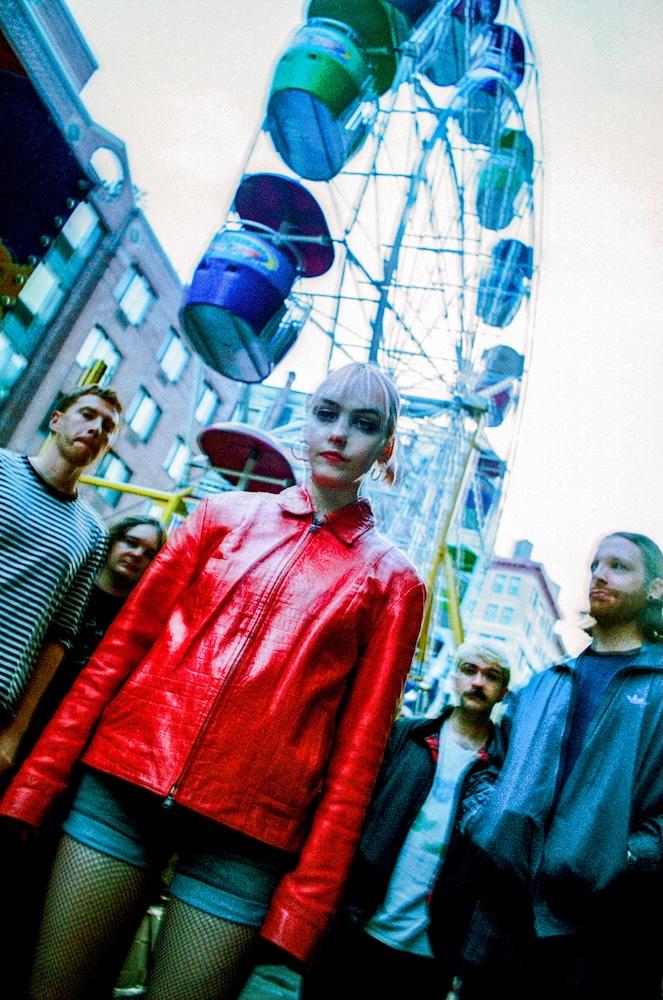
Photo by Conor James
The trajectory of the Dundalk, Ireland quintet Just Mustard (David Noonan, Shane Maguire, Katie Ball, Mete *Kalyoncuoğlu and Robert Hodgers-Clarke), has been a fascinating study in sonic alchemy, beginning with the lo-fi saturation of their 2018 debut, ‘Wednesday’ (Pizza Pizza Records), and solidifying into the more architecturally industrial and kaleidoscopic post-punk of 2022’s breakthrough, ‘Heart Under,’ (Partisan Records). Their métier has always been the liminal space where noise rock meets profound emotional noir. Now, with ‘We Were Just Here,’ (Partisan), the band executes a calculated pivot—a decisive push toward ecstatic dissonance and, crucially, chromatic light. The band’s elevation—evidenced by coveted support slots with their compatriots Fontaines D.C. and, most tellingly, their hand-picking by Robert Smith for The Cure’s 2023 South American tour—underscores a burgeoning mastery of the arena-sized ‘gloom banger’. This experience clearly informs the album’s ambition, forging a sound that marries Smith’s predilection for bittersweet, gothic romance with an amplified textural palette.
‘We Were Just Here’ immediately detonates the preconceptions of their genre. The opener, “Pollyanna,”—a title borrowed from the psychological phenomenon of irrationally intense optimism—erupts in a blinding flash of My Bloody Valentine ferocity, driven by a pulsating, motorik undercurrent. This is not merely a song; it is an orchestration of manic euphoria. The ensuing “Endless Deathless” sets a howling, serpentine guitar conflagration against a thoroughly propulsive beat, establishing a central thematic tension: the lure of the danceable maelstrom amidst existential dread. Mixer David Wrench (known for his work with FKA Twigs and Frank Ocean) acts as a textural alchemist, his signature knack for synthesized de-familiarization amplifying the rhythmic complexity of tracks like “That I Might Not See” and “Silver,”where drummer Maguire’s work transcends mere percussion, delivering moments of rhythmic catharsis.
The album’s structural and emotional apex is the title track, a surprising fusion of Krautrock’s relentless forward-drive and the ethereal waft of dreampop. It serves as a breathtaking, synth-y decompression chamber. Tracks such as “Somewhere” and “Dandelion” follow suit, navigating the emotional abyss with a newfound lightness of touch. This deliberate avoidance of wallowing ensures the darkness never becomes monolithic. However, the late-album exhale, “The Steps,” stands as a fleeting lacuna—a moment of intentional stasis that, while perhaps serving a functional role in the sequencing, slightly dissipates the accumulated kinetic energy. This minor lull is quickly corrected by the closing statement, “Out Of Heaven,” a woozy, trip-hop-inflected ascent that literally reaches for the sublime.
This third album is Just Mustard’s most three-dimensional, dynamically complete statement yet. It is a glorious noise that doesn’t just wallow in the shadows of the goth sub-genre; it aggressively seeks euphoria, charting the entire rollercoaster of adrenaline rush and subsequent comedown. By driving sharp, memorable melody through the sonic malaise on a psych-driven neon bullet train, Just Mustard transforms their signature black skies into a landscape awash with bleach. ‘We Were Just Here’ is a blindingly felt effort, offering a complex, high-vibration sonic world that is perfect for the discernible goth ready to emerge from the shadows and look, however cautiously, toward the light.
Many thanks to Ellen Gurley and Jessica Linker at Pitch Perfect for the coordination.
James Broscheid: Congratulations on the new record! Has it really been seven years since we last spoke??? The album’s title track has a very communal feel to it, and the accompanying video feels like a trance-like Lynch-ian experience. What does the album title mean to you, and how do you feel it represents the overall themes and sound of this record?
Katie Ball: Thank you very much! Yes, apparently so! The meaning of the album title is different for me because it’s a lyric that I wrote so I know what I meant when I wrote it but love that it can be up to other people to interpret in their own way. Who was here, where is here and where are they now?
JB: The band’s been described as riding “a wave of noise to the front of the shoegaze pack.” With such a label being thrown around so effortlessly these days, how do you feel about being associated with the shoegaze genre? How do you think your sound on this new album both fits within and breaks away from that description?
KB: I don’t mind if people associate us with shoegaze, I like the genre, I think it breaks away a lot though in many ways. I think this album has a lot of closeness and clarity.
JB: How did being in a familiar environment like Black Mountain (studio) influence the creative process and the final sound of the album?
David Noonan: The familiarity of Black Mountain was great as we were able to work quickly and fairly fluidly as I was comfortable with the equipment, it really helped keep the focus on the performance and experimentation at all times during recording.
JB: On your previous albums, you often started with instrumental loops and textures, then built the vocals around them. For this record, you reversed that process and focused on the vocal structure first. What prompted this change, and what was the most challenging or rewarding part of adopting this new approach?
KB: Because we already tried that process we wanted to try something new and focus on trying to get some good songs together. It was nice for me to write freely, melodically and put the vocals first, without trying to fit in around loops and textures like we did previously.
JB: Nirvana is mentioned as influences for this album. In what ways did their dynamic song structures inspire you as you were writing?
KB: I think because Nirvana songs all sound good on acoustic guitar/ piano and don’t require specific tones/textures to sound like a solid song, that was something I was inspired by.
JB: The album is mixed by David Wrench. What was it like collaborating with him, and how did his unique style help shape the final mix of this record? Did he bring a new perspective to your music?
DN: David is brilliant to collaborate with, he really breathes new life into the tracks. He has an ability to create excitement in the mix and on this record, somehow managed to make the melodic elements feel more melodic and full of life.
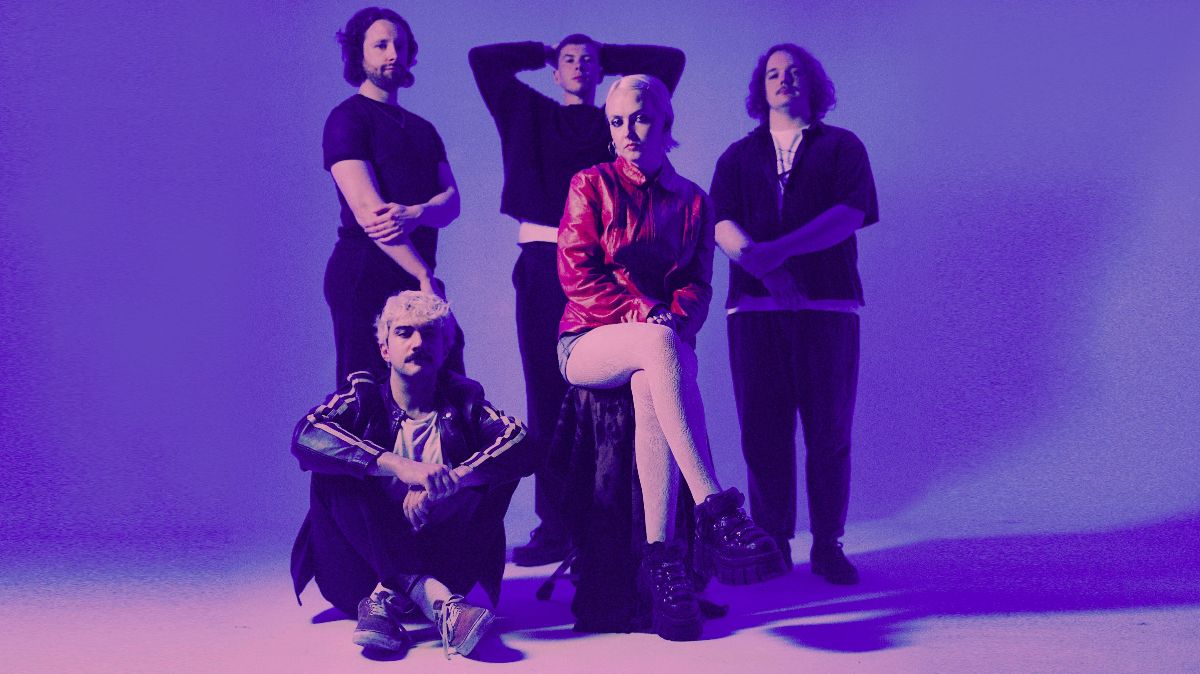 Photo by Greg Purcell
JB: Katie, you mentioned that on this album, you were “trying to write more optimistically” but sometimes felt like a fraud. Can you talk more about that conflicted feeling and how it’s explored in your lyrics?
KB: I wanted to write optimistically but didn’t always have the optimistic outlook inside of myself to write that way, and couldn’t find it looking outside myself into the world with everything going on at the minute. Which is why I sometimes felt like a fraud. I think, although to me, I am writing positively there is still apprehension in my words and delivery which is how I felt.
JB: The album is described as a “sound that leans toward light and euphoria,” a shift from the previous album, ‘Heart Under.’ Can you talk about the decision to move in this direction? What inspired this change in emotional tone?
KB: For me, it was natural to want to try something different but personally chasing euphoria was where I found myself after leaving the headspace I was when writing ‘Heart Under’ which was a pretty grim place.
JB: The press release mentions the new album was club spaces. How did these inspirations translate into the music? Were there specific sounds, rhythms, or feelings from those spaces that you wanted to capture?
KB: We wanted to write music that people could dance to and would be fun to play live. And yeah, wanting to capture the feeling of being on a dance floor, I imagined myself in those places and wrote songs from there.
JB: The album is said to channel noise into something “warmer and more melodic.” How did you approach this balancing act? Was it a conscious effort to make the music more immediate and melodic, or did it happen more organically in the creative process?
DN: It was both. We wanted to push each track’s mood as far as we could in the sense of, if it was dark make it really dark, if it was melodic push the melody to the front, etc. Not trying to push everything into a similar mold across the album. In doing this we found the melodic warmer and immediate tracks to be the most exciting to us and also echoed the lyrical themes best.
JB: Was there a specific intention behind bringing the vocals to the forefront in the mix on this record? Katie, did this change your approach to vocal performance and writing?
KB: It was more the other way round. Having the vocals to the forefront was informed by the songwriting approach, putting the vocals first in the arrangement meant that they were leading the track and need to be heard.
JB: The release also notes your signature elements—“warped guitars, cavernous low ends, twisted sound design”—remain intact. How do you find a balance between experimenting with new ideas in sonics and emotion while staying true to the core elements of your sound?
DN: I think the experimentation in sound is where we are most excited instrumentally. Staying true to the core sound is partly due to using limited equipment and also having a small window of taste that the entire band agrees on. We like to challenge ourselves to push as far as we can in different directions but I naturally settle somewhere that feels new but familiar often.
To follow Just Mustard online or to make a purchase, please visit: Website | Instagram | Bandcamp | Partisan Records
2026 Tour Dates
Wed. Apr. 8 – Stockholm, SE at Debaser
Thu. Apr. 9 – Oslo, NO at John Dee
Sat. Apr. 11 – Copenhagen, DK at Loppen
Sun. Apr. 12 – Hamburg, DE at Nochtspeicher
Mon. Apr. 13 – Cologne, DE at Helios 37
Wed. Apr. 15 – Amsterdam, NL at Paradiso
Thu. Apr. 16 – Brussels, BE at Botanique
Fri. Apr. 17 – Paris, FR at Le Trabendo
Sun. Apr. 19 – Norwich, GB at The Waterfront
Mon. Apr. 20 – Birmingham, GB at The Castle & Falcon
Tue. Apr. 21 – Newcastle, GB at The Grove
Thu. Apr. 23 – Glasgow, GB at Glasgow School of Art
Fri. Apr. 24 – Leeds, GB at Brudenell Social Club
Sat. Apr. 25 – Manchester, GB at Gorilla
Mon. Apr. 27 – Bristol, GB at Thekla
Tue. Apr. 28 – Brighton, GB at CHALK
Wed. Apr. 29 – London, GB at Electric Brixton
Fri. May 1 – Dublin, IE at Olympia Theatre
Fri. May 8 – Seattle, WA at Tractor Tavern
Sat. May 9 – Vancouver, BC at Fox Cabaret
Sun. May 10 – Portland, OR at Polaris Hall
Tue. May 12 – San Francisco, CA at Cafe Du Nord
Thu. May 14 – Santa Ana, CA at Constellation Room
Sat. May 16 – West Hollywood , CA at Troubadour
Sun. May 17 – Phoenix, AZ at Valley Bar
Tue. May 19 – Denver, CO at Larimer Lounge
Thu. May 21 – Chicago, IL at Empty Bottle
Sat. May 23 – Toronto, ON at The Garrison
Sun. May 24 – Montréal, QC at Bar Le Ritz PDB
Tue. May 26 – New York, NY at Bowery Ballroom
Fri. May 29 – Philadelphia, PA at Johnny Brenda’s
Sat. May 30 – Washington, DC at Songbyrd Music House
Fri. June 26 – Dublin, IE at Marlay Park (with The Cure, Stella and the Dreaming)
Sun. June 28 – Belfast, IE at Belsonic (with The Cure and The Twilight Sad)
Sun. Aug. 23 – Edinburgh, SF at Royal Highland Showgrounds (with The Cure, Slowdive and Mogwai)