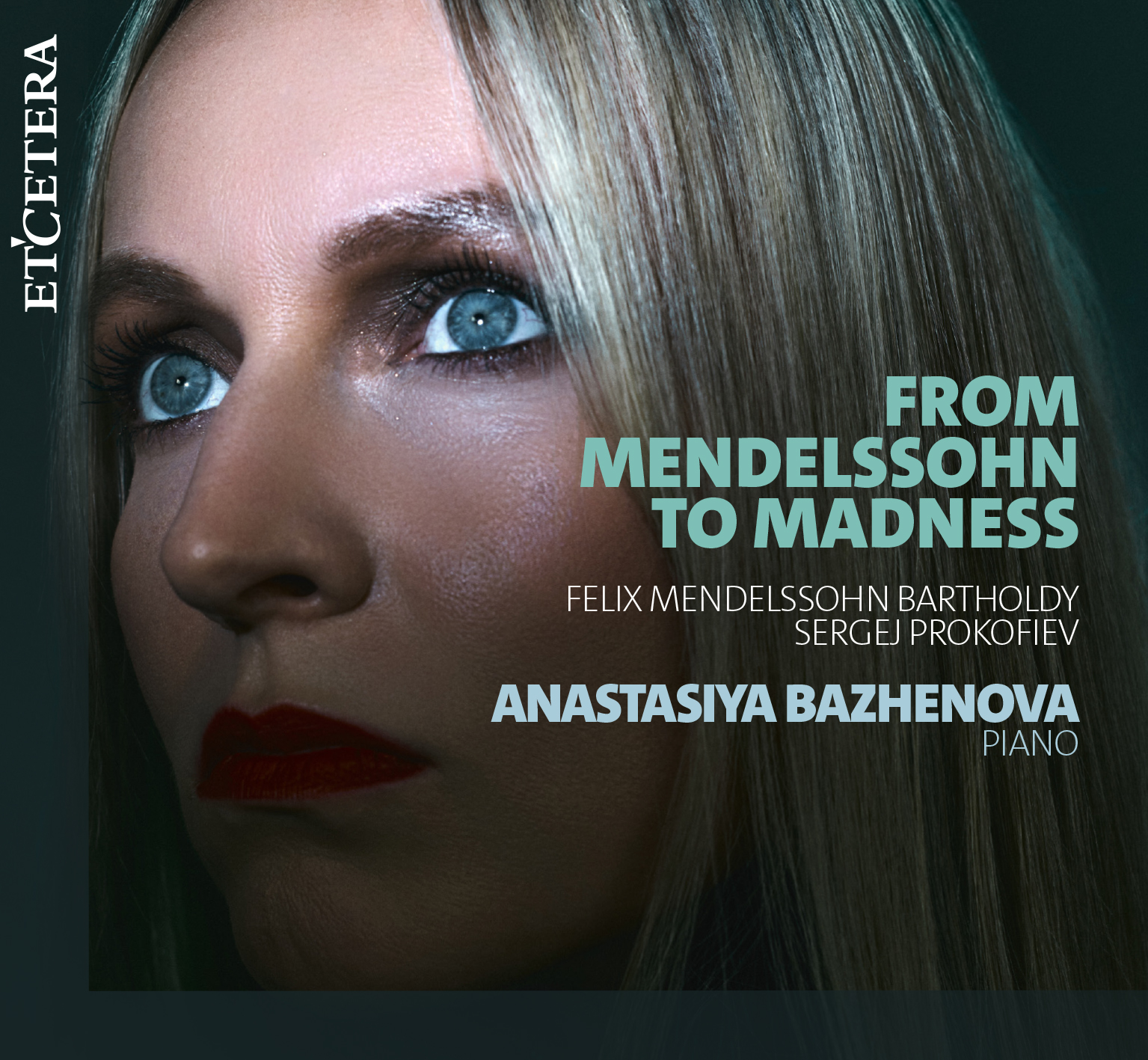
Less a debut album, rather what Anastasiya Bazhenova prefers to call her “first complete artistic statement”, the release of From Mendelssohn to Madness was the perfect opportunity to sit down with the recitalist and find out how it all came together and what drove the creative process.
Last time we spoke, we talked about your music and career in a more general way; this time I’d like to focus more on your debut album, From Mendelssohn to Madness. This is your debut album; why did now feel like the right time to release it?
I never wanted to record an album simply because it was “time” to make a debut. For me, an album should be more than a collection of performances—it should express something that cannot be said in a single concert. Over the past few years, I found myself thinking less about individual pieces and more about the relationships between them.
Certain works stayed with me, not because they belonged to the same period or style, but because they seemed to speak to one another in unexpected ways. At some point, I realised I wasn’t building a recital programme anymore—I was shaping a single artistic narrative. Once that became clear, recording the album no longer felt like a career milestone. It felt like the natural form that this idea had to take.
That’s why I don’t really think of From Mendelssohn to Madness as my debut album. I think of it as my first complete artistic statement.
Can you explain the concept behind the album, and what the journey is when these pieces are taken as a whole? Can you explain the emotional arc that runs through it?
I never imagined this programme as two separate worlds placed side by side. From the beginning, I heard it as a single emotional landscape that gradually changes its shape. It begins with Mendelssohn’s ‘Songs Without Words’, where emotion is intimate and contained. There is melancholy, longing and tension, but everything still exists within a sense of balance. Nothing has broken yet.
‘The Fantasie’ becomes a turning point. The emotional world begins to expand, and with it comes a growing feeling of instability. The music no longer seems entirely at peace with itself.
By the time Prokofiev ’s ‘Sixth Sonata’ begins, that inner tension can no longer remain hidden. It becomes physical, fragmented and, at times, almost overwhelming. So the journey isn’t really from Mendelssohn to Prokofiev. It is the gradual transformation of one emotional world into another. The title From Mendelssohn to Madness describes that transformation—not a composer, but the destination of the listener’s journey.
These are more than just recitals; these are personal interpretations. What do you bring to these pieces, and what are you looking to highlight in the original works?
I don’t think interpretation means adding something to the music that wasn’t there before. If anything, it requires the opposite. It means listening carefully enough to avoid imposing your own ideas too quickly. What fascinates me is ambiguity. The greatest works rarely express just one emotion. A single phrase can contain tenderness and doubt, strength and vulnerability at the same time. I try not to simplify those contradictions, because I believe that’s where music becomes truly alive.
In Mendelssohn, I wanted to reveal the complexity hidden beneath the elegance. In Prokofiev, I was interested in the humanity behind the violence. Those qualities have always been there in the music—I simply wanted to give them enough space to be heard.
If listeners leave with the feeling that these familiar works have become a little less predictable, then I feel I have done my job.
The album is based on the music of the titular Mendelssohn and that of Prokofiev. Why did you choose these two composers, and does the title suggest that the latter is the “madness” of the piece?
Mendelssohn and Prokofiev have been part of my musical life for many years, but for very different reasons. Mendelssohn taught me the power of restraint. His music often speaks most deeply through what it chooses not to say. Everything depends on colour, balance and the ability to create intensity without ever forcing the sound. Prokofiev challenges me in a completely different way. His music demands courage. It pushes both the performer and the listener towards emotional and technical extremes.
At first they may seem like opposites, but I gradually realised that they explore the same human experience from different directions. The emotional tension that appears openly in Prokofiev is already present in Mendelssohn—it is simply quieter, more deeply hidden beneath the surface.
That is also what the title means to me. I never intended “madness” to describe Prokofiev himself. It is not attached to one composer. It is something that exists throughout the programme, gradually revealing itself. By the end it can no longer remain hidden, but its first traces are already there in the opening pages of Mendelssohn.
Also, how easy is it to bring these two composers together in one piece given that they are of different musical eras, their lives never overlapping?
 I never felt that I was trying to “connect” Mendelssohn and Prokofiev. History wasn’t really my starting point. When we speak about literature, we don’t find it strange that Shakespeare, Dostoevsky and Kafka can all speak to us in the same conversation. They lived in different centuries, yet they explore questions that remain deeply human.
I think music works in much the same way. Great composers don’t belong only to their own time. They continue to speak because they reveal something fundamental about human experience. Once I stopped thinking in terms of historical periods and started listening to what the music was actually saying, placing Mendelssohn and Prokofiev together no longer felt unusual. It felt completely natural.
If so, can you describe the process of choosing how to choose the running order so that you run from one to the other?
The running order wasn’t something I calculated after choosing the repertoire. It emerged together with the concept itself. From the beginning, I knew I wasn’t looking for contrast. I wanted each work to make the next one feel inevitable, as though the emotional world of one piece naturally opened the door to the next.
That is why the programme begins with Mendelssohn’s ‘Songs Without Words’. They establish an emotional language that gradually becomes more unsettled in the Fantasie. By the time Prokofiev’s ‘Sixth Sonata’ begins, the musical language has changed dramatically, but the emotional thread has never been broken.
Once I discovered that thread, I never seriously considered another order. It no longer felt like a sequence of individual works, but like a single story that could only unfold in one direction.
As a recitalist, there must be an element of spontaneity and freedom in live performance. Is the opposite true? Is the studio environment restrictive for someone used to such freedoms when playing?
Not really. I don’t experience the studio as restrictive. If anything, it asks a different kind of honesty. A concert disappears the moment it is over. A recording remains. It preserves every musical decision, so you can no longer rely on the energy of the moment. Everything has to be convincing on its own.
I actually enjoy that process. Recording forces me to listen differently—not only to the music, but also to myself. Sometimes an idea that feels completely natural in a concert doesn’t survive repeated listening. Other times, the quietest and most understated moments become the most powerful.
The studio isn’t about creating a flawless performance. It’s about discovering which interpretation still feels true when nothing is hidden behind the excitement of a live performance.
The album feels rooted in psychology as much as virtuosity and interpretation. Is this a reminder that perhaps the deeper messages of the original works often get lost on a modern audience as the music moves away from the cultures and times of its original backdrop?
I don’t think great music needs to be updated in order to speak to us. If a work survives for centuries, it is because it already contains something that goes beyond its own time.
My intention was never to make Mendelssohn or Prokofiev feel more “modern.” I think they already are. The emotions they explore—uncertainty, hope, loneliness, fear, resilience—are experiences that haven’t changed very much.
What interested me was not changing the meaning of these works, but creating a new conversation between them. Sometimes placing familiar music in a different context allows us to notice things that were always there but that we had stopped hearing. If this album encourages someone to return to these composers with fresh ears, then it will have achieved exactly what I hoped it would.
Having spent so much time with the music of Mendelssohn and Prokofiev, do you feel you have a greater understanding of their music, themes and psyche, or was it such an already deep understanding that compelled you to make such an album?
I certainly understand this music differently than I did when I first began working on it, but I wouldn’t say I understand it completely. In fact, I hope I never will.
What changed most was not my opinion of Mendelssohn or Prokofiev, but the way I listen. The longer I lived with this programme, the less interested I became in finding definitive answers. Instead, I found myself asking better questions. I think that’s one of the greatest qualities of truly great music. It never stops inviting you to reconsider what you thought you already knew.
So I don’t see this album as the conclusion of a journey. If anything, it marks the beginning of a much longer conversation with these works.
And what do you hope listeners, both of the record and the live performances, will take away from this album?
I don’t hope that everyone will leave with the same impression. In fact, I think that would be a disappointment. Music becomes meaningful because each listener brings something of themselves into it. What I do hope is that people will experience the programme as a whole, rather than as a series of individual works. For me, From Mendelssohn to Madness is a single artistic journey, and I hope listeners allow themselves to travel through it without trying to define every emotion along the way.
If, after listening, someone feels compelled to return to the album—or to these composers—with a different kind of curiosity, then I would feel that the programme has found its purpose.
Thank you so much for taking the time to take us deep into the motivation and themes of this fantastic album. Best of luck with it, the recitals that you have planned this year and everything else you are working on.