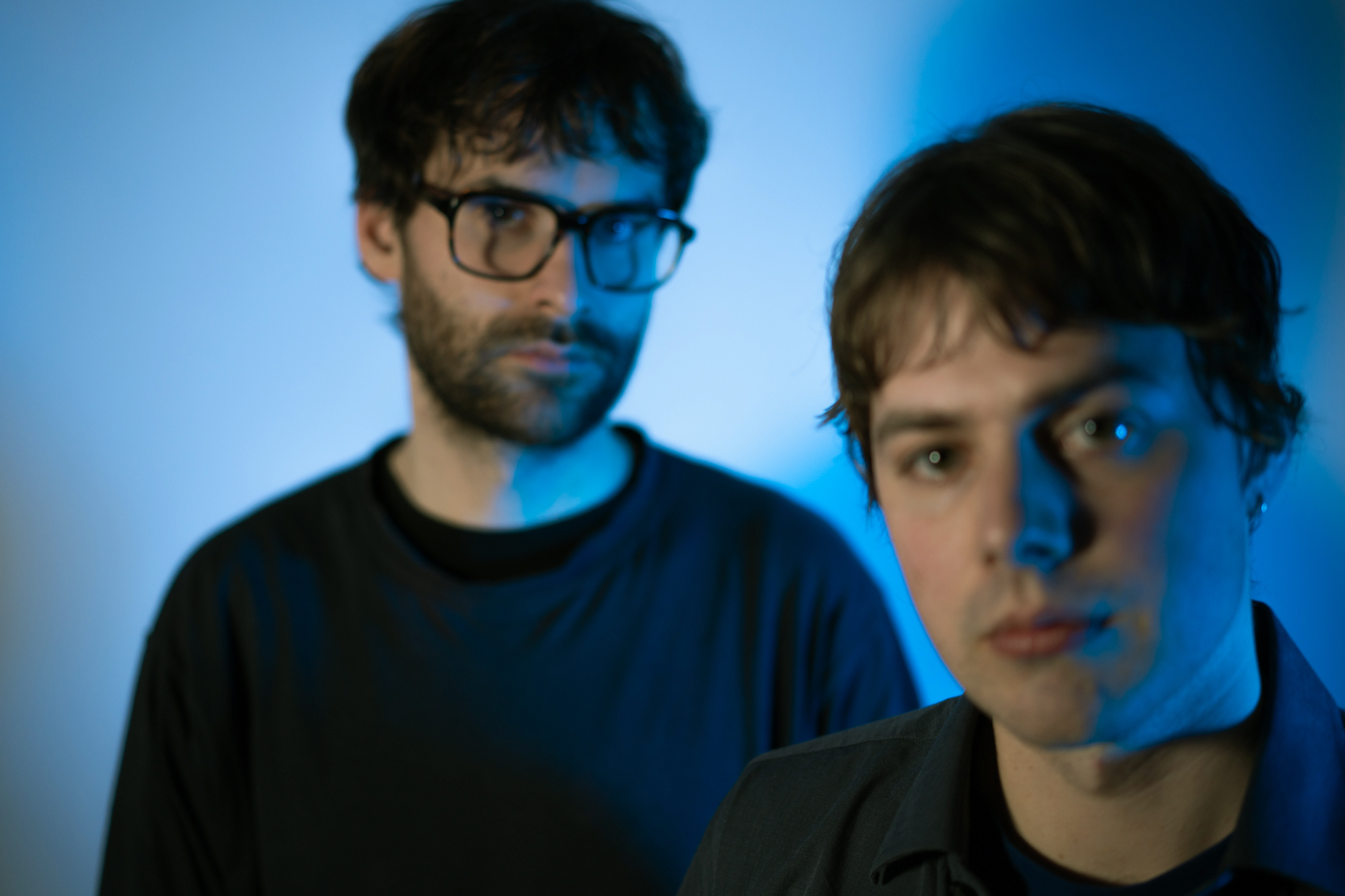
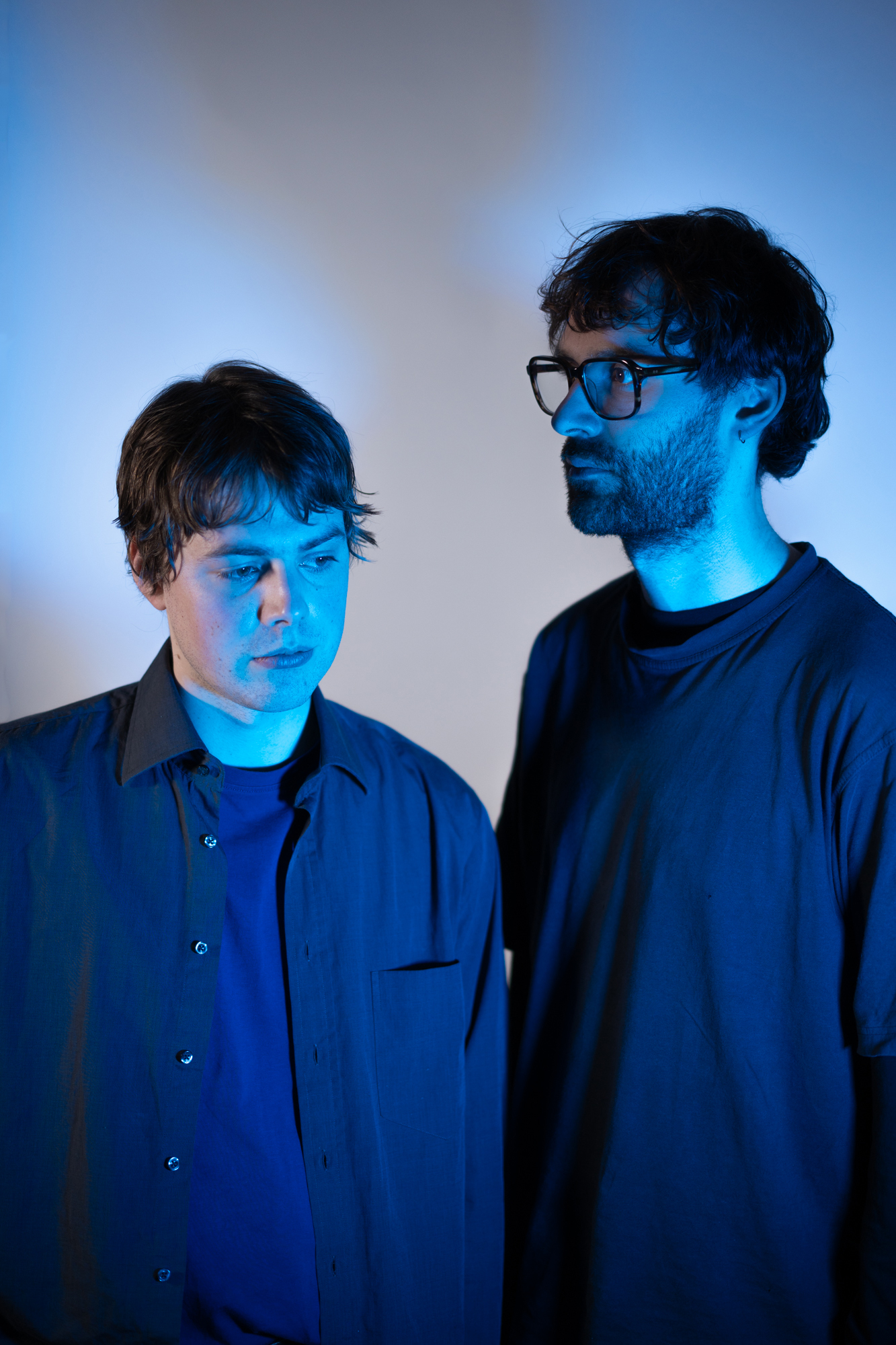
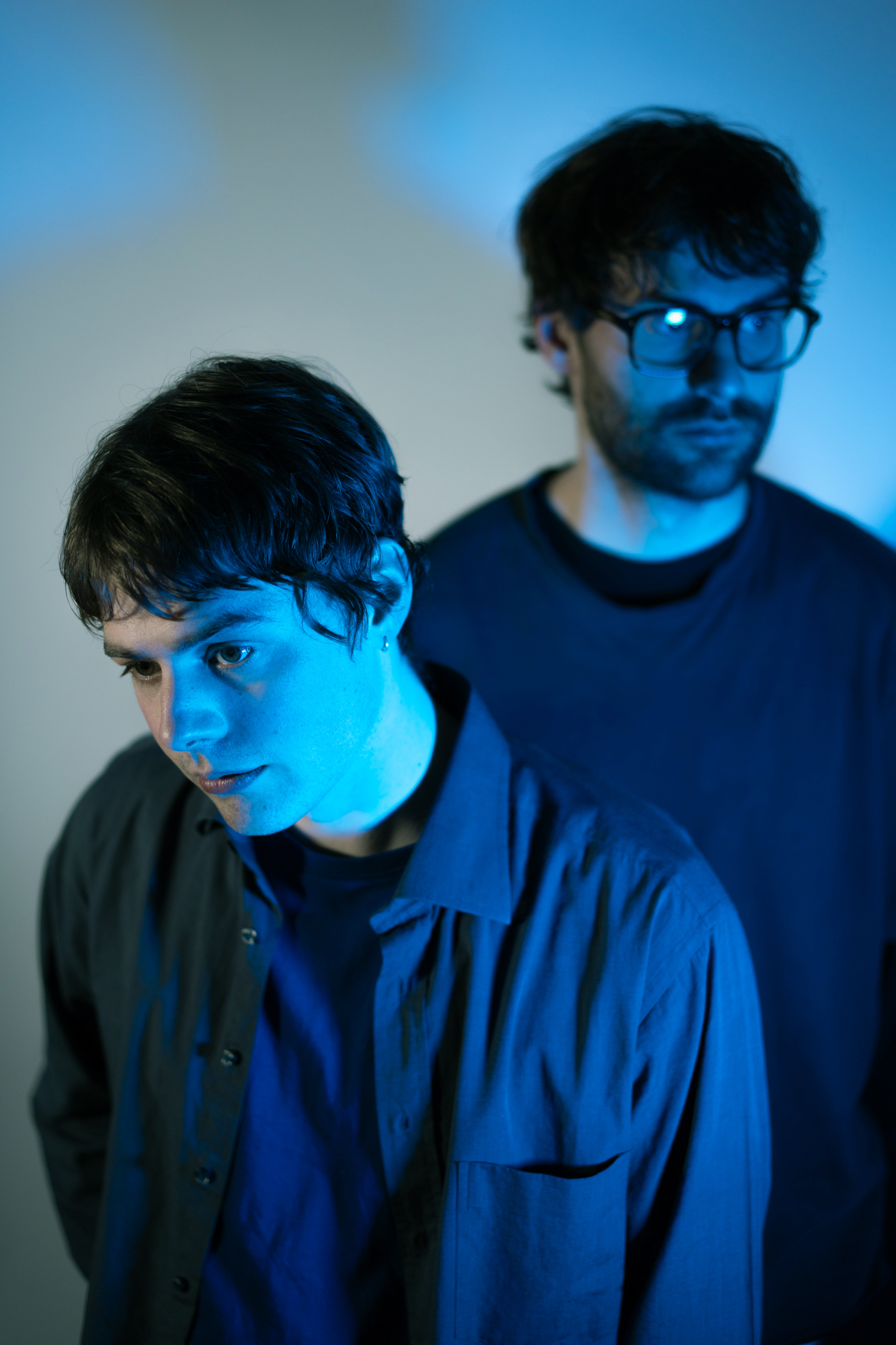
All photos by Agnes Zimmermann
Emerging from Dortmund’s industrial sprawl, Telephonist operate with a quiet defiance, reshaping the language of contemporary shoegaze and electronic music into something more austere, more deliberate, and distinctly their own. Formed in 2023 by multi-instrumentalists Dennis Mielke and Oskar Middelhauve, the duo has quickly carved out a space that resists easy categorization, drawing from the textural density of shoegaze, the skeletal pulse of minimal electronics, and the emotional directness of German lyricism. Their work does not seek comfort; instead, it confronts the listener with a carefully constructed sense of unease that mirrors the dissonance of modern urban life.
Their debut EP for Dreams Never End called ‘Gegen die Wand’ (“Against the Wall”) stands as a stark introduction to this ethos, a record that trades excess for precision and spectacle for atmosphere. Across its five compositions, Telephonist construct a world where sound behaves like architecture, rigid yet immersive, enclosing the listener within shifting corridors of memory and mood. The title track establishes this framework with unflinching clarity, its driving rhythm colliding with cold, synthetic surfaces that evoke both physical and psychological confinement.
What distinguishes Telephonist from many of their contemporaries is their commitment to restraint. In “Was du Warst” (“What You Were”), the duo pares back their approach, allowing absence to carry as much weight as presence. The result is a piece that lingers in the space between recollection and erasure, its emotional core defined as much by what is withheld as by what is expressed. This sensibility reaches a kind of stark culmination in “Kalter Beton” (“Cold Concrete”), where the textures feel almost architectural in their severity, translating the starkness of the built environment into sound.
Yet Telephonist are not solely concerned with rigidity. “Ins Blau” (“Into the Blue”), introduces a subtle expansion, a moment where the music seems to loosen its grip, drifting into a more fluid, almost weightless state without abandoning the underlying sense of melancholy. By the time the EP arrives at “Von Grund Auf” (“From the Ground Up”), the duo has constructed and dismantled an entire emotional landscape, leaving behind fragments that resist easy resolution.
Singing in German, Mielke and Middelhauve position themselves slightly outside the dominant currents of the genre, where English-language abstraction often softens emotional edges. Their choice brings a different kind of immediacy, grounding their work in a specific cultural and linguistic context while amplifying its sense of intimacy. It also underscores their broader ambition: not merely to participate in an established sound, but to reshape it, to locate new expressive possibilities within its familiar contours.
As Telephonist step into wider recognition, they do so with a debut that feels both self-contained and suggestive of future evolution. ‘Gegen die Wand’ is less an introduction than a statement of intent, a carefully measured exploration of space, memory, and emotional distance. It invites listeners into a world where beauty and austerity coexist, and where the act of listening becomes an exercise in navigating the spaces between.
Much appreciated to Dennis and Oskar for their time.
James Broscheid: The title ‘Gegen die Wand’ evokes confrontation, restriction, pressure, both physically and emotionally. What specific experiences or states of being were you channelling into this title, and how do you feel they shaped the sonic world of the EP?
Oskar Middelhauve: On the one hand, the title refers to the city we live in. This type of city, which is common in Germany, can be very oppressive due to its gray, rundown buildings. On the other hand it is much more a metaphor for personal obstacles that stand in front of you like a concrete wall. Maybe that’s why we wanted the songs to sound not only dreamy, but also brutally mechanical and dark at times.
JB: The EP highlights a tension between melancholic fragility and intensity in the sound; a sense of beauty emerging from emotional constraint. How conscious were you of navigating that tension while writing and arranging these songs?
Dennis Mielke: In our eyes, shoegaze is exactly that, the ambivalence between melancholy and heavy. That’s why it made sense to approach these themes and feelings in this way.
JB: Your decision to write in German rather than English stands out in the shoegaze and dream pop genres, which are often dominated by English lyricism. How does working in your native language influence the emotional texture, imagery, and cadence of the music for you? Can you talk about how you navigate linguistic nuance and musicality in German in ways that differ from multilingual influences you admire?
OM: When dealing with these personal topics of memories and changes,it is important to write in your own language in order to be truly honest and sincere about these topics. However, German is not easy to write in because many words can sound very direct and do not have a pleasant sound. Furthermore, it was important to us that the vocals and lyrics were not the absolute focus, as is usually the case in German music. Therefore, it was important for us to write the lyrics as abstractly and universally as possible in order to tone them down a bit. We knew it would be difficult and that it is always easier to write in English. But we wanted to take on the challenge, especially since this doesn’t exist in this form yet.
JB: Telephonist formed in 2023 and Gegen die Wand is your debut EP. Looking back on the creative journey from your first collaborative moments to completing this record, what aspects of your partnership surprised you most from then up to now?
DM: It quickly became clear that we both understand and see music, as well the guitar in a similar way. However, what has become apparent over time and remains very important is that we have different approaches on some topics as well and that seems to be a good balance.
JB: Shoegaze is often associated with immersive textures, muted vocals, and layered atmospheres. When you began shaping this EP, did you start with sound design, lyrics, emotional themes, or something else entirely? Can you run us through your process for writing & recording?
OM: The first part of writing a song is usually a guitar idea on which the rest is built around. It’s hard to say, but the lyrics were probably often created by association with the sounds and harmonies. The EP was mainly created in Dennis’ room. That’s where the songs were written, the first demos were created, and where we mixed the EP. It was recorded in different rooms, whatever was available to us.
JB: How do you decide when a song feels complete, especially in a genre that often embraces ambiguity?
DM: That was difficult. Since we always had the option of recording more, we kept adding new things when we noticed something was missing during the mixing phase. In the end, there were so many tracks that it was easy to lose the overview of what a song still needed and when it was really finished.
JB: “Kalter Beton” has been described as evoking the image of cold, obstructive urban landscape. How do physical environments (like the city of Dortmund) influence your songwriting and tonal palette?
OM: The place where you live is always the starting point from which you see things. Dennis originally comes from the seaside. Since moving to a rather gray and dreary city, the lyrics of “Gegen die Wand” could have been written from this perspective.
JB: After a few listens, your music as emotionally potent; a blend of introspection, tension, and catharsis. Do you think of your music as a form of emotional processing? If so, how do you balance personal expression with leaving space for listeners’ interpretations?
DM: Personal experiences are generally more of a starting point and inspiration for us. The lyrics are then more of an abstract form of processing than a direct personal take. We wanted each song to be able to be interpreted in different ways.
JB: In a genre with strong historical influences, what elements of ‘Gegen die Wand’ represent homage, and what elements feel like a break toward something uniquely yours?
DM: The amount of guitar layers are perhaps a kind of homage to the recording process of My Bloody Valentine, just as the lead lines or chord structures are inspired of these bands. Obviously, the German lyrics are something unique. Although it is shoegaze, of course, there are also many approaches that work a little outside the genre. For example, we placed a lot of emphasis on acoustic instruments, such as the cello that Oskar played or the acoustic guitars that are inspired more by Elliott Smith than My Bloody Valentine.
JB: If you were to describe the emotional “arc” of the EP as a journey, what shape would that journey take? Do any specific tracks serve as turning points in that narrative arc?
OM: The EP repeatedly circles around the aspect of time. The EP encourages self-reflection with reference to our present and our past. “Von Grund Auf” is the last song and also the turning point. It deals with the question of what follows from reflecting on ourselves. It is also the only song that looks to the future.
JB: You’ve mentioned frustration with people, structures, and urban life as thematic elements of the EP. How much of the album’s emotional content comes from internal reflection versus observation of your surroundings or social contexts?
DM: That’s pretty much what it all boils down to. However, the frustration is more to be understood in terms of one’s own relationships with others.
JB: Given that your music draws from international influences but retains German lyricism, how do you perceive Telephonist’s place within the broader German music landscape and beyond? Do you feel there’s a particular creative responsibility or opportunity in shaping that landscape?
OM: In Germany, this type of music is still very underground, perhaps because it is more difficult to interpret. Most of the better-known artists are often very direct in their musical or emotional effect. But it’s also the nature of german lyrics, to be kind of direct. Abstract styles of music are still a bit niche, but there is a scene for it and it’s likely we will see it grow, which is cool.
JB: Looking ahead, are there themes, styles, or sonic territories you feel pulled toward exploring next? Perhaps in ways that contrast with or expand the world you’ve built on ‘Gegen die Wand’?
DM: In the new songs, there are other protagonists who go beyond that.
JB: Shoegaze is often described as music that envelops rather than confronts. Do you see a paradox between the EP’s title and the genre? And if so, how do you reconcile these impulses in your music?
DM: A little bit contradictory is the kind of the basic idea of shoegaze. You play beautifully melancholic-sounding chords through aggressive distortion effects.
JB: Finally, if you were tasked with creating a visual art piece, say a film, installation, or performance that encapsulates the emotional core of this EP, what form would it take and why?
OM: Perhaps a constantly recurring pattern or movement. A process that, depending on interpretation, can be seen as beautiful, sad, angry, or indifferent.
Learn more by visiting Bandcamp | Dreams Never End | Found Links.