
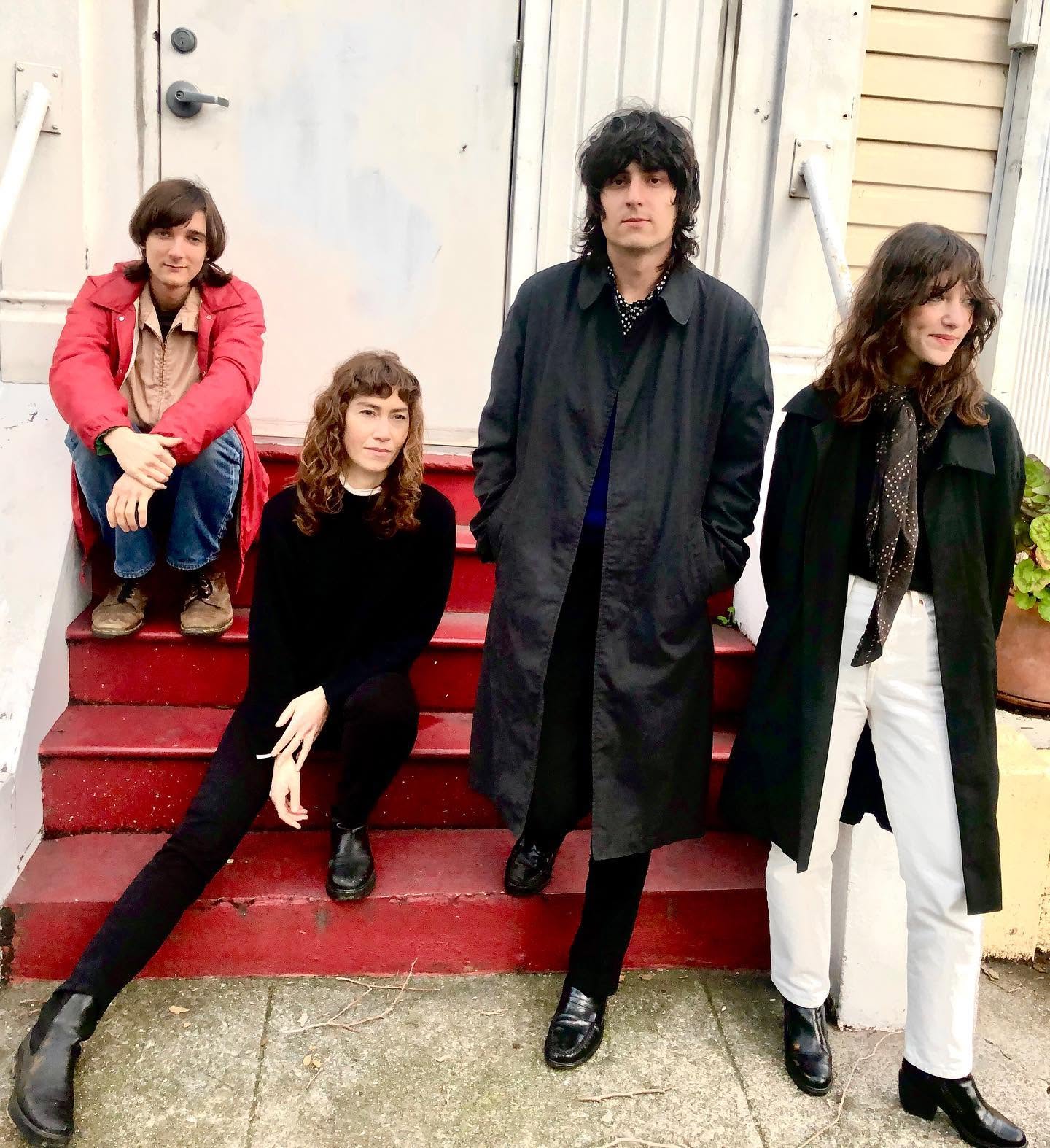
Photos courtesy of Cindy
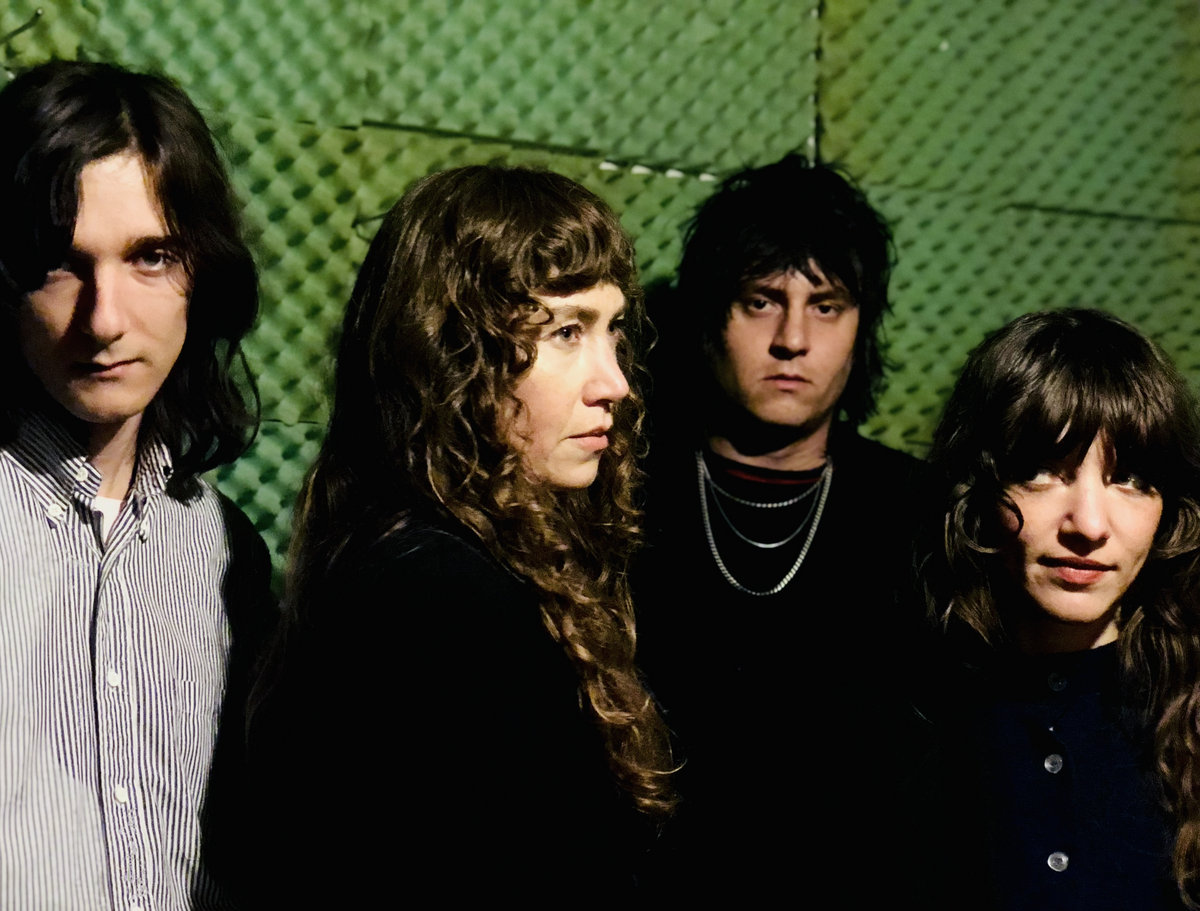
In an era that often rewards immediacy and overexposure, Cindy continue to find power in ambiguity, creating songs that linger like half-remembered dreams and conversations overheard through open windows. The San Francisco quartet, led by songwriter Karina Gill and completed by Staizsh Rodrigues, Will Smith and Oli Lipton, have spent the better part of a decade refining a musical language that thrives in the space between certainty and suggestion. Their work resists easy interpretation, inviting listeners into carefully observed worlds where emotional truths emerge not through grand declarations but through subtle shifts in atmosphere, perspective and feeling.
That sensibility reaches a compelling new depth on latest LP ‘Another Country,’ (Tough Love), the band’s fifth full-length album and their first recorded with the same line-up that shaped 2024’s ‘Swan Lake EP’ (Tough Love Records, 2024). Across its songs, Cindy transform intimate fragments of experience into something expansive and quietly cinematic. Private reflections brush against larger questions of longing, perception and belonging, while everyday scenes take on an almost mythic resonance. The record unfolds with remarkable patience, revealing itself gradually through layers of melody, texture and imagery that feel both deeply personal and strangely universal.
Inspired in part by the emotional complexity and searching spirit of James Baldwin’s novel of the same name, ‘Another Country’ explores the limitations of obvious explanations and easy conclusions. Rather than offering answers, the album inhabits uncertainty, tracing the contours of desires, doubts and fleeting revelations that exist beneath the surface of ordinary life. It is a collection that rewards attention, drawing listeners further into its mysteries with each return.
With their latest release, the band stand at a fascinating point in their evolution. Their music remains unmistakably their own, elegant, understated and emotionally rich, yet continues to uncover new dimensions within its distinctive aesthetic. For Karina Gill, whose songwriting has long served as the group’s guiding compass, the album represents both a deeply personal vision and the creative chemistry of a band whose shared understanding has never felt stronger. In this conversation, Gill reflects on the making of ‘Another Country,’ the collaborative spirit behind the record, and the enduring allure of songs that reveal their secrets slowly.
Many thanks to Stephen Pietrzykowski at Tough Love Records for the assistance and to Karina for her time.
James Broscheid: How did Baldwin’s ‘Another Country’ (Dial Press, 1962), become more than a literary reference point for this record and evolve into something more structurally embedded within the emotional logic of the album itself?
Karina Gill: Maybe the clearest way to put it is that the record pays homage to Baldwin’s rejection of inadequate accounts of how things are and his ability to point to the forces at work that those inadequate accounts might try to cover up. Those forces are simple and maybe even singular and get expressed everywhere in a million different ways.
JB: You’ve described Cindy songs as “X-rays” generated from your perception of experience. When you listen back to ‘Another Country’ now, do you hear those songs as documents of clarity, or do they preserve confusion in a way that still feels unresolved to you?
KG: The “x-ray” is maybe a lame analogy, but it works. X-rays are clear in a way, but they also miss a lot, like flesh and organs. People annoyed with me have described the way I see things as too much of an x-ray, too either/or. There’s nothing confusing to me about the songs, but I can see how they might be for anyone else. The songs hang together like a skeleton in the sense that all the connections work, but yeah, there’s no face on it.
JB: Across the album, there’s an extraordinary tension between intimacy and distance, where songs feel emotionally close yet psychologically obscured at the same time. What draws you toward ambiguity as an expressive language rather than direct confession?
KG: Welcome to my world! Just kidding, but not entirely. This is not a stylistic choice. I have no idea what I would say if I tried to write a directly confessional song. Of course, I get wrapped up in my personal life like anyone, but that’s not where the songs come from. I remember seeing a clip of a tv interview with Leonard Cohen when he was a young poet. He read a poem and then the host asked him what it meant and he just paused then read the poem again. I can’t be that serious about myself but I understand the gesture, if I could simply say something without a song, then I should do that. Songs, for me, come out of the part of experience that isn’t exactly personal, or maybe it’s even more personal than the stories we identify with. The songs happen where my specific real-time experience lights up a net of association that is not about me but has its own logic.
JB: ’Another Country’ often feels preoccupied with emotional afterimages rather than events themselves. Were you consciously writing about memory and residue, or did those themes emerge unconsciously through the songwriting process?
KG: They do emerge from the songwriting, mostly. It feels like what I’ve heard happens when a liquid crystalizes, one drop of something new reorganizes everything into a pattern. I wouldn’t say it’s unconscious though. Often something I see or hear will connect suddenly with something I’ve thought about for a long time. If I follow the logic of the connection, other elements of the pattern show up and song builds itself like that within the melody and structure of that first connection.
JB: The record captures a uniquely urban loneliness that never feels theatrical or romanticized. How much of San Francisco exists inside these songs as a physical environment versus an emotional condition?
KG: There is a lot of San Francisco in the songs. The images of people are almost always something I saw around; the man with the snickers bar, the girl chewing her hair, the kid calling out. I ride the buses around SF a lot and see a lot of people that way. It feels to me that what I see casts the mood of the song. But it’s likely that my emotional condition has something to do with what I notice and what it means to me. I’ve mostly lived in cities and I’m used to seeing them.
JB: Your vocal performances throughout the album are remarkably restrained, but that restraint somehow intensifies the emotional impact rather than diminishing it. How do you think about understatement as a performative tool when recording vocals?
KG: Yeah this isn’t a choice. That’s just how I sound and how I am, and I don’t have any technical training that would let me sing differently. Someone told me to sing more emotionally years ago when I first started Cindy. I guess it didn’t deter me. There’s a lot about Cindy that has a kind of take-it-or-leave-it quality and how I sing is one of those aspects. Growing up I wasn’t a kid who was really good at things so I know how to value limitation and always walk up to what I cannot do and don’t know and can’t say, that’s part of the intensity for me at least. I’m sure it would be fun to be able to really sing, but I’ll take what I can get.
JB: There are moments on the album where silence and negative space feel just as important as melody or lyrics. Did the band approach absence and restraint as compositional elements from the beginning, or did that emerge naturally through playing together?
KG: We didn’t talk about it in terms of planning, but I do think it’s a clear aspect of the songs. Oli, Will and Staizsh all knew previous Cindy records and are each incredible artists with the style and sensitivity to know how to move forward without anyone having to say anything explicitly. As we played together more, I felt so lucky to get to hear their own takes on the songs emerge and make them better, fuller, more exactly right than I could ever do on my own.
8. Speaking of your bandmates, this is the first Cindy full-length created with a stabilized lineup carried over from ‘Swan Lake’ (Tough Love Records, 2024). How did the continuity of the group alter the emotional or psychological atmosphere of making the record?
KG: Making this record with Will, Staizsh and Oli was a really different and wonderful experience for me. There are a lot of reasons for that. We recorded at Staizsh and Oli’s home where Oli has a set up with his Tascam 388; we would record a song in a day, usually without ever having played it together before (I’d just send extremely basic solo demos and they’d work out ideas); much of it is tracked live with us playing together in a small space. We had been on a few tours together before making ‘Another Country,’ and that bonded us too. It was like a family experience that was really new for me. Will and Oli have been friends and collaborators for years and Oli and Staizsh are a couple, so there was a lot of love built in that I’ve been just lucky to stumble into.
JB: The interplay between the four of you often feels almost telepathic, as though each person is reacting to emotional implications rather than simply musical structure. How do conversations within the band shape arrangements when the music depends so heavily on intuition and atmosphere?
KG: We really don’t have to talk much about it. The three of them are consummate musicians and so nothing I could ever write would pose a technical challenge. So, it really is about feeling. Sometimes there would be questions coming into recording – a few different ideas to decide between. Usually, playing through it together would decide the question on its own and there would be no need to even try out other options.
JB: Oli’s guitar work throughout the album avoids conventional lead guitar gestures and instead feels almost like emotional weather moving around the songs. What role did texture and instability play in shaping the album’s sonic identity?
KG: I can only credit Oli with that. He gets the songs. I remember when we first started playing together and we recorded “The Birds in Birmingham Park” while he was still learning it. Even though he was watching my hands the whole time to follow the changes, he still played this beautifully perfect line. He’s got the excessive brilliance that makes that possible.
JB: Will’s bass performances often function less as rhythmic grounding and more as melodic counter-narratives beneath the songs. How important is subtle internal movement to Cindy’s music when so much of the surface appears calm?
KG: Will is an exquisite song writer and guitarist so he brings that to his contributions to Cindy. He also has deep musical knowledge and is never stuck in an approach. He knows that Cindy songs have their own logic and never tries to make them fit into something they are not. If you listen to his band, Now, you’ll hear the melodic force that he generously brings to playing bass in Cindy.
JB: Staizsh’s tambourine and harmonies create these brief flashes of motion and disorientation inside otherwise meditative arrangements. What do you think her contributions revealed about the emotional architecture of the songs that may not have existed before she entered them?
KG: Staizsh has brought so much beauty to the songs. Her singing has elevated these songs enormously. Where on my own a chorus might point at beauty, Staizsh brings it to bear and makes it real. She is such a vivid person. She and I get each other and both understand intuitively what a song needs.
JB: “Daytime” is astonishing in how much emotional weight it carries in such a short duration. What interests you about miniature forms and compressed songwriting rather than allowing songs to expand outward?
KG: This also feels like a byproduct of who I am. I tend to be direct and not say a lot more than what’s needed. The songs are little worlds lit up by their own little logic and often they bring together that day’s person on the bus with something I’ve been thinking about for a long time, so there is compression in that. Some people have said that the songs should be longer, but I know that’s not true.
JB: “Soft Inheritance” seems haunted by emotional residue passed invisibly between people, almost like psychological inheritance operating beneath conscious awareness. Were you thinking about family history, relationships, or broader social inheritance while writing it?
KG: Yes, I think so. That song originally had lyrics throughout, but when we were ready to record it, I sent a new demo with just those last lines. Maybe that change was right because part of what the song demonstrates is translation of the concrete into something communicated. It was right to let the sound lead and the language follow.
JB: “Killer Kid in the Camaro” introduces a strange undercurrent of violence and Americana into the album without ever fully explaining itself. What fascinated you about presenting menace through detachment instead of dramatic confrontation?
KG: The image of the kid in the muscle car running people down comes from a scene in David Wojnarowicz’s book ‘Close to the Knives’ (Vintage Books, 1991). It’s not clear, or I don’t remember, if Wojnarowicz’s scene is a kind of fever dream or a report of something that happened or an illustration he’s making. But the image lit up and connected up a mood and a structure that immediately came together. I read the scene and then got out of bed and wrote the song. The second verse also comes out of the book, when Wojnarowicz would be making out with a guy in parked car on a back road, keeping one eye out for a cop’s flashlight or head lights. It’s totally uncontroversial to say that the US is a deeply violent place. And if today’s violence is nothing new, it’s no less heartbreaking.
JB: Agreed. There’s a dreamlike quality to the narration on the album where overheard conversations, fragmented observations, and internal thoughts coexist without hierarchy. Do you see songwriting as closer to storytelling or to assembling emotional fragments into a larger psychological landscape?
KG: My guess is that this quality of the songs comes from the way they are made. A line and a melody will pull other ideas and sounds to it; the image of the person on the bus is not less important than a line that starts with “I” because it’s all of a piece.
JB: “Procession” feels almost ritualistic in pacing and movement, as though the song is drifting through some unresolved ceremony. What emotional state were you trying to preserve in that composition?
KG: A few things come to mind when I read that question: being a teenager sitting on a fire escape, watching a religious parade in the street below on a really hot summer day in New York; seeing in someone’s face how exhausting life can be; watching people on the bus watching their phones.
JB: The reprise structure of “Another Country II” is fascinating because it refuses catharsis and instead deepens uncertainty. Were you intentionally resisting resolution as a thematic gesture for the album’s conclusion?
KG: I knew I wanted to record that last song with Peter Hurley (April Magazine) and the pump organ he had recently found at a thrift store, so I knew approximately how it would sound. It is a kind of counterpoint to the opening song, both in its ideas and its tone. If the opening song is the part of life that’s involved and wrapped up in the world, then the ending song is the part that’s watching at a remove.
JB: Your songwriting frequently suggests that emotional truth exists outside ordinary explanatory language. Do you feel music allows access to forms of understanding that conversation or criticism cannot fully articulate?
KG: Yes, I do. I’ve never understood why people are so scandalized that language can’t capture experience. Why should it?
JB: The album repeatedly returns to overheard dramas and partial glimpses of other people’s lives. What attracts you to indirect observation as a songwriting perspective instead of centering yourself explicitly within the narratives?
KG: I guess there are a lot of reasons for this. I’m used to being watchful and it’s a longstanding habit. And I’m a concrete thing in a concrete world and so I am partly made up of these things I witness. The “I” and “you” in songs are often different parts of myself or different aspects of experience, so even my self involves observation and relationship. And I am captured by things I see and hear; they sometimes start a process that ends up in the form of a song.
JB: Many contemporary records equate emotional honesty with maximal disclosure, but ‘Another Country’ achieves intimacy through obscurity and implication. Do you think modern audiences have lost some patience for ambiguity in art?
KG: I don’t know. I am surprised by how well received Cindy is and has been, so I guess I expected there to be less tolerance for the minimal. For whatever obscurity, the songs are emotional and that can cut through.
JB: The production preserves an extraordinary sense of immediacy and fragility, almost as if the songs are still in the process of becoming themselves. How important was it for the recordings to retain imperfections, hesitations, and unresolved edges?
KG: I love that aspect of the recordings. It feels right and fitting. Often, the recordings you hear are made the same day that we get together to work a song out so there is a newness that comes through. Similarly, recording a lot of it live means that flaws stay if the take has the right feel. These recordings are also very minimally produced, all the mixing is done on the tape machine itself; there’s no digital retouching on these. I think that comes across as immediacy as well.
JB: You mentioned that making music has created friendships and artistic community around Cindy. Did creating ‘A Mixtape for Another Country’ (limited companion to the ‘Another Country’ release), change your understanding of the band’s place within a wider musical ecosystem?
KG: Making the mixtape brought home to me how lucky we are to get to meet people through music, travel to tour, and live within a circle of musicians here in the Bay Area. There are lots of other bands around comprised of our friends, but I wanted to choose music by people we met through touring or local projects that are new or unreleased. So, it’s less the everyday scene and more of the outskirts of our connections.
JB: A number of recent conversations around the band have touched on your preference for minimal rehearsal and fresh takes in the studio. What does spontaneity preserve emotionally that repeated refinement might erase?
KG: I’ve recorded songs fresh as you describe, and I’ve recorded songs that the band (in whatever incarnation) has played a lot. I don’t know that one is better for the songs than the other. But I have a lot of respect for working with what’s happening, accepting the limitations of the moment, and recording in a day is what’s practical at the moment. The songs are real things in real time, so they reflect the conditions we have. That’s part of what they are.
JB: The album seems fascinated by people misunderstanding one another despite profound attempts at connection. Do you think misunderstanding is ultimately tragic, or is it simply an unavoidable condition of intimacy?
KG: I like this question, but I’m not sure I should give a straight answer. Maybe what I can say about it is what I said in the last verse of ‘Another Country,’ that our hearts might match exactly except in our assumptions about whether or not they do.
Upcoming live dates supporting Horsegirl:
Jun 15: Pittsburgh, PA – Bottlerocket Social Hall
Jun 16: Cleveland, OH – Grog Shop
Jun 17: Columbus, OH – Rumba Cafe
Jun 18: Kalamazoo, MI – Bell’s
Jun 20: Detroit, MI – Third Man Records
Jun 21: Toronto, ONT – Velvet Underground
Jun 22: Buffalo, NY – Rec Room
Jun 23: Kingston, NY – Tubby’s
For more information, please visit Tough Love Records | Bandcamp | Instagram | Facebook