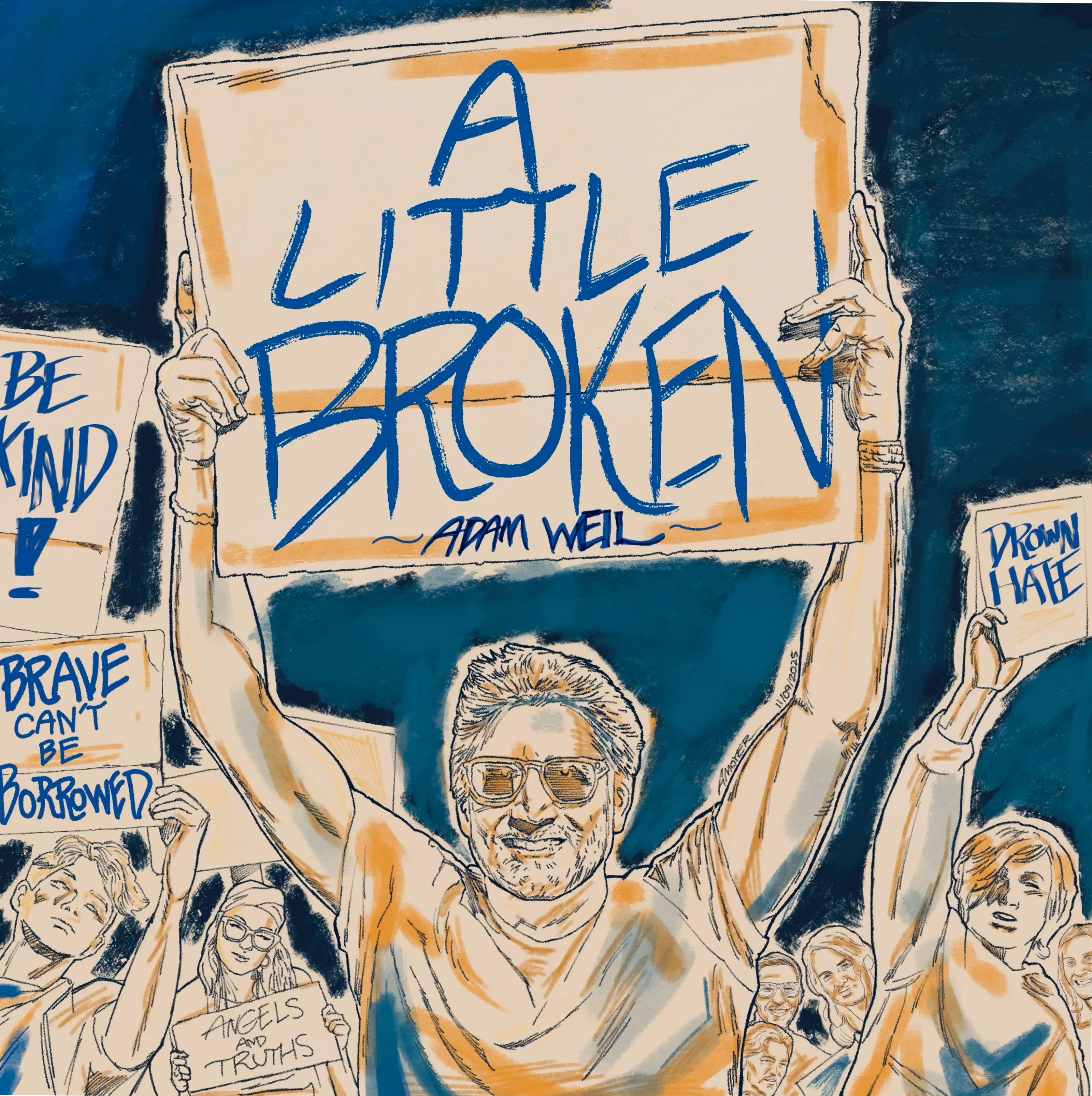
Adam Weil’s ‘A Little Broken’ operates with the quiet confidence of a record uninterested in spectacle. At a time when vulnerability in Americana music is often exaggerated into performance or polished into marketable authenticity, Weil approaches emotional exposure with unusual restraint. These songs are not constructed around grand declarations or cathartic climaxes. Instead, they inhabit the smaller emotional aftershocks that follow disappointment, dislocation, aging, and reluctant self-recognition. The album’s power emerges through accumulation: subtle details, restrained arrangements, and carefully measured performances that trust silence and implication as much as melody.
Produced by Sheldon Gomberg with the understated precision that has long defined his strongest work, ‘A Little Broken’ rejects ornamental excess in favor of emotional clarity. Recorded at Carriage House Studios and elevated by the contributions of players like Jay Bellerose, Gary Novak, and engineer Kevin Smith, the album possesses a deeply organic warmth that never drifts into roots-music traditionalism for its own sake. Every instrumental choice serves the emotional architecture of the songs. Pedal steel sighs through the arrangements like memory resurfacing unexpectedly, piano chords linger with unresolved melancholy, and the rhythm section moves with patient intelligence rather than performative force.
The title track, “A Little Broken,” establishes the album’s emotional language immediately. Weil sings not from the dramatic center of collapse, but from the quieter territory that follows it: the recognition that damage rarely arrives in singular, cinematic moments. His voice carries a fascinating duality throughout the record, balancing exhaustion against perseverance without overstating either. Novak’s drumming on the track is especially effective because of its restraint. Rather than pushing the song toward emotional climax, he creates a loose, spacious pulse that allows Weil’s phrasing to remain central. The result is a song that understands fragility as ongoing condition rather than temporary crisis.
“Girl Like You” shifts the mood slightly, introducing a bittersweet melodic ease that recalls classic West Coast singer-songwriter traditions without sounding trapped by them. Weil approaches romance here with mature skepticism rather than idealized longing. The song recognizes how memory edits relationships into cleaner narratives than reality ever permits. Kevin Smith’s bass playing gives the arrangement remarkable subtle depth, grounding its melodic lightness with emotional gravity that lingers beneath the surface. “Broken Bottles” functions as one of the album’s sharpest meditations on aftermath and self-destruction. Weil avoids the clichés often associated with barroom Americana by refusing to romanticize damage. The imagery throughout the song suggests lives shaped by accumulated disappointments rather than singular tragedies. Gomberg’s production is especially impressive here, preserving the intimacy of the performance while allowing the arrangement to expand naturally around Weil’s voice. The pedal steel lines drift through the mix with understated ache, never announcing themselves too loudly.
“Angels And Truth” explores the uneasy relationship between faith, memory, and personal accountability. Weil writes with an observational patience that allows emotional complexity to surface gradually rather than through dramatic revelation. The song’s arrangement reflects that same philosophy. Piano and acoustic guitar move carefully around one another while the rhythm section maintains a steady but unobtrusive momentum. Gary Novak’s drumming deserves particular recognition across the album for this exact quality: his playing consistently supports emotional nuance rather than demanding attention.
“I Won’t Walk” introduces one of the album’s most quietly defiant moments. The song examines endurance not as triumphant perseverance but as stubborn refusal to disappear emotionally after disappointment. Weil’s vocal performance is beautifully measured, resisting easy catharsis while still conveying profound emotional weight. The arrangement gradually widens around him, subtle layers of instrumentation accumulating until the song carries an understated sense of hard-earned resilience. “Brave Can’t Be Borrowed” stands among the album’s finest compositions because it interrogates courage itself with unusual honesty. Weil rejects simplistic narratives about strength and recovery, recognizing bravery as deeply personal and often isolating. The songwriting is philosophical without becoming abstract, grounded in concrete emotional experience rather than generalized wisdom. Bellerose’s percussion work gives the song a restless pulse that mirrors its lyrical uncertainty, while Gomberg allows enough space in the mix for every hesitation in Weil’s delivery to matter.
“I Don’t Want To Go” captures the emotional paralysis that can accompany transition and loss. The song moves with slow-burning inevitability, as though each line resists arriving at the next. Weil’s writing throughout ‘A Little Broken’ is distinguished by its refusal to force resolution, and this track exemplifies that instinct perfectly. The arrangement never erupts into dramatic release because the emotional state it describes does not permit such clarity.
“Chapter” acts as a kind of reflective midpoint, meditating on narrative itself: how people reshape their histories in order to survive them. Weil understands that memory is both preservation and revision, and the song’s lyrics move through that contradiction with remarkable sensitivity. Acoustic guitar and piano intertwine delicately while the rhythm section remains almost ghostlike in its subtlety.
“Water” may be the album’s emotional centerpiece. The song treats water as symbol for cleansing, erosion, memory, and emotional continuity all at once. Weil’s imagery throughout the track is especially vivid, yet never overwritten. He trusts implication more than explanation. The arrangement mirrors the song’s thematic fluidity, with pedal steel and piano drifting through one another in slow, graceful patterns. Gomberg’s production allows the natural resonance of the instruments to shape the atmosphere without excessive embellishment.
“Solstice” introduces a more contemplative mood, meditating on cycles of darkness and renewal without reducing either to easy metaphor. Weil’s songwriting consistently resists tidy conclusions, and this track benefits enormously from that discipline. The song’s emotional resonance comes from its openness, its willingness to remain unresolved.
“Hard Pouring Rain” carries some of the album’s strongest instrumental interplay. The rhythm section moves with patient authority while Weil’s vocal performance approaches emotional breaking point without fully crossing into collapse. The song examines external hardship and internal weather simultaneously, suggesting how easily the two become indistinguishable during periods of prolonged uncertainty.
“Summertime” avoids nostalgia by treating memory as unstable emotional terrain rather than sentimental refuge. Weil recognizes that even joyful recollections are shaped by loss because they exist only in retrospect. The arrangement carries a subtle warmth that never slips into comfort, preserving the bittersweet ambiguity at the song’s center.
Closing track “Be Kind” serves as the album’s quiet moral statement. Crucially, Weil does not present kindness as naïve optimism or moral purity. Instead, the song frames compassion as difficult, deliberate practice in a world shaped by disappointment and emotional fatigue. The restraint of the arrangement amplifies the song’s emotional impact. No grand finale arrives, no swelling orchestration insists upon catharsis. Weil leaves the listener with something more enduring: the fragile possibility of grace despite accumulated damage.
What distinguishes ‘A Little Broken’ from so much contemporary Americana is its refusal to dramatize authenticity. Weil never performs suffering for effect, nor does he flatten emotional complexity into aphoristic wisdom. His songwriting values ambiguity, hesitation, and emotional contradiction because those qualities reflect lived experience more honestly than neat resolutions ever could. Sheldon Gomberg’s production plays an essential role in preserving that honesty. The album sounds warm and expansive without sacrificing intimacy, polished without losing emotional immediacy. Every musician contributes with remarkable sensitivity. Bellerose and Novak provide rhythmic foundations rooted in patience rather than force, Smith’s bass quietly deepens the emotional atmosphere, and the arrangements consistently privilege songcraft over ornamentation.
‘A Little Broken’ succeeds because it understands that emotional survival rarely announces itself dramatically. More often, it appears in smaller acts: continuing conversations after disappointment, carrying memory without being consumed by it, choosing tenderness despite accumulated hurt. Adam Weil captures those moments with uncommon intelligence and restraint, crafting a record that lingers not through volume or spectacle, but through emotional truth spoken plainly.
Learn more by visiting Adam Weil | Instagram