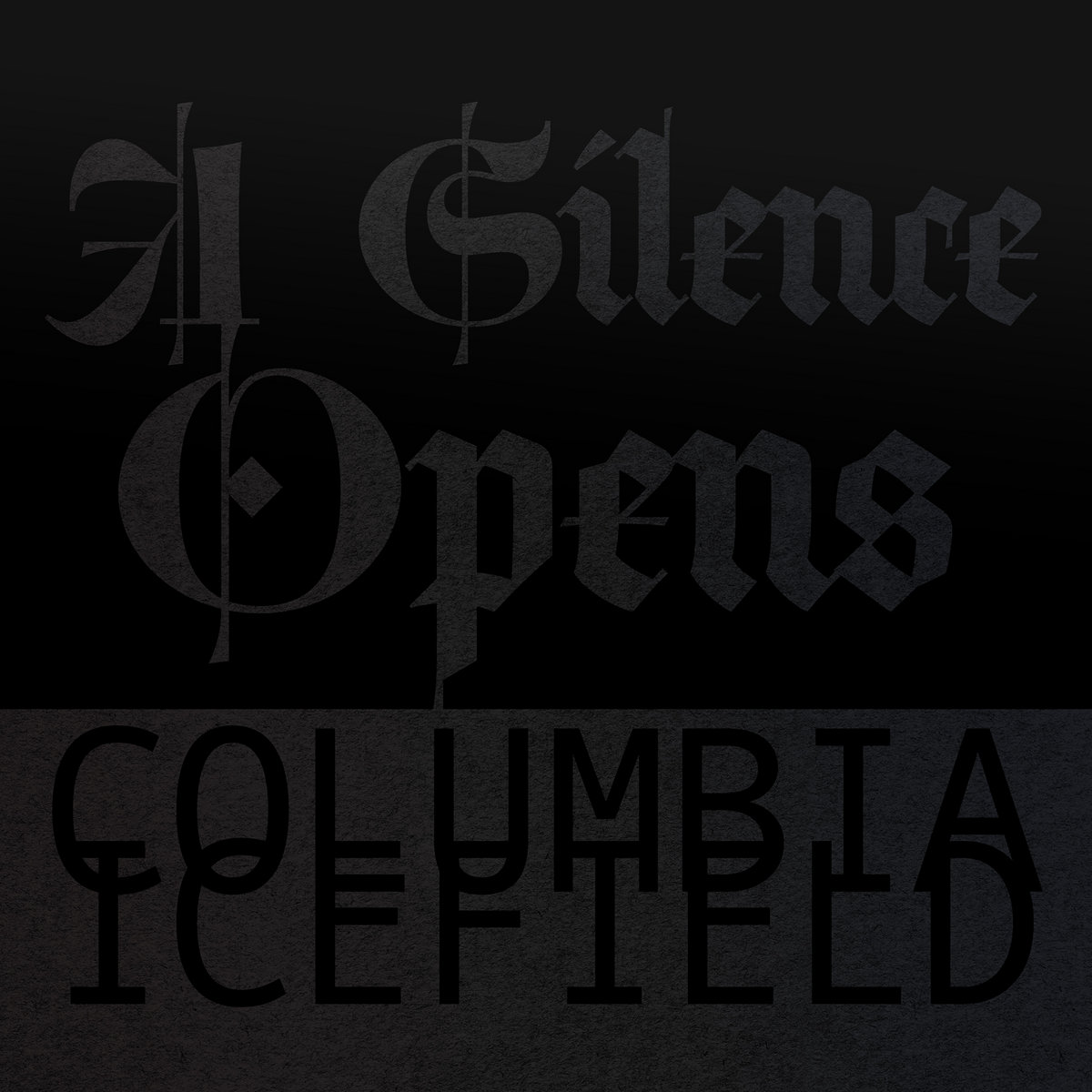
Columbia Icefield’s ‘A Silence Opens’ confronts grief not as emotional abstraction but as physical transformation. Nate Wooley approaches loss as a force that alters spatial perception itself, reshaping the contours of memory, sound, intimacy, and artistic responsibility. Few records about mourning manage to avoid sentimentality without retreating into intellectual distance, yet ‘A Silence Opens’ inhabits that difficult balance with extraordinary emotional intelligence. This is music that understands bereavement as both rupture and continuation, a process through which absence acquires mass and memory becomes architectural.
The album emerges from the deaths of trumpeter Ron Miles and pedal steel guitarist Susan Alcorn, but it resists functioning merely as memorial. Nate Wooley recognizes that tribute becomes hollow when it imitates surface characteristics rather than engaging the deeper emotional and spiritual qualities of the people being honored. Consequently, ‘A Silence Opens’ does not attempt to reproduce Miles or Alcorn stylistically. Instead, it searches for ways of carrying their generosity, openness, and emotional presence into new sonic forms. What results is among the most profound statements Columbia Icefield has produced and perhaps the ensemble’s most complete realization of its singular language.
The recurring “El Derecho” pieces function as emotional and structural pillars throughout the album. Drawn from Victor Jara’s work, these brief interstitial movements establish an atmosphere of communal mourning and political memory that radiates outward into the larger compositions. “El Derecho 1” introduces the album with unsettling fragility. Wooley’s trumpet and amplifier create tones that seem suspended between human voice and electrical interference, while Ryan Sawyer’s percussion moves with ceremonial patience rather than rhythmic certainty. Ava Mendoza’s guitar enters less as accompaniment than as environmental force, shaping emotional terrain through texture and resonance. The piece immediately establishes silence as active presence rather than absence.
“Howard Beach,” derived from Ron Miles’ composition, expands the emotional scale dramatically. Wooley approaches Miles’ material with remarkable humility, preserving the melodic soul of the piece while allowing Columbia Icefield’s distinct sensibility to transform its atmosphere. Mendoza’s guitar work throughout the track is astonishingly nuanced, alternating between abrasive surges and moments of aching lyricism. Sawyer’s drumming remains one of the ensemble’s defining strengths because of how intuitively he responds to emotional movement rather than formal structure. His percussion never simply marks time; it shapes psychological momentum. Wooley’s trumpet phrases hover at the edge of collapse, sounding at times like grief attempting to articulate itself before language fully forms.
“El Derecho 2” compresses emotional devastation into miniature form. Susan Alcorn’s pedal steel presence becomes especially significant here. Her instrument does not function traditionally within the arrangement. Instead, it drifts through the composition like memory itself; unstable, luminous, impossible to fully contain. The brevity of these interstitial tracks intensifies their emotional impact because they arrive like sudden waves of recollection interrupting ordinary consciousness.
“Darken My Door” stands among the album’s most devastating pieces. Ron Miles’ compositional generosity remains palpable throughout, yet Columbia Icefield transforms the material into something profoundly collective. Wooley’s trumpet lines ache with restraint, refusing dramatic release even as emotional pressure accumulates. Mendoza and Sawyer shape the composition’s atmosphere with extraordinary sensitivity, allowing the music to hover perpetually between intimacy and dissolution. The performance captures the peculiar emotional duality of mourning: the desire both to preserve memory and to survive its weight. “El Derecho 3” introduces one of the album’s most quietly radical gestures. The ensemble allows fragility itself to become structural principle. Sounds emerge tentatively, almost uncertain of their own right to exist. This willingness to embrace vulnerability without ornamentation gives the album much of its emotional authority.
“We Say Goodbye Twice/Wildwood Flower” operates as the record’s spiritual center. Wooley’s composition merges personal farewell with folk memory, creating a piece that examines how communal song traditions carry grief across generations. The inclusion of the choir (Wooley, Sawyer, Mendoza, Mary Halvorson, Ingrid Laubrock, Wendy Eisenberg, gabby fluke-mogul, Laura Ortman, and Patrick Holmes), transforms the track into collective ritual rather than individual statement. Crucially, the performance preserves imperfection. Voices drift slightly apart, harmonies blur, emotional immediacy overtakes technical precision. That openness gives the piece immense emotional force because it sounds genuinely lived rather than carefully staged. Susan Alcorn’s absence becomes almost physically perceptible here, shaping the emotional atmosphere through what can no longer be heard.
The brief “El Derecho 4” functions like a suspended breath before the album’s emotional climax. Wooley’s use of amplifier noise and sparse trumpet textures creates an atmosphere of uncanny stillness, as though the music itself is hesitating before confronting what follows.
“You Taste” stretches across more than eleven minutes and achieves something genuinely extraordinary. Based on another Ron Miles composition, the piece transforms grief into sprawling emotional landscape. Wooley’s trumpet work here may represent some of his finest recorded playing, balancing abrasion, tenderness, restraint, and instability with astonishing emotional precision. Mendoza’s guitar becomes almost orchestral in scope, generating waves of harmonic density that alternately engulf and support the ensemble. Sawyer’s drumming remains deeply conversational, constantly adjusting to the shifting emotional currents within the performance. The track’s immense length allows Columbia Icefield to inhabit mourning as process rather than event. Emotions emerge, dissolve, return altered. Moments of beauty appear unexpectedly amidst sonic disorientation, much like memory itself.
“El Derecho 5” closes the primary sequence not with resolution but with acceptance of incompletion. The piece recognizes that grief does not conclude cleanly. It changes shape, becomes integrated into perception, settles into the body as permanent presence. The music’s restraint here is remarkable. Columbia Icefield trusts silence enough to let it carry emotional meaning equal to sound.
The inclusion of “You Taste [single edit]” at the end is fascinating because it reframes the preceding epic through compression. Rather than diminishing the original piece, the abbreviated version highlights how much emotional information Columbia Icefield can communicate even within reduced form. Themes and gestures become more concentrated, almost dreamlike in their fragmentation. What makes ‘A Silence Opens’ such a profound achievement is its refusal to sentimentalize either grief or artistic communion. Wooley understands that mourning does not purify people into idealized figures. Instead, loss intensifies awareness of complexity, contradiction, impermanence, and unfinished emotional conversations. This understanding permeates every aspect of the album.
The ensemble itself embodies that philosophy beautifully. Wooley’s trumpet and amplifier work consistently destabilize conventional notions of jazz lyricism while remaining emotionally direct. Mendoza’s guitar playing balances violence and delicacy with remarkable instinct, creating textures that feel simultaneously grounding and destabilizing. Sawyer’s percussion shapes emotional movement with extraordinary subtlety. Susan Alcorn’s pedal steel contributions radiate immense emotional generosity, transforming the instrument into vessel for memory, ache, and transcendence. The production work across Oktaven Studios, Jaybird Studios, and Circular Ruin preserves the ensemble’s fragile chemistry without sanitizing its rough edges. Ryan Streber, Owen Mulholland, Ben Greenberg, and Eivind Opsvik each contribute to an atmosphere where every resonance, amplifier hum, breath, and accidental sound acquires emotional significance.
As what may be Columbia Icefield’s final statement, ‘A Silence Opens’ carries additional emotional gravity. Yet the album never frames ending as defeat. Instead, it understands closure as another form of transformation, another way absence acquires presence. The record suggests that grief, memory, and artistic collaboration all involve learning how to carry what can no longer physically remain. Few albums address death with this degree of emotional courage and philosophical depth. Columbia Icefield has created music that neither escapes sorrow nor collapses beneath it. Instead, ‘A Silence Opens’ inhabits mourning fully, discovering within loss not consolation, but a more profound awareness of connection, fragility, and love.
Releases May 29, 2026
For more information or to pre-order, please visit Out Of Your Head Records | Bandcamp | Instagram | Facebook