
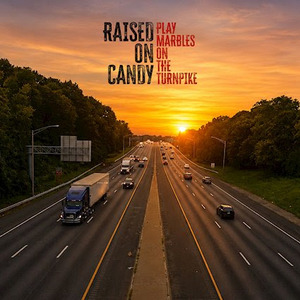
Raised On Candy have a wonderful way of making a song feel as though it might burst apart at any moment, even when the melody is too good to lose. On “Red M&M,” the opening track of their second album, Play Marbles On The Turnpike, a thin, scraping guitar introduces an immediate sense of friction. Distortion gradually gives that sound a heavier, more threatening body, while Joe Penna’s comparatively controlled vocal moves through the arrangement with an almost unsettling calm. It is an intriguing beginning to a record that repeatedly finds pleasure in pushing its instruments toward their limits, then discovering something unexpectedly melodic inside the commotion.
The Montclair, New Jersey duo of Penna and drummer Scotty Imp return with ten songs that move through alternative rock, post-punk, noisy guitar experiments and moments of almost dreamlike sweetness. Their self-titled 2024 debut was recorded with Steve Albini at Electrical Audio in Chicago, while the new album was produced alongside Ray Ketchem at Magic Door Recording in Montclair. Ketchem also engineered, mixed and mastered the record, working with the musicians to accommodate an increasingly varied collection of sounds and arrangements. The results have a tremendous physical presence, but there is just as much excitement in the smaller musical details, the peculiar guitar figures, vocal melodies and rhythmic changes that make each song so enjoyable to follow.
Arriving November 13 through Magic Door Record Label, Play Marbles On The Turnpike finds Raised On Candy sounding particularly adventurous, with an appetite for new musical possibilities that seems to grow throughout the record. The Big Takeover is delighted to premiere the album, offering listeners the opportunity to experience all ten compositions together.
Behind the opening friction of “Red M&M” lies a lyric about manipulation, fear disguised as seduction and an eventual reversal of power. The song’s unease is already present in the instruments, allowing the narrative to emerge naturally from a sound that seems almost determined to resist the listener.
“Micromagnon” introduces a different kind of energy, built around a repetitive guitar figure that becomes increasingly infectious. Penna’s vocal has a wonderfully angsty indie-rock quality, carrying a certain rebellious enjoyment without sacrificing the melody’s appeal. There is something immediately familiar about its attitude, the pleasure of hearing a band sound thoroughly unconcerned with being polite. As Imp’s drums and the layered vocals begin gathering around that central figure, the repetition becomes almost hypnotic. The melody retains its identity through every change, giving the song a wonderfully stubborn character even as the arrangement becomes more crowded and restless.
That instinct for making every musical change count is equally apparent on “Pickle Eyes.” The song unfolds through a series of carefully measured releases, with each return bringing thicker guitars, more animated drumming and increasingly urgent vocals. Imp’s percussion is especially exciting, the fills pushing against the song’s boundaries while Penna’s exposed, higher-register singing keeps the arrangement emotionally open. By the final surge, the guitars and backing voices have spread outward into an almost overwhelming finish, yet the melody remains clearly audible beneath the weight.
“Popo, Be Kool” is a particularly lovely change of pace, and one of the album’s most immediately memorable compositions. Its opening melody has an irresistible, almost playful movement, with a gentle rhythmic character that makes the smallest turns in the guitar line feel completely captivating. There is something wonderfully satisfying about the pacing, the way the notes seem to answer one another before returning to a familiar phrase. It is the kind of melody that stays in your head long after the song has finished.
As the kick drum and guitars enter with greater force, the arrangement expands into a more substantial rock performance, complete with fuller melodic passages and a stronger rhythmic drive. Yet the return of that opening figure remains one of the song’s greatest pleasures. Raised On Candy seem to understand exactly how much character a melody can carry on its own, allowing the heavier sections to grow around it without diminishing its appeal. The result is wonderfully infectious, full of small musical decisions that make repeated listening especially rewarding.
“The Hammer And The Nail” moves into a more immersive atmosphere. Its guitars have a dreamy, almost enveloping quality, their textures spreading around the listener until the melody seems suspended inside the surrounding sound. There is an extraordinary depth to the arrangement, with the instruments creating a thick, absorbing atmosphere that remains present even as the music grows more forceful.
The heavier passages seem to move through that same dreamlike space, with the drums and guitars adding physical weight without disturbing the strange suspension underneath. There is something almost consuming about the effect, the sensation of being surrounded by sound while still following the melody through its shifting textures. When the final release arrives, the sheer density of the arrangement makes it exhilarating. The music feels enormous, yet the atmospheric character that first drew the listener in remains beautifully intact.
“The Littlest Lamb” takes the guitars in another direction, opening with a heavy, crushed texture that seems to wail from somewhere inside a surrounding haze. A more dramatic lead guitar emerges, bringing a sharper rock character to the arrangement, before Imp’s drums introduce a restless rhythmic movement. Penna’s vocal then changes the personality of the song again. There is a fascinating sense of transformation here, the instrumental introduction suggesting several possible directions before the singing draws everything into a more distinctive musical identity.
These shifting relationships between guitar, rhythm and voice become one of the album’s greatest strengths. Penna and Imp frequently establish a compelling musical idea, allow it to settle just long enough to become familiar, then introduce something that changes its character. The pleasure comes from hearing those changes unfold, particularly when an arrangement seems to have already reached its natural conclusion and the musicians somehow find another level of intensity.
“Brutally Blue” is among the album’s most thrilling examples. Its opening guitar has an almost seductive quality, the riff moving with an effortless confidence that immediately commands attention. When Penna’s vocal enters, the song becomes stranger, the singing appearing slightly at odds with the instrumental rhythm and distortion. That initial separation is fascinating, creating an unexpected tension between a guitar sound that feels completely assured and a voice that seems to approach the melody from somewhere else.
Then the guitar returns with greater intensity, and the relationship begins to change. Penna’s vocal becomes more direct, meeting the riff with a new sense of conviction, until the two elements seem to be moving together despite their different characters. There is real excitement in hearing that relationship develop. What initially feels almost disconnected gradually becomes the source of the song’s momentum.
The arrangement grows even more exhilarating through a punkier passage, where the vocal takes on additional force and the rhythm section gives the music a tremendous physical lift. Just when the intensity seems ready to overwhelm everything, the band makes room for the listener to breathe. The resulting contrast is wonderfully judged, allowing the next movement to arrive with renewed energy. “Brutally Blue” is a superb piece of guitar-driven songwriting, full of instinctive musical chemistry and changes that make the performance feel constantly alive.
“Zephyr” brings a lighter guitar introduction, its strumming carrying an uplifting movement beneath Penna’s more clouded, airy vocal. His voice seems to emerge from somewhere within the arrangement, with the melody drawing attention through its gentle persistence. There is an appealingly unpolished intimacy to the song, something reminiscent of hearing an excellent band through the open doorway of a small club and finding yourself unable to keep walking. The rhythmic character is particularly engaging, giving the music an immediate sense of movement without requiring the same instrumental force as the heavier recordings.
“Luxury Bones” brings another unexpected change, introducing a more soulful rhythmic quality through its percussive accents before the heavier guitars arrive. Once the riffs and drums begin pushing against one another, the song becomes wonderfully animated. Imp’s playing has an almost argumentative relationship with the guitar, the two instruments seeming to challenge each other as the arrangement gathers momentum. The excitement lies in that restless interaction, the sensation of musicians constantly finding new opportunities to push the performance forward.
It is worth remembering that this enormous range of sound comes from a duo. Penna handles guitar, vocals, bass and synthesizers, while Imp contributes drums, cymbals, percussion, piano and backing vocals. Their musical relationship gives the record much of its character, with Penna’s melodic instincts and willingness to explore abrasive guitar sounds continually meeting Imp’s precise but highly expressive percussion. Ketchem’s production allows those individual contributions to remain distinguishable even when the arrangements grow crowded, preserving the little rhythmic changes and instrumental details that make the songs so compelling.
The album closes with “Something,” a composition that seems determined to draw every remaining possibility out of the band’s sound. Its opening carries a moderately heavy rock character before suddenly giving way to lighter, delicately plucked guitar passages. The change is deeply satisfying, introducing a moment of gentleness that makes the following vocal entrance particularly effective. Penna sings with an appealing combination of restraint and passion, his voice finding a warmth that feels especially pronounced against the softer instrumentation.
As the song continues, the arrangement moves repeatedly between quieter interludes and increasingly forceful passages. Each return carries its own variation, with the music continually gathering momentum before allowing another brief moment of relief. The repetition becomes part of the pleasure, as the listener begins to anticipate the shifts while remaining absorbed in the different ways they unfold.
By the final stretch, the guitars and drums have become enormous. The closing passage has the exhilaration of a farewell shouted at full volume, carrying all the enthusiasm, impatience and affection of a band that still has plenty left to express. There is something wonderfully youthful about that energy, regardless of how long its musicians have been playing together. The final surge feels like a celebration of everything that has animated the preceding songs, the sheer pleasure of playing loudly, following a melody wherever it leads and allowing the music to become as excessive as it wants to be.
Play Marbles On The Turnpike is driven by a remarkable combination of melodic instinct and restless experimentation. Penna and Imp can make a small guitar figure every bit as absorbing as their loudest passages, and the clarity of Ketchem’s production lets those details register even when the instruments seem to be competing for space. There is an infectious love of music throughout these ten songs, evident in the peculiar melodies, abrasive textures and unexpected turns that keep the listener absorbed. The duo’s willingness to follow an idea wherever it leads gives the record its distinctive energy, making even its most extravagant moments feel thoroughly enjoyable.
The album finishes with the guitars at their loudest, but what lingers is the pleasure of everything that led them there.
Play Marbles On The Turnpike arrives November 13, 2026, via Magic Door Record Label.