
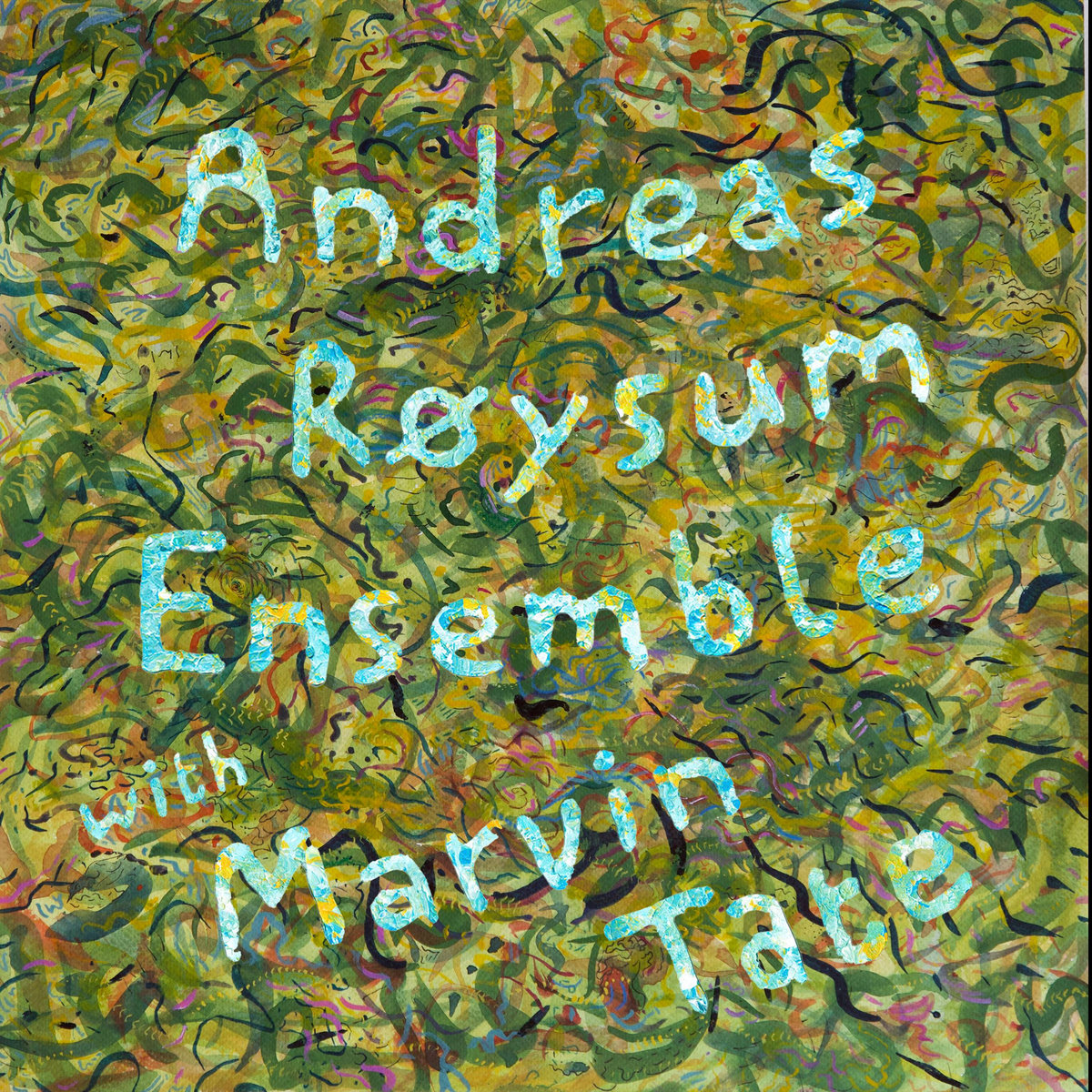
Collaboration across tectonic plates of genre and geography rarely yields such a cohesive collision as seen in ‘Andreas Røysum Ensemble with Marvin Tate’. While the Norwegian woodwind practitioner Andreas Røysum has long steered his ensemble through the currents of expansive folk-jazz and avant-garde exploration, the addition of Chicagoan poet Marvin Tate injects a narrative urgency that transforms the collective’s sprawling sound into a vessel for sharp, social observation and raw human emotion. This fourth album represents a mutation of their established identity, moving away from purely instrumental abstraction toward a more pointed, vocal-centric architecture.
The chemistry is immediate. Throughout the opener “Ode to Sweet T”, the ensemble demonstrates a remarkable restraint, allowing Tate’s vocal delivery to anchor a swirling storm of textures. The dual percussion of Ivar Myrset Asheim and Andreas Wildhagen provides a flickering, polyrhythmic foundation that feels alive rather than programmed, while the double bass of Christian Meaas Svendsen offers a deep, woody resonance. It is a dialogue where the music doesn’t merely accompany the words but reacts to their emotional weight in real-time.
On “Monkey bars”, the group leans into a more rhythmic, almost street-parade energy. The brass section, featuring the sharp articulations of Erik Kimestad Pedersen on trumpet and Øyvind Brække on trombone, creates a bright, brassy contrast to the more contemplative moments found elsewhere on the record. Signe Emmeluth and Aksel Rønning contribute saxophone lines that dart and weave through the arrangement, mimicking the playful yet precarious movement implied by the title. Henriette Eilertsen’s flute adds a silver thread of melody that occasionally breaks through the denser improvisations, providing a necessary lightness to the ensemble’s thick, orchestral palette.
The contribution of Sofie Tollefsbøl on vocals serves as a vital counterpoint to Tate’s gravelly, rhythmic spoken word. Her presence adds a melodic soulfulness that bridges the gap between the ensemble’s free-jazz instincts and more traditional song structures. This is particularly evident on “Closing,” where the arrangements take on a widescreen, cinematic quality. Egil Kalman’s modular synthesizer and Joel Ring’s cello provide a modern, slightly uncanny backdrop, grounding the organic instruments in a contemporary, electronic atmosphere.
The finale, “If You See Jesus,” acts as the record’s spiritual and technical peak. Here, the full power of the twelve-piece group is realized, oscillating between moments of hushed intimacy and roaring, ecstatic peaks. Røysum’s leadership is subtle; he directs the flow not through dominance, but through a shared understanding of space and volume. The result is a work that feels remarkably unified for a first meeting of these specific minds. It is a record of note not for its technical flourishes alone, but for its ability to speak clearly through a complex, multi-voiced language.
Find out more by visiting: Motvind Records | Bandcamp.