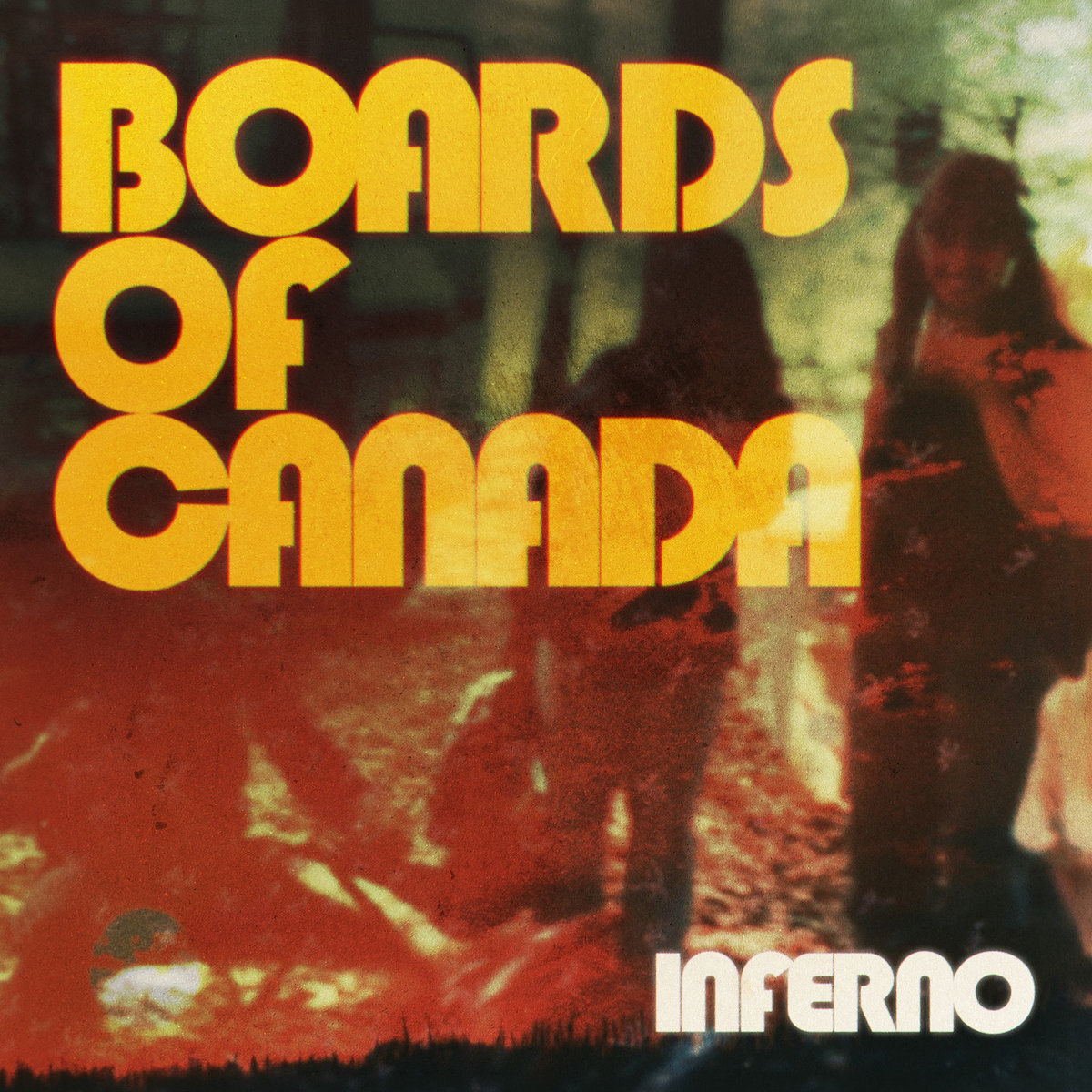
After thirteen years of silence, Boards of Canada return with a record that confronts some of humanity’s oldest questions while sounding more engaged with the present moment than any release in their remarkable catalogue. ‘Inferno’ is neither a nostalgic retreat nor a simple continuation of familiar themes. Instead, it is a profound meditation on memory, faith, identity, mortality, and the increasingly unstable relationship between human consciousness and the systems we have built around ourselves. Across eighteen tracks, brothers Marcus Eoin and Michael Sandison craft a work of extraordinary scope, one that transforms electronic music into a philosophical landscape where science, mysticism, history, and imagination coexist in uneasy proximity.
Boards of Canada have always excelled at creating worlds rather than collections of songs. Their greatest albums invite listeners into environments governed by their own internal logic, where recurring symbols, cryptic voices, and recurring melodic motifs operate like fragments of a larger language. ‘Inferno’ extends this tradition while expanding its emotional and conceptual reach. It is a record fascinated by revelation, but equally fascinated by the impossibility of certainty.
The brief opening piece, “Introit,” serves as a ceremonial threshold. Lasting only seconds, it establishes a sense of anticipation that recalls the opening of a forgotten educational film or the first moments of an abandoned religious broadcast. The track functions as an invitation into a space where familiar categories quickly lose their stability.
That invitation is answered spectacularly by “Prophecy At 1420 MHz,” one of the album’s standout compositions. Named after the hydrogen line frequency long associated with theories of interstellar communication, the track explores humanity’s longing to connect with something beyond itself. The rhythm possesses an unusual force for Boards of Canada, while vast synthesizer structures rise and recede like signals traveling through cosmic distances. The track encapsulates the album’s central concern: the search for meaning in a universe that offers no straightforward answers.
“Hydrogen Helium Lithium Leviathan” follows with a remarkable synthesis of old and new. Longtime listeners will recognize echoes of the duo’s earlier work in its melodic contours, yet the production possesses a newfound clarity and scale. The elemental progression suggested by the title evokes both creation myths and scientific taxonomy, transforming chemistry into poetry. It is one of the most immediately captivating pieces on the record, balancing wonder and unease with remarkable precision.
The enigmatic “Age Of Capricorn” introduces religious symbolism more directly. Computerized voices, coded references, and sacred imagery drift through the composition without ever settling into a singular interpretation. Boards of Canada have always understood that mystery is more powerful than explanation, and the track thrives on ambiguity. Its beauty emerges not from certainty but from contradiction. “Father And Son” presents one of the album’s most compelling examinations of belief. Fragments of evangelical rhetoric collide with a rhythm section that possesses a rare sense of propulsion within the duo’s discography. Beneath the surface lies a subtle critique of inherited systems of thought and the ways institutions shape personal identity. Yet the song never becomes polemical. Questions matter more than conclusions.
The deceptively brief “Somewhere Right Now In The Future” functions as a transitional reflection on time itself. Boards of Canada have always approached time as something fluid rather than linear, and here they condense that fascination into a compact, dreamlike composition. The title alone suggests multiple realities existing simultaneously, a concept that resonates throughout the album. “Naraka” stands among the most powerful tracks the duo have recorded. Named after the concept of hell within several South Asian religious traditions, the piece juxtaposes luminous textures with darker undercurrents. What makes it extraordinary is its refusal to portray damnation as simple horror. Instead, it suggests a condition of spiritual dislocation, where beauty and suffering occupy the same space.
The miniature “Acts Of Magic” serves as a reminder of the duo’s enduring fascination with hidden mechanisms and unseen forces. Positioned between larger compositions, it acts as a brief glimpse behind the curtain, hinting at systems that remain frustratingly beyond comprehension. One of the album’s most significant moments arrives with “Memory Death.” Throughout their career, Boards of Canada have explored memory as both refuge and illusion. Here, memory itself appears endangered. The track carries an emotional weight that extends far beyond its runtime, functioning as a lament for a culture increasingly dependent upon external archives and digital records. The piece asks a profound question: what becomes of humanity when remembrance is outsourced?
“The Word Becomes Flesh” develops these concerns through imagery of biological creation and embodiment. Educational narration collides with deeply emotional music, producing a striking contrast between clinical description and lived experience. The song examines the miracle of existence while questioning the systems through which existence is categorized and understood. A rare sense of wonder emerges from “Into The Magic Land.” While much of the album grapples with uncertainty, this track allows space for curiosity and imagination. Childlike melodic motifs drift through the arrangement, suggesting that enchantment remains possible even within a world dominated by skepticism and technological mediation.
“Blood In The Labyrinth” returns to darker territory. The title evokes mythology, sacrifice, and psychological entrapment, themes reflected in the track’s intricate architecture. Every melodic turn seems to lead toward revelation before diverting elsewhere, mirroring the experience of searching for truth within increasingly complex cultural and informational systems.
The contemplative “Deep Time” expands the album’s perspective beyond individual existence. Human concerns appear fleeting against the immense temporal scales implied by the title. Yet rather than diminishing humanity, the track suggests a deeper appreciation for our brief participation within a vast continuum.
One of the album’s most extraordinary achievements arrives with “All Reason Departs”. The composition explores the limits of rational thought without descending into chaos. Instead, it examines what happens when logic encounters experiences it cannot fully explain. Rich melodies emerge from shadowy textures, creating a powerful contrast between intellectual inquiry and emotional intuition. “Arena Americanada” introduces a subtle political dimension. While characteristically oblique, the track seems concerned with spectacle, mythology, and collective identity. The arrangement possesses a cinematic quality, evoking vast public spaces filled with competing narratives and unresolved histories.
“The Process” deepens the album’s examination of institutional structures. Voices emerge and disappear within layers of electronic interference, creating a sense of fragmented authority. The composition captures the disorienting experience of navigating systems whose purposes have become increasingly opaque. By the time “You Retreat In Time And Space” arrives, the album has accumulated immense philosophical weight. Yet the track provides a form of emotional release. Richly atmospheric and deeply evocative, it revisits themes of memory and perception through some of the record’s most beautiful melodies. The music seems suspended between recollection and imagination, past and future.
Closing piece “I Saw Through Platonia” serves as a breathtaking conclusion. Referencing ideas associated with timeless existence and alternate states of reality, the track gathers the album’s concerns into a final meditation on perception itself. Its luminous textures and delicate melodic structures suggest transcendence without certainty, enlightenment without dogma. Rather than delivering answers, it leaves listeners contemplating possibilities. The production throughout ‘Inferno’ represents a significant evolution in Boards of Canada’s sound. Marcus Eoin and Michael Sandison retain their unmistakable sonic identity while embracing greater clarity, depth, and dynamic range. Familiar elements remain present like weathered synthesizers, manipulated voices, hypnotic rhythms, but they are deployed with renewed confidence and ambition. Every sound feels purposeful, contributing to an immersive environment that rewards sustained attention.
What makes ‘Inferno’ such a remarkable achievement is its refusal to separate the intellectual from the emotional. The album engages with cosmology, theology, memory, biology, and metaphysics, yet never loses sight of human vulnerability. Its questions are grand, but their implications remain deeply personal. Boards of Canada understand that uncertainty is not a failure of understanding but an essential aspect of existence itself. After more than a decade away, Marcus Eoin and Michael Sandison have returned with a work that expands their artistic legacy while reaffirming the qualities that made them singular in the first place. ‘Inferno’ is an album about searching—for meaning, connection, memory, and truth. It recognizes that such searches may never reach definitive conclusions. Yet within that uncertainty lies its greatest insight: the act of seeking remains one of humanity’s most vital and enduring pursuits.
To learn more, please visit Warp Records | Bandcamp | YouTube | Instagram | Twitter