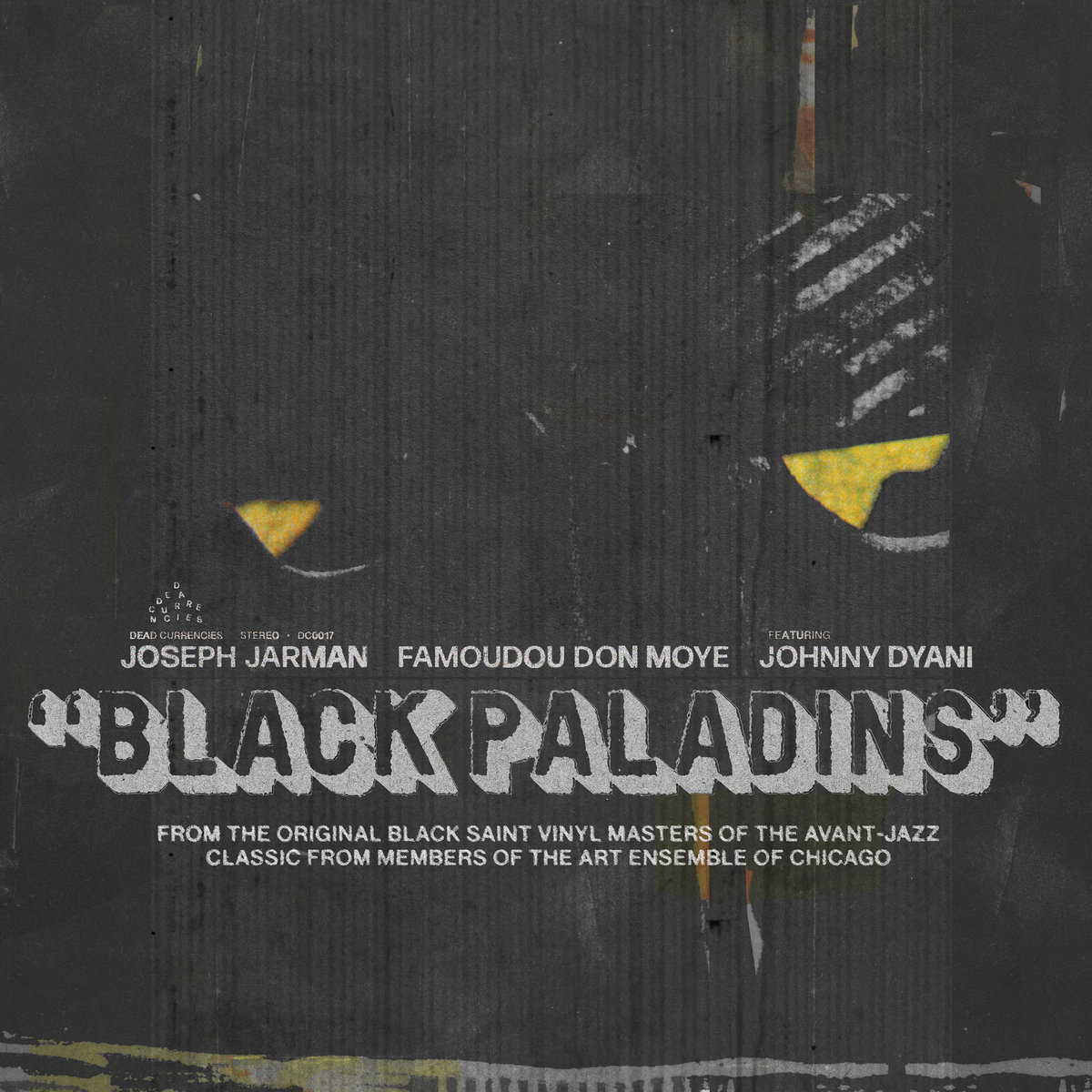
Few recordings from the late 1970s avant-jazz landscape carry the moral force, spiritual depth, and historical consciousness of ‘Black Paladins.’ Recorded by Joseph Jarman and Don Moye of the Art Ensemble of Chicago alongside South African bassist Johnny Dyani, the album operates simultaneously as musical statement, memorial, protest, and cultural reclamation. More than four decades after its creation, its themes remain unsettlingly current, not because the music seeks relevance, but because the social wounds that inspired it have never fully healed.
At the center of the album lies an extraordinary clarity of intent. Inspired by the killing of poet Henry Dumas and anchored by Dumas’s poem “Saba: Black Paladins,” the recording channels grief into artistic expression without reducing itself to a political document. Jarman, playing saxophones, flutes, percussion, and voice, joins forces with Moye’s expansive percussion arsenal and Dyani’s deeply expressive bass work to create music that draws from African ritual traditions, free jazz improvisation, blues memory, and collective storytelling. Their interplay rejects conventional hierarchies. No instrument dominates for long. Instead, the album thrives on communal dialogue, each musician contributing to a larger spiritual and cultural conversation.
“Mama Marimba” serves as an invocation. Compact yet remarkably rich, it introduces the album’s core aesthetic through layered percussion, buoyant rhythmic motion, and an atmosphere that evokes both celebration and remembrance. Moye’s command of texture is immediately apparent, while Dyani’s bass provides melodic direction rather than simple accompaniment. Jarman responds with lines that seem to emerge organically from the ensemble rather than sit above it. The piece functions as a ceremonial doorway, preparing the listener for the deeper meditations ahead. The lengthy “In Memory of My Seasons” expands the album’s emotional range considerably. Here the trio explores memory as a living presence rather than a fixed recollection. Dyani becomes particularly crucial, his bass carrying a lyrical quality that constantly shifts between songfulness and declamation. Jarman’s reeds move through passages of introspection and urgency, while Moye constructs a rhythmic environment that never settles into predictable patterns. The music reflects changing emotional climates, suggesting cycles of loss, renewal, reflection, and perseverance. Its structure remains fluid without becoming diffuse, a testament to the musicians’ extraordinary collective intuition.
“Humility in the Light of the Creator” offers one of the album’s most profound statements. Spiritual jazz often risks grandiosity, but this composition embraces reverence without spectacle. The performance radiates a sense of contemplation, with silence and space carrying as much weight as sound. Jarman’s playing acquires an almost prayerful quality, while Dyani’s resonant bass lines anchor the piece with quiet authority. Moye’s percussion becomes less a driving force than an atmosphere, shaping the contours of the music through subtle gestures. The result is a work of remarkable emotional clarity, one that communicates devotion through restraint rather than excess.
The title piece stands as the album’s defining achievement. Built around Jarman’s recitation of Dumas’s poem, it transforms literature into collective ritual. Jarman’s voice does not merely deliver text; it inhabits it. The words become inseparable from the surrounding music, carried forward by Moye’s ceremonial percussion and Dyani’s deeply resonant bass figures. What makes the composition so compelling is its refusal to separate art from lived experience. The poem’s vision of Black dignity, resistance, and historical continuity emerges through a musical language that draws connections across continents and generations. Ancient Africa, the American South, urban America, and the broader Black diaspora all seem present within the performance. Few recordings manage to integrate spoken word and improvisation with such conviction.
Following the gravity of the title composition, “Ginger Song” introduces a more intimate and lyrical atmosphere. Yet beneath its warmth lies the same commitment to collective expression that defines the album as a whole. Dyani’s melodic instincts shine brilliantly here, revealing why he remains one of the most distinctive bassists in creative music. His ability to make the instrument sing is extraordinary. Jarman and Moye respond with sensitivity, allowing the composition to develop through subtle exchanges rather than dramatic declarations. The piece serves as a reminder that beauty itself can be a form of resistance.
The closing “Ode to Wilbur Ware” pays tribute to one of jazz’s great bass innovators while simultaneously acknowledging the importance of artistic lineage. Dyani approaches the dedication not as imitation but as continuation. His performance honors Wilbur Ware’s spirit while maintaining his own unmistakable voice. Jarman and Moye surround him with music that balances affection, admiration, and creative freedom. As the album concludes, the tribute broadens into something larger: an acknowledgment of the elders whose contributions continue to shape contemporary expression.
What makes ‘Black Paladins’ so enduring is its remarkable synthesis of political awareness, spiritual inquiry, and musical imagination. Many recordings address social realities; fewer transform those realities into art of lasting significance. Jarman, Moye, and Dyani achieve exactly that. The album never lectures, never settles for symbolism alone, and never sacrifices artistic complexity for ideological clarity. Instead, it presents history, memory, identity, and resistance as living forces that animate every note. The chemistry among the three musicians remains astonishing. Jarman provides intellectual and spiritual direction, Moye supplies rhythmic architecture and ceremonial energy, and Dyani contributes a profound emotional center. Together they create music that is both fiercely rooted and endlessly exploratory. The album’s power derives not from nostalgia but from its continuing capacity to speak across decades, illuminating unfinished histories while affirming the possibility of cultural survival and renewal.
‘Black Paladins’ stands among the finest recordings produced outside the core Art Ensemble of Chicago discography, not merely because of its technical excellence or historical importance, but because it achieves something rarer. It transforms remembrance into action, poetry into sound, and collective memory into a living artistic presence. Forty-five years after its recording, its voice remains clear, urgent, compassionate, and profoundly human.
Releases June 12, 2026
Visit Dead Currencies | Bandcamp | Instagram for more information.