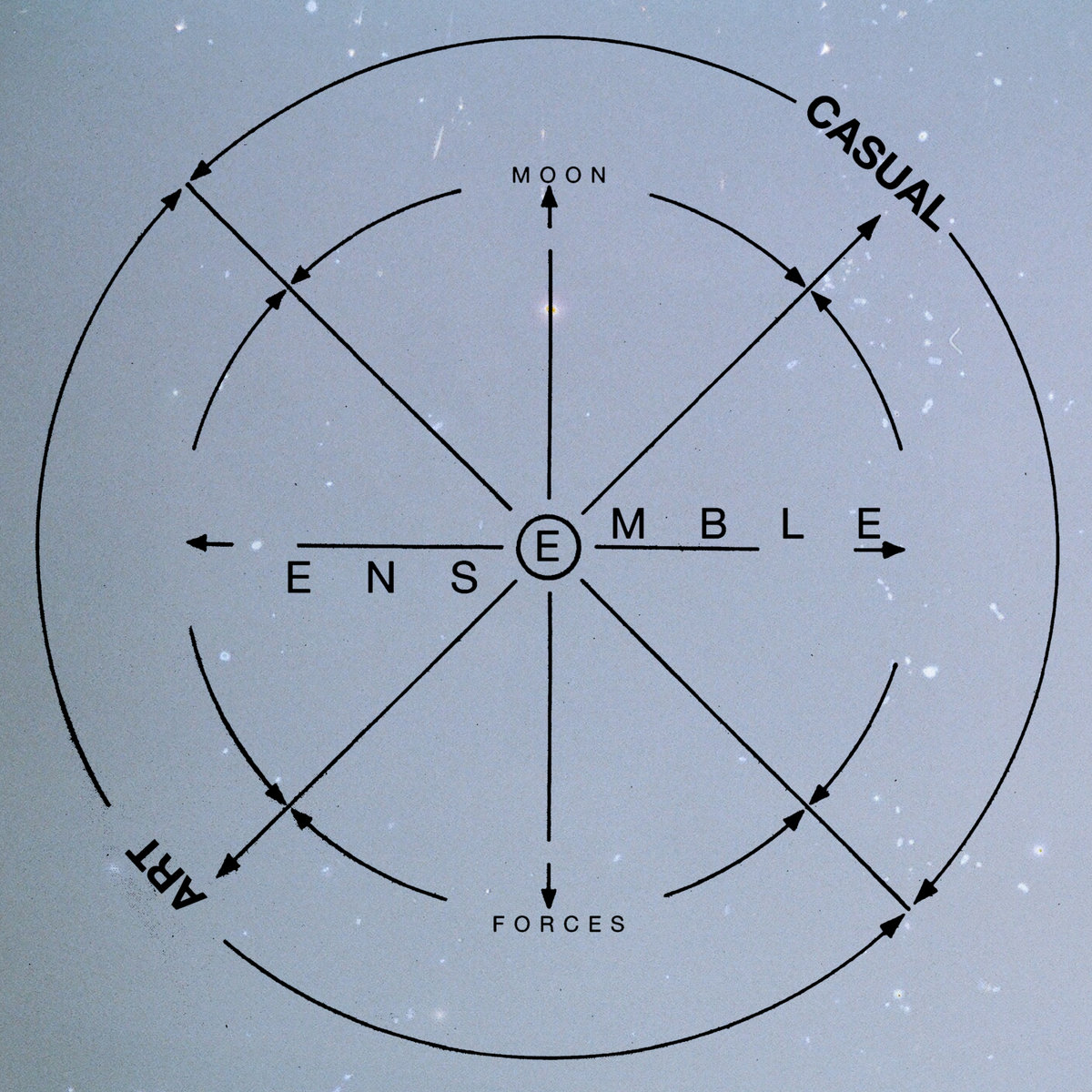
Casual Art Ensemble’s debut album ‘Moon Forces’ carries the peculiar electricity of musicians discovering one another in real time while also sounding as though they have been communicating for decades through some private dialect of instinct and intuition. Conceived by Lê Almeida after returning to Brazil from Seattle, the record thrives on the chemistry of proximity: rooms filled with friends, instruments exchanged without ceremony, improvisations captured before self-consciousness could interfere. Yet despite its spontaneous origins, ‘Moon Forces’ never resembles an archival document or a loose assemblage of studio fragments. Almeida’s patient year-long process of mixing, reshaping, and layering overdubs transforms these encounters into something remarkably cohesive, an album preoccupied with movement, memory, and the strange emotional afterglow left behind by collective creation.
“Dúvidas para trás” opens the record with an atmosphere that is simultaneously celestial and deeply grounded. Almeida’s guitar and samplers establish a humid, unstable environment around Ana Zumpano’s drumming and João Casaes’ bass, while Beeau Gomez’s guitar lines drift through the composition like signals half-caught on a distant frequency. The later saxophone overdubs by Alexander Zhemchuzhnikov alter the track’s emotional geometry completely. His phrases neither dominate nor decorate; instead, they introduce a searching quality that gives the improvisation a psychological dimension. The performance seems occupied with the act of reconsideration itself, as if every instrument is attempting to revise the previous gesture before the sound has fully disappeared.
“Orestes” shifts toward denser terrain. Recorded in Rio de Janeiro with a larger ensemble, the piece operates through accumulation and interruption. Ynaiã Benthroldo’s drumming propels the ensemble forward with restless momentum while João Luiz Lourenço’s electronics destabilize any fixed rhythmic center. The contributions from Markito Campello on trumpet and Guilherme Paz on flute create fleeting moments of lyricism, but these passages are quickly absorbed back into the ensemble’s swirling architecture. Rather than pursuing the explosive crescendos often associated with large-group improvisation, Casual Art Ensemble favors continual mutation. Musical ideas appear briefly before dissolving into new configurations, giving the piece an almost cinematic sense of editing.
The miniature “Encorajamento Sereno” functions as a recalibration of perspective. Bigú Medine’s synth textures and Gomez’s keyboards establish a delicate harmonic mist while Casaes, here playing drums, restrains the rhythm to the barest pulse. Almeida’s bass playing is especially striking because of its patience; every note seems chosen for resonance rather than propulsion. Zhemchuzhnikov’s saxophone enters like a distant voice remembered rather than heard directly. In less than two minutes, the ensemble constructs one of the album’s most emotionally affecting passages, suggesting serenity not as passive calm but as a hard-won condition achieved after disorientation.
“Dança Coesa” reveals the ensemble’s fascination with rhythm as social interaction. The title suggests coherence through movement, and the track embodies exactly that principle. Zumpano and Casaes lock into patterns that constantly threaten fragmentation without ever collapsing. Almeida and Gomez treat their guitars less as melodic instruments than as surfaces for texture and momentum, allowing the piece to hover somewhere between post-punk repetition, free improvisation, and psychedelic drone. The music radiates a sense of communal trust, each player adjusting to microscopic changes in the ensemble dynamic with remarkable sensitivity.
The brief “Redemoinhos” acts almost like a transmission intercepted from another version of the album. Sofia Amante’s trumpet and Zhemchuzhnikov’s saxophone spiral around Almeida’s fragmented sonic backdrop with disorienting immediacy. At only forty-three seconds, the track could have been a disposable interlude, but its brevity becomes its strength. It introduces instability at precisely the moment the record risks settling into familiarity.
“Plenitude Horizontal” may be the album’s most enigmatic composition. The Rio ensemble reconvenes here with a more spacious and contemplative approach. Gabriel Nunes and Joab Régis add subtle layers of percussion that seem to stretch time rather than divide it. The overdubs by Amante and Zhemchuzhnikov are integrated with extraordinary care, creating brass and reed harmonies that hover at the edge of audibility. The title evokes openness without hierarchy, and the music follows that philosophy rigorously. No instrument claims central authority; every sound exists in relation to every other sound.
The album’s emotional centerpiece arrives with “Curso Intensivo Noturno,” recorded at Formigaz Garden with a different quartet configuration. Cacá Amaral’s drumming possesses an earthy looseness that contrasts sharply with the more nervous propulsion heard earlier on the record. Leandro Archela’s keyboard work is especially compelling, introducing warm harmonic clusters that lend the piece an almost nocturnal romanticism. Iládio Davesse’s bass anchors the improvisation with remarkable patience while Almeida’s guitar drifts between abstraction and melody. Amante’s trumpet overdubs elevate the track further, adding a melancholic glow that recalls late-night cityscapes observed from moving vehicles. The performance captures the peculiar intimacy that emerges among musicians playing deep into the night, when fatigue lowers defenses and instinct takes over completely.
“Convenções Perigosas” confronts structure itself. The title (translated as “Dangerous Conventions”), hints at skepticism toward inherited forms, and the ensemble responds with music that constantly resists stabilization. Benthroldo’s drums push against the pulse while Lourenço’s electronics fracture the sonic field into irregular shapes. Campello’s trumpet enters not as a solo voice but as an agitator inside the ensemble fabric. Zhemchuzhnikov’s saxophone and Amante’s trumpet overdubs intensify the atmosphere, introducing sharp tonal contrasts that destabilize the piece further. Yet the track never descends into chaos. Casual Art Ensemble demonstrates an impressive understanding of density, knowing precisely when to pull back before saturation overwhelms clarity.
Album closer “Tempo Vivido” serves as both resolution and reflection. The São Paulo quartet returns with a calmer, more spacious sensibility, allowing silence and resonance to occupy greater importance. Casaes’ bass lines move with quiet confidence beneath Almeida and Gomez’s shimmering guitar exchanges, while Zumpano’s drumming emphasizes texture over momentum. The composition carries a profound awareness of duration, not merely in temporal terms but in emotional accumulation. After the album’s constant transformations, this final piece sounds almost reflective, as though the musicians are listening back to the traces left behind by their own interactions.
What distinguishes ‘Moon Forces’ from many contemporary improvisational records is its refusal to fetishize spontaneity. Almeida understands that improvisation gains significance not simply from freedom but from attention: attention to space, to collective psychology, to the subtle emotional consequences of sound placement and texture. His mixing decisions reveal a producer deeply invested in sculpting atmosphere without sacrificing immediacy. Casaes’ mastering preserves the record’s raw intimacy while giving the various sessions a surprising sonic continuity.
More importantly, the album proposes an alternative understanding of musical collectivity. Casual Art Ensemble does not operate through virtuosic competition or individual assertion. Instead, these musicians pursue a form of shared perception in which identity becomes fluid and collaborative. The rotating personnel never fractures the album because the unifying principle is not style but attentiveness. Every participant contributes to a larger conversation about listening itself. ‘Moon Forces’ occupies a fascinating space between free improvisation, ambient experimentation, psychedelic abstraction, and communal ritual. Yet genre labels seem increasingly irrelevant the longer the record continues. What remains is the sensation of artists discovering forms of communication unavailable through ordinary language, shaping fleeting encounters into something unexpectedly enduring.
Learn more by visiting Transfusão Noise Records | Bandcamp