
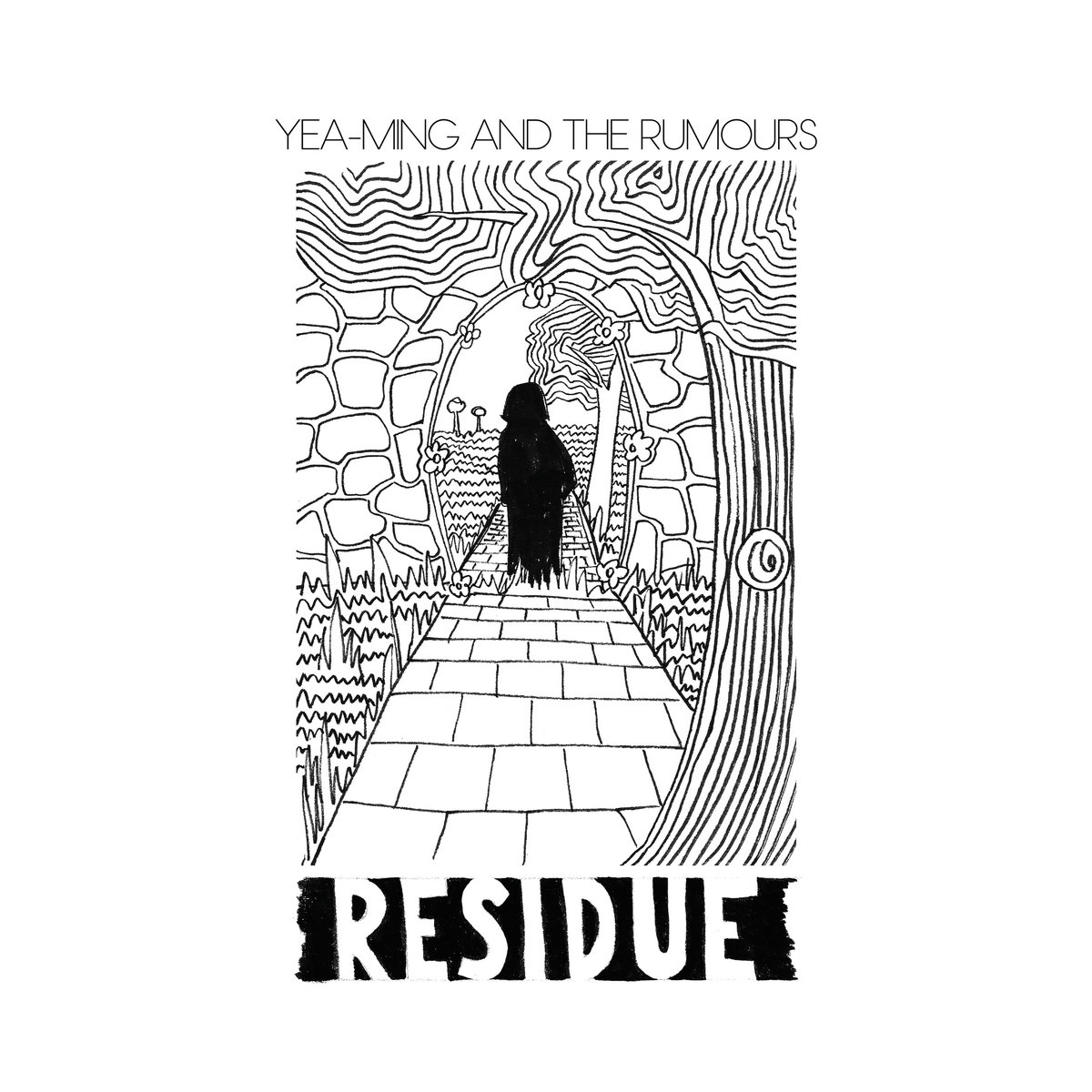
Yea-Ming and The Rumours shape ‘Residue’ as a study in aftermath rather than rupture, a record preoccupied with what remains once emotional weather has passed. Following 2024’s ‘I Can’t Have It All’, this fourth album reframes uncertainty not as crisis but as condition, a lived space where memory, regret, and renewal coexist without resolution. At its center, Yea-Ming Chen’s voice carries a distinctive tonal duality: softly luminous yet edged with a reflective distance, guiding the listener through songs that are intimate in scale but expansive in implication. Around her, Eóin Galvin’s lead guitar and lap steel, Rob Good’s bass and recording work, and Luke Robbins’ percussion construct a setting that is both carefully shaped and deliberately permeable.
“Paper Doll” opens with a self-examining stance, its arrangement leaning into slight disorientation while maintaining melodic coherence. Chen’s vocal delivery suggests a recognition of constructed identity, as though the song is both confession and observation. The band supports this ambiguity with layered guitar textures that feel gently unstable, allowing the track to hover between clarity and fragmentation. “Cheap Thrill” shifts into a more immediately melodic register, its rhythmic flow steady and unforced. Robins’ percussion anchors the track with quiet assurance, while Good’s bass provides a warm counterbalance to Galvin’s understated guitar embellishments. Chen’s writing here is direct but never simplistic, capturing fleeting emotional states without overstating them.
“Sweet Opiate” introduces a more fluid energy, its cadence suggesting movement without urgency. The track’s sensibility aligns with the subtle pop elegance associated with acts like St. Etienne, yet it retains a distinct identity through Chen’s phrasing and the band’s restrained interplay. The song’s emotional center rests in its refusal to dramatize vulnerability, instead allowing it to surface naturally within the arrangement. “Waist” pares things back, emphasizing space and tonal restraint. The instrumentation feels carefully distributed, each element occupying its own defined region within the mix. This attentiveness to proportion underscores the band’s broader aesthetic, where absence carries as much weight as presence.
“Cold” introduces a denser sonic palette, its guitars taking on a more pronounced fuzz-laden character without disrupting the album’s overall equilibrium. Galvin’s contributions here are particularly notable, his lines threading through the mix with subtle persistence. Chen’s vocal remains steady, anchoring the track’s emotional tone without leaning into excess. “Treasury Of Loved Ones” stands among the album’s most affecting moments, its thematic focus on memory rendered through a composition that balances intimacy with breadth. The presence of Galvin’s lap steel adds a plaintive quality, while Good and Robbins provide a grounded rhythmic foundation. The song approaches remembrance not as fixed archive but as shifting terrain, where emotional clarity and erosion coexist.
“Uncommon Dreaming” returns to a more introspective mode, its melodic contour gentle and unhurried. The interplay between instruments here is particularly refined, with each contribution serving the song’s reflective atmosphere. Chen’s vocal delivery maintains its characteristic balance of warmth and distance, drawing the listener into a space of quiet contemplation. “Fine Afternoon” articulates one of the album’s central ideas with striking precision. The line “in this life renewed, you’re my residue” situates the record’s thematic core within a moment of lyrical clarity, framing renewal as something inherently marked by what persists. Musically, the track leans into subtle rhythmic motion, allowing its reflective tone to coexist with a sense of forward movement.
“Birds Fly Home” carries a gentle sense of release, its arrangement shaped by a careful interplay between lap steel and vocal melody. The song’s atmosphere suggests return rather than departure, though without settling into definitive meaning. It occupies a liminal space, consistent with the album’s broader preoccupation with states of in-betweenness. “Mistakes” closes the record with a quiet refusal of finality. Rather than offering resolution, it acknowledges continuity, allowing the album to end in a state of thoughtful suspension. The instrumentation remains understated, yet its emotional resonance persists beyond its duration.
Across ‘Residue’, Chen’s authorship is unmistakable. Her role as vocalist, guitarist, organist, writer, mixer, and co-producer ensures a unified artistic vision, one that is realized with precision rather than excess. Good’s engineering input and bass work provide structural clarity, Robbins’ percussion maintains rhythmic coherence, and Galvin’s guitar and lap steel contribute a textural depth that enriches without overwhelming.
What defines the album is its attention to what remains after transformation. Rather than framing change as a clean break, ‘Residue’ treats it as accumulation, where traces of earlier selves persist within new configurations. The result is a work that resists closure, favoring continuity over resolution. Yea-Ming and The Rumours offer a record shaped by reflection, where emotional experience is neither resolved nor abandoned, but carefully held in view.
Releases June 12, 2026
For more information or to pre-order, please visit Yea-Ming and The Rumours | Dandy Boy Records | Instagram