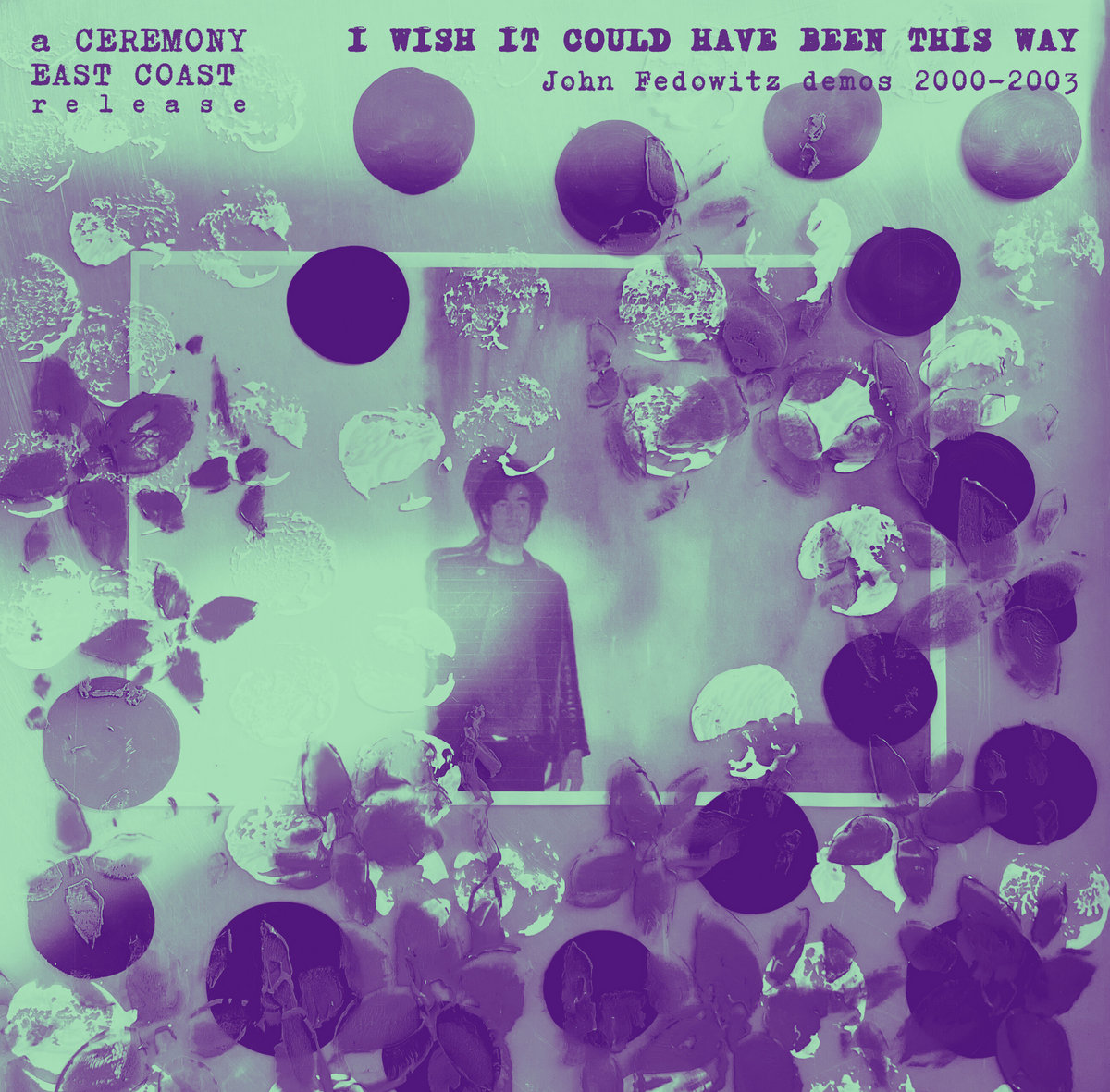
A document of transition as much as expression, ‘I wish it could have been this way (demos 2000 – 2003)’ captures Ceremony at a formative threshold, where instinct precedes refinement and emotion outruns structure. These cassette recordings, traced back to the years when John Fedowitz was moving from his role in Skywave toward the identity that would define Ceremony, carry an immediacy that resists polish not out of necessity alone, but as a kind of aesthetic commitment. What emerges is less a retrospective compilation than an origin point preserved in motion.
“The Summer The Sun” opens with a sense of fragile propulsion, its melodic core already hinting at the band’s later sensibilities while remaining tethered to the limitations (and possibilities), of its medium. The distortion is not merely a byproduct of lo-fi recording but an active presence, shaping the emotional register of the song. Fedowitz’s vocals, partially obscured and partially revealed, establish a dynamic that recurs throughout the album: clarity struggling against saturation.
That interplay deepens on “No Good For You” and “Without Your Love,” where the songwriting begins to assert itself more confidently. Beneath the layers of cassette warble and overdriven sound, there is a clear melodic instinct at work, one that leans toward romantic melancholy without succumbing to sentimentality. The recordings feel intimate not because they are minimal, but because they are unguarded; each imperfection becomes part of the communication rather than a barrier to it.
“Walk Away” and “Living For Today” introduce a slightly more rhythmic urgency, suggesting the lingering influence of Fedowitz’s earlier role behind the drum kit. Even in these rough forms, there is a sense of movement that feels physical, as though the songs are being shaped as much by bodily memory as by compositional intent. This quality gives the tracks a forward momentum that contrasts with the more introspective pieces surrounding them.
The emotional center of the album begins to crystallize with “Throw Your Love Away” and “World War.” Here, the juxtaposition of personal and broader thematic language becomes more pronounced, though never fully resolved. The distortion thickens, the melodies push harder against it, and the result is a sound that feels both expansive and confined. The cassette medium, with its inherent limitations, becomes a kind of frame within which these contradictions play out.
“Tears Keep Coming Down” and “Our Last Goodbye” lean further into vulnerability, their titles almost disarmingly direct. Yet the music itself resists any straightforward reading. The layering of sound, the occasional collapse of fidelity, and the uneven balance between elements all contribute to a sense of emotional complexity that belies the apparent simplicity of the material. These are not polished expressions of heartbreak, but immediate ones, captured before they could be shaped into something more conventional.
“Dull Life” and “Cold Cold Night” shift the tone toward a more subdued introspection. The pacing slows, the arrangements thin out, and the focus turns inward. The imperfections of the recordings become more pronounced here, not as distractions but as textures that deepen the sense of isolation. Each crackle and fluctuation in volume feels like part of the atmosphere, reinforcing the album’s commitment to presenting these songs as they were first conceived. The closing track, “The End,” functions less as a conclusion than as a quiet acknowledgment of transition. It does not resolve the threads that precede it, nor does it attempt to summarize them. Instead, it leaves the listener with a sense of continuation, as though these demos are leading directly into something not yet heard.
Throughout ‘I wish it could have been this way (demos 2000 – 2003),’ Fedowitz stands as the central creative force, handling the songwriting and performances in a manner that feels both exploratory and assured. The absence of a fully formed band dynamic is not a limitation but a defining characteristic, allowing the listener to hear the ideas in their most immediate state. The influence of his time in Skywave lingers, but these recordings clearly point toward a new direction, one defined by a synthesis of melody and distortion that would become Ceremony’s signature.
What makes this collection compelling is not simply its historical value, but its ability to communicate something essential about the act of beginning. These songs exist at a point where intention and discovery are inseparable, where the boundaries of form are still being negotiated. In preserving that moment, ‘I wish it could have been this way (demos 2000 – 2003)’ offers a rare glimpse into the formation of an artistic voice, one that is already distinct even in its earliest articulations.
Visit Bandcamp | Instagram | Facebook for more information.